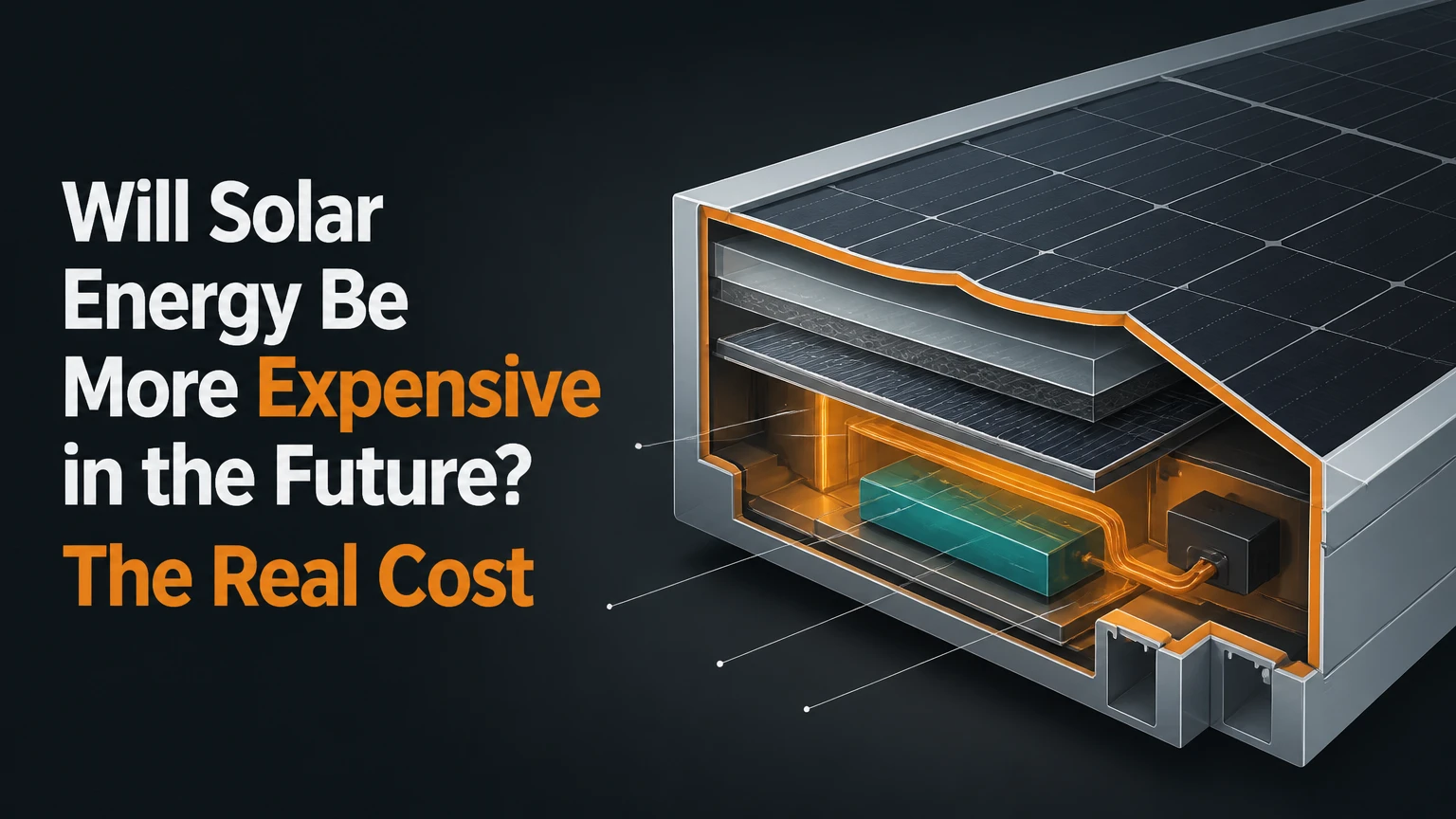
Solar energy is highly unlikely to become more expensive to generate over the long term, because photovoltaic modules, installation methods, and power-plant operations have historically become cheaper with scale. However, a solar electricity bill can rise if batteries, grid charges, financing, labor, interconnection, tariffs, or weaker export credits offset lower panel costs.
Key Facts at a Glance
- Utility-scale solar photovoltaic electricity is among the lowest-cost sources of new generation in many markets.
- Solar module prices can fall while complete residential systems become temporarily more expensive because labor, financing, and permitting costs rise.
- Batteries increase the upfront price of solar, but they can improve resilience and reduce purchases during expensive peak periods.
- A 6 kW US residential solar installation typically costs about $15,000-$21,000 before incentives, with local variation that can exceed several thousand dollars.
- Solar panels commonly carry 25-30-year performance warranties, while many residential inverters last about 10-15 years.
- The cheapest solar design for most grid-connected homes is still a properly sized system without a battery, unless backup power or time-of-use savings matter.
Will Solar Energy Be More Expensive in the Future?
Solar energy will probably become cheaper at the generation level, but the total cost paid by a customer will not decline automatically. The answer depends on which cost is being measured: the photovoltaic module, a completed solar plant, the levelized cost of electricity, a retail electricity bill, or a solar-plus-storage system.
The International Energy Agency described solar photovoltaic technology as “the new king of electricity markets” in its Renewables 2020 analysis, based on falling costs and rapid deployment. That statement describes the competitive position of solar generation, not a promise that every household bill or installation quote will fall each year.
Short-term reversals are normal. Polysilicon, freight, steel, aluminum, interest rates, skilled labor, insurance, and trade restrictions can raise project prices for several years. A homeowner may therefore receive a higher quote in 2026 than in 2024 even if the underlying solar modules are cheaper.
The durable forecast remains favorable because fuel-free generation has a different cost structure from gas or coal. A solar plant does not need a continuous fuel purchase, although it still needs land, transmission, maintenance, financing, replacement equipment, and a reliable way to match production with demand.
Why Have Solar Costs Fallen?
Solar costs have fallen because manufacturing scale, factory automation, wafer improvements, higher module efficiency, and competitive supply chains reduce the cost of each watt produced. Swanson’s Law describes an observed pattern of roughly a 20% price reduction for each doubling of cumulative photovoltaic production, although the percentage is an empirical trend rather than a guaranteed physical law.
The most important distinction is between module price and system price. A module may represent roughly 20%-35% of a residential system’s installed cost, while design, labor, permitting, electrical equipment, customer acquisition, financing, and overhead make up the remainder. Falling module prices therefore do not produce an equal reduction in a finished rooftop quote.
The US Department of Energy’s Solar Futures Study identifies efficiency, manufacturing scale, storage, transmission, and domestic supply chains as major drivers of future deployment. NREL’s Annual Technology Baseline uses scenario ranges rather than one certain future price, because financing, construction, grid expansion, and policy assumptions strongly influence the result.
What Does Swanson’s Law Actually Predict?
Swanson’s Law predicts a continuing tendency toward lower photovoltaic module prices as cumulative manufacturing capacity expands. It does not predict that retail electricity prices, installation quotes, batteries, or grid connection fees will fall at the same rate.
| Cost component | Typical share or behavior | Main future pressure | Result for customers |
|---|---|---|---|
| PV modules | 20%-35% of residential installed cost | Automation and oversupply can reduce price | Lower equipment cost |
| Inverter and electrical gear | 8%-15% | Semiconductor and copper prices vary | Mixed movement |
| Labor and installation | 20%-35% | Wages, productivity, permitting | Often slower declines |
| Financing and sales | 15%-30% | Interest rates and customer acquisition | Can rise sharply |
| Battery storage | $5,000-$15,000 typical residential addition | Cell prices, minerals, demand | Higher total project cost |
| Interconnection and grid work | Site-specific | Utility congestion and upgrades | Can increase independently |
A practitioner rule of thumb is to treat module prices as a technology indicator, not as a complete answer to the question “What will solar cost me?” A low panel price cannot compensate for a poorly designed roof, expensive financing, or unfavorable export compensation.
How Does Solar Energy Become Usable Electricity?
Solar photovoltaic electricity begins when photons strike semiconductor material, release electrons, and create direct current. An inverter converts that direct current into alternating current for household loads or the electrical grid, while surplus power can charge a battery or move through a meter under the applicable export rules.
The process has four operational stages:
- Photovoltaic conversion: Silicon cells absorb photons and create an electrical charge.
- Current collection: Cell and module conductors combine the charge into direct-current output.
- Inversion: A string, microinverter, or hybrid inverter converts DC into grid-compatible AC.
- Energy management: Loads consume the electricity first; surplus electricity charges a battery or exports to the grid.
Solar output changes with irradiance, temperature, shading, orientation, and season. A 6 kW array does not produce 6 kW continuously, and its annual production may vary from roughly 6,500 to 10,000 kilowatt-hours depending on location, tilt, weather, and system losses.
Concentrated solar power uses mirrors to heat a receiver and drive a thermal turbine. Solar thermal systems use sunlight directly for water or process heat. Neither technology follows exactly the same cost path as rooftop PV, and CSP is most relevant to large projects with strong direct sunlight and thermal-storage requirements.
What Will Solar Cost in 2030-2050?
Solar generation is expected to remain one of the cheapest new electricity options through 2030-2050, but no credible forecast supports one universal price for every country. NREL scenarios show continued cost reductions under technology progress, while land, transmission, financing, storage, and supply-chain constraints determine the delivered cost in a specific region.
Lazard’s Levelized Cost of Energy+, version 17.0, published in 2024, placed unsubsidized utility-scale solar in a broad global range of approximately $29-$92 per megawatt-hour, equal to $0.029-$0.092 per kilowatt-hour. The range is wide because it includes different financing conditions, resource quality, construction costs, and market assumptions.
LCOE is a useful comparison metric, not a household tariff. It spreads construction and operating costs across expected lifetime electricity production, but it does not fully represent transmission, distribution, backup capacity, taxes, fixed charges, or the timing of electricity output.
| Measure | Typical present reference | 2030-2050 direction | Why the measure can differ |
|---|---|---|---|
| PV module price | Market-dependent, often below historic levels | Downward with technology cycles | Silicon, glass, freight, trade policy |
| Utility-scale solar LCOE | $0.029-$0.092/kWh in Lazard 2024 | Likely lower in strong-resource regions | Financing and grid connection |
| Residential installed solar | $15,000-$21,000 for 6 kW before incentives | Gradual decline, with reversals possible | Labor, permitting, customer acquisition |
| Solar plus 10-15 kWh battery | About $25,000-$45,000 before incentives | Battery costs likely decline | Storage controls total system price |
| Retail electricity bill | Region-specific tariff | Could rise or fall | Utility rates and fixed charges |
| Off-grid electricity | Often above grid-connected cost | Technology may improve | Oversized batteries and backup generation |
Future solar will also face value pressure as adoption increases. When many solar plants produce electricity at midday, wholesale prices can fall, and some projects may experience curtailment. Solar remains inexpensive to produce, but its market value can decline unless storage, flexible demand, transmission, or better operating schedules absorb the output.
Can Solar Bills Rise Even When Generation Gets Cheaper?
Solar bills can rise even when solar generation becomes cheaper because a customer pays for more than the panels. Fixed utility charges, demand charges, interconnection upgrades, financing interest, battery replacement, insurance, and lower net-metering credits can increase the amount a household pays over time.
A rooftop system usually affects a bill through three separate mechanisms:
- Avoided purchases: Solar reduces electricity bought from the utility.
- Export compensation: Surplus generation receives a credit or payment under local rules.
- Non-bypassable charges: Fixed fees, delivery charges, taxes, and minimum bills may remain.
A utility that replaces one-to-one net metering with a lower export rate can reduce solar savings without changing the array’s output. In California, for example, the transition from Net Energy Metering 2.0 to Net Billing, commonly called NEM 3.0, changed the value of exported electricity and increased the importance of batteries and load shifting for many new customers.
That policy example is not evidence that solar generation became expensive. It demonstrates that solar economics are partly a tariff question. Consumers should compare the value of one kilowatt-hour exported at noon with the price of one kilowatt-hour purchased at 7 p.m.
Will Batteries Make Solar More Expensive?
Batteries make a solar project more expensive upfront, but storage can improve its financial and practical value when electricity prices vary by hour or grid outages are frequent. A battery is usually a resilience purchase first and a pure payback optimization second.
| System configuration | Typical upfront cost before incentives | Outage capability | Best economic condition |
|---|---|---|---|
| Grid-tied PV, no battery | $15,000-$21,000 for 6 kW | No backup during normal outage | High self-consumption or strong export credit |
| PV with 10 kWh LFP battery | $25,000-$40,000 | Selected circuits for several hours | Time-of-use pricing |
| PV with 15-20 kWh battery | $30,000-$50,000 | Overnight essential-load backup | Frequent outages and peak pricing |
| Off-grid PV plus storage | $40,000-$100,000 or more | Designed for independent operation | Remote locations without grid access |
Lithium iron phosphate, or LFP, batteries generally offer strong cycle life and thermal stability, but battery capacity does not guarantee multi-day autonomy. A home using 30 kWh per day needs more than a 10 kWh battery to endure a cloudy 24-hour period, and winter conditions may require a generator or substantially larger array.
Storage also loses energy during charging and discharging. A round-trip efficiency of roughly 85%-95% means that 10 kWh sent into a battery may return about 8.5-9.5 kWh. That loss matters when the battery is charged from grid electricity rather than surplus solar.
Which Solar System Costs Least?
A grid-tied photovoltaic system without a battery usually costs least and produces the shortest payback for a homeowner with reliable grid service. Hybrid systems cost more but add backup power, while off-grid systems require enough generation and storage for the worst practical weather period rather than the average sunny day.
| User situation | Recommended configuration | Typical capacity pattern | Main trade-off |
|---|---|---|---|
| Budget-focused homeowner | Grid-tied PV | 4-10 kW | No backup in a blackout |
| Home with frequent outages | Hybrid PV and LFP storage | 6-12 kW plus 10-20 kWh | Higher capital cost |
| Renter or apartment resident | Community solar subscription | Utility-defined share | No private roof control |
| Remote cabin | Off-grid PV, storage, generator | 2-8 kW plus 10-40 kWh | Winter oversizing |
| Small business | Commercial PV with load management | 25-500 kW | Demand charges and roof constraints |
| High evening consumption | PV plus time-shifting battery | Usage-dependent | Battery replacement planning |
Off-grid solar is not automatically cheaper because it avoids a monthly utility bill. Grid infrastructure is expensive, but it also provides nearly unlimited backup capacity. Replacing that capacity requires batteries, a generator, spare equipment, and enough solar production during the least favorable season.
How Do Location and Policy Change the Answer?
Location, electricity rates, solar resource, roof conditions, and export policy can change a solar payback period from roughly six years to more than fifteen years. The same equipment can be financially attractive in Arizona and marginal in a shaded northern roof with low electricity prices and weak export compensation.
| Variable | Favorable condition | Unfavorable condition | Effect on future cost |
|---|---|---|---|
| Solar resource | 1,800-2,200 annual sun-hours | 1,000-1,300 sun-hours | Changes annual production |
| Retail electricity price | $0.25-$0.40/kWh | $0.10-$0.15/kWh | Changes avoided-cost value |
| Export credit | Near retail rate | Wholesale or reduced rate | Changes surplus value |
| Roof orientation | South, southeast, southwest exposure | Heavy north-facing shade | Changes array yield |
| Utility outages | Frequent and costly | Rare and brief | Raises battery value |
| Financing rate | 4%-6% loan | 9%-12% loan | Changes total repayment |
| Interconnection | Existing local capacity | Transformer or feeder upgrade | Adds project cost and delay |
The most important regional calculation is not the panel price. It is the value of each kilowatt-hour at the time the system produces it. A household that consumes power during the afternoon may need no battery, while a household that exports at noon and returns home at 6 p.m. may need storage to preserve more of the solar value.
What Happens to Solar Costs After Installation?
Solar panels usually have low operating costs after installation, but inverters, monitoring equipment, roof conditions, insurance, and battery capacity create lifecycle expenses. A typical panel performance warranty lasts 25-30 years, with annual degradation commonly stated near 0.25%-0.5%, while an inverter may require replacement once during that period.
| Component | Typical service life | Common cost or loss | Planning action |
|---|---|---|---|
| PV modules | 25-35 years | 0.25%-0.5% annual degradation | Check performance warranty |
| String inverter | 10-15 years | $1,500-$4,000 residential replacement | Reserve replacement funds |
| Microinverter | 20-25 years typical warranty range | Higher initial equipment count | Compare warranty coverage |
| LFP battery | 10-15 years typical | Capacity fades with cycles and heat | Budget for later replacement |
| Roof surface | 20-30 years depending on material | Removal and reinstall cost | Replace roof before panels |
| Monitoring platform | 5-15 years | Subscription or hardware changes | Keep production records |
Solar degradation is gradual, not a sudden end-of-life event. A panel with 0.5% annual degradation would retain approximately 88% of its initial output after 25 years under a simple compounding assumption, although actual performance depends on heat, moisture, manufacturing quality, and installation.
A common practitioner mistake is installing panels on a roof that will need replacement in five years. Removing and reinstalling an array can add thousands of dollars and interrupt production, so roof timing belongs in the original financial model.
Which Solar Costs Could Increase?
Solar generation may become cheaper while project costs for land, transmission, labor, insurance, financing, and grid integration rise. These non-module costs are the main reason future solar prices can move upward temporarily or remain high in constrained locations.
Potential upward pressures include:
- Interest rates: Solar plants are capital-intensive, so a higher cost of debt raises LCOE before one panel is installed.
- Transmission congestion: A low-cost solar site has limited value if new lines cannot deliver electricity to demand centers.
- Interconnection upgrades: A utility may require transformer, protection, or feeder work that a small project cannot avoid.
- Trade restrictions: Tariffs and domestic-content requirements can change module and inverter sourcing.
- Insurance and extreme weather: Hail, wildfire, wind, and flood exposure can increase operating premiums.
- Curtailment: A plant may produce electricity that the grid cannot accept during low-demand hours.
- Skilled labor: Electrical and construction wages can rise faster than hardware costs.
The counterintuitive point is that a larger solar fleet can create both lower production costs and lower midday prices. That outcome benefits consumers with flexible loads or batteries, but it can weaken the revenue of solar projects that sell every kilowatt-hour immediately.
Should You Wait to Install Solar?
Waiting can produce cheaper equipment, but installing now can produce more avoided utility purchases and lock in available incentives, so the better decision depends on payback, roof timing, financing, and local policy. No forecast can guarantee that future savings will exceed the value of several years of current production.
Use a wait-versus-install comparison with these inputs:
- Current installed quote after incentives.
- Annual production in kilowatt-hours.
- Retail electricity rate and expected escalation.
- Export credit by hour or tariff period.
- Loan interest and total repayment.
- Battery replacement year, if applicable.
- Roof replacement date.
- Incentive expiration or eligibility conditions.
A simple payback estimate divides net project cost by first-year bill savings, but a stronger model discounts future cash flows and includes degradation, inverter replacement, insurance, maintenance, and tariff changes. A six-year simple payback can become eight years after financing and reduced export credits.
Install sooner when the roof is ready, electricity prices are high, incentives are secure, and the system can consume most of its output. Wait or redesign when the roof needs work, the quote contains expensive financing, shading has not been measured, or the installer has not explained export rules.
What Are the Most Common Solar Cost Mistakes?
The most expensive solar mistakes involve sizing, tariff assumptions, roof timing, and battery selection rather than the choice between two similar panel models. A lower-priced quote can cost more over its life when it uses weak production assumptions, excludes electrical upgrades, or sells a battery that the tariff cannot justify.
Watch for these failure modes:
- Oversizing under weak export rules: A large array can produce low-value surplus electricity.
- Ignoring future loads: An electric vehicle, heat pump, or induction range may change the right system size.
- Treating battery capacity as backup duration: Usable energy depends on essential loads, inverter limits, and weather.
- Using average annual output: Winter production can determine generator use and resilience.
- Overlooking inverter clipping: A high DC-to-AC ratio may be economical, but excessive clipping wastes potential output.
- Failing to inspect shade growth: Trees can reduce production for decades after installation.
- Comparing only monthly payments: A low payment can conceal a long loan term, escalator, or large total repayment.
For troubleshooting, compare current production with the same month in prior years, then inspect inverter alerts, shading, soiling, and communications. A sudden output drop points toward a fault or obstruction, while a slow decline may indicate degradation, seasonal weather, or equipment aging.
Frequently Asked Questions
Will solar panels be cheaper in 10 years?
Solar panels are likely to be cheaper per watt in 10 years in real technological terms, but the installed price may not fall by the same percentage. Labor, permitting, financing, electrical equipment, tariffs, and local demand can increase, and higher-efficiency modules may cost more per panel while producing more electricity per square meter.
Is solar cheaper than coal and natural gas?
New utility-scale solar is often cheaper than new coal and can compete strongly with new natural-gas generation, according to Lazard’s 2024 LCOE analysis. The comparison changes when storage, firm capacity, fuel-price risk, transmission, and existing-plant costs are included, because solar output varies by hour and weather.
Will solar energy become too cheap to be profitable?
Solar can become less valuable at midday without becoming unprofitable. High deployment may reduce wholesale prices during sunny hours, so profitable projects increasingly combine batteries, transmission, demand response, contracts, or west-facing generation that produces later in the day.
How long does solar take to pay for itself?
Residential solar commonly reaches simple payback in about six to ten years in favorable markets, but 10-15 years is possible where electricity prices are low, export credits are weak, roofs are difficult, or financing is expensive. A discounted cash-flow model gives a more reliable result than dividing cost by first-year savings.
Is solar worth it without net metering?
Solar can remain worthwhile without one-to-one net metering when the home uses substantial electricity during daylight, retail rates are high, or a battery shifts production into expensive hours. The financial case is weaker for a lightly occupied home that exports most output at a low wholesale-linked credit.
Can solar work during a power outage?
Standard grid-tied solar shuts down during an outage to protect utility workers and prevent unintended power on the line. Solar can operate during outages only with approved islanding equipment, usually a hybrid inverter, battery, critical-load panel, and local utility-compliant controls.
The Bottom Line
Will solar energy be more expensive in the future? Solar photovoltaic generation is unlikely to become structurally more expensive, and continued manufacturing scale should keep module and utility-scale production costs under downward pressure. The parts most likely to rise are batteries, grid upgrades, labor, financing, insurance, and other system costs that generation-only forecasts exclude.
For most grid-connected households, compare the complete installed system rather than the panel price. Model production, self-consumption, export credits, fixed charges, battery replacement, roof timing, and financing. Solar is cheapest when the system matches the load and tariff, not when the array has the most panels.