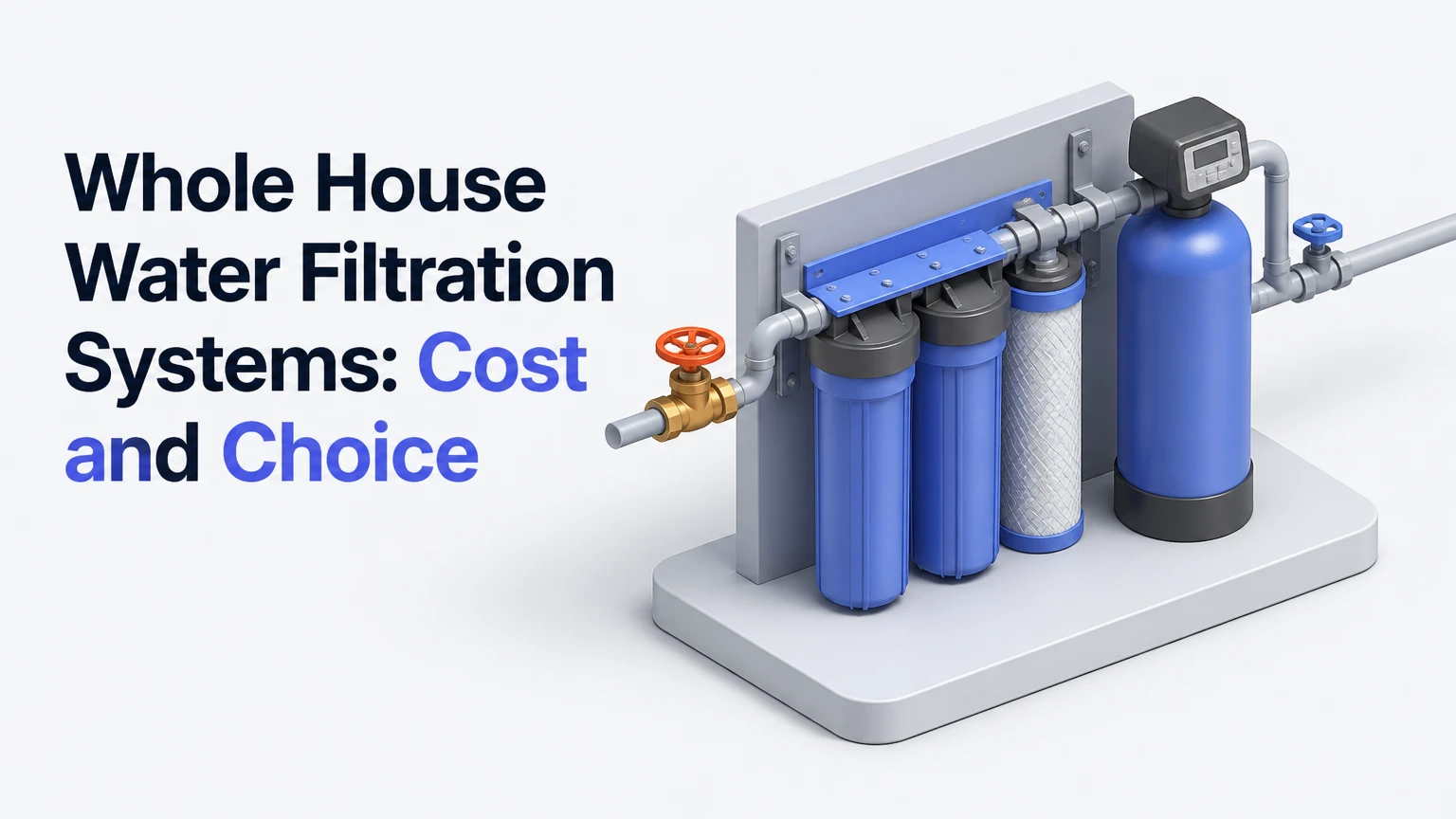
Whole house water filtration systems are point-of-entry treatment units installed on a home’s incoming main water line. A POE system treats water before it reaches faucets, showers, toilets, water heaters, and appliances, whereas a point-of-use filter treats water at one fixture only. The correct technology depends on laboratory results, peak flow, pressure, and the contaminant requiring reduction.
Key Facts at a Glance
- A whole-house water filter belongs on the cold-water service line before the plumbing branches and water heater.
- Carbon media commonly improves chlorine, chloramine, taste, odor, and selected organic chemicals, but it does not reliably remove every dissolved contaminant.
- Private-well water should be tested for bacteria, nitrate, pH, iron, manganese, hardness, arsenic, and other locally relevant contaminants before equipment selection.
- A UV unit disinfects water only when the lamp receives the correct dose and sediment, color, and turbidity have been controlled upstream.
- A water softener removes calcium and magnesium hardness through ion exchange; a salt-free conditioner does not remove hardness.
- Typical installed costs range from about $600-$1,500 for basic municipal-water filtration and $3,500-$6,000 for more complex well-water treatment.
What Is a Whole-House Water Filter?
A whole-house water filtration system is a centralized treatment assembly connected to the building’s incoming cold-water pipe. The assembly can include a sediment cartridge, carbon tank, specialty oxidation filter, UV reactor, softener, or reverse osmosis equipment, but no single configuration treats every water problem.
The system is also called a point-of-entry filter because treatment occurs where water enters the property. That location gives one unit access to every downstream fixture. A pitcher, refrigerator cartridge, or under-sink reverse osmosis unit is point-of-use equipment because each device treats water at one tap.
Whole-house treatment is useful when chlorine odor affects showers, sediment damages fixtures, or well-water iron stains multiple bathrooms. It is unnecessary when a laboratory test shows safe, acceptable water and the only concern is drinking taste at one kitchen tap.
What does a whole-house filter remove?
A whole-house filter removes only the contaminants its media and rated operating conditions are designed to reduce. Sediment filters capture suspended particles, carbon adsorbs many organic compounds and disinfectant chemicals, oxidation systems address iron or sulfur, and UV targets microorganisms without removing dissolved chemicals.
The contaminant claim must come from a performance data sheet, not from the number of stages. NSF, ANSI, and WQA certification can help verify specific claims, but certification for chlorine reduction does not prove lead, nitrate, PFAS, or pathogen removal.
How Does a Whole-House Water Filter Work?
A typical treatment train moves water through isolation valves, a sediment stage, chemical or specialty media, optional polishing, and final disinfection or conditioning. Water enters from a municipal service or well pressure tank, passes through the treatment equipment, and then continues to the home’s cold-water branches and water heater.
The order matters. Sediment filtration protects carbon and UV components from clogging or shielding. Carbon reduces disinfectant chemicals and organic compounds. Oxidation media converts dissolved iron, manganese, or hydrogen sulfide into particles that a subsequent filter can capture. UV normally comes after fine prefiltration because cloudy water can reduce ultraviolet performance.
A three-valve bypass loop allows the owner to isolate the equipment while keeping household water available. Pressure gauges before and after a cartridge housing reveal whether a clogged filter, inadequate supply pressure, or undersized plumbing is causing a restriction.
Typical treatment sequence
| Stage | Typical specification | Main target | Maintenance |
|---|---|---|---|
| Sediment cartridge | 5-20 microns | Sand, silt, rust flakes | Replace every 3-6 months |
| Catalytic carbon tank | 1.0-2.5 cubic feet of media | Chlorine, chloramine, VOCs | Backwash or service by model |
| Fine post-filter | 1-5 microns | Carbon fines and residual particles | Replace every 6-12 months |
| UV reactor | 30-40 mJ/cm² typical design dose | Bacteria, viruses, protozoa | Replace lamp annually |
| RO membrane | 95%-99% dissolved-solids reduction | Salts, nitrate, some PFAS | Replace about every 3-5 years |
Why is water pressure important?
A filtration system must deliver the home’s peak flow while preserving usable pressure at the farthest fixture. Residential systems commonly operate around 5-15 gallons per minute, but the actual requirement depends on simultaneous showers, toilets, appliances, pipe diameter, and incoming supply pressure.
A four-bathroom home may need more flow than a two-bathroom home even when both use the same treatment media. A filter rated at 7 GPM can restrict a larger home during simultaneous demand, especially as its sediment cartridge loads with particles.
Which Whole-House System Fits Your Water?
The best system is determined by the contaminant profile, not by the marketing label “multi-stage.” Municipal water usually needs aesthetic treatment, while private-well water requires broader testing because groundwater chemistry and microbial conditions vary by property.
Municipal water: carbon and sediment are common starting points
A city-water home with chlorine odor, occasional rust particles, or unpleasant taste often needs a sediment prefilter followed by activated or catalytic carbon. Chloramine-treated supplies may require catalytic carbon with adequate bed volume and contact time because chloramine is more persistent than free chlorine.
Carbon does not solve hardness, nitrate, arsenic, or high dissolved salts. A kitchen reverse osmosis unit may be more economical when the goal is lower dissolved solids only at the drinking tap.
Private wells: test before selecting equipment
A private well should receive laboratory testing before treatment design. The test should include total coliform and E. coli, nitrate, pH, hardness, iron, manganese, turbidity, total dissolved solids, and any contaminants associated with local geology or agriculture.
Iron and sulfur treatment often uses air injection oxidation, chemical oxidation, or specialized media. The correct method depends on concentration, pH, alkalinity, dissolved oxygen, flow rate, and whether iron is dissolved or already particulate. Typical air-injection systems may address iron concentrations around 5-10 ppm, but manufacturer limits vary substantially.
Contaminant-to-technology guide
| Water symptom or result | Appropriate technology | Typical limitation | Verification needed |
|---|---|---|---|
| Chlorine odor | Activated or catalytic carbon | Media capacity declines with high use | Chlorine or chloramine test |
| Rotten-egg odor | Air injection, catalytic media, or chemical oxidation | Hydrogen sulfide concentration changes performance | Sulfur and iron analysis |
| Orange stains | Oxidation plus backwashing filter | pH and iron form affect removal | Iron speciation and pH |
| White scale | Ion-exchange softener or scale conditioner | Conditioner does not lower hardness | Hardness test |
| Coliform bacteria | UV after suitable prefiltration, or disinfection | UV does not remove contamination sources | Certified bacterial laboratory test |
| Nitrate or arsenic | Point-of-use or whole-house RO, ion exchange, or specialty media | Treatment is contaminant-specific | Certified laboratory test |
| PFAS | Certified carbon or RO application | Capacity and chain length vary | PFAS laboratory panel |
| Sand and rust particles | Sediment filter or spin-down separator | Fine filters can clog quickly | Particle observation and pressure readings |
What Are the Main Whole-House Filter Types?
Cartridge, media-tank, oxidation, UV, and reverse osmosis systems differ in flow, maintenance, footprint, and contaminant scope. Comparing those attributes prevents a low-cost purchase from becoming an expensive series of incompatible add-ons.
| System type | Typical flow | Typical cost installed | Service interval |
|---|---|---|---|
| Two-stage cartridge | 8-15 GPM | $600-$1,500 | Cartridges every 3-6 months |
| Carbon media tank | 8-20 GPM | $1,000-$2,500 | Media commonly 5-10 years |
| Iron and sulfur filter | 8-15 GPM | $1,500-$3,000 | Backwash every few days; media varies |
| UV disinfection | 5-30 GPM | $500-$1,200 | Lamp every 12 months |
| Whole-house RO | System-specific | $4,000-$12,000 or more | Membrane about 3-5 years |
Cartridge systems
Large “Big Blue” housings are compact and relatively accessible for do-it-yourself replacement. A 20-inch housing generally holds more media and provides more capacity than a 10-inch housing, although cartridge pressure loss still depends on micron rating, flow, and dirt loading.
Cartridge systems suit modest sediment and chlorine problems. They are less suitable for high sediment loads, heavy iron, or a large household that cannot tolerate frequent pressure changes and cartridge replacement.
Media tanks
A media tank holds a large volume of carbon or specialty media and can provide better flow and longer service intervals than small cartridges. Backwashing models need a drain connection, electrical power for the control valve, and sufficient flow to lift and clean the media bed.
Media capacity is not a universal gallon number. Chlorine concentration, chloramine concentration, contact time, water temperature, bed volume, and household consumption determine exhaustion. Treat advertised capacity as a model-specific estimate.
UV disinfection
UV damages microbial genetic material and prevents replication, but UV does not remove sediment, metals, chemicals, or dissolved minerals. The chamber requires a clear quartz sleeve, continuous power, correct flow, and prefiltration that controls turbidity and color.
The U.S. Centers for Disease Control and Prevention recommends testing private-well water and maintaining treatment devices according to manufacturer instructions. A UV lamp can still glow after its effective output has declined, so annual replacement is based on operating hours rather than visible brightness.
Whole-house reverse osmosis
Whole-house RO is appropriate for selected severe dissolved-contaminant problems, including some brackish supplies and high TDS conditions. RO reduces water pressure and creates reject water, so a residential installation normally needs pretreatment, a storage tank, a delivery pump, drain capacity, and often remineralization.
RO is usually excessive for chlorine odor or ordinary hardness. A point-of-use RO unit provides drinking-water treatment with less equipment, lower wastewater volume, and fewer plumbing consequences.
Filter, Softener, Conditioner, and RO Compared
A filter, water softener, scale conditioner, and RO system perform different jobs. A softener exchanges calcium and magnesium for sodium or potassium, while a salt-free conditioner changes precipitation behavior without removing hardness; neither description should be confused with broad chemical filtration.
| Equipment | Removes or changes | Whole-house use | Main drawback |
|---|---|---|---|
| Sediment filter | Suspended particles | Protects plumbing and appliances | Clogs under heavy sediment |
| Carbon filter | Chlorine, odors, selected organics | Showers, laundry, general water | Does not remove hardness or nitrate |
| Ion-exchange softener | Calcium and magnesium | Scale control throughout home | Uses salt or potassium and creates brine |
| Salt-free conditioner | Scale formation tendency | Some hard-water applications | Does not lower hardness readings |
| RO system | Many dissolved solids | Specialized whole-house or kitchen use | Requires pressure, storage, and reject-water handling |
How Should You Size the System?
Size the system by peak flow, service-line diameter, water pressure, contaminant load, and household demand. Do not size solely by the number of filter stages or the advertised maximum gallon-per-minute figure.
Record the home’s static pressure and pressure while several fixtures run. Compare those readings with the filter’s pressure-drop chart at the intended flow, then confirm that the inlet and outlet match the existing pipe, commonly 3/4-inch or 1-inch residential plumbing.
Practical sizing checkpoints
- Count bathrooms and identify simultaneous-use patterns.
- Measure incoming pressure with a hose-bib gauge.
- Estimate peak flow from fixture ratings or a plumber’s calculation.
- Select a unit whose service flow remains below its maximum rating.
- Confirm bypass valves, drain requirements, electrical needs, and clearance.
- Check whether the well pump can support backwashing flow.
A practitioner rule of thumb is to keep normal operating flow below the manufacturer’s maximum service flow, often by 20%-30%, because media beds and cartridges become more restrictive as they load. The rule is not a substitute for the manufacturer’s pressure-drop data.
What Does a Whole-House System Cost?
Typical installed costs range from $600-$1,500 for basic municipal-water sediment and carbon treatment, $1,500-$3,000 for specialty iron or sulfur equipment, and $3,500-$6,000 for a multi-component well-water setup. Whole-house RO commonly costs $4,000-$12,000 or more because storage, pumping, pretreatment, and drainage add complexity.
| Cost component | Typical range | Replacement timing | Cost driver |
|---|---|---|---|
| Sediment cartridge | $10-$50 | 3-6 months | Micron rating and size |
| Carbon cartridge | $25-$150 | 3-12 months | Carbon mass and contaminant load |
| Bulk carbon media | $300-$900 | 5-10 years | Tank volume and water chemistry |
| UV lamp and sleeve service | $100-$300 | 12 months | Lamp type and service labor |
| Professional installation | $400-$2,000 | One-time | Access, pipe changes, drainage |
| Annual consumables | $100-$400 | Annual budget | Cartridges, lamps, media service |
Installation usually takes 2-5 hours when the main line is accessible and nearby drainage or power already exists. A difficult crawlspace, copper-to-plastic transition, new electrical outlet, drain routing, or well-pump modification can extend the work.
How Do You Install and Maintain a POE System?
Install the treatment assembly on the cold incoming line, before the water heater and downstream branches, with a shutoff valve, bypass loop, pressure relief where required, and enough clearance for cartridge removal. Local plumbing codes may require an approved backflow device, air gap, or licensed installation.
Maintenance is part of system performance. Replace cartridges before they become fully blocked, inspect tank and housing connections for leaks, sanitize UV components as directed, and record pressure readings and water-test results.
Maintenance schedule
| Task | Typical interval | Success indicator | Failure consequence |
|---|---|---|---|
| Inspect for leaks | Monthly | Dry fittings and housings | Water damage |
| Read pressure gauges | Monthly | Stable pressure differential | Restricted flow |
| Replace sediment cartridge | 3-6 months | Normal flow restored | Pressure loss |
| Replace UV lamp | Every 12 months | Current lamp date recorded | Reduced disinfection |
| Test private-well bacteria | At least annually | Acceptable laboratory result | Undetected contamination |
| Replace or service media | 5-10 years, model dependent | Capacity confirmed | Returning odor or contaminants |
Never install a standard plastic filter housing on a hot-water line. Heat can deform the housing and damage media. Keep equipment protected from freezing, provide a drain for backwash discharge, and flush new carbon until black fines no longer appear.
Common Problems and Safety Limits
A sudden pressure drop usually indicates a loaded sediment cartridge, closed valve, undersized housing, or a restriction elsewhere in the plumbing. Compare the pressure before and after the filter; a large differential across the housing points toward cartridge loading.
Cloudy water after replacement commonly consists of harmless trapped air, while black specks usually indicate carbon fines that need flushing. Returning odor can mean exhausted media, excessive flow, channeling, incorrect media, or a contaminant outside the equipment’s design range.
Troubleshooting table
| Symptom | Likely cause | Immediate action | When to call a professional |
|---|---|---|---|
| Low pressure at all fixtures | Loaded cartridge or closed bypass | Check gauges and replace cartridge | Pressure remains low after service |
| Black particles | Unflushed carbon fines | Flush to drain for 10-15 minutes | Particles continue after flushing |
| Milky appearance | Entrained air | Run a cold faucet for 5-10 minutes | Cloudiness persists or has odor |
| Orange staining returns | Iron system exhausted or mis-sized | Test iron, pH, and flow | Staining continues after regeneration |
| Rotten-egg odor returns | Sulfur load exceeds capacity | Test hydrogen sulfide and inspect media | Odor occurs with bacterial symptoms |
| UV alarm activates | Lamp, sleeve, sensor, or power issue | Stop relying on untreated water | Alarm does not clear after service |
Whole-house filtration is not a guarantee of safe drinking water. A failed UV lamp, contaminated storage tank, damaged well casing, or exhausted carbon bed can create a false sense of security. The National Sanitation Foundation certification should match the exact contaminant claim, and private-well owners should continue periodic laboratory testing.
Which System Should You Choose?
Choose a sediment and catalytic-carbon system for a municipal home with chlorine, taste, odor, or visible rust. Choose iron or sulfur oxidation equipment for a tested private well with staining or odor, and add UV when laboratory results or local risk justify microbial disinfection.
Four practical buying scenarios
- City water, two bathrooms, chlorine odor: Use a 5-micron sediment cartridge and catalytic-carbon tank or large carbon cartridges. Add an under-sink RO unit only if drinking-water TDS or a specific dissolved contaminant is a concern.
- Private well, orange stains and sulfur odor: Test iron, manganese, sulfur, pH, hardness, and bacteria first. A typical design may use oxidation, backwashing filtration, and a downstream UV reactor.
- Hard water with white scale: Use an ion-exchange softener when measured hardness requires removal. A carbon filter alone will not protect fixtures from calcium deposits.
- Nitrate, arsenic, or PFAS concern: Select equipment certified for that specific contaminant, often at the kitchen tap or throughout the home depending on exposure routes and laboratory results. Do not infer removal from a generic “five-stage” label.
The least expensive correct system is usually the one with the fewest technologies that address verified contaminants. More stages can increase pressure loss, maintenance, failure points, and replacement cost without improving water quality.
Frequently Asked Questions
Do whole-house water filters remove lead?
Whole-house water filters can reduce lead only when the specific cartridge or media has a verified lead-reduction claim under an applicable standard. Lead may enter through service lines, solder, or household plumbing, so a certified point-of-use filter at drinking and cooking taps is often a practical supplement.
Can a whole-house filter remove fluoride?
A standard sediment or carbon filter does not reliably remove fluoride. Fluoride reduction generally requires reverse osmosis, activated alumina, or another technology designed and tested for that contaminant, with performance depending on pH, concentration, flow, and replacement schedule.
Are whole-house filters worth it for city water?
A whole-house filter can be worthwhile when chlorine odor, sediment, or shower-related skin and hair complaints affect multiple fixtures. It is less economical when only drinking taste matters, because a refrigerator cartridge or under-sink system treats the target tap with lower equipment and maintenance cost.
Does filtration reduce water pressure?
Filtration can reduce pressure when the cartridge is restrictive, the media tank is undersized, the flow exceeds the service rating, or the incoming supply is weak. A clean, correctly sized system should maintain useful household pressure, but every filter creates some pressure drop.
How often should private-well water be tested?
The CDC recommends testing private-well water at least annually and after flooding, repairs, changes in taste or odor, or nearby land-use changes. Test immediately when illness, bacterial contamination, or a damaged well cap creates concern; treatment equipment does not replace source protection.
Can one filter treat every contaminant?
No single whole-house filter treats every contaminant. Sediment, carbon, oxidation, softening, UV, ion exchange, and RO technologies target different water-quality problems, so a laboratory report and contaminant-specific performance claim must guide the equipment choice.
The Bottom Line
Whole house water filtration systems provide centralized treatment for every fixture, but the correct design begins with water testing rather than a stage count or attractive gallon-capacity claim. Municipal homes commonly need sediment and carbon treatment, while private wells may require oxidation, softening, UV, or contaminant-specific media. Match the system to verified chemistry, peak flow, pressure, maintenance capacity, and installation conditions, then confirm each removal claim through NSF, ANSI, WQA, or manufacturer performance documentation.