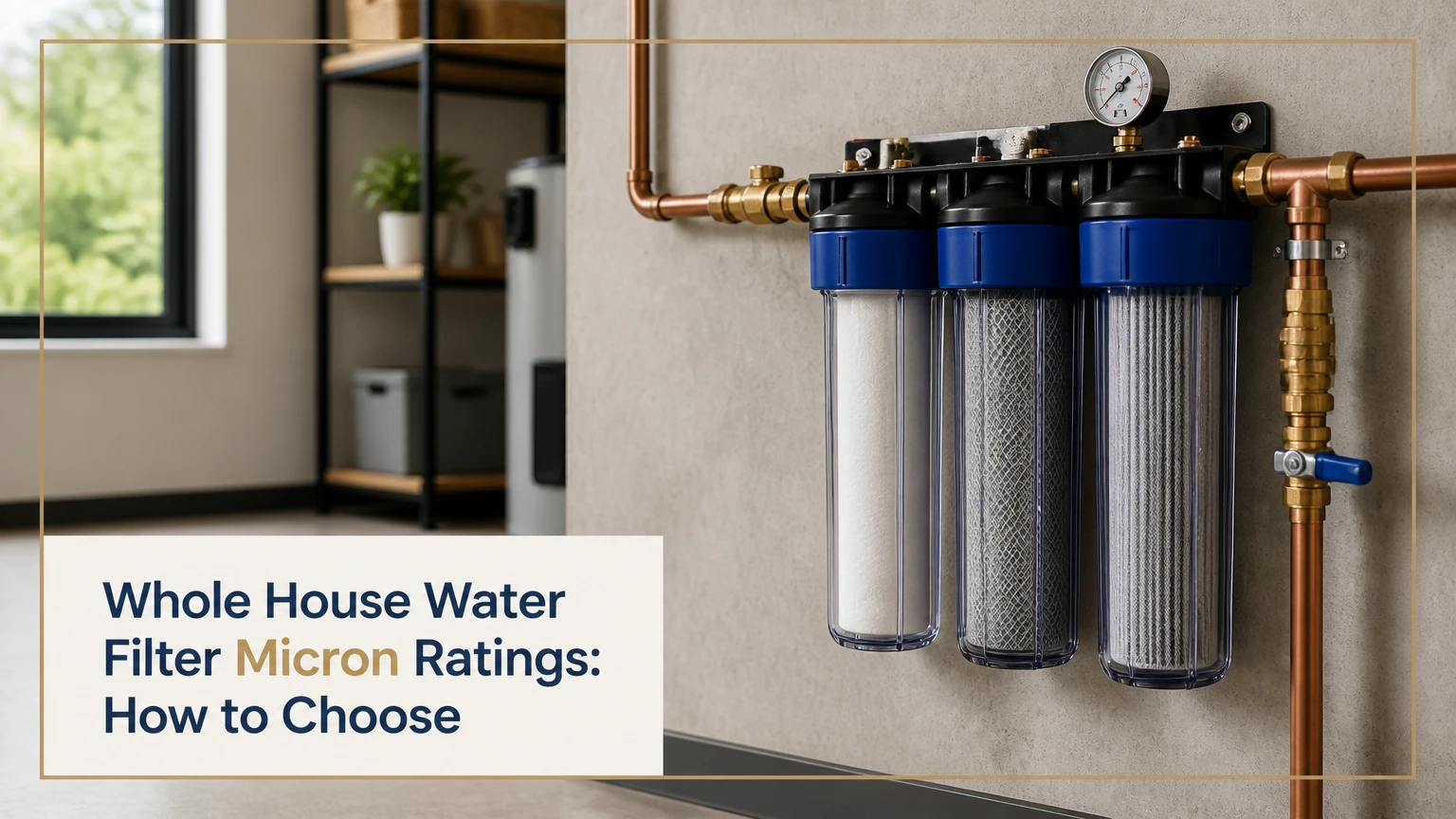
Whole house water filter micron ratings describe the approximate particle size a filter can retain, but the number alone does not define contaminant removal. A 50-micron prefilter protects flow from sand, a 5-micron cartridge captures finer sediment, and sub-micron membranes require certification, adequate flow, and contaminant-specific testing.
Key Facts at a Glance
- One micron equals one-millionth of a meter, or 0.001 millimeter.
- A lower micron number generally captures smaller particles, but it can reduce flow and shorten cartridge life.
- Nominal ratings describe approximate or percentage removal; absolute ratings describe much tighter tested retention under specified conditions.
- A micron rating does not remove dissolved chlorine, nitrate, hardness, PFAS, or metals unless the filter media and certification specifically support that claim.
- A staged system normally places coarse sediment filtration before fine sediment, carbon, UV, or ultrafiltration.
- Private well owners should test the water before choosing a cartridge, because sediment, iron, manganese, bacteria, and hardness need different treatment methods.
What Do Whole House Micron Ratings Mean?
A whole-house water filter micron rating identifies the approximate size of particles that a filter media can retain. The unit is a micrometer, written as micron or µm, and one micron equals one-millionth of a meter. A 20-micron filter targets larger particles than a 5-micron filter, while a 0.02-micron membrane has far smaller pores.
The rating describes physical particle separation, not complete water purification. Sand, rust flakes, pipe scale, and silt are particulate contaminants. Chlorine, nitrate, dissolved iron, hardness minerals, and many PFAS compounds are dissolved or molecular contaminants, so a simple sediment cartridge cannot remove them because they pass through its openings.
Particle dimensions vary by shape and measurement method. A long, thin fiber may pass through a pore in one orientation and lodge in another. For that reason, a product’s flow curve, test standard, media type, and certified contaminant claims matter as much as the printed micron number.
What does one micron look like?
One micron measures 0.001 millimeter. A human hair is commonly cited at roughly 50-100 microns in diameter, although hair thickness varies by person and measurement location. Typical bacteria often measure about 0.5-5 microns, but species and shape vary substantially.
| Material or particle | Typical size | What a sediment filter may do |
|---|---|---|
| Coarse sand grain | 100-1,000 µm | Captured by 50-100 µm prefilters |
| Rust flake | 20-500 µm | Usually captured by 20-50 µm media |
| Fine silt | 2-63 µm | Often requires 1-20 µm media |
| Many bacteria | 0.5-5 µm | Requires validated membrane or disinfection process |
| Dissolved nitrate ion | Molecular scale | Not removed by ordinary micron media |
How Does Mechanical Filtration Work?
Mechanical filtration forces water through a porous barrier or fibrous depth medium. Particles larger than available passages become trapped by surface interception, while smaller particles can pass through or become retained deeper inside the cartridge. As particles accumulate, pressure loss rises and available flow falls.
Pleated polypropylene cartridges provide substantial surface area, so they often hold more sediment than similarly rated spun cartridges. Spun or melt-blown media trap particles through depth, which can improve loading capacity for some water conditions but makes the cartridge opaque to inspection.
Filter performance changes with pressure, flow, particle shape, temperature, and cartridge loading. A cartridge rated at 5 microns may perform differently at 2 gallons per minute than at 10 gallons per minute. Always interpret the micron number alongside the manufacturer’s rated flow and pressure-drop data.
Why do staged filters use larger pores first?
A coarse first stage prevents large particles from rapidly blocking a finer second stage. A typical private-well sequence might use a washable 50-micron screen, a 20-micron pleated cartridge, and a 5-micron polishing cartridge. The sequence protects the expensive or restrictive media downstream.
A city-water installation may need only a 20-micron sediment cartridge before carbon, especially where the utility supplies clear water and the home’s problem is chlorine taste. A 1-micron cartridge installed directly after a dirty well pump can clog in days or weeks.
What Is Nominal Versus Absolute Filtration?
Nominal filtration provides approximate particle reduction at a stated size, while absolute filtration indicates a much tighter tested retention claim under defined laboratory conditions. Nominal and absolute ratings cannot be compared as though they were identical specifications.
| Rating label | Meaning | Typical interpretation | Buying implication |
|---|---|---|---|
| Nominal 20 µm | Percentage reduction near 20 µm | Performance varies by manufacturer | Suitable for general sediment prefiltration |
| Nominal 5 µm | Approximate reduction near 5 µm | Does not guarantee total removal | Useful for polishing sediment |
| Absolute 5 µm | Tested retention near 5 µm | Stronger claim than nominal | Verify test conditions and flow |
| Absolute 0.02 µm | Tight membrane retention claim | May target bacteria and cysts | Confirm pathogen certification and maintenance |
The terms are not regulated uniformly across every cartridge category. One manufacturer’s “absolute” rating may use a different test protocol from another manufacturer’s rating. Compare published test data, pressure conditions, and certification rather than choosing the smallest printed number.
NSF/ANSI standards provide a more useful boundary. NSF/ANSI 42 addresses aesthetic effects such as chlorine taste and odor, NSF/ANSI 53 covers specific health-effect contaminants, NSF/ANSI 55 covers ultraviolet systems, and NSF/ANSI 58 applies to reverse-osmosis systems. Certification applies to a stated contaminant and model, not to every possible contaminant.
Is a Lower Micron Rating Better?
A lower micron rating is better for fine particulate removal only when the system can maintain adequate flow and the water contains enough coarse pretreatment. A 1-micron cartridge may produce clearer water than a 20-micron cartridge, but it can create greater pressure loss and require more frequent replacement.
The correct rating is therefore the smallest practical value that meets the water-quality objective without starving fixtures. A 5-micron cartridge is not automatically superior to a 20-micron cartridge in a high-sediment well, because rapid blockage can make the system perform worse between replacements.
| Micron choice | Main strength | Main weakness | Typical application |
|---|---|---|---|
| 100-50 µm | High flow and washable operation | Leaves fine silt behind | Well or rainwater prefilter |
| 25-20 µm | Balanced sediment control | Limited fine-particle removal | Municipal pipe scale and ordinary well sediment |
| 10-5 µm | Improved clarity | More pressure loss and loading | Final sediment stage before carbon or UV |
| 1 µm | Fine particulate reduction | Rapid clogging without pretreatment | Polishing stage or selected cyst applications |
| 0.1-0.01 µm | Membrane-level separation | Higher cost and maintenance | UF system with validated performance |
Which micron rating fits each water source?
Municipal water commonly starts with a 20-micron sediment stage when the objective is rust and scale control, followed by carbon rated for the specific chlorine or chemical claim. Private wells more often benefit from a 50-micron screen before 20-micron and 5-micron cartridges.
Municipal water
A practical city-water arrangement is a 20-micron pleated sediment cartridge followed by a carbon block. Use a 5-micron carbon block only when the housing, cartridge capacity, and household flow are adequate. The carbon block’s chemical performance depends on contact time and media capacity, not simply its 5-micron label.
Private well with ordinary sediment
A common starting point is 50 microns, then 20 microns, then 5 microns. Test the well after heavy rain and during seasonal changes, because a clear sample in summer does not prove that the pump will not carry sediment after groundwater movement.
Well with bacteria concerns
A 5-micron sediment prefilter may protect downstream treatment, but it does not make contaminated well water safe. A validated UV system, ultrafiltration membrane, or another treatment approved for the identified organism must follow laboratory water testing.
How Do Housing Size and Flow Rate Change the Choice?
Housing size and peak flow determine whether a whole-house cartridge can deliver usable pressure. A 20-inch Big Blue-style housing generally has more media area and lower pressure loss than a 10-inch standard housing using the same micron rating.
Calculate likely peak demand before buying. Two showers at 2.0 gallons per minute each, a toilet refill, and a washing machine can exceed 6 gallons per minute. A cartridge advertised at 10 gallons per minute may have that rating at a clean-filter pressure drop that does not match your plumbing pressure.
| Housing format | Typical cartridge length | Typical usable flow range | Typical cartridge cost |
|---|---|---|---|
| 10-inch standard | 9.75-10 inches | 2-6 GPM | $10-$45 |
| 10-inch slim | 9.75-10 inches | 1-3 GPM | $8-$30 |
| 20-inch standard | 20 inches | 4-10 GPM | $20-$70 |
| 20-inch Big Blue | 20 inches, 4.5-inch diameter | 8-15 GPM | $25-$100 |
These are typical retail and application ranges, not universal performance guarantees. Read the manufacturer’s pressure-drop curve. A larger housing often costs more initially but can extend cartridge life and reduce nuisance pressure loss.
What flow rule should homeowners use?
Size the system for peak simultaneous demand, then add margin rather than sizing for average daily use. For a four-bathroom home, a 10-15 GPM whole-house assembly is often more practical than a small 10-inch housing, but the actual requirement depends on fixture flow restrictors and household behavior.
Install pressure gauges before and after the filter when possible. A rising differential pressure shows loading more reliably than appearance alone. Replace or clean the filter when the pressure drop approaches the manufacturer’s limit or when fixtures experience a measurable reduction in flow.
How Long Do Whole-House Cartridges Last?
Whole-house cartridge life commonly ranges from one month to twelve months, depending on sediment mass, water consumption, cartridge area, and the selected micron rating. A calendar replacement schedule is less reliable than pressure monitoring and water-quality observation.
| Filter type | Common rating | Typical replacement interval | Typical retail cost |
|---|---|---|---|
| Washable spin-down screen | 50-100 µm | Flush weekly to monthly; screen often lasts years | $20-$100 |
| Pleated sediment cartridge | 10-30 µm | 3-6 months | $15-$60 |
| Spun polypropylene cartridge | 1-5 µm | 1-4 months | $10-$35 |
| Carbon block cartridge | 0.5-5 µm | 6-12 months or capacity limit | $40-$120 |
| UF membrane | 0.01-0.1 µm | Often 1-3 years with maintenance | $150-$400 |
A cartridge may need replacement before its rated calendar life if water pressure drops, taste changes, or the filter becomes heavily discolored. Carbon cartridges also have capacity limits for chlorine and other adsorbed contaminants even when flow remains acceptable.
What Can Micron Filtration Not Remove?
Ordinary micron filtration cannot remove dissolved salts, nitrate, most hardness, or chlorine unless a separate treatment medium addresses those contaminants. Mechanical pores separate particles, while adsorption, ion exchange, oxidation, ultraviolet light, and reverse osmosis address different contaminant classes.
| Contaminant concern | Does a sediment micron rating solve it? | Treatment category to investigate |
|---|---|---|
| Sand, rust, and silt | Yes, if particles exceed retention size | Sediment cartridge or screen |
| Chlorine taste and odor | No | Activated carbon certified for chlorine |
| Lead or VOCs | Not by pore size alone | Certified carbon or specialty media |
| Hardness and scale | No | Water softener or scale-control process |
| Nitrate | No | Reverse osmosis or certified ion exchange |
| Iron and manganese | Usually no | Oxidation, filtration, or specialty media |
| Bacteria and viruses | Not reliably from label alone | UV, UF, chlorination, or certified process |
Activated carbon can reduce chlorine, taste, odor, and selected organic chemicals, but carbon performance depends on media quantity, contact time, water chemistry, and cartridge capacity. A carbon block marked 0.5 micron does not automatically remove lead or PFAS.
The U.S. Centers for Disease Control and Prevention states, “No single treatment method can remove all contaminants from water.” That principle prevents a common buying error: treating the micron rating as a complete water-safety specification.
When Should You Use UF, UV, or Reverse Osmosis?
Ultrafiltration, ultraviolet disinfection, and reverse osmosis solve different problems. UF physically retains particles through a membrane, UV inactivates microorganisms without removing them, and reverse osmosis reduces many dissolved substances through a semipermeable membrane.
| Technology | Typical stated scale | Primary target | Main limitation |
|---|---|---|---|
| Sediment filtration | 100-1 µm | Sand, rust, silt | Does not address dissolved contaminants |
| Ultrafiltration | 0.1-0.01 µm | Selected bacteria, cysts, suspended solids | Virus performance varies by membrane and validation |
| Ultraviolet | No pore rating | Microbial inactivation | Requires clear water and electricity |
| Reverse osmosis | Membrane process | Dissolved salts, nitrate, many metals | Reject water, lower flow, and point-of-use complexity |
A 0.02-micron UF membrane may retain many bacteria and cysts, but the printed pore size alone is not proof of virus removal or drinking-water safety. Verify the exact organism reduction claim, flow rate, integrity testing, and certification.
For a microbiologically unsafe well, disinfection and corrective source management come before convenience filtration. Test the water through an accredited laboratory, identify the organism or indicator result, and select treatment around that result.
Why Does a Whole-House Filter Lose Pressure?
A whole-house filter loses pressure when trapped solids restrict the media, the cartridge is undersized, the flow exceeds its rating, or the inlet pressure is already inadequate. Sudden pressure loss usually indicates loading or a valve problem, while consistently low pressure often indicates poor system sizing.
Use this diagnostic sequence:
- Check the inlet and outlet gauges with no fixtures running.
- Compare the pressure differential with the cartridge manufacturer’s limit.
- Inspect or flush the coarse prefilter.
- Replace the fine cartridge if it is loaded or distorted.
- Confirm that bypass valves are fully open and cartridges are seated correctly.
- Test peak flow after replacement.
| Symptom | Likely cause | Corrective action |
|---|---|---|
| Pressure falls within days | Excessive sediment load | Add a 50-100 µm prefilter |
| Pressure falls after 2-4 months | Normal cartridge loading | Replace the cartridge |
| Cloudiness remains | Rating is too coarse or particles are colloidal | Test turbidity and consider finer media |
| Flow is low immediately | Housing is undersized or cartridge restricts flow | Use a larger housing or higher-capacity cartridge |
| Brown water returns after replacement | Source or plumbing corrosion | Test iron, manganese, and rust source |
A sudden pressure drop is not a reason to move immediately from 20 microns to 1 micron. That change may increase blockage. The better correction is often a larger housing, greater cartridge area, or upstream sediment separation.
What Are the Most Common Selection Mistakes?
The most expensive mistakes involve treating one number as the entire specification. Micron size, nominal or absolute method, cartridge area, rated flow, pressure drop, contaminant certification, and replacement capacity must be considered together.
- Installing a 1-micron cartridge first. Heavy well sediment can blind fine media quickly. Put a washable screen or coarse pleated cartridge upstream.
- Assuming smaller means safer. A 0.02-micron membrane without validated pathogen claims is not a universal safety barrier.
- Using a sediment cartridge for dissolved contaminants. Nitrate, hardness, chlorine, and PFAS need purpose-built treatment.
- Ignoring cartridge dimensions. A 10-inch housing may restrict a high-demand home even with a high-flow cartridge.
- Replacing by color alone. A gray cartridge may still flow adequately, while an apparently clean carbon cartridge may have exhausted its chemical capacity.
- Skipping laboratory testing. Well-water treatment selected without a report can miss bacteria, nitrate, arsenic, iron, or manganese.
A practitioner rule of thumb is simple: protect fine media with coarse media, protect household flow with adequate cartridge area, and protect health decisions with laboratory results.
What Is the Best Starting Configuration?
The best starting configuration depends on the source and contaminant objective, not on the smallest available micron number. The following arrangements are reasonable starting points for evaluation, not universal prescriptions.
| Household situation | First stage | Second stage | Additional treatment |
|---|---|---|---|
| City water with pipe debris | 20 µm pleated | 5 µm sediment or carbon | Carbon certified for stated claims |
| Clear city water with chlorine | 5-20 µm sediment | Carbon block | NSF/ANSI 42 or applicable claim |
| Well with sand | 50-100 µm screen | 20 µm pleated, then 5 µm | Test iron, manganese, and bacteria |
| Well with fine silt | 50 µm screen | 10-5 µm depth media | Larger housing and pressure gauges |
| Well with microbial concern | 20-50 µm prefilter | 5 µm protection stage | Validated UV, UF, or chlorination |
| High nitrate or dissolved salts | Sediment prefilter | Carbon where needed | Point-of-use or whole-house RO design |
For municipal water, begin with the utility’s annual water-quality report and a sample at the tap if the home has old plumbing. For private wells, obtain a laboratory panel that includes total coliform and E. coli, nitrate, pH, hardness, iron, manganese, and contaminants relevant to local geology.
FAQ
Does a 5-micron filter remove all bacteria?
No. A 5-micron label does not guarantee complete bacterial removal. Some bacteria are smaller than 5 microns, and nominal media can allow passage around the stated size. Use a membrane or disinfection system with a documented organism-reduction claim when microbial safety is the objective.
Is a 1-micron filter enough for well water?
A 1-micron filter may improve fine sediment and turbidity, but it is rarely a good first stage for a sediment-heavy well. Install coarse pretreatment first, confirm the household flow requirement, and test for bacteria, nitrate, iron, manganese, and other well-water risks.
Can a whole-house micron filter remove lead?
A sediment micron filter does not remove dissolved lead reliably. Lead reduction requires a cartridge certified for lead reduction under the applicable standard, correct installation, adequate contact time, and replacement before the cartridge’s rated capacity is exhausted.
What micron rating is best for drinking water?
The best drinking-water rating depends on the contaminant. A 5-micron sediment stage can protect carbon or reverse osmosis equipment, while a certified carbon block may address chlorine and selected chemicals. Nitrate, arsenic, and microbial contaminants require different certified processes.
Does a higher micron rating improve water pressure?
A higher micron rating usually creates less resistance and maintains higher flow, especially when the cartridge is new. Housing diameter, cartridge area, media design, water pressure, and flow rate also affect pressure, so micron size alone cannot predict the final result.
Should a whole-house filter be installed before or after a water softener?
Sediment filtration normally goes before a water softener to protect its control valve and resin bed. Carbon may go before or after softening depending on the equipment design, while ultraviolet treatment generally belongs after sediment reduction and near the final point of distribution.
The Bottom Line
Whole house water filter micron ratings are useful for matching particulate size, flow, and maintenance demands, but they are not complete water-treatment specifications. Start with water testing and peak-flow requirements, use coarse-to-fine staging, compare nominal with absolute performance, and select carbon, UV, UF, softening, or reverse osmosis only for contaminants those technologies are designed and certified to address. A 50-micron prefilter followed by 20- or 5-micron media often protects a household system better than a single restrictive 1-micron cartridge.