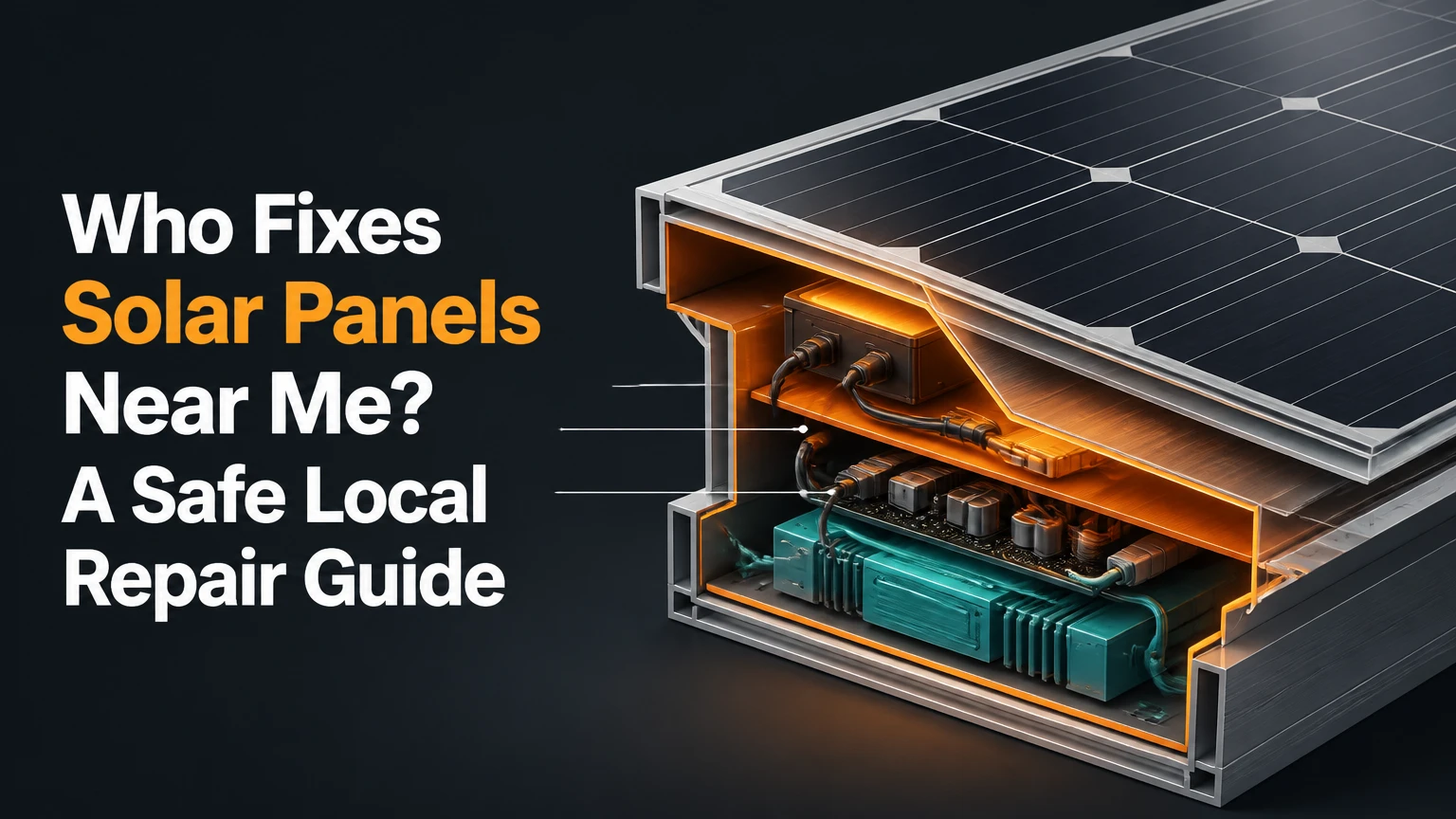
For a Dhaka homeowner, the right answer to “who fixes solar panels near me” is a qualified solar service technician, solar EPC contractor, or electrical repair specialist whose experience matches the failed component. Panel glass, DC wiring, inverters, solar IPS units, charge controllers, batteries, and roof structures require different skills, so confirm the fault and provider scope before booking.
Key Facts at a Glance
- A cracked PV module normally requires replacement, not a safe glass repair, because moisture can reach cells and create insulation faults.
- Typical Dhaka diagnostic visits cost approximately ৳1,000-৳3,000, before replacement parts and transport.
- Inverter, solar IPS, and battery faults often cause a complete power loss even when the panels appear visibly clean.
- A technician should test DC string voltage, current, insulation resistance, inverter logs, battery condition, earthing, and connector temperature.
- Never disconnect MC4 connectors, open an inverter, or touch rooftop DC wiring while sunlight can energize the array.
- A provider with the highest online rating is not automatically the right provider for rooftop PV, LiFePO4 batteries, or grid-connected equipment.
What Does Solar Panel Repair Include?
Solar panel repair includes diagnosis and servicing of the photovoltaic modules, DC connectors, string wiring, fuses, isolators, mounting structure, inverter, charge controller, batteries, earthing, and monitoring equipment. A business selling panels may not repair inverter circuit boards, and an IPS repair shop may not be qualified to work on rooftop DC circuits.
A complete solar installation has several linked layers. PV modules create DC electricity, string cables carry it to protection equipment, a charge controller regulates battery charging in off-grid systems, and an inverter converts DC into household AC. Hybrid systems use all of these functions, while on-grid systems usually omit batteries and export energy through a grid-interactive inverter.
| System component | Typical fault | Correct specialist |
|---|---|---|
| PV module | Cracked glass, hotspot, diode failure | Solar PV technician |
| DC circuit | Burnt MC4 connector, blown fuse, cable damage | Solar electrician |
| Inverter or IPS | MOSFET failure, relay fault, error code | Inverter or power-electronics technician |
| Battery bank | Low capacity, sulphation, BMS fault | Battery and solar-storage technician |
| Roof structure | Corrosion, loose clamps, water entry | Solar installer and roofing contractor |
The first task is therefore not “repair the panel.” The first task is identifying which layer has failed. A professional quotation should name the affected component, test performed, part required, expected output after repair, and warranty period.
Which Local Solar Repair Provider Fits Your System?
Dhaka residents can begin with local leads such as Energy System Company, Global Renewable Energy Ltd., BCMG BD, Safin Electric & Solar, TECHXZON, and Energy Bangla Solar Engineering, all of which appeared in the supplied local search results. Verify current address, service area, technician availability, equipment scope, and recent customer experience before paying a call-out fee.
The listed businesses have different apparent profiles. Global Renewable Energy Ltd. is presented as an EPC engineering firm, while BCMG BD is associated with solar support, IPS repair, and hybrid inverter maintenance. TECHXZON is associated with electronics and IPS or UPS motherboard work. Energy Bangla Solar Engineering is presented as handling on-grid, off-grid, and hybrid inverter troubleshooting.
| Provider lead from local results | Listed Dhaka location | Apparent service fit to verify |
|---|---|---|
| Energy System Company, Ensysco | 583/C, Taltola Market Road, Dhaka 1219 | Diagnostics, LiFePO4 and tubular batteries, inverter repair, emergency support |
| Global Renewable Energy Ltd. | Suite F-4, Compass Jamidar Palace, 291 Inner Circular Road, Dhaka 1000 | EPC work, feasibility, PV maintenance, module replacement |
| BCMG BD | Uttara, Dhaka 1230 | Cleaning, solar IPS repair, Exide and UTL equipment, electrical troubleshooting |
| Safin Electric & Solar | Sundarban Square Market, Old Dhaka | Controllers, hybrid inverters, hardware replacement, battery maintenance |
| TECHXZON | Tropical Centre, 218 New Elephant Road, Dhaka 1205 | On-site electronics, solar IPS and UPS motherboard repair |
| Energy Bangla Solar Engineering | 824, 1 Middle Monipur, Dhaka 1216 | String inverter troubleshooting and solar-array rewiring |
These descriptions come from the supplied search material, not an independent inspection or guarantee of current service quality. Ask every provider whether the technician has worked on your exact inverter brand, battery chemistry, system voltage, and connection type.
Which Provider Should You Call First?
Call a solar PV or EPC technician for low generation, rooftop wiring, module damage, string faults, earthing, or grid-tied inverter problems. Call an IPS or power-electronics technician for a non-charging solar IPS, burnt relay, motherboard fault, or inverter that trips under load. Call a battery specialist when backup time has declined despite normal solar input.
For a commercial rooftop, select an O&M contractor that can produce an electrical test report, thermal scan, string map, insulation-resistance result, and corrective-action list. For a small home system, a technician who provides on-site diagnosis and written parts pricing is usually more useful than a large installer that only sells new systems.
How Do Technicians Diagnose the Fault?
Professional solar diagnosis begins with safe isolation, followed by visual inspection, electrical measurements, component testing, repair, and commissioning. A typical residential visit takes 1-3 hours when replacement parts are available, but a board repair, inaccessible rooftop, battery load test, or grid-authority issue can extend the job to one or two days.
Technicians normally isolate the AC main, PV DC isolator, and battery breaker according to the equipment instructions. The array can remain electrically live in daylight even after an inverter is switched off, so shutdown controls do not make exposed connectors safe by themselves.
The diagnostic sequence usually includes:
- Record the symptom and inverter history. The technician photographs error codes, production data, battery voltage, and event logs before resetting anything.
- Inspect the array and wiring. Cracked glass, brown junction boxes, rodent damage, loose clamps, water entry, melted connectors, and shading patterns receive priority.
- Compare string measurements. Open-circuit voltage, operating voltage, and current are compared between strings under similar sunlight. A low voltage can indicate an open circuit, while low current can indicate shading, soiling, a connector fault, or a module problem.
- Test protection and insulation. Fuses, DC isolators, surge-protection devices, earth continuity, polarity, and insulation resistance help identify fire and shock hazards.
- Review inverter operation. The technician checks DC input, AC output, grid voltage and frequency, temperature, fan operation, relay behavior, and manufacturer error codes.
- Assess storage. Lead-acid batteries require terminal, electrolyte, cell-voltage, and load checks. LiFePO4 batteries require pack voltage, BMS status, balancing behavior, temperature, and charge-discharge data.
- Repair and recommission. The system is energized in stages, then output, alarms, battery charging, monitoring, and export behavior are documented.
A clamp meter alone cannot prove that a panel is healthy. A module can show acceptable open-circuit voltage while producing weak current because of a damaged cell interconnect, bypass diode, shading, or high-resistance connector.
What Tools Should a Solar Technician Bring?
A competent technician may use a calibrated multimeter, DC clamp meter, insulation-resistance tester, irradiance meter, thermal camera, torque tools, polarity tester, IV-curve tracer, and battery analyzer. Large rooftops benefit from a string tester and thermal inspection because one defective connector can heat without obvious visible damage.
| Diagnostic tool | Measurement or observation | Useful fault indication |
|---|---|---|
| DC clamp meter | String current in amperes | Low-current string, imbalance, shading |
| Multimeter | DC voltage, polarity, continuity | Open circuit, reverse polarity, missing string |
| Insulation tester | Resistance to earth in megohms | Damaged cable, wet junction box, ground fault |
| Thermal camera | Connector and module temperature | Hotspot, loose terminal, bypass-diode issue |
| Battery analyzer | Capacity and voltage under load | Weak cell, high internal resistance, ageing pack |
IEC 62446-1 provides a framework for documentation, commissioning tests, and inspection of grid-connected PV systems. The standard does not make every technician certified, but a provider familiar with its testing logic is more likely to produce evidence rather than diagnose from appearance alone.
Which Solar Faults Can Be Repaired?
Solar faults that are often repairable include loose or corroded connectors, damaged external cable, failed fuses, defective isolators, charge-controller faults, replaceable inverter cooling fans, and some inverter board components. A repair is unsuitable when the module has cracked glass, widespread delamination, severe backsheet damage, repeated insulation failure, or an uneconomical cell defect.
| Fault | Repair possibility | Usual remedy | Typical risk if ignored |
|---|---|---|---|
| Burnt MC4 connector | High | Replace matched connector pair and re-crimp cable | DC arcing and heat |
| Failed bypass diode | Medium to high | Replace diode or junction box if compatible | Hotspot and output loss |
| Cracked tempered glass | Low | Replace entire module | Moisture ingress and insulation fault |
| Inverter fan failure | High | Replace fan and clean airflow path | Thermal shutdown or board damage |
| Roof-rack corrosion | Medium | Replace clamps, rails, or fasteners | Wind movement and roof leakage |
A bypass diode replacement is only appropriate when the junction box is accessible and the module construction permits reliable work. Field-soldering a damaged cell string rarely restores the module’s original weatherproofing or warranty.
Cold-water cleaning requires more precision than the common warning suggests. Spraying water on a hot panel does not guarantee glass failure, but a large temperature difference, existing microcracks, thermal stress, and pressure washing can increase damage risk. Clean panels early in the morning or near sunset with manufacturer-compatible methods, and avoid abrasive brushes.
Can a Cracked Solar Panel Be Repaired?
A cracked solar panel should generally be replaced rather than resealed or patched. Sealant may slow water entry temporarily, but it cannot restore the module’s insulation resistance, tempered-glass strength, cell interconnect reliability, or manufacturer warranty.
A replacement module must match more than wattage. Check maximum power voltage, open-circuit voltage, operating current, short-circuit current, dimensions, connector type, mounting position, and inverter voltage limits. In a series string, the electrical behavior of the replacement affects every module connected to that string.
When Should an Inverter or Solar IPS Be Repaired?
Repair an inverter or solar IPS when the unit is relatively new, replacement boards are available, the fault is localized, and the repair includes a meaningful written warranty. Replace it when the equipment is near the end of its expected service life, has suffered repeated board failures, uses obsolete batteries or firmware, or costs more than roughly 40%-60% of a suitable replacement.
The 40%-60% rule is a planning threshold, not a manufacturer standard. A cheap board repair can become poor value if swollen capacitors, heat-damaged terminals, fans, relays, and insulation faults remain in the same enclosure.
| Decision factor | Repair is usually sensible | Replacement is usually sensible |
|---|---|---|
| Equipment age | Under 5 years | 8-12 years or obsolete model |
| Repair quote | Under 40% of replacement price | Above 60% of replacement price |
| Parts | Original board or documented equivalent | Unavailable or salvaged board |
| Failure pattern | One isolated fault | Two or more repeat failures |
| Warranty | Written 3-12 month coverage | New manufacturer warranty available |
A solar IPS is not identical to a grid-tied inverter. A solar IPS commonly combines battery charging, backup transfer, inverter output, and sometimes PV regulation. A grid-tied inverter synchronizes with utility voltage and frequency and normally shuts down during a grid outage unless paired with approved backup equipment.
Repeatedly resetting a ground-fault or high-DC-voltage alarm is unsafe. The alarm may indicate wet connectors, cable insulation damage, incorrect string design, or a failed surge-protection device.
What Battery Service Do You Need?
Battery service depends on chemistry. Flooded tubular and other lead-acid batteries require electrolyte-level, terminal, specific-gravity, ventilation, and load testing, while LiFePO4 batteries require BMS diagnostics, cell balancing, temperature checks, and controlled capacity testing. AGM and gel batteries should not be topped up with water.
| Battery type | Service action | Replacement signal | Safety requirement |
|---|---|---|---|
| Flooded tubular lead-acid | Distilled-water level and specific gravity check | One weak cell or rapid voltage collapse | Ventilation and eye protection |
| AGM lead-acid | Terminal and load test | Low capacity with normal charging | No electrolyte refilling |
| Gel lead-acid | Voltage, charger profile, load test | Swelling or persistent low capacity | Correct gel charging voltage |
| LiFePO4 | BMS, cell voltage, temperature, capacity test | BMS lockout or degraded cells | Approved charger and insulated tools |
Adding distilled water does not restore a sulphated or physically damaged battery. Battery capacity must be checked under load, because a battery can show normal resting voltage while delivering very little backup energy.
Lithium battery enclosures should not be opened by a general electrician unless the manufacturer permits cell-level service. A BMS fault, swollen cell, unusual heat, or burning odor requires isolation and specialist inspection.
What Does Solar Repair Cost in Dhaka?
Typical Dhaka solar service pricing is approximately ৳1,000-৳3,000 for diagnosis, ৳2,000-৳5,500 for many IPS or inverter board repairs, and ৳2,500-৳7,000 for cleaning plus a rewiring inspection. Actual invoices vary with rooftop access, brand, parts, transport distance, system size, and whether the technician must return.
The following figures are planning ranges derived from the supplied local search material and should not be treated as fixed market tariffs. Ask whether VAT, delivery, testing, scaffolding, and old-part removal are included.
| Service | Typical Dhaka range | Typical working time |
|---|---|---|
| Site inspection and diagnosis | ৳1,000-৳3,000 | 1-3 hours |
| IPS motherboard or MOSFET repair | ৳2,000-৳5,500 | 1-2 days |
| Bypass diode or junction-box work | ৳1,500-৳3,500 | 2-4 hours |
| Module replacement labor | ৳2,500-৳6,000 | About 1 day |
| Tubular or LiFePO4 servicing | ৳1,000-৳4,000 | 2-6 hours |
| Cleaning and rewiring check | ৳2,500-৳7,000 | Half day |
A panel replacement quotation should list the panel price separately from labor. A technician who proposes a higher-wattage module without checking string voltage, inverter limits, roof dimensions, and connector compatibility has not completed a proper replacement assessment.
Repair or Replace the Solar Equipment?
Repair is preferable for a localized, documented fault in otherwise healthy equipment. Replacement is preferable for cracked modules, obsolete inverters, repeated battery failures, severe corrosion, fire-damaged connectors, or a repair price that approaches the cost of a warranted new component.
| Situation | Better decision | Reason |
|---|---|---|
| One burnt connector, healthy string | Repair | Low-cost localized fault |
| Cracked module with moisture marks | Replace module | Sealing does not restore electrical safety |
| Six-year-old inverter, available board | Compare quote | Age and parts support remain relevant |
| Ten-year-old inverter with repeated trips | Replace inverter | Multiple ageing components may fail |
| LiFePO4 BMS fault under warranty | Warranty service | Avoid unauthorized cell-level work |
| Battery capacity below usable requirement | Replace bank | Servicing cannot reverse cell degradation |
Panel warranties commonly cover product defects for around 10-15 years, while performance warranties often extend to 25-30 years, but terms differ by manufacturer and technology. Inverter warranties commonly range from 5-10 years. A third-party board repair can affect warranty eligibility, so check the serial number and warranty conditions before opening equipment.
The cheapest repair is not always the lowest-cost decision. A failed connector that damaged a module junction box, cable insulation, and inverter input may require a broader corrective job.
What Does the Symptom Mean?
Solar symptoms identify likely fault areas but cannot confirm them without measurement. A sunny-day shutdown may come from a tripped isolator, inverter fault, grid overvoltage, damaged cable, failed fuse, battery problem, or protection device, so safe external checks should precede a service call.
| Symptom | Likely cause | Safe homeowner action |
|---|---|---|
| Zero output in strong sun | Isolator, fuse, inverter, or grid fault | Read display and check labeled breakers |
| 20%-50% production drop | Dust, shade, string fault, diode failure | Photograph array and monitoring data |
| Midday inverter shutdown | Heat, fan blockage, grid overvoltage | Check clear airflow around inverter |
| Backup ends quickly | Aged battery, weak cell, low charge | Record runtime and battery alarm |
| Ground-fault message | Wet junction box or damaged cable | Stop resetting and call a technician |
| One panel visibly dark | Shading, bypass diode, connector fault | Do not disconnect rooftop connectors |
Do not use a household multimeter on unfamiliar high-voltage DC strings unless trained and equipped for the measurement category. DC arcs can persist after a circuit is interrupted, and a wrong probe setting can damage the meter or injure the operator.
What Should You Check Before Calling a Technician?
Before booking, record the inverter brand and model, battery chemistry, approximate installation year, system type, last normal operating date, exact error code, and whether the problem affects generation, backup, or both. Photos of the inverter screen, labels, breakers, roof array, and battery bank help a provider estimate the correct skill and parts.
Safe checks include:
- Confirm whether the outage affects the entire building or only solar equipment.
- Photograph, rather than repeatedly reset, inverter warning messages.
- Check labeled AC and DC breakers visually for an obvious trip.
- Compare current output with the same time on a clear day.
- Note recent rain, lightning, roof work, flooding, construction, or rodent activity.
- Keep children away from batteries, exposed wiring, and rooftop access.
- Do not spray water on a hot array or pressure-wash connectors.
What Questions Should You Ask Before Hiring?
Ask whether the technician provides on-site diagnosis, carries an insulation tester, works on your inverter brand, handles your battery chemistry, and gives a written estimate before replacing parts. Also ask for the diagnostic fee, travel fee, expected turnaround, parts source, repair warranty, commissioning test, and old-part return policy.
A credible quotation identifies measurements and parts. “Motherboard problem” without an error code, test result, or component explanation is not enough to approve expensive work.
How Often Should Solar Systems Be Maintained?
Most residential systems benefit from a visual inspection at least annually, with cleaning scheduled according to dust, bird activity, pollen, nearby construction, and rainfall. Commercial rooftops often use quarterly or semi-annual inspection, thermal scanning, torque checks, vegetation control, and production review.
Maintenance frequency should follow the environment rather than a universal calendar. Dhaka rooftops exposed to dust, humidity, monsoon rain, salt air, bird droppings, or nearby construction may need more frequent checks than a clean suburban roof.
| Maintenance item | Residential interval | Commercial interval |
|---|---|---|
| Monitoring review | Monthly | Weekly |
| Visual roof inspection | Annual | Quarterly |
| Panel cleaning | 1-2 times yearly as needed | Quarterly or soil-based |
| Thermal inspection | Every 2-3 years | Annual |
| Battery inspection | Monthly for flooded lead-acid | Monthly or contract schedule |
| Earthing and protection test | Annual | Annual and after lightning events |
An annual visit should not be reduced to washing modules. The provider should also check connectors, cable support, corrosion, roof penetrations, inverter ventilation, surge protection, earthing, battery terminals, and system production against expected output.
Which Situations Need Different Specialists?
Apartment owners usually need a technician who can coordinate roof access, shared electrical spaces, landlord approval, and safe cable routes. Rural off-grid users need battery and charge-controller expertise because storage often determines whether appliances operate overnight. Factory and commercial sites need documented O&M procedures, isolation plans, and utility-compliance knowledge.
A grid-connected fault may require coordination with the utility or net-metering authority, especially when the inverter reports abnormal grid voltage or frequency. An installer cannot safely bypass anti-islanding protection, and a technician should never promise continued export during a utility outage without approved equipment.
For emergency symptoms, isolate the affected equipment only through labeled controls if you can do so safely, keep away from smoke or heat, and contact a qualified electrical or solar professional. Burning odor, melted insulation, sparking, water inside an inverter, swollen batteries, and ground-fault alarms require urgent attention.
How Do You Judge a Repair After Completion?
A completed repair should include a staged restart, stable inverter operation, correct polarity, acceptable insulation result, normal battery charging, restored monitoring, and a written record of replaced parts. For grid-connected systems, the technician should also verify that generation and export behavior follow the approved system design.
Request these handover details:
- Fault found and measurements taken.
- Parts replaced, including model or rating.
- DC and AC readings after repair.
- Battery voltage and load-test result where applicable.
- Warranty duration and exclusions.
- Photos of repaired connectors, wiring, or equipment.
- Recommended follow-up date.
A technician who only confirms that lights have turned on has not necessarily confirmed safe PV operation. Output verification matters because a system can power a small load while one string, battery section, or protection circuit remains defective.
FAQ
Can a normal electrician repair solar panels?
A normal electrician may repair AC distribution, breakers, and building wiring, but rooftop PV adds energized DC circuits, string design, MC4 connectors, insulation testing, and inverter configuration. Choose a technician with solar experience for array wiring, DC protection, inverter faults, and rooftop work, then use a general electrician for clearly separated building-side repairs.
How long do solar panels usually last?
Many crystalline-silicon modules are sold with performance warranties covering approximately 25-30 years, but useful output depends on heat, humidity, mechanical stress, installation quality, and degradation. A panel can continue operating beyond its warranty period, while connectors, junction boxes, inverters, and batteries often need service earlier.
Can dust alone stop solar generation?
Dust can materially reduce output, especially when combined with bird droppings, construction debris, or persistent dry-season accumulation, but complete zero generation usually indicates a switching, inverter, fuse, wiring, or grid fault. Cleaning is reasonable when the array is safely accessible, but a zero-output system still requires electrical diagnosis.
Should I replace all panels if one panel fails?
Replace one panel when the remaining modules are electrically compatible, physically available, and in comparable condition. Replace more modules when the original model is discontinued, string voltage becomes unsuitable, degradation is uneven, or repeated failures indicate broader water ingress or installation defects.
Can a solar inverter work without a battery?
A grid-tied inverter normally operates without a battery when utility voltage and frequency are present. An off-grid solar IPS generally needs a battery or another approved energy-storage source to regulate power and supply loads when solar input changes, although some hybrid inverters support limited batteryless operation.
What information should I send for a repair estimate?
Send the system location, inverter and battery model numbers, installation age, error-code photo, recent production or backup-runtime data, roof-access details, and pictures of the equipment labels. Include whether the system is on-grid, off-grid, or hybrid, because the diagnostic scope and safety controls differ.
The Bottom Line
The best answer to “who fixes solar panels near me” is the local technician whose tested capability matches the failed component, not simply the nearest solar seller. In Dhaka, compare solar PV technicians, EPC contractors, IPS repair specialists, and battery-service providers by equipment experience, diagnostic tools, written pricing, safety process, and warranty. Start with diagnosis, then repair or replace only after the technician documents the fault.