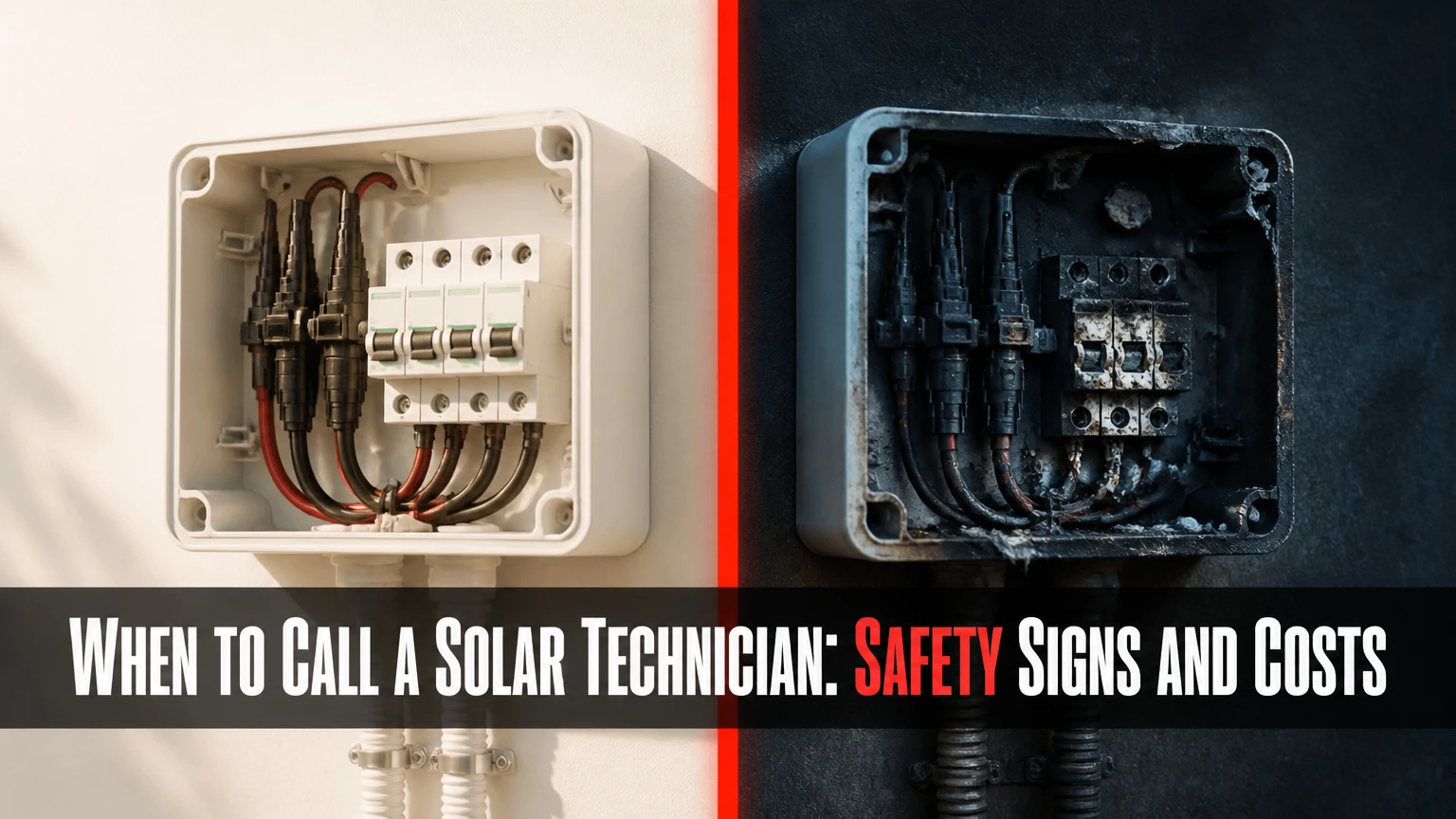
Call a solar technician immediately for total power loss, active inverter fault codes, exposed wiring, storm damage, smoke, burning smells, or battery overheating. A homeowner may check monitoring data and inspect panels from the ground, but opening electrical enclosures, moving roof equipment, testing conductors, or replacing components requires a qualified PV professional.
Key Facts at a Glance
- Solar arrays can produce dangerous DC voltage during daylight, even when household power is turned off.
- A ground-fault, isolation-fault, arc-fault, or insulation-fault alarm requires professional diagnosis.
- A monitoring-app outage does not always mean the solar array stopped generating electricity.
- A persistent production decline of 10% or more after weather and shading are considered merits a diagnostic review.
- A typical US solar diagnostic visit costs $150-$300 and takes 1-2 hours.
- A qualified technician should understand photovoltaic DC circuits, rapid shutdown, battery systems, utility interconnection, and NEC Article 690.
When Should You Call a Solar Technician?
A solar technician should be called immediately when the system stops producing, displays an active electrical fault, suffers physical damage, exposes conductors, or creates heat, smoke, or unusual odors. A technician is also appropriate when production falls persistently, a roof repair affects the array, or the installer cannot resolve a warranty issue.
The urgency depends on the hazard and the system symptom. A blank app caused by a router failure can wait for a safe communications check, while a red inverter fault accompanied by a burning smell requires electrical isolation from a safe location and emergency assistance.
| Symptom | Recommended response | Typical urgency | Homeowner action |
|---|---|---|---|
| Burning smell or smoke | Leave the area and call emergency services if needed | Immediate | Do not touch equipment |
| Exposed DC wire | Keep people away and call a PV technician | Immediate | Photograph from ground level |
| Ground-fault alarm | Stop troubleshooting and arrange diagnosis | Same day | Record the code |
| Blank monitoring app | Check router and internet status | Within 1-3 days | Do not open inverter |
| 10%-20% unexplained loss | Compare weather and historical data | Within 1-2 weeks | Export monitoring records |
| Cracked panel after hail | Keep clear and contact installer or insurer | Same day | Do not climb onto roof |
Which solar problems are emergencies?
Fire, arcing, battery swelling, electrolyte leakage, severe flooding, fallen equipment, and damaged overhead conductors are emergencies rather than ordinary service calls. Call the fire department for active smoke or fire, keep people away from the array and battery, and tell responders that the property has solar equipment and energy storage.
A fire department may not be able to make a photovoltaic array electrically dead during daylight. The International Association of Fire Fighters and the National Fire Protection Association emphasize photovoltaic hazard awareness because modules can remain energized when illuminated. Do not spray water directly into an inverter, battery enclosure, or damaged electrical cabinet unless emergency responders direct that action.
What Does a Solar Technician Do?
A solar technician installs, tests, diagnoses, repairs, and maintains photovoltaic equipment, including modules, racking, inverters, optimizers, disconnects, wiring, monitoring gateways, batteries, and rapid-shutdown devices. The role combines electrical testing, roof-system inspection, manufacturer procedures, utility requirements, and code compliance.
A competent technician distinguishes a generation fault from a communications fault. That distinction prevents an unnecessary panel replacement when the array is producing normally but the gateway has lost internet access.
Technicians commonly use digital multimeters, clamp meters, insulation-resistance testers, IV-curve tracers, thermal cameras, irradiance meters, and manufacturer monitoring portals. Each tool answers a different question, and a thermal image alone cannot prove that a module is electrically defective.
| Tool or record | What it measures | Example finding | Usual user |
|---|---|---|---|
| Digital multimeter | DC voltage, AC voltage, continuity | Incorrect string voltage | Qualified technician |
| Clamp meter | Current without conductor disconnection | Low string current | Qualified technician |
| Thermal camera | Surface temperature differences | Hot connector or cell area | Qualified technician |
| Irradiance meter | Sunlight at array plane | Low production explained by clouds | Qualified technician |
| Monitoring portal | Power, energy, alerts, history | Inverter offline for 48 hours | Homeowner and technician |
| IV-curve tracer | Current-voltage performance | Mismatch or module degradation | Specialist technician |
How Does a Technician Diagnose a Solar System?
A solar technician normally follows five stages: visual inspection, thermal screening, electrical testing, fault isolation, and commissioning. The technician first identifies the symptom and system architecture, then tests the smallest safe section that can confirm or exclude a cause.
1. Inspect the array and equipment
The technician checks module glass, backsheets, frames, junction boxes, connectors, racking, roof attachments, conduits, disconnects, inverter condition, and battery cabinets. They look for cracked glass, delamination, discoloration, corrosion, rodent damage, loose hardware, water entry, shifted modules, and “snail trails,” which can indicate cell or metallization damage.
Roof access is not always necessary for the first diagnosis. Monitoring records, ground-level photos, and inverter alerts can establish whether a roof visit is warranted.
2. Scan for abnormal heat
Infrared thermography can reveal hot cells, failed bypass diodes, loose connectors, overloaded conductors, and uneven string behavior. A useful scan requires adequate sunlight, stable operating conditions, and comparison between similar modules; a hot-looking area may otherwise reflect shade, wind, dirt, or a temporary load difference.
Thermal imaging is a screening method, not a complete repair decision. A technician confirms the suspected defect with electrical measurements and manufacturer specifications.
3. Test voltage, current, and insulation
The technician may measure open-circuit voltage, commonly called Voc, short-circuit current, commonly called Isc, operating current, polarity, insulation resistance, and AC output. Testing occurs at appropriate disconnects or equipment terminals under a controlled procedure, not by probing random exposed conductors.
A string with normal Voc but very low current can indicate shading, a failed connector, a module problem, or an open circuit under load. A string with abnormal voltage can indicate a missing module, optimizer issue, wiring fault, or incorrect configuration.
4. Isolate the failed component
The technician narrows the problem to a module, string, optimizer, microinverter, central inverter, combiner, disconnect, conductor, gateway, battery, or utility interface. Lockout and verification procedures prevent the technician from relying only on a switch position, because photovoltaic conductors may remain energized from sunlight.
5. Recommission and document the system
After repair, the technician restarts equipment in the manufacturer’s sequence, confirms AC and DC measurements, checks monitoring communication, verifies production, clears or records alarms, and documents replaced parts. Request the diagnostic readings, equipment serial numbers, photographs, and warranty details for future claims.
Which Inverter Error Codes Require a Technician?
Ground fault, isolation fault, arc fault, insulation fault, DC overvoltage, grid fault, internal hardware fault, and repeated rapid-shutdown alarms require a solar technician. The exact wording varies by manufacturer, but the code category matters more than the color of the indicator light.
A single communications alert can be low risk, but a repeated electrical fault can indicate moisture, damaged insulation, connector failure, or internal equipment damage. Do not repeatedly reset an inverter that returns the same fault, because repeated energization can worsen arcing or conceal a developing failure.
| Alert or condition | Likely system area | Risk level | Appropriate response |
|---|---|---|---|
| No internet connection | Router, gateway, cellular modem | Low to moderate | Check network status |
| Isolation fault | DC insulation, moisture, wiring | High | Call technician |
| Ground fault | Conductor leakage to ground | High | Stop physical troubleshooting |
| Arc fault | Electrical arcing or detection circuit | High | Arrange same-day service |
| Grid fault | Utility voltage or frequency interface | Moderate to high | Check utility outage, then call |
| DC overvoltage | String design or inverter input | High | Do not restart repeatedly |
| Battery communication fault | BMS, gateway, or firmware | Moderate to high | Call storage-qualified technician |
Can You Troubleshoot Solar Panels Yourself?
Homeowners can safely review monitoring history, check whether the utility has an outage, inspect panels from ground level, confirm that household internet works, and photograph visible damage. Homeowners should not climb onto the roof, remove covers, open disconnects, test wires, alter settings, wash hot modules, or replace electrical parts.
A monitoring portal that says “offline” may represent lost internet communication rather than zero generation. Compare the inverter display, utility bill, and historical production before concluding that the array has failed, but do not open equipment to verify the difference.
| Homeowner task | Safe boundary | Stop condition |
|---|---|---|
| Review monitoring app | Record dates, power, energy, and alerts | Electrical fault appears |
| Check internet connection | Restart router only | Inverter alarm remains |
| Inspect from ground | Use binoculars or a camera zoom | Wire or glass damage is visible |
| Check utility outage | Use the utility outage map | Solar remains offline after restoration |
| Remove light debris from ground | Never approach energized conductors | Debris is tangled in wiring |
| Observe battery status | Read display without opening cabinet | Heat, swelling, odor, or alarm occurs |
Cleaning can improve output when dust, pollen, leaves, or bird residue cover modules, but dirty panels rarely explain sudden zero production across a healthy system. Use a soft approach approved by the module manufacturer, avoid pressure washers and abrasive pads, and hire a professional when roof access is required.
Why Did Solar Production Suddenly Drop?
Sudden solar production loss usually comes from shading, severe soiling, inverter shutdown, communications failure, grid interruption, failed module-level electronics, wiring faults, or weather conditions. Production should be compared with the same season, sunlight availability, temperature, snow cover, and new obstructions before a degradation conclusion is made.
The National Renewable Energy Laboratory reported median photovoltaic degradation of about 0.5% per year in its 2012 analysis of more than 2,000 systems. A sudden 15% decline over one month is therefore not normal panel aging and deserves investigation, although monitoring gaps can create a false appearance of loss.
| Observed pattern | More likely explanation | First check | Technician threshold |
|---|---|---|---|
| Zero output on sunny day | Inverter, grid, disconnect, or wiring fault | Utility and inverter status | Same day |
| One panel lower than neighbors | Module, optimizer, or shade problem | Monitoring by module | Within 1-2 weeks |
| Output loss only in afternoon | New shade or thermal derating | Seasonal shade pattern | If persistent |
| App offline, bill normal | Gateway or internet issue | Router and portal timestamp | If unresolved 48 hours |
| Gradual 5% annual decline | Aging, soiling, or weather | Historical production | Monitor and compare |
| Sudden loss after storm | Physical or water damage | Ground-level inspection | Same day |
Production estimates from a weather application are not proof of equipment failure. A technician can compare plane-of-array irradiance, inverter logs, string current, and historical performance more reliably than a household bill alone.
What Should You Do After Storm, Fire, or Flood Damage?
After storm damage, keep people away from the array, do not touch displaced modules or hanging conduit, and contact the installer, a PV technician, and the insurer. After fire or flooding, treat the array and battery as energized and damaged until qualified responders inspect and isolate them.
Hail can crack module glass without stopping output immediately. Wind can shift racking while leaving modules visually intact, and water can enter connectors or inverters before an insulation fault appears several hours later.
Document the date, weather event, visible damage, monitoring alerts, and utility status from ground level. Do not move panels to inspect the roof, because a displaced module may have damaged conductors beneath it.
How Much Does a Solar Technician Cost?
A typical US solar diagnostic visit costs $150-$300 for 1-2 hours, while component repairs and roof work cost more. Final pricing depends on location, system size, roof access, travel, equipment availability, emergency timing, licensing requirements, and whether the warranty provider pays the technician.
These are typical planning ranges, not guaranteed 2026 prices. Get a written scope that separates diagnostic labor, parts, permitting, roof access, electrical work, disposal, and tax.
| Service | Typical cost | Typical duration | Main price variables |
|---|---|---|---|
| Diagnostic visit | $150-$300 | 1-2 hours | Travel, urgency, system size |
| Annual inspection | $250-$500 | 2-3 hours | Roof access, batteries, thermography |
| Optimizer replacement | $400-$800 | 2-3 hours | Roof access, parts, permits |
| Central inverter replacement | $1,500-$3,500 | 2-4 hours | Capacity, rewiring, warranty |
| Panel removal and reinstall | $2,000-$5,000 | 1-2 days | Array size, roof repair, permits |
| Battery service | $300-$1,200 | 2-6 hours | Battery brand, BMS, fault type |
A low diagnostic price may exclude testing, roof access, or a written report. A high quote may include a lift, permit, multiple technicians, or emergency response, so compare scope rather than the headline number.
Should You Hire an Electrician or a Solar Specialist?
Choose a solar specialist for PV array faults, inverter problems, optimizers, rapid-shutdown equipment, monitoring systems, and battery storage. A residential electrician may handle the home service panel or AC circuit, but electrical licensing alone does not prove experience with high-voltage DC photovoltaic systems.
The best provider has the license required by the local authority, liability insurance, PV-specific training, manufacturer familiarity, and experience with the system brand. North American Board of Certified Energy Practitioners certification can support competence, but certification does not replace a legally required contractor or electrical license.
| Provider | Best task | PV-specific requirement | Limitation |
|---|---|---|---|
| PV service technician | Array, inverter, optimizer diagnosis | PV electrical testing | May not perform all utility work |
| Licensed electrician | AC panel and service wiring | Solar and NEC experience preferred | May lack DC troubleshooting |
| Roofing contractor | Roof repair beneath array | Solar removal partner required | Should not diagnose energized PV |
| Battery specialist | BMS, storage, thermal faults | Brand training and storage experience | May not repair roof arrays |
| Original installer | Warranty and workmanship claims | System records and commissioning data | May be unavailable |
Ask how the provider will verify Voc, Isc, insulation resistance, inverter logs, and rapid-shutdown operation. A provider who proposes replacement before testing cannot establish whether the part caused the symptom.
When Is Repair Better Than Replacement?
Repair is usually preferable when the fault is isolated, the inverter is under warranty, the array has healthy production, and replacement parts remain available. Replacement becomes more reasonable when a central inverter is near the end of its expected service life, repeated failures cost more than a new unit, or the system requires obsolete equipment.
Panel warranties often cover output for 25-30 years, while inverter warranties commonly cover 10-25 years depending on the brand, model, registration, and extensions. Warranty length does not guarantee free labor, roof access, shipping, or troubleshooting.
Get the diagnosis in writing before accepting replacement. The report should identify the failed component, test evidence, serial number, warranty path, expected repair life, and the effect on rapid shutdown and utility approval.
How Often Should a Solar System Be Inspected?
A residential grid-tied system should receive monitoring review monthly and a professional inspection about every 2-5 years, or sooner after severe weather, roof work, unusual production, or a fault. Battery systems benefit from more frequent review because battery temperature, firmware, state of charge, and BMS alarms add failure modes.
Commercial systems usually use an operations and maintenance contract with defined response times, scheduled thermography, vegetation control, torque checks, and performance reporting. A two-year battery inspection interval is a reasonable planning point for many off-grid systems, but the manufacturer’s service schedule controls.
| System type | Monitoring habit | Typical inspection interval | Extra inspection trigger |
|---|---|---|---|
| Residential grid-tied | Monthly | 2-5 years | Storm or 10% loss |
| Residential battery | Weekly alerts, monthly review | 1-2 years | Heat or BMS alarm |
| Off-grid cabin | Weekly when occupied | 1-2 years | Low battery reserve |
| Commercial rooftop | Daily automated alarms | Quarterly to annual | Performance guarantee |
| Ground-mounted array | Monthly visual review | Annual | Vegetation or animal damage |
A professional inspection is not a substitute for performance monitoring. Annual visits can miss a fault that began months earlier, while monthly production records can identify the date and likely cause.
What Information Should You Give the Technician?
Give the technician the system address, installation date, inverter and battery models, error-code photographs, monitoring exports, recent utility bills, storm dates, roof-work details, and warranty documents. Accurate history shortens diagnosis because the technician can distinguish a new failure from a long-standing design or communications issue.
Record when the symptom began, whether the inverter restarts, whether all panels or only some report low output, and whether household electricity remains available. Do not clear alerts before photographing them unless emergency responders instruct you to do so.
What records matter for a warranty claim?
The purchase agreement, commissioning report, serial numbers, monitoring history, invoices, maintenance records, and photographs matter most. Manufacturer warranties often require proof of purchase, authorized service, and documentation that the failure is covered rather than caused by animals, weather, unauthorized modification, or installation defects.
Contact the original installer first for workmanship problems. Contact the manufacturer for component defects, and contact the utility for interconnection or meter issues. If the installer has closed, a manufacturer-approved service provider may preserve the equipment warranty, but confirm that arrangement in writing.
The Bottom Line
Call a solar technician immediately for electrical fault codes, zero production, exposed conductors, storm displacement, smoke, fire, flooding, or battery abnormalities. Use only monitoring checks and ground-level observation for initial homeowner troubleshooting, then provide the technician with system records and photographs.
For a less urgent production decline, arrange service when the loss remains at least 10% after weather, shade, and soiling are excluded. A qualified PV technician should test the system before recommending an inverter, panel, optimizer, wiring, or battery replacement.
Frequently Asked Questions
Can rain damage solar panels or inverters?
Rain normally does not damage properly installed modules, but wind-driven water can enter cracked glass, connectors, conduit, roof penetrations, or inverter cabinets. After flooding, pooling water, or a storm with physical displacement, keep clear and request professional inspection. Do not assume normal output proves that insulation remains safe.
Can a solar technician repair a roof leak?
A solar technician can remove and reinstall modules when the roof leak lies beneath the array, but roofing repair itself may require a licensed roofer. Coordinate both trades so the roofer does not disturb energized PV wiring and the solar contractor can preserve flashing, racking, module placement, and warranty documentation.
Does a power outage mean the solar system is broken?
A grid-tied solar system usually shuts down during a utility outage to prevent unintentional energizing of utility lines. If the grid has returned but the inverter remains offline, check the monitoring status and call a technician when the inverter shows a persistent grid, isolation, or internal fault.
Can squirrels cause solar panel failure?
Squirrels and other rodents can chew exposed conductors, damage conduit, and nest beneath modules, causing low production or isolation faults. Do not reach under the array or remove nesting material. A technician should inspect wiring and connectors, while a pest-control or roofing professional can address access points.
Is solar panel cleaning worth paying for?
Cleaning can be worthwhile where dust, pollen, bird residue, or snow causes measurable shading, especially on low-tilt arrays in dry climates. Cleaning is less valuable where regular rain removes light soil. Never pressure-wash modules or climb onto a roof without appropriate fall protection and electrical precautions.
What if the solar installer is no longer in business?
Contact the equipment manufacturers, review the installation contract, check state contractor records, notify the utility if interconnection equipment changes, and hire an independent PV technician for diagnosis. Keep the original serial numbers and commissioning documents because manufacturer warranty service may remain available even when the installer has closed.