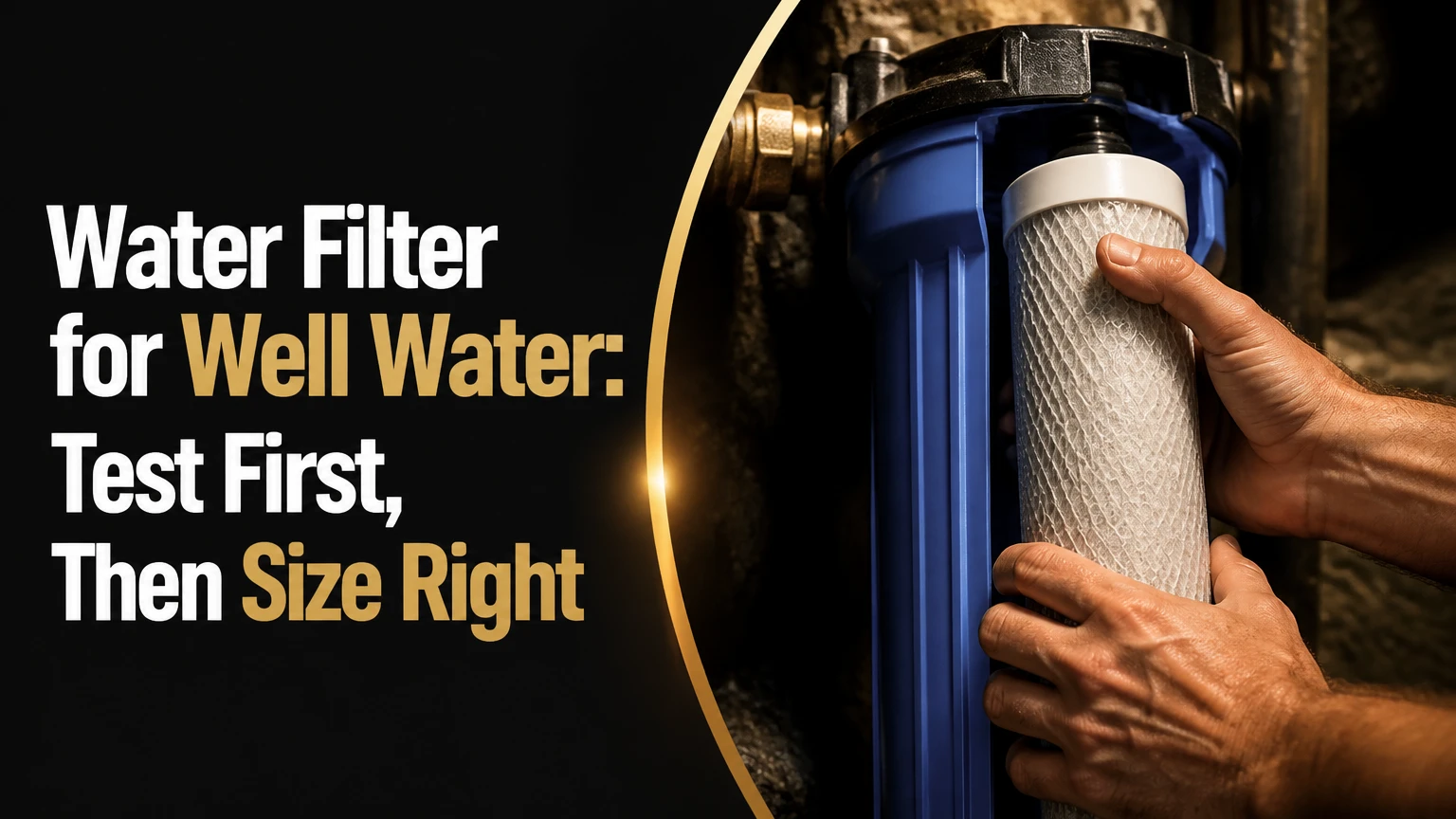
A water filter for well water must be selected from laboratory results, not taste or odor alone. The correct system may combine sediment filtration, iron or sulfur oxidation, water softening, activated carbon, ultraviolet disinfection, or reverse osmosis, because each technology targets a different contaminant and requires specific flow, pressure, and maintenance conditions.
Key Facts at a Glance
- Private well owners should test drinking water at least annually for coliform bacteria and nitrate, with additional tests based on local geology and land use.
- Sediment filters remove particles such as sand, silt, and rust, but they do not remove dissolved iron, nitrate, hardness, bacteria, or viruses.
- Water softeners remove calcium and magnesium hardness through ion exchange, but they do not disinfect water or reliably remove nitrate.
- Ultraviolet systems inactivate microorganisms only when water is clear enough and the lamp receives the manufacturer’s specified dose.
- Reverse osmosis is usually a point-of-use treatment for dissolved contaminants such as nitrate, arsenic, lead, and fluoride.
- A whole-house treatment system must meet the home’s peak flow demand without reducing pressure below the pump and fixture requirements.
Does Every Well Need a Water Filter?
Not every private well needs the same filter, but every drinking-water well needs periodic testing. A clear, odorless sample can still contain nitrate, arsenic, uranium, radon, or pathogenic organisms, so appearance is not a safety assessment.
The U.S. Environmental Protection Agency regulates public water systems, not most private wells. The Centers for Disease Control and Prevention recommends that private well owners test at least once a year for total coliform bacteria and nitrate, and test after flooding, repairs, or changes in taste, odor, or color.
A filter is justified when testing identifies a contaminant, when a treatment professional confirms a documented nuisance problem, or when a source-risk assessment indicates a need for precautionary treatment. Source correction can be better than filtration when a damaged well cap, cracked casing, poor drainage, or contaminated plumbing is allowing pollution into the water.
What should a well water test include?
A baseline test should include total coliform, E. coli, nitrate, nitrite, pH, total dissolved solids, hardness, iron, manganese, turbidity, and lead. Add arsenic, fluoride, uranium, radon, chloride, sulfate, copper, volatile organic compounds, pesticides, or PFAS when local geology, agriculture, industry, mining, or fuel storage creates a plausible exposure route.
| Test or observation | Typical concern | Treatment implication | Retest trigger |
|---|---|---|---|
| Total coliform and E. coli | Fecal or sanitary intrusion | Disinfection and source inspection | Positive result or flooding |
| Nitrate and nitrite | Septic, fertilizer, or manure contamination | Reverse osmosis or anion exchange | Annual test in agricultural areas |
| Iron and manganese | Staining, metallic taste, black deposits | Oxidation and filtration | After media replacement |
| pH and alkalinity | Corrosion or poor oxidation performance | Neutralizer or adjusted oxidant | After treatment changes |
| Hardness | Scale on heaters and fixtures | Ion-exchange softener | When scale returns |
| Arsenic, uranium, or radon | Geologic contamination | Certified contaminant-specific system | Per local health guidance |
Use a laboratory accredited by the relevant state, provincial, or national authority. A home strip can help identify a sudden change, but it is not a substitute for a preserved, properly collected laboratory sample.
How Does a Well Water Filtration System Work?
A well water filtration system works by placing treatment stages in an order that protects later equipment and matches each contaminant to a removal mechanism. A common sequence is well pump, pressure tank, sediment filter, oxidation or neutralization, softener, carbon treatment, UV disinfection, and point-of-use reverse osmosis.
The sequence is not universal. A high-iron well may need oxidation before a softener, while a low-pH well may need neutralization before iron treatment. A treatment designer should also account for backwash flow, drain capacity, electrical power, contact time, pressure loss, and the pump’s actual delivered flow.
Recommended treatment sequence
- Measure raw water. Record laboratory results, static pressure, pump cut-in and cut-out settings, and flow at a hose bib.
- Remove sediment first. Use a spin-down separator for coarse sand and a cartridge or media filter for finer particles.
- Treat pH, iron, manganese, or sulfur. Oxidation converts dissolved contaminants into particles that a media bed can capture.
- Soften hard water when needed. Place the softener after iron removal if iron would foul its resin.
- Add carbon for selected chemicals and taste compounds. Confirm the media has capacity for the named contaminant.
- Disinfect after clarification. UV belongs downstream of turbidity, iron, and manganese control.
- Use reverse osmosis at the drinking tap. Protect the membrane with sediment and carbon prefilters, then verify treated water quality.
The main practitioner rule is simple: do not ask a downstream device to perform an upstream job. UV cannot clarify muddy water, and a softener cannot make bacteriologically unsafe water potable.
Which Filter Removes Each Well Water Contaminant?
The correct well water filter depends on the contaminant’s physical form, concentration, pH, and required flow rate. Sediment, dissolved metals, hardness, microorganisms, volatile chemicals, and dissolved salts require different technologies.
| Contaminant | Common symptom or source | Effective treatment | Important limitation |
|---|---|---|---|
| Sand, silt, and rust | Cloudiness or grit | Spin-down and sediment filter | Does not remove dissolved contaminants |
| Ferrous iron | Clear water that stains after exposure | Air-injection or catalytic oxidation | Performance depends on pH and chemistry |
| Ferric iron | Orange or brown particles | Sediment or backwashing media | Cartridge loading can be rapid |
| Manganese | Black staining or metallic taste | Oxidation and specialized media | Often needs higher pH than iron |
| Hydrogen sulfide | Rotten-egg odor | Oxidation, catalytic carbon, or aeration | Severe gas may need source investigation |
| Calcium and magnesium | Scale and poor soap lather | Ion-exchange softener | Adds sodium or potassium ions |
| Bacteria and viruses | Positive coliform result | UV, chlorination, or both | Source repair remains necessary |
| Nitrate | Usually no taste or odor | Reverse osmosis or anion exchange | Carbon filters do not reliably remove it |
| Arsenic | Usually no visible symptom | Certified RO, adsorption, or exchange | Treatment depends on arsenic species |
| VOCs and pesticides | Chemical taste or nearby land use | Certified activated carbon | Media exhaustion can cause breakthrough |
What is the best filter for iron and sulfur?
An air-injection oxidation system is often suitable for dissolved iron, manganese, and hydrogen sulfide when the raw-water chemistry and pump flow meet its specifications. The system introduces air or another oxidant, converts dissolved compounds into particles, and captures those particles in a backwashing media tank.
Typical residential backwash demand is about 5-10 gallons per minute, but the exact requirement belongs to the valve and media manufacturer. A pump that supplies only 4 gallons per minute cannot reliably backwash a system labeled for 7 gallons per minute.
Air-injection systems are not universal sulfur solutions. Low pH, organic sulfur compounds, high hydrogen sulfide, or bacterial growth inside the well may require chlorination, aeration, catalytic carbon, or professional source treatment. Test pH, iron, manganese, sulfur, alkalinity, and dissolved oxygen before purchasing an iron filter.
Is a water softener a well water filter?
A water softener is a hardness-treatment device, not a general-purpose water filter. Ion-exchange resin captures calcium and magnesium and releases sodium or potassium, reducing scale formation in water heaters, boilers, fixtures, and appliances.
Softener capacity is measured in grains. A typical household estimate uses daily water consumption multiplied by hardness grains per gallon, then adds iron-equivalent loading where the manufacturer specifies it. A four-person home using 50 gallons per person daily with 20 grains per gallon has approximately 4,000 grains of daily hardness demand before design reserve.
| Treatment | Typical capacity or specification | Service interval | Main target |
|---|---|---|---|
| Sediment cartridge | 5, 20, or 50 microns | 1-6 months | Particles and rust |
| Softener resin | 32,000-64,000 grains | Regeneration every 3-14 days | Hardness minerals |
| AIO media tank | 10-15 inch residential vessels | Backwash every 1-7 days | Iron, manganese, sulfur |
| Carbon tank | 1-2 cubic feet of media | Media change about 3-5 years | VOCs, taste, odor |
| UV lamp | Manufacturer-rated dose | Lamp replacement about 12 months | Microorganisms |
| RO membrane | 50-100 gallons per day | Replacement about 2-5 years | Dissolved contaminants |
A sodium-sensitive household should discuss potassium chloride or an alternative treatment with a clinician and water professional. A softener does not remove nitrate, bacteria, arsenic, or most pesticides.
When Should You Use UV, Carbon, or Reverse Osmosis?
UV is appropriate for microbiological inactivation, activated carbon is appropriate for selected organic chemicals and taste compounds, and reverse osmosis is appropriate for many dissolved inorganic contaminants. The decision must follow the laboratory result and the treatment unit’s verified performance claim.
UV disinfection
UV light damages microbial genetic material and prevents organisms from reproducing; the process is properly described as inactivation rather than sterilization. A UV unit needs clear water, stable flow, electrical power, and a lamp dose appropriate for the target organisms.
Many residential manufacturers specify turbidity below 1 NTU and iron below approximately 0.3 milligrams per liter, although the exact pretreatment limits vary. Iron or manganese can coat the quartz sleeve, while turbidity can shield microorganisms from the light.
UV has no residual disinfectant. A contamination event downstream of the lamp can therefore reintroduce risk, and a positive coliform test still requires well and plumbing investigation.
Activated carbon
Activated carbon adsorbs many chlorine compounds, volatile organic compounds, pesticides, herbicides, and taste or odor compounds. Carbon performance depends on empty-bed contact time, flow rate, media volume, contaminant concentration, and the specific certification.
Carbon is not a dependable general solution for nitrate, hardness, bacteria, fluoride, or arsenic. A carbon tank can also become a microbial growth site if neglected, so manufacturers’ replacement and sanitation instructions matter.
Reverse osmosis
Reverse osmosis forces water through a semipermeable membrane and rejects a large proportion of dissolved salts and contaminants. Under-sink RO is usually more efficient than treating the entire house because drinking and cooking consume a small fraction of household water.
Typical residential RO systems produce 50-75 gallons per day under specified pressure and may discharge 1-4 gallons for each gallon collected, depending on design, temperature, pressure, and whether a permeate pump is installed. Systems with WaterSense or contaminant-specific NSF/ANSI certification offer stronger evidence than a generic “purification” label.
RO is not a complete whole-house solution for high sediment, bacteria, or severe iron. Those conditions can foul the membrane, reduce production, and increase maintenance.
What Size Well Water Filter Does a Home Need?
A whole-house well water filter should be sized for peak simultaneous demand, available pump flow, service-flow limits, and backwash requirements. A system that treats contaminants correctly can still fail if its valve or media bed cannot supply showers, toilets, appliances, and outdoor taps at the same time.
Measure flow at the pressure tank or a full-flow hose bib rather than relying only on the pump horsepower label. Compare that measurement with the treatment system’s service flow and required backwash flow, while preserving enough pressure for the highest fixture.
| Home condition | Typical peak demand | Sizing response | Common failure |
|---|---|---|---|
| One-bathroom cottage | 6-8 GPM | Compact media or cartridge system | Pressure loss during shower use |
| Two-bathroom home | 10-12 GPM | Larger tank and valve | Undersized service flow |
| Three-bathroom home | 12-16 GPM | High-flow valve and adequate pump | Incomplete backwash |
| Home with irrigation | 15-25 GPM | Separate irrigation line preferred | Treatment bypass or rapid exhaustion |
Micron rating also requires judgment. A 5-micron cartridge captures smaller particles than a 20-micron cartridge, but it usually clogs sooner and creates more pressure loss. Use coarse separation before fine filtration when sand or sediment is heavy.
An expert rule of thumb is to keep a pressure gauge before and after cartridge filtration. A rising differential pressure identifies loading before the entire house experiences a sudden pressure collapse.
How Much Does a Well Water Filtration System Cost?
A typical residential well water treatment installation costs approximately $300-$700 for a basic whole-house carbon unit, $500-$1,500 for UV, $900-$2,500 for a softener, $1,200-$3,500 for iron or sulfur treatment, and $250-$1,200 for under-sink reverse osmosis. Local labor, plumbing changes, electrical work, drain installation, and difficult access can substantially change the total.
These are planning ranges, not quotations. A complete multi-stage system can exceed $5,000 when it includes a neutralizer, oxidation tank, softener, carbon tank, UV, RO, new pressure controls, and laboratory verification.
| Component | Typical equipment cost | Typical installed range | Recurring cost |
|---|---|---|---|
| Sediment housing | $40-$250 | $150-$500 | $30-$180 yearly cartridges |
| Water softener | $500-$1,500 | $900-$2,500 | Salt and service |
| Iron or sulfur filter | $800-$2,500 | $1,200-$3,500 | Media and valve service |
| UV disinfection | $400-$1,200 | $700-$1,800 | Lamp and sleeve service |
| Under-sink RO | $250-$900 | $500-$1,500 | Filters and membrane |
Lifecycle cost often determines the better choice. A low-cost cartridge system may require monthly changes, while a backwashing media system may use less operator labor but require drain plumbing, electricity, and periodic media replacement.
Which Well Water Treatment Should You Choose?
The best water filter for well water is the smallest verified treatment train that addresses every confirmed health contaminant and nuisance contaminant without exceeding available flow. A typical decision should be mapped to the test result, not to a symptom-based package.
| Water profile | Recommended configuration | Drinking-water addition | Main caution |
|---|---|---|---|
| Sand and rust only | Spin-down separator plus sediment cartridge | Optional carbon | Monitor cartridge pressure |
| Iron, manganese, and sulfur | Sediment plus oxidation media | Carbon polishing if needed | Confirm pH and backwash flow |
| Hardness and scale | Sediment plus demand-initiated softener | RO if dissolved contaminants exist | Size by grains and occupants |
| Bacteria or coliform | Sediment plus UV or chlorination | RO does not replace disinfection | Repair contamination source |
| Nitrate or arsenic | Pretreatment plus certified RO or adsorption | Dedicated treated tap | Verify treated-water result |
| Pesticides or VOCs | Certified carbon with adequate contact time | RO where certified | Replace media before breakthrough |
For homes with iron staining
Choose oxidation media when laboratory iron exceeds the acceptable household threshold or staining returns after basic filtration. Avoid installing a softener first if iron is high enough to foul resin, and verify the system can backwash with the well pump’s delivered flow.
For homes with bacteria
Choose source inspection and disinfection together. UV can provide continuous treatment, but it cannot correct a cracked well casing, failed sanitary seal, or contaminated pressure tank.
For homes with nitrate or arsenic
Choose a contaminant-certified point-of-use system when only drinking and cooking water require treatment. Confirm the laboratory result after installation because membrane rejection and adsorption capacity vary with pH, competing ions, pressure, and maintenance.
What Are the Most Common Installation Mistakes?
The most common well water filtration mistakes are skipping laboratory testing, placing treatment stages in the wrong order, undersizing flow, and ignoring maintenance. Each error can reduce water quality even when the equipment itself is functional.
- Buying from taste alone. Nitrate and arsenic usually have no reliable taste or odor signal.
- Installing UV before clarification. Turbidity, iron, and manganese can shield organisms or block lamp output.
- Putting a softener before iron oxidation. Dissolved iron can foul resin and increase regeneration demand.
- Using a fine cartridge without a pressure gauge. A clogged cartridge can damage a pump or cause inadequate household flow.
- Forgetting the drain line. Backwashing equipment needs an unrestricted drain with an air gap where local plumbing rules require one.
- Trusting an unverified claim. Look for NSF/ANSI 42, 44, 53, 55, 58, or 61 certification that matches the actual contaminant and performance claim.
A treatment system also needs a bypass valve, sampling taps before and after treatment, and an accessible location for cartridges, lamps, salt, and control valves. Those details make verification and maintenance practical.
How Do You Troubleshoot a Well Water Filter?
Troubleshooting begins with a new water test, pressure readings, and a review of recent maintenance rather than immediate replacement of the entire system. Symptoms often identify a blocked prefilter, exhausted media, poor regeneration, microbial intrusion, or a pump-flow problem.
| Symptom | Likely cause | First check | Corrective action |
|---|---|---|---|
| Sudden low pressure | Loaded sediment cartridge | Differential pressure gauge | Replace cartridge and inspect source |
| Orange staining returns | Exhausted or bypassed iron media | Raw and treated iron tests | Service valve and regenerate media |
| Rotten-egg odor returns | Sulfur breakthrough or poor oxidation | pH, sulfur, backwash schedule | Adjust cycle or redesign treatment |
| Scale remains | Softener salt, resin, or sizing problem | Hardness before and after | Check brine system and capacity |
| UV alarm activates | Lamp failure or sleeve fouling | Lamp age and sleeve condition | Replace lamp, clean sleeve safely |
| Positive coliform result | Source or plumbing contamination | Repeat certified test | Stop drinking use and investigate |
Do not handle a UV lamp while the unit is energized. Follow the manufacturer’s electrical isolation procedure, and do not use an acid cleaner unless the manual permits it and the sleeve material is compatible.
A returning odor can also come from a drain, water heater, sulfur bacteria, or plumbing biofilm rather than the well. Diagnose the raw well sample, treated sample, and hot and cold household taps separately.
How Often Should Well Water Filters Be Maintained?
Well water filter maintenance ranges from monthly cartridge inspection to annual UV lamp replacement and multi-year media service. The correct interval depends on water volume, contaminant loading, backwash performance, and manufacturer instructions.
| Equipment | Inspection interval | Typical replacement or service | Verification |
|---|---|---|---|
| Sediment cartridge | Weekly pressure check | 1-6 months | Pressure and visual inspection |
| Softener | Monthly salt and brine check | Resin often 7-15 years | Hardness test |
| Oxidation media | Monthly cycle review | Media often 5-10 years | Iron and sulfur test |
| Carbon media | Quarterly flow check | Often 3-5 years | Target contaminant test |
| UV system | Monthly alarm check | Lamp about 12 months | Dose or alarm status |
| RO system | Monthly leak check | Prefilters 6-12 months | TDS and contaminant test |
Retest after replacing media, changing well equipment, flooding, drilling nearby, or observing a persistent change in water quality. A filter is part of a water safety system, not proof that the source remains safe indefinitely.
FAQ
Can a sediment filter make well water safe to drink?
A sediment filter cannot make well water safe by itself. Sediment cartridges remove suspended particles, but they do not reliably remove dissolved nitrate, arsenic, hardness, VOCs, bacteria, viruses, or protozoa. Safe drinking water requires laboratory testing and treatment matched to the detected contaminants.
Is bottled water better than filtering a private well?
Bottled water avoids exposure to untreated well water at the drinking tap, but it does not solve household bathing, cooking, or plumbing concerns. A certified point-of-use treatment system can provide a lower-waste long-term option when the well owner verifies performance, replaces components, and retests treated water.
Can one whole-house filter remove iron, hardness, and bacteria?
One whole-house filter rarely removes iron, hardness, and bacteria reliably because the contaminants require different mechanisms. A typical system may use oxidation for iron, ion exchange for hardness, and UV or chlorination for microorganisms, with sediment pretreatment protecting each downstream stage.
Does boiling well water remove nitrate?
Boiling does not remove nitrate and can increase its concentration as water evaporates. Boiling can inactivate many microorganisms, but it does not address arsenic, lead, nitrate, hardness, or most dissolved chemicals. A nitrate-positive well needs certified treatment or an alternative drinking-water source.
Should a well water filter be installed before or after the pressure tank?
The treatment layout depends on the equipment, but many residential systems place the main treatment after the pressure tank so the pump and pressure tank operate normally. A sediment separator may be installed earlier when sand threatens the pump or pressure controls, while final treatment must preserve required household pressure and flow.
The Bottom Line
A water filter for well water should begin with an accredited laboratory test, a measured pump flow rate, and an assessment of the well’s construction and surroundings. Sediment filters handle particles, oxidation media handle iron and sulfur, softeners handle hardness, carbon handles selected organic chemicals, UV handles microorganisms, and reverse osmosis handles many dissolved contaminants. Choose a verified treatment train, install it in the correct sequence, and retest the treated water after commissioning.