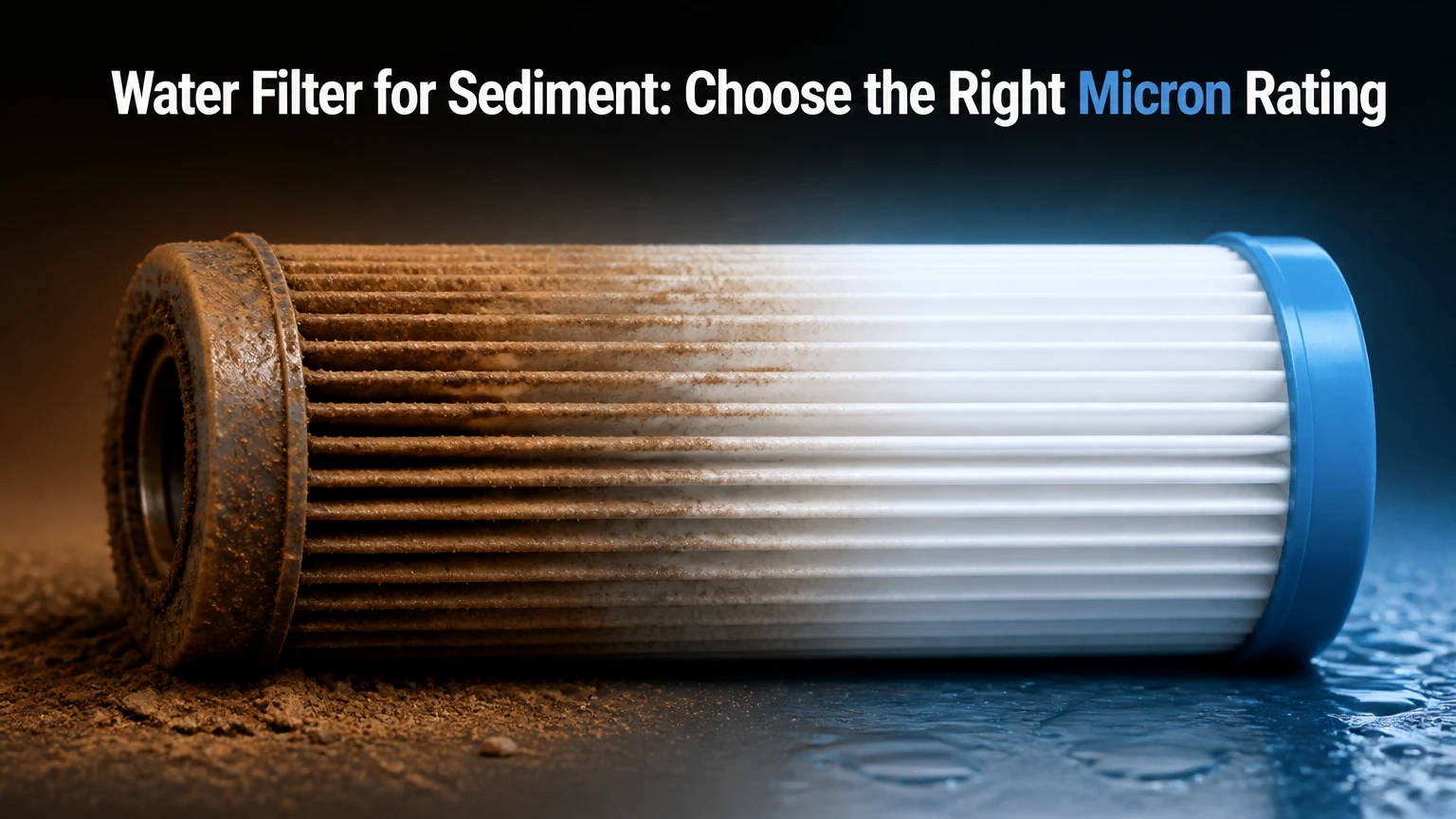
A water filter for sediment mechanically removes suspended particles such as sand, silt, clay, rust flakes, pipe scale, and organic debris. The correct choice depends on particle size, water source, peak flow, and pressure tolerance: coarse spin-down screens suit heavy grit, while pleated or depth cartridges capture finer material and protect downstream treatment equipment.
Key Facts at a Glance
Sediment filters remove suspended solids, not dissolved chemicals or microorganisms.
A 100-micron prefilter can protect finer cartridges from rapid blockage in sandy well water.
Nominal micron ratings describe approximate reduction, while absolute ratings indicate a tighter particle-retention threshold.
Spin-down filters are washable and practical for coarse debris, but they usually do not polish fine clay.
A clogged cartridge causes pressure loss because trapped particles increase resistance to water flow.
Sediment filtration should normally precede carbon, water softeners, ultraviolet systems, and reverse osmosis membranes.
What Is a Water Filter for Sediment?
A water filter for sediment is a physical barrier that separates suspended solids from flowing water. Typical targets include sand grains, silt, clay, rust, pipe scale, flakes from a water heater, and pieces of organic debris that remain insoluble.
Sediment filtration addresses appearance, plumbing protection, and equipment reliability. A cartridge can prevent abrasive grit from reaching faucet aerators, toilet fill valves, washing-machine solenoids, water softener control heads, carbon blocks, and reverse osmosis membranes. It does not make contaminated water microbiologically safe.
The word sediment covers particles with very different behavior. Coarse sand settles quickly, fine clay can remain suspended for hours, and rust may arrive as flakes or colloidal particles. A filter selected for one form may perform poorly against another, so a water sample and a pressure reading are more useful than color alone.
What Does Sediment Filtration Not Remove?
Sediment filtration does not reliably remove dissolved iron, manganese, lead, nitrate, fluoride, pesticides, chlorine, bacteria, viruses, or dissolved salts. Activated carbon, ion exchange, oxidation, ultraviolet treatment, reverse osmosis, or disinfection may be needed for those contaminants.
The U.S. Environmental Protection Agency distinguishes particulate material from contaminants dissolved in water, and NSF explains that certification applies to specific contaminant claims rather than to a filter category in general. A sediment cartridge therefore should not be marketed as a complete drinking-water purifier.
How Does a Sediment Filter Work?
A sediment filter separates particles through mechanical interception as water passes through a screen or porous media. Large particles remain on the surface, while smaller particles can become lodged within a depth medium whose fibers form a winding path.
The basic sequence is straightforward:
- Pressurized water enters the filter housing.
- A flow path spreads water across the screen or cartridge.
- Particles encounter openings, fibers, or mesh.
- Particles larger than the effective passage are retained.
- Filtered water exits through the outlet port.
Water molecules are not individually “strained” according to a simple micron sieve model. A micron rating describes particle-retention performance under defined test conditions, and actual removal varies with particle shape, concentration, flow, pressure, and the manufacturer’s test method.
Surface, Depth, and Spin-Down Filtration
Surface filtration catches much of the contaminant on the outer face of a medium. Pleated polyester cartridges use this approach, which gives them substantial dirt-holding area and often allows cleaning.
Depth filtration captures particles throughout the thickness of a fibrous matrix. Melt-blown polypropylene and string-wound cartridges can hold different particle sizes at different depths, but the cartridge becomes harder to clean as its internal passages fill.
Spin-down filtration uses a screen and a flow pattern that directs heavier particles toward a collection bowl. The term “centrifugal” is often used broadly, but screen geometry, gravity, turbulence, and flow velocity all contribute. A spin-down filter is not a substitute for a fine cartridge when the problem is clay or fine silt.
Which Types of Sediment Filters Are Available?
The main options are spin-down screens, pleated cartridges, melt-blown depth cartridges, and string-wound depth cartridges. Each option trades particle capacity, fineness, flow resistance, cleaning ability, and purchase cost differently.
| Filter type | Typical rating | Cleaning method | Best application |
|---|---|---|---|
| Spin-down screen | 50-500 microns | Purge valve or manual disassembly | Coarse sand, grit, shale |
| Pleated polyester | 5-100 microns | Rinse, then replace when damaged | Silt, rust flakes, high flow |
| Melt-blown polypropylene | 1-50 microns | Disposable replacement | Fine silt, clay, muddy water |
| String-wound polypropylene | 5-100 microns | Disposable replacement | Variable particles, moderate flow |
| Disc or screen module | 50-200 microns | Manual flushing | Irrigation and heavy solids |
Spin-Down Screens
Spin-down filters use a reusable stainless-steel or polymer screen inside a housing with a sediment collection area. Many models include a bottom valve that allows a short flush without removing the screen.
A 100-micron screen can protect a finer cartridge from large sand in a private well. A 20-micron screen may capture smaller grit but can require more frequent flushing. Screen ratings and recommended flow rates differ, so the product data sheet controls the final choice.
Spin-down units are strongest when the water contains visible, heavy particles. They are weaker against fine clay, rust haze, and particles that remain suspended in water. Clear bowls make loading visible, but ultraviolet exposure can degrade some plastics.
Pleated Cartridges
Pleated cartridges fold a sheet of polyester or polypropylene into an accordion shape. The folds provide more surface area than a flat sheet, which can support higher flow and longer service under a similar footprint.
Pleated media can be rinsed when the manufacturer permits it. Rinsing from the clean side toward the dirty side is usually more effective, although the cartridge should be replaced if the pleats deform, split, develop odor, or remain restricted after cleaning. “Washable” does not mean indefinitely reusable.
Melt-Blown and String-Wound Cartridges
Melt-blown polypropylene cartridges use thermally bonded fibers with a density that commonly increases toward the center. String-wound cartridges use fibers wrapped around a core, creating a depth path for particles.
Depth cartridges are inexpensive and effective against fine suspended solids. Their limitation is capacity: a high sediment load can block the outer layer quickly, even when the cartridge has a fine nominal rating. These cartridges should be treated as consumables, not cleaned and returned to service.
What Micron Rating Should You Choose?
The best micron rating is the coarsest filter that removes the target particles while preserving required flow and pressure. A practical starting point is 100 microns for heavy grit, 20-50 microns for ordinary well sediment, and 5-10 microns for final particulate protection.
| Water symptom or particle | Starting rating | Typical next step | Caution |
|---|---|---|---|
| Visible sand at faucets | 100-200 microns | Add 20-50 microns downstream | Fine cartridges may clog quickly |
| Fine tan or red silt | 20-50 microns | Test a 5-10 micron stage | Check iron chemistry separately |
| Cloudy clay after pumping | 5-20 microns | Add settling or larger prefilter | Very high loading needs pretreatment |
| Rust flakes from city pipes | 20-50 microns | Use 5-10 microns for polishing | Investigate galvanized plumbing |
| Black particles | 20-50 microns | Identify source before filtering | May be carbon, rubber, or scale |
| Irrigation grit | 100-200 microns | Use a flushable screen | Drinking-water needs differ |
A smaller micron number is not automatically better. A 1-micron cartridge placed directly after a sandy well can plug within days, create a large pressure differential, and cause a pump to cycle abnormally. Start with coarse separation, then step down only when the water remains visibly dirty or testing shows a need.
Nominal Versus Absolute Ratings
Nominal ratings estimate the percentage of particles removed at or above a stated size. Absolute ratings indicate a much tighter maximum-particle passage under a defined test, but the term is not perfectly standardized across every manufacturer.
For purchasing, compare the test method, rated flow, pressure drop, and capacity rather than comparing the micron number alone. A nominal 5-micron cartridge from one brand may not perform like an absolute 5-micron cartridge from another.
Which Sediment Filter Is Best for Well or City Water?
Private wells with coarse sand usually benefit from a flushable prefilter followed by a cartridge. Municipal water commonly needs one high-capacity cartridge to catch rust and scale, provided the incoming pressure and sediment load are moderate.
| Situation | Recommended first stage | Optional second stage | Main reason |
|---|---|---|---|
| Sandy private well | 100-200 micron spin-down | 20-50 micron pleated | Protects fine media from grit |
| Fine clay well | 50-100 micron screen | 5-20 micron depth cartridge | Reduces rapid cartridge loading |
| City water with rust flakes | 20-50 micron pleated | 5-10 micron depth cartridge | Protects carbon and fixtures |
| Low-pressure home | Oversized 100-200 micron screen | High-area 20-50 micron pleated | Limits pressure loss |
| Irrigation line | 100-200 micron flushable screen | 50-100 micron disc filter | Handles high solids economically |
| Reverse osmosis feed | 5-20 micron cartridge | Carbon and membrane stages | Protects the membrane from particles |
For a well, install the coarse filter where it can be isolated and serviced without starving the pump. In many systems, the pressure tank and well equipment arrangement determines the safest location, so follow the pump manufacturer’s requirements and local plumbing rules.
For city water, a point-of-entry housing after the main shutoff can protect every fixture. A 10-inch by 4.5-inch Big Blue housing provides more media area than a standard 10-inch housing and usually produces less pressure loss at comparable flow, although cartridge capacity still depends on sediment concentration.
How Do Flow Rate and Housing Size Affect Performance?
Flow rate determines contact time, pressure loss, and the amount of water a cartridge can process before replacement. A small 10-inch housing may suit one faucet or a low-demand apartment, while a 20-inch Big Blue housing is more appropriate for several simultaneous fixtures.
| Housing or filter format | Typical usable flow | Common application | Typical cartridge cost |
|---|---|---|---|
| 10-inch standard, 2.5-inch diameter | 3-8 gallons per minute | One to two fixtures | $5-$20 |
| 10-inch Big Blue, 4.5-inch diameter | 8-15 gallons per minute | Small whole-house system | $12-$35 |
| 20-inch Big Blue, 4.5-inch diameter | 12-25 gallons per minute | Larger home or high demand | $20-$60 |
| 100-micron spin-down | 10-30 gallons per minute | Well prefiltration | $50-$250 |
| Commercial cartridge vessel | 25-100 gallons per minute | Multi-unit or light commercial use | $100-$600 |
These are typical planning ranges, not universal specifications. A cartridge’s published flow may assume a particular pressure drop, and a home’s peak demand can exceed its average demand when showers, toilets, and appliances run together.
A useful sizing check is to compare the manufacturer’s rated flow at a stated pressure drop with the home’s estimated peak demand. Oversizing often costs less than repeated cartridge changes and gives the filter more dirt-holding capacity.
How Much Does Sediment Filtration Cost?
A basic cartridge housing costs about $30-$150, a whole-house Big Blue assembly commonly costs $100-$400, and a well-water system with a flushable prefilter and staged cartridges often reaches $250-$900 before professional labor.
| System configuration | Equipment range | Replacement range | Typical service interval |
|---|---|---|---|
| Under-sink sediment stage | $30-$120 | $5-$25 | 3-12 months |
| Standard whole-house housing | $50-$180 | $8-$30 | 1-6 months |
| Big Blue single stage | $120-$400 | $15-$60 | 2-12 months |
| Spin-down plus cartridge | $180-$600 | $10-$60 | Flush weekly to monthly |
| Three-stage well setup | $300-$900 | $30-$120 | 1-6 months |
Regional prices vary considerably. The Bangladesh figures in the supplied overview should not be treated as universal because housing costs, cartridge standards, labor, and currency differ by market.
Replacement timing should follow pressure loss and water quality, not a calendar alone. A cartridge may last twelve months in a low-sediment city system and only two weeks after well construction, flooding, pipe work, or pump disturbance.
How Should You Install a Whole-House Sediment Filter?
Install a whole-house sediment filter after the main shutoff and before downstream treatment, with an isolation valve on each side, a pressure-relief point, and enough clearance to remove the bowl or cartridge.
Installation sequence
- Confirm flow direction. Match the housing arrow to the actual water flow, because reverse installation can bypass the intended support structure or damage a cartridge.
- Shut off and depressurize. Close the main valve and open a nearby faucet until the gauge reaches zero.
- Mount the housing. Secure the bracket to structural material, not unsupported pipe, and leave clearance below the sump.
- Add isolation and bypass valves. Use shutoff valves before and after the filter; a three-valve bypass allows service without shutting down the entire property.
- Install the cartridge. Center the cartridge on the locating post and verify that the gasket seats correctly.
- Inspect and lubricate the O-ring. Clean the groove and apply a thin layer of food-grade silicone grease, not petroleum grease.
- Open water slowly. Use the pressure-relief button if supplied, then inspect the cap and connections for leaks.
- Flush the cartridge. Run water to waste until carbon-colored dust or manufacturing debris disappears, if the cartridge instructions require flushing.
You will know the installation works when the housing remains dry, the gauge shows stable pressure, and the outlet runs clear without an unusual flow restriction. The most common installation error is leaving no safe space to remove the sump, which turns routine maintenance into a plumbing disassembly.
How Can You Monitor and Maintain the Filter?
Monitor the pressure difference between the inlet and outlet, because pressure loss provides a more reliable replacement signal than cartridge color. Replace or clean the filter when the differential approaches the manufacturer’s limit or when fixtures lose unacceptable flow.
| Maintenance task | Frequency | Tools or material | Completion check |
|---|---|---|---|
| Flush spin-down screen | Weekly to monthly | Bucket, hose, purge valve | Bowl clears and flow improves |
| Inspect cartridge color | Weekly at first | Flashlight | Loading pattern is recorded |
| Check pressure gauges | Every service visit | Two gauges | Differential remains below limit |
| Clean sump and threads | At cartridge change | Clean cloth, mild soap | No grit remains on seal |
| Lubricate O-ring | At each opening | Silicone grease | Seal sits flat without pinching |
| Replace pleated media | After damage or poor recovery | Correct cartridge | Flow returns after installation |
| Replace depth media | When pressure drops or capacity ends | New cartridge | No bypass or collapse is visible |
The strongest practitioner rule is to record the installation date, inlet pressure, outlet pressure, and cartridge type. That four-point log reveals whether the problem is excessive sediment, an undersized housing, low source pressure, or a defective cartridge.
What Problems Occur With Sediment Filters?
The most common problems are rapid clogging, pressure loss, leaks, cartridge collapse, and persistent cloudy water. Each symptom points to a different failure, so replacing the cartridge alone may not solve the cause.
| Symptom | Likely cause | Corrective action | Escalation point |
|---|---|---|---|
| Low pressure throughout home | Clogged cartridge or undersized housing | Clean or replace; increase area | Check pump and regulator |
| Filter clogs within days | Extreme sediment or too-fine rating | Add 100-200 micron prefilter | Test well and inspect casing |
| Leak at housing cap | Dirty, dry, or pinched O-ring | Depressurize, clean, grease, reseat | Replace damaged seal |
| Cartridge collapses | Excessive differential pressure | Replace immediately; add gauge | Verify pressure below housing limit |
| Water remains cloudy | Clay, air, or dissolved chemistry | Test sample; add appropriate treatment | Use settling or specialist design |
| Filter bowl turns opaque | UV exposure or plastic aging | Replace bowl or shield it | Use UV-rated housing |
| Black flakes continue | Degraded rubber, carbon, or pipe scale | Identify source before selecting media | Inspect hoses and plumbing |
A cartridge that collapses should not be reused. Excessive pressure differential can deform the media and may allow channeling, where water finds a low-resistance path around much of the filter.
If household pressure exceeds the housing’s rated maximum, install appropriate pressure control and follow local code. The 80 psi figure commonly used in residential plumbing is a practical warning threshold, not permission to ignore the housing manufacturer’s lower limit.
Can Sediment Filters Remove Iron or Bacteria?
Sediment filters can remove some particulate iron and attached organic debris, but they do not reliably remove dissolved iron, bacteria, viruses, or other dissolved contaminants. A laboratory water test is necessary when water has metallic taste, staining, odor, or microbiological risk.
| Contaminant form | Sediment filter result | More suitable treatment |
|---|---|---|
| Sand particles | Usually effective | Spin-down or cartridge |
| Rust flakes | Usually effective | Pleated or depth cartridge |
| Dissolved ferrous iron | Ineffective | Oxidation, filtration, or ion exchange |
| Ferric particulate iron | Sometimes effective | Oxidation plus media filtration |
| Bacteria | Not a disinfection method | UV, chemical disinfection, or verified treatment |
| Lead dissolved in water | Ineffective | Certified adsorption or reverse osmosis |
| Chlorine taste | Ineffective | Activated carbon |
| Hardness minerals | Ineffective | Water softener or membrane system |
The National Sanitation Foundation advises consumers to match a product’s certification to the specific contaminant claim. A sediment cartridge may protect a certified carbon or membrane system, but the sediment cartridge itself does not inherit that system’s contaminant-removal capability.
Which Alternatives Should You Consider?
Choose an alternative or additional treatment when the problem is dissolved, biological, or chemical rather than particulate. Sediment filtration remains useful as a protective first stage even when carbon, softening, ultraviolet, or reverse osmosis follows it.
| Water problem | Primary treatment | Role of sediment filtration |
|---|---|---|
| Sand and visible grit | Screen or cartridge filtration | Main treatment |
| Chlorine and odor | Activated carbon | Protects carbon from solids |
| Hard water | Ion-exchange softener | Protects control valve |
| Dissolved salts | Reverse osmosis | Protects membrane |
| Bacterial contamination | UV or disinfection | Removes particles before UV |
| Iron staining | Oxidation and dedicated media | Removes precipitated solids |
| Turbidity from clay | Settling plus depth filtration | Captures remaining particles |
A sediment filter is often the least expensive protective stage, but it cannot compensate for an unsuitable treatment train. For example, ultraviolet disinfection requires clear water because suspended particles can shield microorganisms from ultraviolet energy.
FAQ
Is a 5-micron filter better than a 20-micron filter?
A 5-micron filter captures smaller particles, but a 20-micron filter generally offers greater flow and longer life under the same sediment load. Use 5 microns for final particulate polishing when the water has already passed through a coarser stage, not automatically as the first filter on a sandy well.
How often should a sediment filter be replaced?
A cartridge may last two weeks to twelve months, depending on sediment concentration, household demand, cartridge area, and micron rating. Replace it when pressure drops, flow becomes unacceptable, or the cartridge reaches the manufacturer’s capacity, even if the calendar interval has not arrived.
Can I use a washable sediment filter for drinking water?
A washable screen or pleated cartridge can reduce suspended particles, but cleaning does not disinfect the media or guarantee drinking-water safety. Use a product rated for the application, sanitize serviceable components as directed, and add certified treatment when testing identifies pathogens or dissolved contaminants.
Should a sediment filter go before a water softener?
A sediment filter should normally go before a water softener because sand and rust can foul the softener control valve and resin bed. Very heavy well sediment may require a flushable screen first, followed by a finer cartridge before the softener inlet.
Why does my new cartridge turn brown quickly?
A brown cartridge usually indicates rust, iron-bearing particles, sediment released by plumbing, or a recent disturbance in the source. Test the water and inspect the particle texture before selecting a finer filter, because a smaller rating may clog quickly without addressing the source.
What is the best filter for low water pressure?
A large-area pleated cartridge or oversized spin-down screen usually creates less pressure loss than a small fine-depth cartridge. Select a housing rated above the home’s peak flow, measure pressure before and after the filter, and avoid a 1-micron first stage unless testing justifies it.
The Bottom Line
A water filter for sediment should be selected by particle type, micron performance, peak flow, pressure, and maintenance capacity. Use a flushable 100-200 micron screen for heavy well grit, a pleated or depth cartridge for finer silt and rust, and staged filtration when the source carries mixed particle sizes. Sediment filtration protects plumbing and downstream equipment, but laboratory testing and specialized treatment remain necessary for dissolved chemicals, metals, and microorganisms.