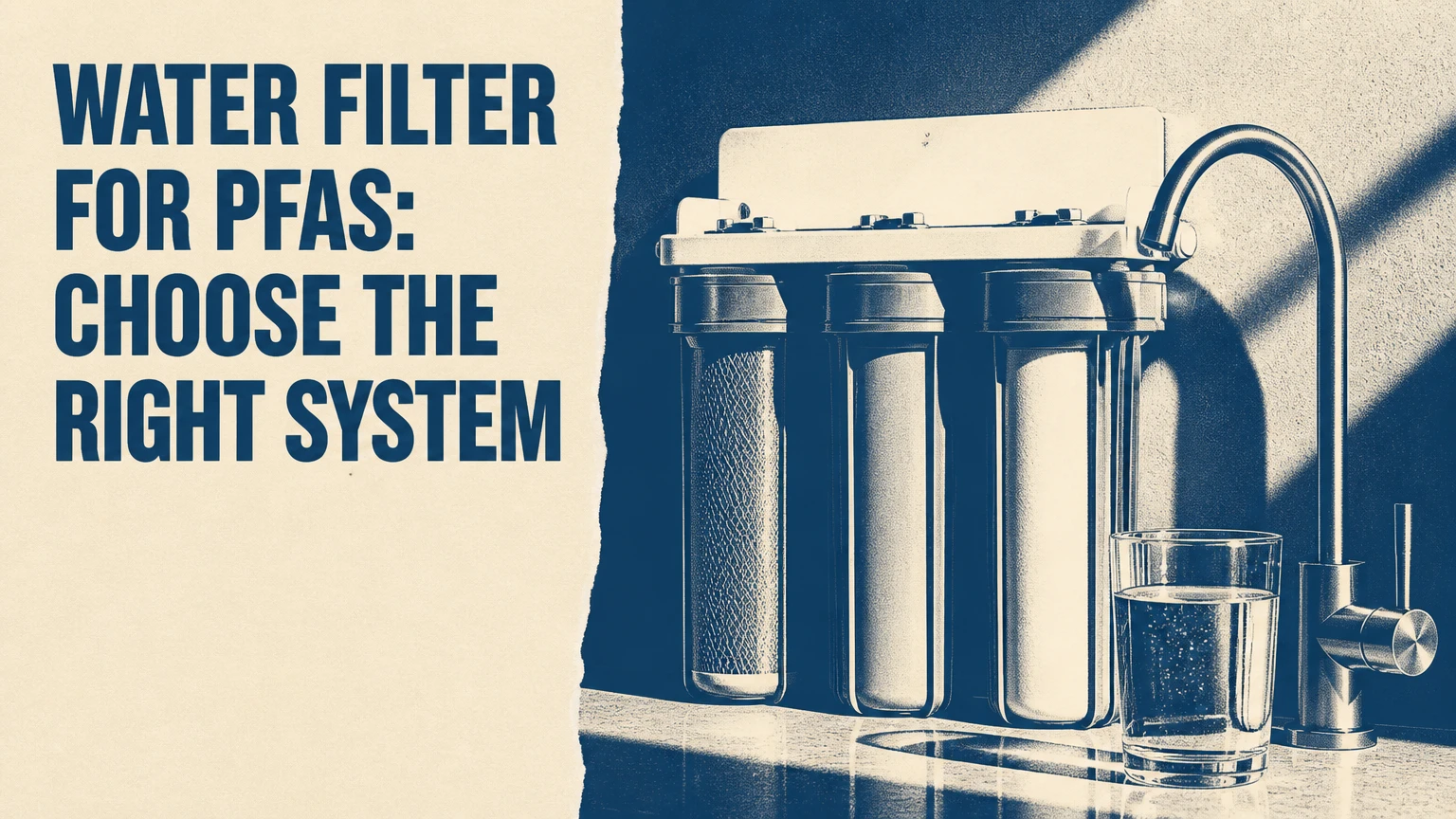
A water filter for PFAS should use certified reverse osmosis, activated carbon, or anion-exchange treatment with a documented reduction claim for the specific PFAS in your water. Reverse osmosis usually provides the strongest point-of-use barrier, while carbon can cost less and ion exchange can protect a whole home when professionally sized and maintained.
Key Facts at a Glance
- NSF/ANSI 53 and NSF/ANSI 58 do not automatically certify every filter for PFAS; the specific model and contaminant-reduction claim must be verified.
- Reverse osmosis is generally the most practical choice for drinking and cooking water because it addresses multiple PFAS types at the point of use.
- Activated carbon performance depends on carbon type, bed volume, flow rate, contact time, competing contaminants, and cartridge replacement.
- Anion exchange can support whole-house treatment, but resin capacity, pretreatment, and spent-media disposal determine real-world performance.
- Boiling, ultraviolet light, sediment filters, water softeners, and ordinary taste-and-odor cartridges do not reliably remove dissolved PFAS.
- A total-dissolved-solids meter cannot detect PFAS, because PFAS concentration and TDS are different measurements.
What Are PFAS, and Why Does Filtration Matter?
PFAS, or per- and polyfluoroalkyl substances, are a large family of manufactured chemicals used in applications such as stain resistance, nonstick materials, water resistance, and some firefighting foams. The carbon-fluorine bond makes many PFAS persistent, so ordinary municipal treatment, household storage, and natural breakdown cannot be assumed to eliminate them.
The term “PFAS” covers chemicals with different chain lengths, functional groups, and treatment behavior. PFOA and PFOS are two widely studied long-chain compounds, while compounds such as PFBS and PFHxS can behave differently during adsorption and ion exchange. A filter that reduces one named compound is not automatically proven for every PFAS.
The U.S. Environmental Protection Agency finalized national drinking-water limits in 2024 for PFOA and PFOS at 4.0 parts per trillion, with a hazard-index approach for certain mixtures. Federal requirements, implementation schedules, and state rules can change, so households should compare a utility report or laboratory result with current EPA and state guidance rather than treating a filter label as a health-risk assessment.
What Does a PFAS Filter Actually Remove?
A PFAS treatment system transfers or separates PFAS from the water; it does not destroy the chemicals in a typical household installation. Carbon and ion-exchange media retain PFAS until the media is replaced, while reverse osmosis sends a concentrated portion to a reject stream.
That distinction affects disposal. A spent cartridge can contain concentrated contaminants, and a reverse-osmosis drain can carry PFAS into wastewater treatment or a septic system. Ask the manufacturer how it manages spent media and follow local disposal instructions. “Zero PFAS” is not a meaningful claim without an influent concentration, test method, detection limit, and certified reduction result.
Which PFAS Treatment Technology Should You Choose?
For most households concerned about drinking water, choose a certified under-sink reverse-osmosis system when the purchase and wastewater requirements are acceptable. Choose carbon when a specific model has an appropriate PFAS claim and the household can follow capacity-based replacement intervals; choose anion exchange for whole-house treatment after a professional water analysis.
| Technology | Typical installation | Main PFAS strength | Main limitation | Typical initial cost |
|---|---|---|---|---|
| Reverse osmosis | Under-sink or countertop | Broad point-of-use reduction | Reject water and slower production | $150-$600 |
| Carbon block or GAC | Pitcher, under-sink, or tank | Lower cost and simple operation | Capacity varies sharply by PFAS and water chemistry | $50-$2,000 |
| Anion exchange | Whole-house tank or paired vessels | High capacity when correctly sized | Resin fouling and spent-media handling | $1,500-$4,000 |
| Combined treatment | Well or high-risk supply | Redundant protection and pretreatment | Higher cost and more maintenance | $2,000-$6,000+ |
Removal percentages are not universal technology constants. A 99% result from a laboratory challenge test may not represent the same percentage after months of household use, particularly when water contains natural organic matter, high sulfate, iron, manganese, or other substances that compete for treatment sites.
How Does Reverse Osmosis Remove PFAS?
Reverse osmosis removes PFAS by forcing pressurized water through a dense semipermeable membrane while retaining a concentrated reject stream. The membrane is not a simple sieve with one universal pore diameter; dissolved-solute rejection also depends on membrane structure, charge, diffusion, pressure, recovery, and feed-water chemistry.
A typical residential RO sequence includes sediment filtration, chlorine protection through carbon, the RO membrane, and a post-filter. Some systems add remineralization, which changes taste but does not improve PFAS removal unless the system separately documents that claim.
| RO specification | Typical residential range | Why it matters |
|---|---|---|
| Feed pressure | 40-80 psi | Low pressure reduces production and rejection |
| Clean-water production | 20-100 gallons per day | Actual output falls with cold water and low pressure |
| Reject-water ratio | 1:1 to 4:1 | Product design and pressure determine water use |
| Membrane replacement | 2-5 years | Chlorine, fouling, and maintenance affect life |
| Sediment cartridge | 6-12 months | Protects flow and downstream components |
| Carbon cartridge | 6-12 months | Protects the membrane and controls contaminant load |
Reverse osmosis is especially useful when the household needs a defined drinking-water outlet rather than treatment at every fixture. Its weaknesses are measurable: it needs space, a drain connection, replacement filters, and a tank or pump strategy. Well water may require iron, hardness, or microbial control before the membrane.
How Do Carbon Filters Remove PFAS?
Activated carbon removes PFAS through adsorption onto a high-surface-area material. Carbon performance improves when the bed provides adequate empty-bed contact time and when the water contains fewer competing organic compounds, but short-chain PFAS often break through sooner than long-chain compounds.
Carbon blocks and granular activated carbon are not interchangeable. A compressed block can reduce channeling and provide a controlled flow path, while a loose GAC cartridge may have less contact time at the same household flow. Neither format earns a PFAS claim merely because it contains “premium coconut carbon.”
Carbon breakthrough is usually gradual, not a guaranteed single release of the entire stored PFAS load. When a cartridge exceeds its tested capacity, effluent concentration can rise and may approach influent concentration. Replacing a cartridge by calendar date alone is less precise than following the manufacturer’s gallon capacity, flow limit, and source-water assumptions.
When Does Anion Exchange Make Sense?
Anion exchange is most appropriate when a household needs high-flow or whole-house PFAS treatment and can support correct sizing, pretreatment, monitoring, and media replacement. Positively charged resin exchanges native anions for negatively charged PFAS, but resin selectivity and capacity vary with PFAS structure and water chemistry.
Anion exchange does not automatically provide maintenance-free treatment. Sulfate, nitrate, natural organic matter, iron, and other anions can consume capacity or foul the bed. Some systems use single-use resin, while others use specialized service arrangements; homeowners should not assume that a conventional water softener resin or home salt regeneration cycle will remove PFAS.
How to Verify a PFAS Filter Claim
Verify the exact model, standard, contaminant, reduction level, capacity, and test conditions before purchasing a PFAS filter. A statement such as “tested to reduce contaminants” is weaker than an independently certified product listing that identifies PFOA, PFOS, or another named PFAS reduction claim.
NSF/ANSI 53 commonly covers drinking-water treatment units for health effects, and NSF/ANSI 58 covers reverse-osmosis systems. The standard number alone is insufficient because a product can be certified for lead, cysts, or another contaminant without being certified for PFAS.
Use this checklist:
- Find the manufacturer’s performance data sheet, not only the product page.
- Confirm the model number matches the certified listing.
- Look for the specific PFAS reduction claim, such as PFOA and PFOS.
- Check rated capacity in gallons and the maximum tested flow rate.
- Confirm whether the claim applies to a pitcher, cartridge, complete system, or membrane only.
- Check replacement-part model numbers and stated service intervals.
- Ask for test influent concentration, effluent result, and detection limit when the claim is not independently certified.
The EPA’s consumer guidance on identifying filters certified to reduce PFAS recommends checking for certification by organizations such as NSF, IAPMO, or WQA. Certification is a strong screening tool, not permission to ignore replacement dates or use a filter outside its rated conditions.
What Does a PFAS System Cost?
A point-of-use PFAS system typically costs $50-$600 initially and $80-$250 per year for replacement media, while professionally installed whole-house treatment commonly begins around $1,500 and can exceed $6,000 when pretreatment, plumbing, monitoring, and multiple vessels are included.
| System format | Purchase range | Typical annual media cost | Installation | Best use |
|---|---|---|---|---|
| Certified pitcher | $50-$150 | $80-$180 | $0-$30 | One or two users, rental |
| Countertop RO | $250-$600 | $100-$250 | $0-$100 | Rental or no under-sink access |
| Under-sink RO | $150-$600 | $100-$250 | $150-$500 | Drinking and cooking |
| Under-sink carbon | $100-$400 | $80-$200 | $100-$300 | Certified point-of-use treatment |
| Whole-house carbon | $800-$2,500 | $150-$500 | $500-$1,500 | Flow-through treatment |
| Whole-house anion exchange | $1,500-$4,000+ | $200-$700 | $500-$2,000 | Higher-volume treatment |
These are typical planning ranges, not quotations. A low purchase price can conceal expensive proprietary cartridges, while a whole-house system can require a plumber, bypass valves, sediment pretreatment, and annual service. Compare five-year cost, not only the checkout price.
Which System Fits Your Home?
The right PFAS filter depends on the water source, the test result, the number of occupants, and whether protection is needed only for ingestion or at every fixture. Most municipal-water households can begin with point-of-use treatment, while private wells require source testing before equipment selection.
| Household situation | Recommended starting point | Add or avoid | Reason |
|---|---|---|---|
| Apartment renter | Certified countertop RO or pitcher | Avoid permanent plumbing | Portable installation and low commitment |
| Municipal water, PFAS detected | Certified under-sink RO | Add carbon prefilters | Focuses treatment on drinking and cooking |
| Private well, PFAS detected | Whole-house design plus kitchen RO | Test iron, hardness, nitrate, and bacteria | Multiple contaminants can damage treatment |
| Large family, high flow | Professional carbon or IX design | Add point-of-use polishing if needed | Kitchen-only flow may be inconvenient |
| Low-pressure plumbing | Booster-assisted RO or carbon | Measure pressure before purchase | RO output declines below rated pressure |
| High hardness or iron | Pretreatment before RO or IX | Do not install untreated resin first | Fouling reduces capacity and service life |
Is a Pitcher Enough?
A certified pitcher can be enough for a small household when the manufacturer’s PFAS claim covers the relevant compounds and the cartridge is replaced at its rated capacity. A generic charcoal pitcher cannot be treated as equivalent, even if it improves taste or reduces chlorine.
Pitchers also have limited throughput and greater user dependence. A family that fills several bottles daily may exceed capacity before the calendar reminder arrives. Record the fill volume, follow the rated gallons, and replace the cartridge early if taste, flow, or source-water conditions change.
Should You Install Whole-House PFAS Treatment?
Whole-house PFAS treatment is justified when testing confirms contamination, the household wants treated water at showers and utility fixtures, or a private well has a persistent source problem. Whole-house treatment is not automatically necessary for every municipal supply because drinking and cooking are the primary exposure routes addressed by point-of-use filtration.
A whole-house carbon or ion-exchange tank must be sized for peak flow, not average daily use. Undersized media can create short contact time and early breakthrough when multiple showers, toilets, or appliances operate together. A kitchen RO system can provide an additional barrier even after whole-house treatment.
What Does Not Reliably Remove PFAS?
Boiling, ultraviolet disinfection, sediment filtration, water softening, and ordinary carbon cartridges do not reliably remove dissolved PFAS. These methods can address other water problems, but they should not be presented as substitutes for a verified PFAS reduction claim.
| Method | PFAS result | What it actually does | Practical warning |
|---|---|---|---|
| Boiling | Does not remove PFAS | Kills some microorganisms | Concentration may rise as water evaporates |
| UV treatment | Does not reliably remove PFAS | Disinfects water | Requires clear water and correct dose |
| Sediment filter | Does not remove dissolved PFAS | Captures rust, sand, and particles | Protects downstream equipment only |
| Water softener | Not a PFAS solution | Exchanges calcium and magnesium | Resin selection and regeneration differ |
| Standard taste carbon | Unproven | Reduces chlorine and odor | No named PFAS claim means no assurance |
| Distillation | Can reduce many dissolved contaminants | Evaporates and condenses water | Requires energy and residue management |
Bottled water is not a universal escape route. Brands differ in source, treatment, packaging, and testing, and bottled water can create recurring cost and storage burdens. If a public water advisory identifies a specific PFAS concern, follow the advisory while arranging verified treatment or an approved alternative supply.
How to Maintain a PFAS Filter
Maintain a PFAS filter by tracking gallons, replacing each cartridge at its rated capacity, preventing hot-water use, and checking for leaks or pressure loss after every service. PFAS treatment fails most often through exhausted media, excessive flow, incorrect replacement parts, or untreated source-water changes.
Use these maintenance controls:
- Write the installation date and rated gallon capacity on every cartridge.
- Estimate household use from drinking, cooking, and appliance consumption rather than relying only on months.
- Replace sediment and carbon prefilters before restricted flow damages RO performance.
- Flush new cartridges according to the manufacturer’s stated volume.
- Use only cold water through point-of-use carbon and RO equipment.
- Inspect tubing, housings, drain connections, and shutoff valves after replacement.
- Retest when a private well changes, a nearby contamination event occurs, or treatment media is replaced with a different type.
A sudden pressure drop usually indicates a blocked prefilter, fouled membrane, closed valve, or inadequate supply pressure. A persistent drain flow on an RO system can indicate a failed automatic shutoff valve, incorrect flow restrictor, low pressure, or a tank problem. Do not diagnose PFAS performance from taste, odor, or a TDS reading.
What If a Water Test Detects PFAS?
If laboratory testing detects PFAS, confirm the sample result, identify the named compounds and concentrations, and use current federal or state guidance to determine the response. Then select treatment based on the highest relevant concentration, water chemistry, household flow, and whether the source is municipal or private.
Use a laboratory accredited for drinking-water PFAS analysis, follow its sampling instructions, and avoid contaminating the sample with unsuitable containers or handling materials. Ask the laboratory about its method, reporting limit, and analytes. A single result does not identify the contamination source, but repeated results can establish whether treatment or source remediation is working.
For private wells, test for other contaminants before purchasing equipment. Iron, manganese, hardness, pH, nitrate, bacteria, and natural organic matter can determine whether an RO membrane, carbon bed, or anion-exchange resin will perform as expected. For public water, review the utility’s monitoring data and contact the utility or state drinking-water program about current results.
Expert Rules for Buying and Using PFAS Treatment
Rule 1: Buy the claim, not the media name. “Activated carbon,” “five-stage,” and “alkaline” describe components or features, not proven PFAS performance. The enforceable buying detail is the model-specific reduction claim and rated capacity.
Rule 2: Size carbon and resin by contact time and peak flow. A large-looking tank can fail if water moves through it too quickly. Whole-house equipment should be evaluated against simultaneous fixture demand, not a single faucet test.
Rule 3: Treat RO reject water as a design issue. Reverse osmosis may offer excellent point-of-use performance, but its reject stream needs a suitable drain and creates a water-use trade-off. A permeate pump or high-efficiency design can reduce waste in some installations.
Rule 4: Use redundancy when the consequence of failure is high. A well-water system may pair whole-house treatment with certified kitchen RO, but redundancy does not replace sampling. Two unverified products do not create verified protection.
FAQ
Can PFAS Pass Through a Brita-Style Filter?
Some pitcher filters reduce certain PFAS, but a brand category does not establish performance. Check the exact cartridge model for a certified PFOA, PFOS, or PFAS reduction claim, then follow its gallon capacity and replacement schedule. A taste improvement cannot confirm PFAS removal.
Does Reverse Osmosis Remove Short-Chain PFAS?
Reverse osmosis can reduce many short-chain and long-chain PFAS, but the result depends on membrane design, pressure, recovery, operating condition, and the specific compound. Select a system with a documented claim that matches the compounds of concern, and replace prefilters so chlorine and fouling do not reduce membrane performance.
Can PFAS Be Removed From Well Water?
PFAS can be removed from private-well water with correctly designed carbon, anion-exchange, reverse-osmosis, or combined treatment. Well owners should test PFAS and competing contaminants first because hardness, iron, manganese, organic matter, nitrate, and bacteria can change pretreatment and maintenance requirements.
How Often Should a PFAS Filter Be Replaced?
Replacement intervals range from roughly two to twelve months for many point-of-use cartridges, while RO membranes commonly last two to five years under suitable conditions. The rated gallons, flow rate, influent concentration, and water chemistry matter more than a generic calendar interval.
Does a Shower Filter Remove PFAS?
A typical shower filter is not a reliable PFAS treatment device unless the complete product has a specific, independently verified PFAS reduction claim at shower flow rates. Most shower filters target chlorine or sediment. Drinking-water treatment remains the most established household control for ingestion exposure.
Is PFAS-Free Water Possible at Home?
Home filtration can reduce PFAS to below a specified test detection limit or regulatory target, but “PFAS-free” is usually too absolute for consumer equipment. Performance should be expressed through a named contaminant, influent level, effluent level, detection limit, and verified operating capacity.
The Bottom Line
The best water filter for PFAS is usually a certified under-sink reverse-osmosis system for drinking and cooking, provided the installation has adequate pressure, a drain, and a replacement plan. Certified carbon can offer a lower-cost alternative, while anion exchange or combined whole-house treatment suits confirmed contamination requiring high flow. Test the water, verify the exact PFAS claim, size treatment for actual conditions, and maintain the media by capacity rather than marketing promises.