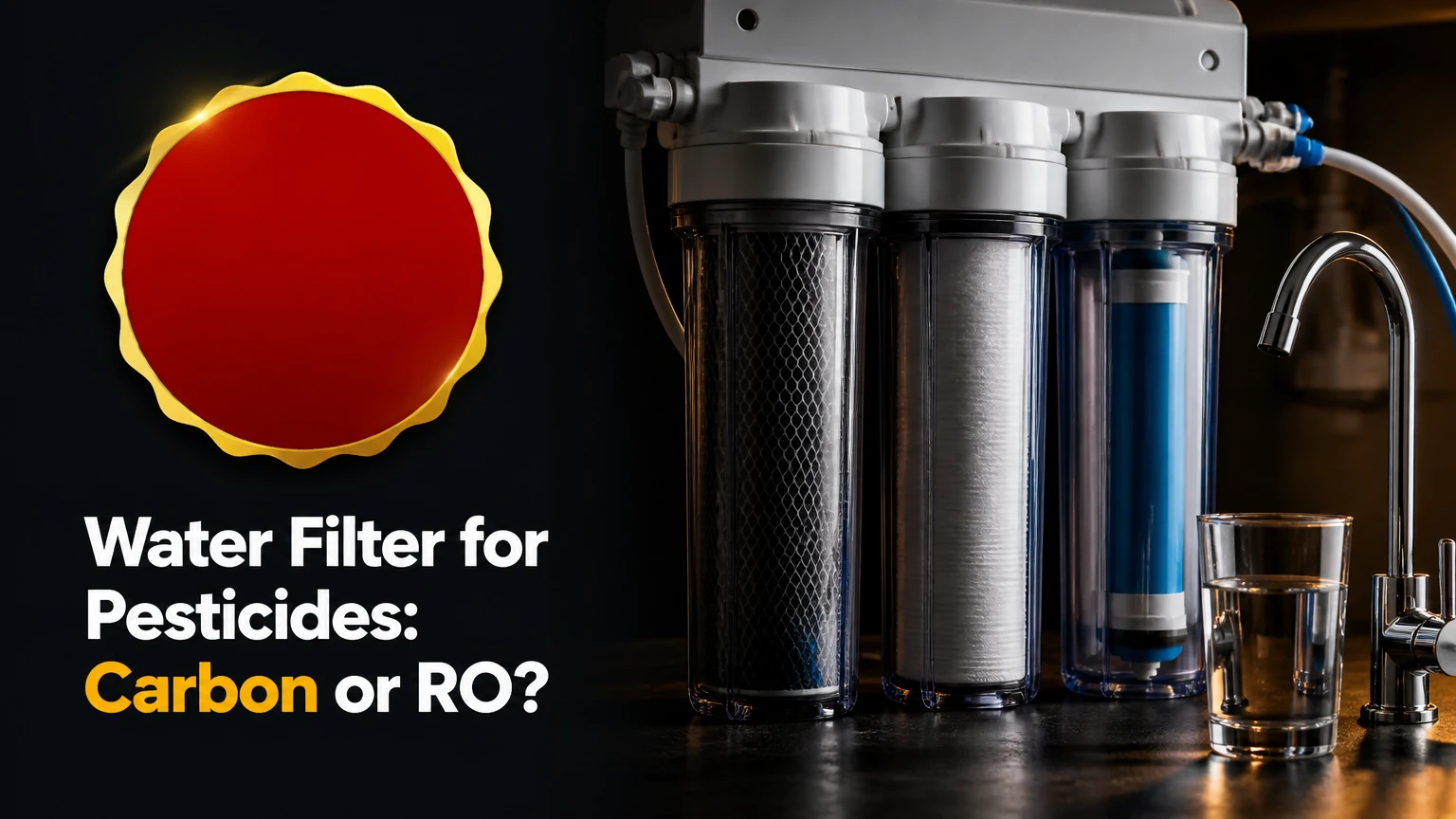
A water filter for pesticides should use a certified activated carbon filter, reverse osmosis system, or both, based on the specific chemical and water test. Carbon often reduces many herbicides and insecticides at the tap, while reverse osmosis adds broader treatment, but no technology guarantees removal of every pesticide without contaminant-specific performance data.
Key Facts at a Glance
- Activated carbon reduces many organic pesticides through adsorption, but performance depends on chemical properties, carbon quantity, flow rate, and cartridge capacity.
- Reverse osmosis can reduce many dissolved pesticides, yet rejection varies by membrane, pressure, pH, temperature, and contaminant.
- Ultrafiltration and ultraviolet treatment are not dependable standalone solutions for dissolved pesticide molecules.
- NSF/ANSI 53, 401, or 58 certification matters only when the product listing names the relevant contaminant reduction claim.
- Point-of-use treatment at the kitchen tap usually costs less and requires less water than whole-home pesticide treatment.
- A certified laboratory water test is the most reliable way to select treatment for a private well or suspected agricultural contamination.
What Is a Water Filter for Pesticides?
A water filter for pesticides is a treatment device designed to reduce specific agricultural chemicals in drinking water. The target contaminants may include herbicides such as atrazine and glyphosate, insecticides such as carbaryl, and other compounds detected in groundwater or surface-water supplies.
Pesticides are not one chemical class with one filtration behavior. Some dissolve readily in water, while others attach strongly to carbon or sediment. Hydrophobicity, polarity, molecular charge, concentration, and treatment conditions determine whether a carbon bed or membrane performs well.
The U.S. Environmental Protection Agency advises, “The best way to know if your drinking water is safe is to have it tested.” That principle matters because a filter marketed for chlorine, taste, or general VOC reduction may have no verified claim for the pesticide present in a well.
How Do Pesticide Filters Remove Chemicals?
Activated carbon removes pesticides mainly through adsorption, while reverse osmosis reduces dissolved chemicals through a pressure-driven membrane separation process. The two technologies address different failure mechanisms and are often combined in a treatment train.
Activated Carbon Adsorption
Granular activated carbon, or GAC, contains a network of pores that attracts and holds many organic molecules. Carbon block cartridges add a compressed carbon structure that usually provides more uniform contact than loose granules, although pressure loss can increase as the cartridge loads with sediment.
Carbon capacity is finite. A new cartridge may reduce a target chemical effectively, but the contaminant can break through after the available adsorption sites become occupied. High flow rates, short contact time, warm water, and competing organic matter can shorten the useful life.
Carbon is therefore not a permanent chemical barrier. A replacement schedule based only on taste is unsafe because pesticide breakthrough can occur without an odor or visible warning.
Reverse Osmosis Membranes
Reverse osmosis forces water across a semipermeable membrane at typical household pressures of about 40-80 psi. The membrane rejects many dissolved salts, metals, microorganisms, and organic compounds, while the concentrated reject stream goes to a drain or recovery system.
Pesticide rejection is chemical-specific. Membrane material, operating pressure, feed-water temperature, pH, ionic strength, and pretreatment all affect results. A claim of 97% or 99% removal should be read as a tested value for named chemicals under defined conditions, not as a universal pesticide guarantee.
RO systems require sediment and carbon prefilters. Chlorine can damage some thin-film composite membranes, and a clogged prefilter can reduce pressure enough to impair production.
What Does a Complete Treatment Train Include?
A typical residential system places sediment filtration first, activated carbon next, reverse osmosis after pretreatment, and a final carbon polish at the drinking-water faucet. Ultraviolet disinfection may follow when microbial contamination is a concern, but UV does not remove pesticide molecules.
| Stage | Typical purpose | Common interval or condition |
|---|---|---|
| 5-micron sediment filter | Protects carbon and membrane from silt | Replace at 3-12 months |
| Carbon block prefilter | Removes chlorine and some organic chemicals | Replace at 6-12 months |
| RO membrane | Reduces dissolved contaminants | Replace at 2-5 years |
| Post-carbon filter | Improves stored-water taste | Replace at 6-12 months |
| UV lamp | Inactivates microorganisms | Replace lamp about every 12 months |
Which Water Filter for Pesticides Works Best?
The best choice depends on the identified pesticide, concentration, water source, and treatment location. A certified carbon block is usually the practical first choice for one kitchen faucet when testing shows a carbon-responsive organic chemical; RO is the stronger broad-treatment choice when several dissolved contaminants are present.
| Technology | Pesticide suitability | Typical use | Main limitation |
|---|---|---|---|
| GAC tank | High for many organics | Whole-home or high-volume treatment | Requires adequate bed depth and periodic media replacement |
| Carbon block | High for listed chemicals | Under-sink drinking water | Limited cartridge capacity and flow |
| Reverse osmosis | High for many dissolved chemicals | Kitchen drinking and cooking water | Rejects water and needs pressure and maintenance |
| Ultrafiltration | Low for many dissolved pesticides | Microbial and particle reduction | Pore size does not reliably retain small dissolved molecules |
| UV disinfection | None for chemical removal | Bacteria and virus control | Does not remove pesticides |
| Pitcher carbon | Variable | Low-volume drinking water | Short contact time and inconsistent contaminant claims |
Carbon Versus Reverse Osmosis
Carbon usually wins on simplicity, water efficiency, and operating cost. RO usually wins when the household also needs reduction of nitrate, arsenic, fluoride, salts, or several unrelated dissolved contaminants, provided the system has suitable pretreatment and verified performance.
A carbon filter can be the better engineering choice for a single known pesticide because it avoids unnecessary mineral removal and reject water. RO can be the safer choice when the contaminant list is incomplete, the well contains multiple chemicals, or laboratory results show substances that carbon alone does not address reliably.
Neither choice should be made from the phrase “multi-stage” alone. Stage count describes configuration, not validated pesticide performance.
What Certifications Prove Pesticide Reduction?
NSF/ANSI certification verifies a defined performance standard, but the standard number alone does not prove that a filter removes a particular pesticide. Buyers should check the certification database or performance data for the exact contaminant, model, capacity, and rated flow.
| Standard or claim | What it generally addresses | What to verify before purchase |
|---|---|---|
| NSF/ANSI 42 | Aesthetic contaminants such as chlorine | No pesticide claim is implied |
| NSF/ANSI 53 | Health-effect contaminants | Confirm the named pesticide or VOC claim |
| NSF/ANSI 58 | Reverse osmosis systems | Confirm the individual contaminant reduction listing |
| NSF/ANSI 401 | Selected emerging contaminants | Confirm the exact pesticide and model |
| WQA certification | Independent product certification route | Check the published contaminant claim |
| Manufacturer testing | Internal or commissioned performance data | Require test method, concentration, flow, and capacity |
NSF/ANSI 401 is not a blanket pesticide certification. A product can comply with a standard while carrying no claim for atrazine, glyphosate, or another agricultural chemical. The relevant evidence is a model-specific reduction statement.
How Should You Test Water Before Buying a Filter?
Test the untreated water through a state-certified or nationally accredited laboratory before selecting equipment. Request pesticide analysis based on local agricultural use, well depth, watershed conditions, and guidance from the local health department rather than ordering a generic “water quality” panel.
Use this sequence:
- Identify the source. Obtain the latest Consumer Confidence Report for public water, or document well depth, location, and nearby crops for private water.
- List likely chemicals. County extension offices, state environmental agencies, and nearby farm records can identify commonly applied herbicides and insecticides.
- Choose laboratory analytes. Ask the laboratory whether its panel includes the relevant parent compounds and, where applicable, degradation products.
- Collect correctly. Use the laboratory’s bottles, avoid touching caps, and follow its instructions about flushing, preservation, and refrigeration.
- Compare results with limits. Review results against EPA maximum contaminant levels, state limits, or health advisories where available.
- Match treatment to evidence. Require a performance sheet naming the contaminant and expected reduction at a stated flow and capacity.
- Retest after installation. A post-treatment sample confirms installation and provides a baseline for future cartridge replacement.
Private wells deserve particular attention because the EPA does not regulate most private wells. Annual testing commonly includes bacteria and nitrate, while pesticide testing should be risk-based and repeated after land-use changes, flooding, spills, or unusual taste and odor.
How Much Does Pesticide Filtration Cost?
Typical residential costs range from about $100-$400 for a quality under-sink carbon system, $250-$1,000 for a point-of-use RO system, and $1,000-$4,000 or more for whole-home treatment with professional installation. Laboratory testing, plumbing modifications, replacement media, and wastewater handling can materially change the total.
| Treatment arrangement | Typical equipment cost | Typical installed cost | Typical maintenance |
|---|---|---|---|
| Countertop carbon unit | $50-$250 | $50-$300 | $50-$200 per year |
| Under-sink carbon block | $100-$400 | $200-$700 | $80-$250 per year |
| Countertop RO | $250-$700 | $250-$800 | $100-$300 per year |
| Under-sink RO | $300-$1,000 | $500-$1,500 | $120-$350 per year |
| Whole-home carbon tank | $800-$2,500 | $1,500-$4,000 | $150-$600 per year |
| Whole-home RO | $2,000-$8,000 | $4,000-$12,000 | $400-$1,500 per year |
These are typical planning ranges, not universal prices. A pesticide treatment design may also require a storage tank, booster pump, bypass valves, sampling ports, or specialty media, especially when well water contains iron, manganese, sediment, or high hardness.
Should You Filter the Whole House or Only Drinking Water?
Point-of-use treatment is usually the rational first step when pesticide exposure is limited to drinking and cooking water. Whole-home treatment becomes more defensible when testing detects contamination throughout the plumbing, residents ingest untreated water elsewhere, or showering and laundry concerns justify treatment after professional risk assessment.
| Situation | Recommended starting point | Reason |
|---|---|---|
| City water with one detected pesticide | Under-sink carbon or RO | Limits cost to ingestion points |
| Private well near cropland | Lab test, then carbon or RO | Treatment depends on analytes and concentration |
| Pesticide spill near a wellhead | Stop use and contact authorities | Household filters are not emergency containment |
| Multiple dissolved contaminants | RO with verified pretreatment | Broadens treatment beyond organic chemicals |
| Whole-house exposure concern | Engineered carbon or specialty system | Requires flow and contact-time calculations |
| No detected pesticide | No automatic pesticide system | Avoids unnecessary maintenance and cost |
A shower filter is generally not a pesticide solution. Most small shower cartridges lack the carbon mass, contact time, and validated chemical testing needed for dependable reduction.
How Do You Install and Maintain a Pesticide Filter?
Install the filter on the cold-water line used for drinking and cooking, flush new cartridges according to the manufacturer’s volume, and record the installation date and rated capacity. Maintenance succeeds when replacement follows gallons or months, whichever comes first, rather than waiting for taste, smell, or flow changes.
For an under-sink carbon unit, typical installation takes 1-3 hours and requires an isolation valve, tubing cutter, adjustable wrench, faucet connection, and leak-check time. RO adds a drain saddle, storage tank, air-pressure check, membrane housing, and reject-water connection.
| Maintenance task | Typical frequency | Failure prevented |
|---|---|---|
| Replace sediment cartridge | 3-12 months | Pressure loss and membrane fouling |
| Replace carbon cartridge | 6-12 months or rated gallons | Pesticide breakthrough |
| Replace RO membrane | 2-5 years | Rising dissolved-solids passage |
| Sanitize RO tank and housings | Annually or per manual | Microbial growth |
| Test treated water | After installation and periodically | Undetected performance loss |
| Inspect fittings and tubing | Monthly for first quarter, then quarterly | Leaks and water damage |
A practitioner rule is to size carbon by contaminant load and contact time, not by the number of cartridges. Two small cartridges can provide less protection than one deep bed when the flow rate is identical and the total carbon mass is lower.
What Problems Occur With Pesticide Filters?
The most serious failure is chemical breakthrough without an obvious sensory warning. Slow flow usually indicates sediment loading, a clogged carbon cartridge, low RO pressure, or a fouled membrane, while a new taste can result from exhausted carbon, stagnant storage water, or installation residue.
| Symptom | Likely cause | Corrective action |
|---|---|---|
| Flow drops suddenly | Sediment or carbon clogging | Replace prefilter and inspect pressure |
| RO produces little water | Low feed pressure or fouled membrane | Measure pressure and replace prefilters |
| Water tastes unusual | Exhausted post-carbon or stagnant tank | Replace cartridge and sanitize system |
| Pesticide remains after treatment | Wrong media or exceeded capacity | Confirm analyte claim and retest |
| Leaking connection | Mis-seated tube or loose fitting | Cut tubing squarely and reseat |
| Cloudy first water | Carbon fines or trapped air | Flush the rated volume before use |
Do not use boiling as a pesticide remedy. Boiling can concentrate nonvolatile contaminants as water evaporates, and it is not a validated general method for agricultural chemicals. Do not assume a refrigerator filter, faucet aerator, or sediment cartridge provides chemical protection.
After a spill, unusually high laboratory result, or notification from a water authority, stop using the water for drinking and food preparation and contact the local health department or environmental agency. Emergency contamination requires source control and validated remediation, not a rushed retail purchase.
Which Option Fits Each Household?
For a budget-conscious city-water household: choose an under-sink carbon block with a model-specific claim for the detected pesticide. It normally uses no reject water and costs less to operate than RO.
For a private well with several dissolved contaminants: choose RO at the kitchen tap after laboratory testing, with carbon and sediment pretreatment. Add whole-home treatment only when exposure assessment supports it.
For a renter: choose a countertop RO or certified countertop carbon unit that documents the target contaminant. Keep the laboratory report and cartridge replacement record with the appliance.
For a household needing maximum verified reduction: use a treatment train combining adequate carbon contact time with RO, then verify treated water in a laboratory. More stages do not compensate for an unverified contaminant claim.
The honest limitation is important: household filters cannot repair a contaminated aquifer, stop pesticide entry into a well, or guarantee safety after a spill. Source protection, wellhead sealing, drainage control, and agency investigation may matter more than the final cartridge.
Frequently Asked Questions
Can a pitcher filter remove pesticides?
A pitcher filter can reduce some pesticides when its cartridge uses sufficient activated carbon and the product has a contaminant-specific performance claim. Many pitchers are certified only for chlorine, taste, or metals. Check the exact model, named pesticide, rated gallons, and replacement interval before relying on the pitcher for drinking water.
Does glyphosate require reverse osmosis?
Glyphosate does not automatically require reverse osmosis, because treatment performance depends on water chemistry, concentration, and the tested carbon or membrane product. A certified carbon system may be appropriate for a verified result, while RO can provide broader treatment when nitrate, salts, metals, or multiple contaminants also occur.
Do water softeners remove pesticides?
Standard ion-exchange water softeners are designed primarily to exchange calcium and magnesium for sodium or potassium. They are not dependable pesticide treatment devices unless a separate, documented media stage specifically lists the target chemical. A softener can also increase water use and should not replace carbon or RO.
Is bottled water safer than filtered well water?
Bottled water is not automatically safer because quality depends on the source, treatment, packaging, and brand testing. Filtered well water can be the better-controlled option when a certified laboratory identifies the pesticide, a validated treatment system is installed, and treated water is retested on a defined schedule.
How often should pesticide filter cartridges be replaced?
Most residential carbon cartridges require replacement every 6-12 months, or sooner when the rated gallon capacity is reached. Heavy contamination, high flow, sediment, and competing organic matter shorten service life. Follow the lower of the time and gallon limits, then confirm performance with periodic testing.
Can pesticides enter water through a private well?
Pesticides can enter a private well through contaminated groundwater, surface runoff, flooding, poor well construction, or an unsealed wellhead. Risk increases near agricultural land and shallow groundwater. A certified laboratory test, well inspection, and local agricultural-use history provide a stronger answer than taste or odor.
The Bottom Line
A water filter for pesticides should be selected from laboratory results and a model-specific reduction claim, not from stage count or a generic “chemical removal” label. Activated carbon is often the efficient point-of-use answer for documented organic pesticides; reverse osmosis is broader but costs more, wastes some water, and needs more maintenance. Test first, maintain by capacity, and retest treated water.