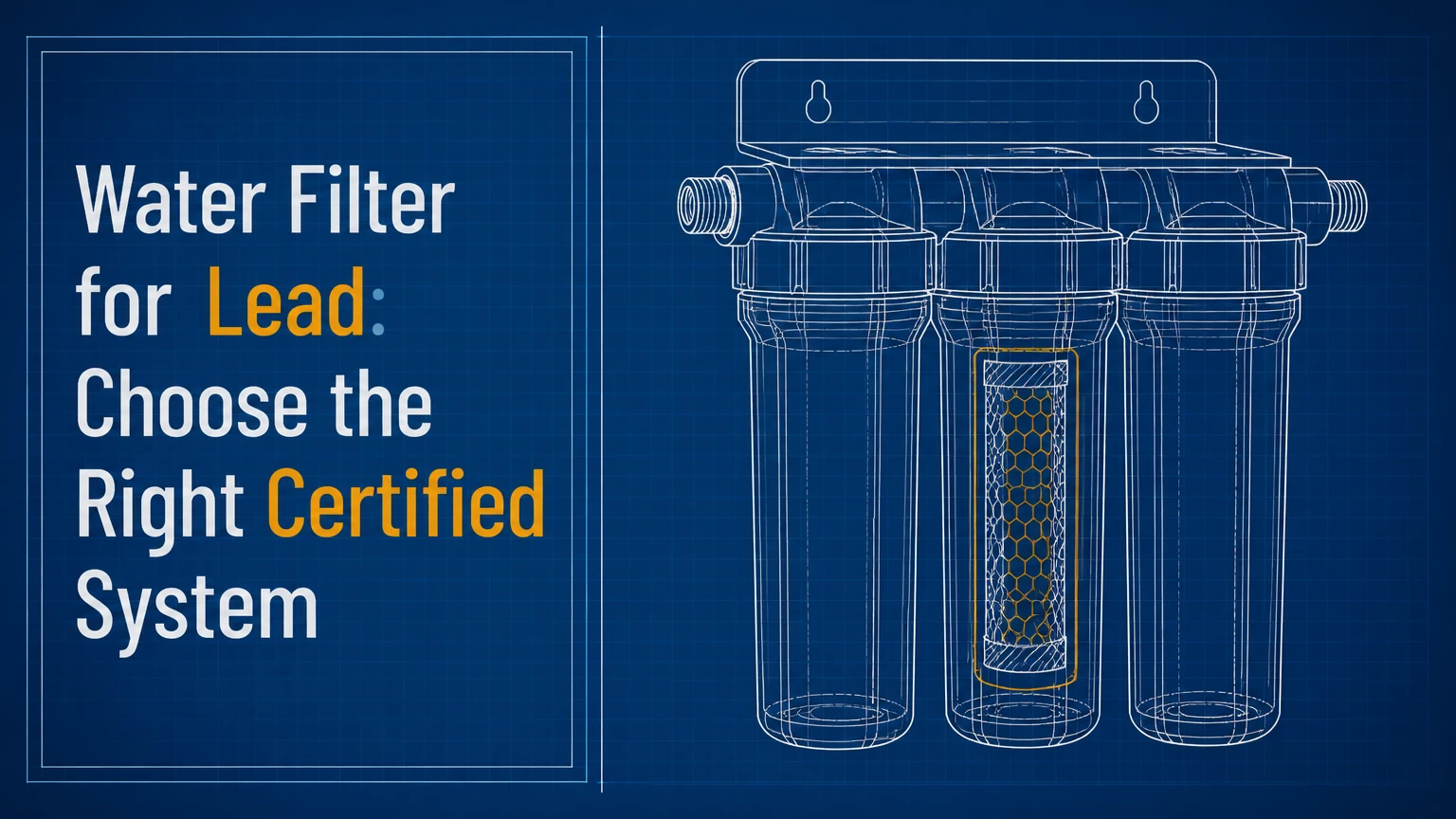
A water filter for lead should be certified for lead reduction under NSF/ANSI 53, or NSF/ANSI 58 when it is a reverse osmosis system. For most homes, a certified point-of-use filter at the kitchen tap is the practical first choice because it treats drinking and cooking water without the cost of filtering every household gallon.
Key Facts at a Glance
- NSF/ANSI 53 identifies drinking-water treatment devices tested for specific contaminant reduction claims, including lead.
- NSF/ANSI 58 applies to reverse osmosis systems and does not automatically prove lead reduction unless the product listing names lead.
- Mechanical sediment filters can trap particulate lead but generally cannot remove dissolved lead ions.
- A water filter for lead must be replaced according to its rated gallon capacity or time limit, whichever comes first.
- Boiling water does not remove lead; evaporation can increase the concentration of nonvolatile contaminants.
- A TDS meter cannot confirm whether a carbon filter is removing lead.
What Is a Water Filter for Lead?
A water filter for lead is a treatment device designed to reduce lead in drinking water in both dissolved and particulate forms. Certified media may include lead-specific activated carbon, ion-exchange material, reverse osmosis membranes, or combinations of these technologies.
Lead commonly enters tap water from lead service lines, brass components, lead solder, faucets, and plumbing disturbed by construction or water-pressure changes. The municipal treatment plant may deliver compliant water, while corrosion inside a private service line or household plumbing adds lead before the water reaches the glass.
The U.S. Environmental Protection Agency identifies corrosion control and lead service-line replacement as major public-health controls, but neither measure guarantees that every individual tap is lead-free. A filter therefore reduces exposure at the point where water is consumed. It does not repair a contaminated pipe.
Is All Lead in Water the Same?
Dissolved lead consists of ions suspended at a molecular scale, while particulate lead consists of tiny solid fragments attached to rust, scale, or plumbing debris. A sediment cartridge can remove the second form while allowing dissolved lead to pass through.
Particulate contamination deserves special attention after plumbing work, hydrant flushing, water-main repairs, or changes in pressure. A first-draw sample can also contain lead released during hours of stagnation, whereas a flushed sample may indicate conditions after water has moved through the service line.
The distinction explains why a “1-micron filter” is not automatically a complete lead solution. Pore size describes particle capture, not chemical removal of dissolved lead.
How Does a Lead Water Filter Remove Contamination?
A certified lead filter combines particle capture with chemical binding or membrane separation. Water first passes through a barrier that reduces sediment and flakes, then through media that retains dissolved lead under the manufacturer’s tested conditions.
Mechanical Filtration Captures Particles
Dense carbon blocks, ceramic elements, and sediment cartridges physically retain particles larger than their effective passage size. This stage can reduce rust, scale, and particulate lead, but a nominal micron rating does not establish dissolved-lead performance.
Sediment loading also shortens cartridge life. A home with rusty water may experience reduced flow weeks before the stated replacement date because the outer surface becomes blocked.
Activated Carbon Binds Dissolved Lead
Lead-reduction carbon usually contains chemically treated carbon or additional binding media rather than ordinary taste-and-odor carbon. Adsorption and ion binding retain lead as water contacts the large internal surface area of the cartridge.
Carbon systems normally preserve calcium and magnesium, so they do not substantially reduce total dissolved solids. That property benefits users who want lead reduction without the mineral removal and wastewater associated with many RO systems.
Reverse Osmosis Separates Ions Under Pressure
Reverse osmosis uses pressure to move water across a semipermeable membrane while rejecting many dissolved contaminants. Product performance depends on feed pressure, temperature, membrane condition, pretreatment, flow restrictor design, and the complete system certification.
The often-repeated claim that RO membranes have “0.0001-micron pores” is an oversimplification. RO separation involves solution-diffusion and membrane chemistry, not merely a sieve with uniform holes of that diameter.
Distillation Uses Phase Change
A distiller evaporates water and condenses the vapor, leaving many nonvolatile contaminants behind. A post-carbon filter is still useful because it improves taste and can address volatile compounds that distillation alone may not handle well.
Distillation uses more electricity and produces water slowly. It can be useful for a small household, but it is rarely the most convenient option for continuous cooking and drinking demand.
Which Water Filter for Lead Should You Choose?
For most households, a certified under-sink carbon block filter is the best balance of lead performance, flow rate, installation effort, and operating cost. Choose certified RO when you also need broad dissolved-contaminant reduction, and choose a certified pitcher or faucet unit when portability matters more than capacity.
| Filter type | Typical purchase cost | Typical service interval | Typical annual cartridge cost | Best fit |
|---|---|---|---|---|
| Pitcher or carafe | $30-$100 | 1-3 months | $60-$150 | Renters, dorm rooms |
| Faucet-mounted unit | $35-$80 | 2-4 months | $50-$100 | Small kitchens |
| Under-sink carbon block | $150-$400 | 6-12 months | $80-$150 | Families, daily cooking |
| Under-sink RO | $250-$1,000 | 6-24 months for stages, 2-5 years for membrane | $100-$250 | Broad contaminant reduction |
| Countertop distiller | $100-$400 | Carbon stage, 6-12 months | $60-$120 plus electricity | Low-volume use |
The prices above are typical retail ranges, not guaranteed quotations. Installation, dedicated faucets, replacement membranes, remineralization cartridges, and local plumbing labor can change the total.
Which Certification Proves Lead Reduction?
The certification must identify lead reduction for the exact model and cartridge combination. NSF/ANSI 53 is the principal standard for many non-RO drinking-water filters, while NSF/ANSI 58 applies to RO systems; neither standard alone proves every contaminant claim.
Use the NSF Certified Drinking Water Treatment Units directory or the certification directory named by the manufacturer. Check four details:
- The exact model number, not merely the brand family.
- The contaminant claim, specifically lead reduction.
- The rated capacity in gallons and rated flow.
- The replacement cartridge approved for that performance claim.
A product can carry a general water-treatment certification while lacking a lead claim. Marketing language such as “heavy-metal filtration” is weaker evidence than a searchable listing with a named lead-reduction claim.
The EPA and CDC both emphasize exposure reduction rather than a consumer device as the sole remedy. The CDC states, “Lead is harmful to health, especially for children,” which is why certification and maintenance matter more than taste, odor, or a low price.
What Does Each System Remove Besides Lead?
| System | Lead claim | TDS reduction | PFAS claim | Wastewater or electricity |
|---|---|---|---|---|
| Certified carbon block | Model-specific NSF/ANSI 53 claim | Usually low | Model-specific | No electricity, no reject stream |
| Certified RO | Model-specific NSF/ANSI 58 claim | Often high | Model-specific | Electricity-free, typically 1-4 gallons reject water per gallon produced |
| Pitcher ion exchange | Model-specific claim | Variable | Model-specific | No electricity, low flow |
| Distiller with carbon post-filter | Usually requires product-specific evidence | Very high | Variable | Electricity required, slow output |
| Sediment-only cartridge | No dissolved-lead claim | None | None | No electricity, no reject stream |
RO can reduce minerals, nitrate, arsenic, fluoride, and some PFAS when the complete system carries those claims. A carbon filter may be preferable when the only known concern is lead and the household wants faster production with no wastewater.
No treatment process should be credited with contaminants absent from its performance data. A UV unit, water softener, whole-house sediment cartridge, or ordinary refrigerator filter is not automatically a lead filter.
Where Should a Lead Filter Be Installed?
A point-of-use filter at the kitchen cold-water tap usually offers the strongest exposure reduction for the least cost. Install treatment at the point of entry only when the system is specifically certified for lead at whole-house flow rates and the installation addresses every contaminated fixture.
| Installation location | Water treated | Typical flow requirement | Main advantage | Main limitation |
|---|---|---|---|---|
| Pitcher | Filled drinking water | 0.1-0.5 gallons per minute | No plumbing | Limited batch capacity |
| Faucet attachment | One faucet | 0.3-0.7 gallons per minute | Fast installation | Often incompatible with pull-out faucets |
| Under-sink dedicated faucet | Drinking and cooking water | 0.5-1.5 gallons per minute | High capacity, hidden equipment | Requires cabinet space |
| Refrigerator line | Ice and chilled water | 0.25-0.75 gallons per minute | Convenient cold water | Model-specific cartridge |
| Whole-house entry | Every cold and hot fixture | 5-15 gallons per minute | Broad fixture coverage | Higher cost and certification burden |
A point-of-use filter does not protect bathroom sinks, showers, laundry, or an unfiltered ice maker. A whole-house filter can reduce exposure from those outlets only if its rated flow, capacity, installation, and certification match the household plumbing.
Whole-house treatment also cannot remove lead already present in interior pipes downstream of the filter. Plumbing materials, stagnant water, and faucet components still require investigation.
How Do You Test Tap Water for Lead?
Use a laboratory test that supplies sampling instructions and reports lead in parts per billion, rather than relying on a color-changing strip alone. Collect the sample exactly as instructed because first-draw and flushed samples answer different questions.
Step 1: Identify the Water Source
Ask the water utility whether the property has a lead service line, galvanized pipe requiring replacement, corrosion-control treatment, or a history of lead results. Older homes, especially those built before local lead restrictions, deserve a plumbing-material assessment.
Step 2: Collect a First-Draw Sample
A first-draw sample usually comes from the cold kitchen tap after water has remained still for at least six hours, although the laboratory’s protocol controls the exact timing and volume. This sample estimates lead accumulated during stagnation.
Do not clean or remove the aerator unless the laboratory instructs you to do so. Aerators can collect particulate lead, and removing them changes the exposure scenario being measured.
Step 3: Consider a Flushed Sample
A flushed sample taken after several minutes of cold-water flow can help distinguish household plumbing from a service-line or distribution concern. It does not prove that the water is safe during the first draw, which is often the water people consume after overnight stagnation.
| Result pattern | Likely interpretation | Immediate response |
|---|---|---|
| High first draw, low flushed result | Interior faucet or plumbing stagnation | Use flushing and certified point-of-use treatment |
| High first draw, high flushed result | Service line or persistent plumbing source | Contact utility and use certified filtered water |
| Low first draw, high flushed result | Sampling variation or intermittent particles | Repeat with laboratory guidance |
| Two low results, unknown plumbing | Reduced detected exposure, source still uncertain | Maintain precautions until materials are confirmed |
A single result is a snapshot, not a permanent guarantee. Water chemistry, construction, seasonal conditions, and plumbing disturbance can change lead release.
How Should You Use and Maintain a Lead Filter?
Use only cold water, flush a new cartridge according to its instructions, and replace the cartridge at the earlier of its rated gallon capacity or stated time limit. Maintenance failure is one of the most common reasons a certified device underperforms in an actual kitchen.
- Install the cartridge in the correct housing and confirm the arrow direction.
- Flush the specified volume, commonly 2-5 gallons for a carbon cartridge, into a drain.
- Record the installation date and estimated daily usage.
- Replace the cartridge before capacity expires, even if taste and flow remain normal.
- Sanitize housings and wash hands during cartridge changes.
- Test filtered water when the source is high-risk or results are unexpected.
A family using 2 gallons per day for drinking and cooking consumes about 730 gallons annually. A cartridge rated for 1,000 gallons may last less than its one-year calendar limit if sediment is heavy, while a lightly used cartridge can still require replacement because the manufacturer sets a time limit.
Why Must Filtered Water Be Cold?
Cold water is the correct feed for a lead filter because hot water can increase lead dissolution and can damage or alter treatment media. Use cold filtered water for drinking, cooking, infant formula, ice, and pet bowls.
Run the cold tap briefly after overnight stagnation when the plumbing source is uncertain, then fill a clean container or use the certified filter. Do not use hot tap water for cooking and heat it separately if needed.
What Does a Lead Filter Not Fix?
A lead filter does not remove lead from pipes, prevent contamination at an unfiltered outlet, or guarantee performance after capacity is exhausted. A filter also cannot identify whether the source is a lead service line, brass fitting, solder, or accumulated sediment.
Boiling Does Not Remove Lead
Boiling kills many microorganisms but does not volatilize lead. As water evaporates, the remaining dissolved contaminants may become more concentrated.
TDS Meters Do Not Detect Lead Reliably
TDS meters estimate electrical conductivity from dissolved ions. Lead may contribute to conductivity, but the reading cannot identify lead or establish a certified filter’s removal performance.
A carbon filter can reduce lead while leaving calcium and magnesium in the water, so a stable or high TDS reading is normal. A low TDS reading after RO also does not prove that the membrane is functioning for every contaminant.
Generic Carbon Is Not Enough
A refrigerator cartridge or charcoal filter that improves taste may lack the media, contact time, and tested capacity required for lead reduction. Treat the product as suitable only when its exact certification listing names lead.
Filter Failure Can Be Silent
Lead has no reliable taste, smell, or visible appearance at concentrations that matter for exposure. Metallic taste is not a valid replacement alarm for a laboratory test or a cartridge-change schedule.
Which Option Fits Each Household?
Renters and Students
Choose a certified pitcher or faucet-mounted system when drilling, plumbing access, and cabinet space are restricted. Confirm that the cartridge, not only the pitcher body, carries the lead-reduction claim and replace it frequently because small cartridges often have limited capacity.
Families With Children or Pregnant Occupants
Choose a high-capacity under-sink carbon system or certified RO unit for drinking, cooking, ice, and infant formula. The best decision follows a laboratory result and service-line assessment, because a filter protects consumption but does not remove lead exposure from every household outlet.
Homeowners With a Lead Service Line
Use a certified point-of-use filter immediately while pursuing utility information, line replacement, or corrosion-control guidance. A whole-house system may be appropriate when non-drinking outlets also require protection, but the system must match the service flow and certified lead capacity.
Users Seeking Broad Purification
Choose RO when lead is one of several concerns, such as arsenic, nitrate, fluoride, or high dissolved solids, and when reject water, maintenance, and reduced mineral content are acceptable. Add a remineralization stage only for taste or mineral preference, not as proof that lead removal improved.
Households Without Plumbing Access
Choose a certified pitcher, countertop RO unit, or distiller with documented lead performance. Gravity ceramic systems require particular scrutiny because ceramic pore size alone does not establish dissolved-lead reduction.
What Are the Real Costs of Lead Filtration?
| Cost category | Pitcher | Under-sink carbon | Under-sink RO | Whole-house lead system |
|---|---|---|---|---|
| Equipment | $30-$100 | $150-$400 | $250-$1,000 | $800-$3,000+ |
| Installation | $0-$30 | $0-$250 | $150-$500 | $500-$2,000 |
| Annual media | $60-$150 | $80-$150 | $100-$250 | $150-$500 |
| Treated outlets | 1 container | 1 faucet | 1 faucet | Most fixtures |
| Typical maintenance time | 5 minutes monthly | 15 minutes twice yearly | 30-60 minutes annually | Professional service often required |
These ranges exclude laboratory testing, which commonly costs about $20-$150 per sample depending on the panel, laboratory, and shipping. Local utility programs may provide testing or filters at no charge.
The cheapest purchase price is not necessarily the lowest cost per gallon. A pitcher used heavily by a family can consume several cartridges each year, while an under-sink cartridge rated for 1,000 gallons may reduce replacement frequency.
Troubleshooting: Why Is the Filter Not Working Properly?
| Symptom | Probable cause | Corrective action | Verification |
|---|---|---|---|
| Slow flow | Sediment loading or exhausted cartridge | Replace cartridge and inspect prefilter | Flow returns near rated range |
| Black particles | Carbon fines after installation | Flush the specified volume | Water runs clear |
| Metallic taste | Source issue, exhausted media, or unfiltered outlet | Test water and verify cartridge date | Laboratory result or proper replacement |
| RO tank fills slowly | Low pressure, blocked prefilter, cold feed water | Check pressure and stages | Output approaches product specification |
| TDS remains high after carbon | Normal mineral retention | Do not use TDS as lead proof | Verify certification and test lead |
| Lead result remains elevated | Wrong model, bypassed filter, capacity exceeded, or persistent source | Inspect plumbing and retest | Filtered sample improves under protocol |
A sudden flow reduction often indicates sediment capture rather than dissolved-lead breakthrough. That observation is useful, but it does not justify extending the cartridge interval because chemical capacity can be exhausted before flow visibly changes.
Frequently Asked Questions
Can a water softener remove lead?
A water softener is designed primarily to exchange calcium and magnesium for sodium or potassium. A softener may reduce some metals under particular conditions, but it should not be treated as a lead filter unless the complete product carries a documented lead-reduction claim and suitable capacity rating.
Is a faucet filter better than a pitcher for lead?
A faucet filter usually provides faster flow and less handling, while a pitcher costs less initially and works in rental housing. Neither format is inherently better for lead; the deciding evidence is the exact cartridge’s lead certification, rated capacity, and compatibility with the tap.
How long should I run the tap before drinking?
The required flushing time depends on pipe length, flow rate, and laboratory or utility guidance. A common temporary practice is to run cold water for several minutes after overnight stagnation, but flushing cannot replace certified filtration when a lead service line or persistent contamination is present.
Can I use filtered water for infant formula?
Use water from a certified lead-reduction filter for infant formula when lead is a concern, and follow local health guidance for microbial safety and formula preparation. Do not use hot tap water through the filter; draw cold filtered water and warm it separately if necessary.
Should I filter shower water for lead?
A certified kitchen point-of-use filter is normally the priority because drinking and cooking create the most direct ingestion route. Shower filtration requires different flow rates and exposure considerations, and a drinking-water cartridge may not be certified for whole-house or shower applications.
The Bottom Line
The right water filter for lead is a model-specific, certified treatment device matched to the contamination source, household flow, and maintenance capacity. Start with a laboratory test and utility plumbing information, then choose NSF/ANSI 53 carbon treatment for focused point-of-use protection or NSF/ANSI 58 RO when broader dissolved-contaminant reduction justifies the extra cost and wastewater. Replace media on schedule, use cold water only, and remember that filtration reduces exposure without repairing lead-containing plumbing.