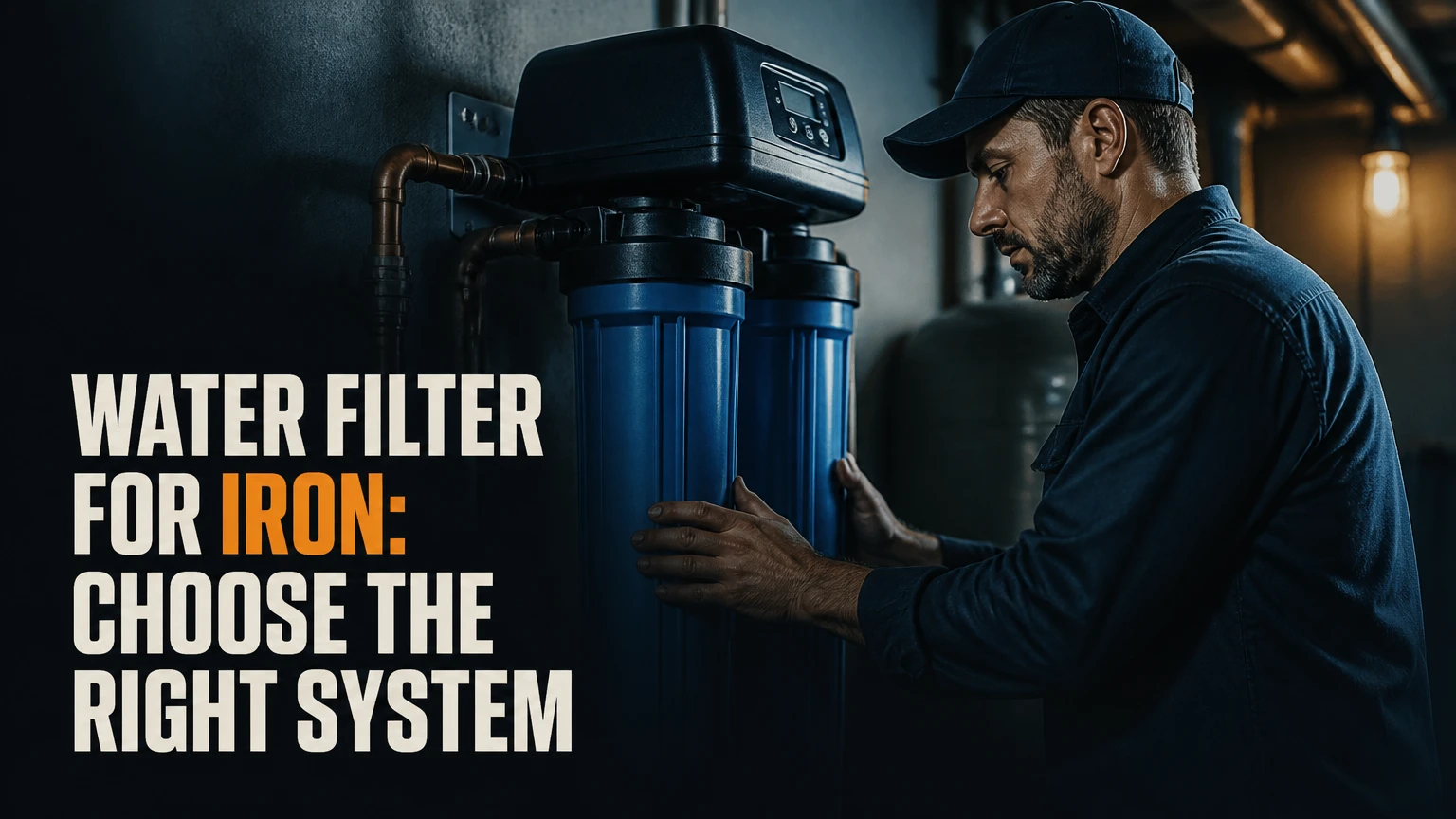
A water filter for iron removes dissolved or particulate iron from well water, preventing orange stains, metallic taste, clogged fixtures, and laundry discoloration. The correct system depends on iron form, concentration, pH, manganese, sulfur odor, iron bacteria, household flow rate, and whether the water requires oxidation before filtration.
Key Facts at a Glance
- The EPA secondary standard for iron is 0.3 mg/L, equal to approximately 0.3 parts per million, mainly because iron causes taste, staining, and color problems.
- Ferrous iron is dissolved and usually requires oxidation before a filter can capture it.
- Ferric iron is already oxidized, so a properly sized sediment or media filter can remove it.
- Air-injection oxidation commonly suits clear-water iron at moderate concentrations when pH and backwash flow are adequate.
- Chlorine injection with retention and carbon filtration is more suitable for iron bacteria, organic iron, very high iron, or multiple contaminants.
- A water softener is generally limited to low concentrations of clear-water iron and can suffer resin fouling when iron loading is high.
What Is a Water Filter for Iron?
A water filter for iron is a whole-house treatment system that converts dissolved iron into particles or captures rust particles already present in water. Most systems are installed on the main line after the pressure tank and before a softener, ultraviolet unit, or household distribution plumbing.
Iron itself is not usually the main health concern at the concentrations found in private wells. The U.S. Environmental Protection Agency classifies iron at 0.3 mg/L as a secondary, aesthetic contaminant level rather than a federally enforceable primary health limit. Private wells still require broader testing because iron can occur with manganese, arsenic, nitrate, bacteria, low pH, or hydrogen sulfide.
Orange water is not enough to select equipment. Clear water that turns orange after standing indicates dissolved ferrous iron, while water that exits the faucet colored indicates suspended ferric iron. A slimy coating, string-like material, or persistent sheen suggests organic matter or iron bacteria and changes the treatment design.
Which Type of Iron Is in the Water?
The iron form determines whether the system needs oxidation, sediment separation, chemical treatment, or biological control. A laboratory test is more reliable than appearance because a sample can change form during storage and transport.
| Iron condition | Appearance at tap | Typical symptom | Primary treatment |
|---|---|---|---|
| Ferrous iron | Clear at first | Orange staining after 5-30 minutes | Air, chlorine, ozone, or catalytic oxidation |
| Ferric iron | Yellow, red, or brown immediately | Sediment and rust particles | Sediment or backwashing media filtration |
| Organic iron | Tea-colored or yellow | Color persists after ordinary filtration | Oxidation plus carbon or specialized media |
| Iron bacteria | Slime, strings, or oily surface | Clogged screens and recurring odor | Shock disinfection plus oxidation treatment |
| Mixed iron | Variable color and staining | Breakthrough changes with flow | Laboratory testing and staged treatment |
A useful field check is to fill a clean glass and observe it for 30 minutes. The test can indicate ferrous iron, but it cannot identify iron bacteria, quantify concentration, or confirm whether manganese is present.
How Does an Iron Filter Work?
An iron filter generally uses oxidation followed by filtration. Oxidation changes soluble ferrous iron into insoluble ferric hydroxide particles, and a media bed then captures those particles before treated water reaches the home.
A typical air-injection system contains a controlled air pocket in a pressurized tank. Incoming well water contacts oxygen, then passes through catalytic media that accelerates oxidation and retains the resulting particles. The control valve periodically reverses flow, expands the media bed, and sends accumulated solids to a drain.
The exact mechanism varies by technology:
- Air oxidation: Atmospheric oxygen oxidizes ferrous iron without continuous chemical dosing.
- Catalytic oxidation: Coated media accelerates the reaction and traps iron.
- Chlorine oxidation: A metering pump injects chlorine, often followed by a retention tank and carbon filter.
- Ozone oxidation: Ozone provides strong oxidation but requires specialized equipment and careful off-gas management.
- Ion exchange: Resin exchanges dissolved iron ions, but the process is sensitive to concentration, pH, and oxidized iron.
Backwashing is part of filtration, not an optional cleaning feature. A tank that cannot receive the manufacturer’s required backwash flow will accumulate iron, lose pressure, and eventually allow untreated water through.
Which Iron Filter Technology Should You Choose?
The best technology depends on contaminant load and operating conditions. Air-injection oxidation is usually the simplest chemical-free choice for moderate clear-water iron, while chemical injection handles difficult biological or very high-load conditions more reliably.
| Technology | Typical iron range | pH and water conditions | Maintenance requirement |
|---|---|---|---|
| Air-injection oxidation | 1-15 ppm | Usually pH 7.0-8.5; adequate backwash flow | Backwash, injector inspection, media checks |
| Catalytic media without air draw | 0.5-10 ppm | Media-specific pH and oxidant requirements | Chemical regeneration or periodic cleaning |
| Chlorine injection | 5-30+ ppm | Suitable for organic load and iron bacteria | Chemical refill, pump service, carbon replacement |
| Ozone injection | 2-30+ ppm | Requires electrical equipment and controlled contact | Ozone generator and injector service |
| Water softener | 0.1-2 ppm | Dissolved iron, suitable hardness and pH | Salt, resin cleaner, regeneration |
| Sediment cartridge | Particulate iron only | Ferric iron with low dissolved iron | Cartridge replacement every 1-6 months |
The ranges are typical design ranges, not guarantees. Manufacturer ratings can assume ideal pH, low manganese, adequate contact time, and a specified service flow. A system rated for 15 ppm under laboratory conditions may perform poorly when the well has low pH, iron bacteria, or a high peak flow rate.
Is Air-Injection Oxidation the Best Choice?
Air-injection oxidation is often the best choice for a private well with 2-15 ppm clear-water iron, pH near neutral or above, and a pump capable of backwashing the media. The method adds no ongoing chlorine or potassium permanganate and can also reduce hydrogen sulfide odor when the contact and filtration stages are correctly sized.
Air-injection systems are poor choices when water is strongly acidic, iron bacteria produce heavy slime, or the available well yield cannot support regeneration. Some systems also struggle with unusually high organic iron because the oxidized material can load the media faster than normal backwashing removes it.
A practitioner rule is to test the raw water after the pressure tank and before any treatment. Testing only a kitchen faucet can hide pressure-tank sediment, chlorine, or an existing filter’s effect.
When Is Chlorine Injection Better?
Chlorine injection is usually better for iron bacteria, organic-bound iron, very high iron, or a combination of iron and persistent microbial slime. Chlorine oxidizes iron and manganese while disinfecting the water, but the system normally needs contact time followed by activated carbon to remove residual chlorine and improve taste.
A common arrangement is a chlorine pump, mixing or retention tank, backwashing catalytic carbon, and optional sediment polishing. The required tank volume depends on flow rate and contact-time design. Chemical injection costs more to install and maintain, but it provides a wider operating margin for difficult well water.
Chlorine does not eliminate the need for testing. Excessive dosing can create taste, accelerate corrosion in some plumbing, and consume carbon quickly when organic matter is high.
What Water Test Does an Iron Filter Need?
A complete private-well test should include iron, manganese, pH, hardness, alkalinity, hydrogen sulfide, total dissolved solids, and coliform bacteria. Add nitrate, arsenic, sulfate, and other local contaminants when the property’s geology or agricultural history warrants them.
| Test parameter | Typical result to evaluate | Why it changes treatment |
|---|---|---|
| Iron | 0.3-30+ ppm | Determines oxidation and media capacity |
| pH | 6.0-8.5 | Low pH slows oxidation and can increase corrosion |
| Manganese | 0.05-5 ppm | May require stronger oxidation and specialized media |
| Hardness | 3-50 grains per gallon | Determines softener size and salt demand |
| Hydrogen sulfide | 0-10+ ppm | Supports air, chlorine, ozone, or carbon treatment |
| Coliform bacteria | Detected or absent | Requires disinfection investigation |
| Alkalinity | 10-400 mg/L | Helps assess pH stability and neutralization |
| Flow rate | 5-20 gallons per minute | Determines service and backwash sizing |
Collect a raw-water sample according to the laboratory’s instructions. Use a sterile bottle for bacteria, avoid hose-end samples, and test after the well has run long enough to represent normal groundwater conditions.
The EPA secondary iron value of 0.3 mg/L is a useful aesthetic benchmark, not a universal equipment cutoff. A household with 0.4 ppm may need treatment because of severe staining, while another household with 2 ppm may tolerate the water temporarily if pH and plumbing conditions differ.
How Should pH and Treatment Order Be Managed?
Low-pH water often needs pH correction before or within the iron-treatment design because oxidation becomes less effective as acidity increases. The treatment order must be engineered from the actual water chemistry, rather than applying a universal rule that always places an iron filter before an acid neutralizer.
| Water profile | Preferred sequence | Main design concern |
|---|---|---|
| pH 7.2, dissolved iron | Air oxidation, media filter, softener | Backwash flow and iron loading |
| pH 6.5, dissolved iron | Neutralization, oxidation, filtration | Calcite fouling and pH stability |
| Ferric sediment, neutral pH | Sediment prefilter, iron media | Cartridge loading and pressure drop |
| Iron bacteria, sulfur odor | Chlorine, retention, carbon filtration | Contact time and biological regrowth |
| Iron plus hardness | Iron removal, then softener | Preventing resin fouling |
| Iron plus manganese | Oxidation media, then polishing | Manganese-specific capacity and pH |
An acid neutralizer can become fouled when raw water contains substantial oxidized iron or sediment. Conversely, placing an iron filter before a neutralizer can leave the oxidation stage underperforming when pH is too low. A sediment prefilter, staged media, or a combined neutralization and oxidation design may resolve the conflict.
How Much Backwash Flow Does an Iron Filter Need?
Backwash flow is commonly 6-15 gallons per minute for residential tanks, but the exact requirement depends on tank diameter, media density, temperature, and manufacturer instructions. A well pump must deliver the required flow at the actual pressure and through the household plumbing, not merely advertise that flow at zero pressure.
| Tank diameter | Typical media volume | Typical backwash demand | Approximate drain duration |
|---|---|---|---|
| 9 inches | 1.0-1.5 cubic feet | 5-8 gpm | 10-15 minutes |
| 10 inches | 1.5-2.0 cubic feet | 7-10 gpm | 10-15 minutes |
| 12 inches | 2.0-2.5 cubic feet | 10-15 gpm | 12-20 minutes |
| 13 inches | 2.5-3.5 cubic feet | 12-18 gpm | 12-20 minutes |
These are typical planning values, not substitute specifications. Measure well recovery and pump output with a pressure gauge and flow test before purchasing equipment. A restricted drain, undersized pipe, or failed control valve can produce the same symptoms as an undersized pump.
Backwash frequency may range from every one to three days for heavy iron loading to every two to four weeks for low-load applications. Demand-based valves can adjust the schedule, but severe iron often requires more frequent cleaning than a simple calendar setting provides.
Can a Water Softener Remove Iron?
A water softener can remove a small amount of dissolved clear-water iron while also reducing hardness, but it is not a dependable primary iron filter for concentrations above roughly 1-2 ppm. Oxidized iron, ferric sediment, iron bacteria, and organic iron can foul or block the resin bed.
| Softener condition | Practical result | Recommended action |
|---|---|---|
| 0-0.5 ppm clear-water iron | Usually manageable | Use iron-cleaning salt or resin cleaner |
| 0.5-1 ppm clear-water iron | Often manageable with reserve capacity | Increase cleaning and monitor breakthrough |
| 1-2 ppm clear-water iron | Borderline for many units | Consider dedicated iron pretreatment |
| Above 2 ppm iron | High fouling risk | Install oxidation and filtration first |
| Ferric or bacterial iron | Poor resin compatibility | Use sediment or oxidation treatment |
Water softeners measure hardness capacity, not necessarily iron capacity. Iron can occupy exchange sites and form deposits inside the resin, causing premature regeneration and declining soft-water quality. The safer arrangement for moderate or high iron is dedicated iron removal followed by softening.
What Does an Iron Filter Cost?
A typical professionally installed residential iron-treatment system costs approximately $1,200-$5,000, depending on technology, tanks, electrical work, plumbing changes, and water chemistry. A basic air-injection system usually costs less than a chlorine injection plant with retention and carbon polishing.
| System component | Typical equipment cost | Typical installed range | Replacement interval |
|---|---|---|---|
| Sediment cartridge housing | $75-$300 | $200-$700 | Cartridge: 1-6 months |
| Air-injection iron filter | $700-$1,800 | $1,200-$2,800 | Media: 4-10 years |
| Catalytic media tank | $800-$2,000 | $1,400-$3,200 | Media: 4-10 years |
| Chlorine injection system | $1,200-$3,000 | $2,500-$5,000+ | Pump parts: 1-5 years |
| Carbon polishing tank | $600-$1,800 | $1,000-$2,500 | Carbon: 2-5 years |
| Water softener pretreatment | $500-$1,500 | $1,000-$2,500 | Resin: 8-15 years |
Typical annual operating costs range from $100-$950. Air systems usually use less consumable material, while chemical systems incur chlorine, pump, carbon, and testing expenses.
How Do You Install and Maintain an Iron Filter?
Installation requires a raw-water test, flow-rate check, bypass valve, drain connection, power supply when applicable, and enough clearance to service the control valve. Most whole-house systems are installed after the well pressure tank, with a sediment stage added when the well carries visible particles.
- Test the raw water. Record iron, manganese, pH, hardness, sulfur, bacteria, and flow rate.
- Choose the treatment sequence. Add neutralization, oxidation, retention, carbon, or softening according to the results.
- Confirm service and backwash flow. Compare measured pump output with the manufacturer’s requirements.
- Install the tank and valve. Keep the tank vertical, protect it from freezing, and provide a bypass.
- Connect the drain correctly. Use an air gap where local plumbing rules require one and avoid a restricted discharge line.
- Program the valve. Enter time, hardness or capacity settings, backwash duration, and regeneration frequency.
- Flush and test. Run the system until media fines clear, then retest treated water for iron and pH.
- Record performance. Note pressure, stain recurrence, regeneration dates, and cartridge loading.
Backwash discharge can contain concentrated iron solids and must not flood the wellhead or septic system. Confirm local disposal requirements, particularly when chlorine, potassium permanganate, or high manganese levels are involved.
What Are the Main Failure Modes?
Most iron-filter failures result from incorrect water chemistry, inadequate backwash, or untreated biological contamination. Replacing media without correcting the underlying condition usually produces only temporary improvement.
| Symptom | Probable cause | Corrective action |
|---|---|---|
| Orange stains return | Low pH, exhausted media, failed air draw | Test raw and treated iron; inspect injector |
| Pressure drops gradually | Fouled media or clogged cartridge | Backwash, replace cartridge, verify flow |
| Water smells like sulfur | Insufficient oxidation or biological growth | Test sulfide; evaluate chlorine or air treatment |
| Air sputters from faucets | Excess air carryover or valve fault | Inspect air draw, drain line, and pressure tank |
| Black staining appears | Manganese breakthrough | Test manganese and raise treatment capacity |
| Slime returns after treatment | Iron bacteria in the well or plumbing | Disinfect well and redesign oxidation stage |
Manual backwashing can temporarily restore flow when iron has compacted the bed, but repeated emergency backwashes indicate a sizing or chemistry problem. Do not use household bleach, acids, or oxidizers in a media tank unless the manufacturer specifies the concentration and procedure.
What Are the Best Alternatives to a Whole-House Iron Filter?
A sediment cartridge can remove ferric particles but cannot remove dissolved ferrous iron. Point-of-use reverse osmosis can reduce dissolved iron at a drinking-water faucet after pretreatment, but untreated iron may foul the membrane and the system will not protect showers, toilets, laundry, or water heaters.
| Alternative | Removes dissolved iron | Covers whole house | Best application |
|---|---|---|---|
| Pleated sediment cartridge | No | Yes | Visible ferric particles below cartridge capacity |
| Big Blue depth cartridge | No | Yes | Moderate sediment with frequent service access |
| Reverse osmosis | Yes, after pretreatment | No | Drinking and cooking water |
| Distillation | Yes | No | Small-volume drinking-water treatment |
| Bottled water | Yes at point of use | No | Temporary response during system repair |
| Dedicated oxidation filter | Yes | Yes | Persistent well-water iron and staining |
A cartridge-only setup may be appropriate as a temporary measure while laboratory testing is pending. It is rarely an economical permanent solution for dissolved iron because replacement intervals shorten rapidly as iron concentration rises.
Which System Fits Each Household?
| Household profile | Water conditions | Recommended system | Avoid |
|---|---|---|---|
| Light iron and hardness | 0.5-1 ppm iron, pH above 7.0 | Softener with iron-cleaning program | Standard resin without iron maintenance |
| Typical well home | 2-15 ppm clear iron, pH above 7.0 | Air-injection oxidation filter | Undersized backwash system |
| Iron and sulfur odor | 2-15 ppm iron, hydrogen sulfide | AIO or chlorine with carbon | Sediment cartridge alone |
| Iron bacteria | Slime, recurring clogs, biological growth | Well disinfection plus chlorine and retention | Softener-only treatment |
| Severe mixed contamination | Above 15 ppm, low pH, manganese | Engineered chemical or staged oxidation | One small media tank |
| Drinking-water-only need | Low whole-house priority | Reverse osmosis after iron pretreatment | Feeding high-iron water directly to membrane |
The standard well-owner choice is often an air-injection oxidation filter, but only after pH, manganese, sulfur, bacteria, and backwash flow are confirmed. High iron or biological slime shifts the decision toward chemical injection and staged treatment.
Frequently Asked Questions
Does boiling remove iron from well water?
Boiling does not reliably remove dissolved iron from well water. Evaporation can concentrate iron and other dissolved minerals, while heating may accelerate staining or produce sediment without making the water suitable for drinking. Use laboratory testing and an appropriate oxidation, filtration, or point-of-use treatment system instead.
Will an iron filter remove manganese?
An iron filter may remove manganese when the media, pH, oxidant, and contact time support manganese oxidation. Many systems remove iron more easily than manganese, so a manganese result above approximately 0.05 mg/L should influence media selection and sizing. Confirm treated-water performance with a laboratory test after installation.
Does an iron filter remove arsenic?
An ordinary iron filter is not an arsenic-treatment system. Some arsenic can adsorb to iron hydroxide under specific conditions, but reliable removal requires validated media, controlled chemistry, and laboratory verification. Test private-well water for arsenic separately, especially in regions where arsenic occurs naturally in groundwater.
How long does iron-filter media last?
Iron-filter media commonly lasts four to ten years, while a complete control-valve system may operate for ten to fifteen years with correct backwashing and water chemistry. Media life becomes shorter when iron concentration, manganese, organic matter, or iron bacteria is high, or when the tank receives insufficient backwash flow.
Can an iron filter make water safe to drink?
An iron filter can reduce iron and related aesthetic problems, but it does not automatically make private-well water microbiologically or chemically safe. Coliform bacteria, nitrate, arsenic, and other contaminants require separate tests and treatment. Use a certified laboratory and follow local health-department recommendations for drinking-water safety.
Should an iron filter go before or after a water softener?
A dedicated iron filter usually goes before a water softener because oxidized iron can foul softener resin. A pH neutralizer may need to go before oxidation when acidic water prevents effective iron removal, although the sequence should include sediment protection and be based on measured water chemistry rather than a universal installation rule.
The Bottom Line
A water filter for iron should be selected from a laboratory water profile, not from stain color alone. Air-injection oxidation is a practical choice for moderate dissolved iron with adequate pH and backwash flow, while chlorine injection with retention and carbon filtration is better for iron bacteria, organic iron, severe concentrations, and complex well conditions. Test first, size for peak and backwash flow, and place softening after iron removal when resin fouling is likely.