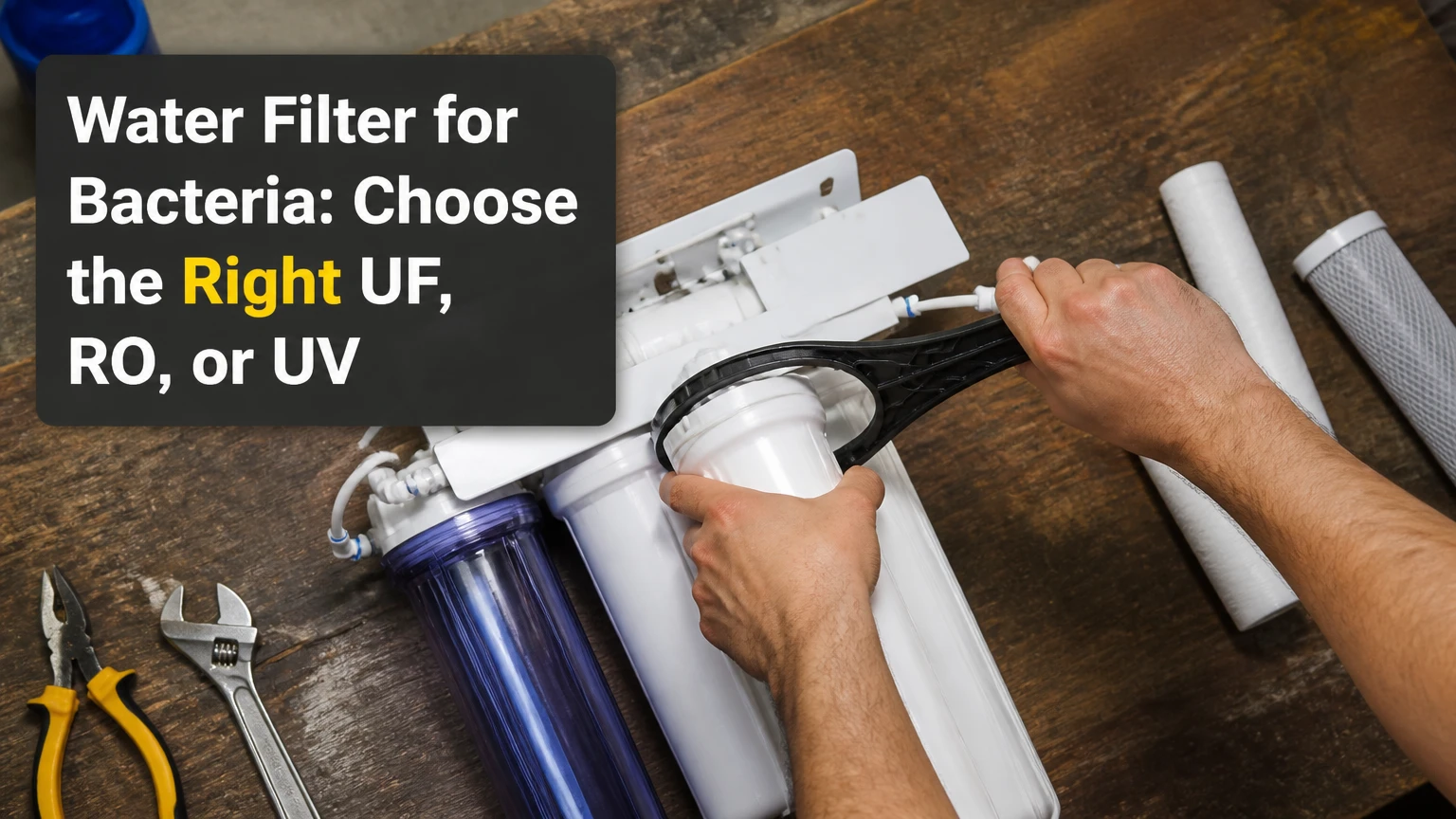
A water filter for bacteria is a treatment system that physically removes bacteria, inactivates them with ultraviolet light, or uses both methods. Ultrafiltration and ceramic membranes can block many bacteria, reverse osmosis provides broader contaminant reduction, and UV disinfection neutralizes microorganisms only when water is clear and the system receives its specified dose.
Key Facts at a Glance
Ultrafiltration membranes commonly use pores near 0.01 micron and retain bacteria while allowing dissolved minerals to pass.
Reverse osmosis removes bacteria, many viruses, dissolved metals, nitrate, and salts, but requires pressure and produces a reject-water stream.
Ultraviolet treatment inactivates microorganisms instead of removing them, and UV requires electricity, clear water, and adequate exposure.
Standard activated-carbon taste filters are not automatically bacteria-safe unless the manufacturer states a microbiological reduction claim.
NSF/ANSI certification must match the contaminant claim, because certification for chlorine or taste does not prove bacterial reduction.
A private well, surface-water source, or failed water test requires a different treatment design than treated municipal water.
What Is a Water Filter for Bacteria?
A water filter for bacteria is a point-of-use or point-of-entry device designed to reduce viable bacterial organisms in drinking water. The device may use a physical barrier, ultraviolet energy, chemical disinfection, or a combination, and the meaningful performance measure is the tested reduction claim rather than the cartridge’s marketing label.
Common waterborne bacteria include Escherichia coli, Salmonella, Shigella, and Vibrio cholerae. Individual cells vary in size, commonly occupying roughly 0.2-2 microns, but a filter’s advertised pore size does not alone guarantee removal because defects, bypass, pressure, flow rate, and installation errors can determine real performance.
The U.S. Centers for Disease Control and Prevention states, “Boiling is the best way to kill germs in water.” That advice matters during a boil-water advisory or when a treatment device has failed. Filtration and UV treatment are convenient household controls, but neither excuses ignoring a public-health notice.
Filtration versus disinfection
Filtration physically retains organisms on or within a barrier. Disinfection leaves organisms in the water but renders them unable to reproduce or cause infection. Reverse osmosis combines separation with broad dissolved-contaminant reduction, while UV is a disinfection process rather than a sieve.
How Do These Systems Remove Bacteria?
Bacterial water treatment works through size exclusion, adsorption, membrane separation, or microbial inactivation. A reliable installation normally places sediment control before the bacteria barrier because suspended solids can block membranes and reduce UV penetration.
A typical drinking-water train follows this sequence:
- A sediment filter reduces sand, rust, and mud.
- An activated-carbon stage reduces chlorine, odors, and selected organic chemicals.
- A UF, ceramic, or RO membrane removes organisms and, in the case of RO, dissolved substances.
- A UV chamber provides disinfection when the source and equipment support the required dose.
- A post-carbon cartridge improves taste without providing dependable pathogen control.
Activated carbon deserves careful interpretation. Carbon can remove chlorine and some organic compounds, but a normal carbon block is not a bacterial barrier. A poorly maintained cartridge can accumulate organic material and support microbial growth, especially when water sits warm inside the housing.
Why does turbidity matter?
Turbidity matters because suspended particles can shield microorganisms from UV radiation and rapidly clog fine membranes. A practical design target is often less than 1 NTU before UV treatment, although the equipment manufacturer’s maximum turbidity and UV-transmittance specifications control the installation.
Which Filter Technologies Handle Bacteria?
UF, RO, UV, ceramic, and microfiltration systems can address bacteria, but they differ in what they remove, what they leave behind, and how failure occurs. The correct choice depends on laboratory results, source risk, flow demand, electricity, wastewater tolerance, and the product’s independently verified claim.
| Technology | Typical specification | Bacterial action | Main limitation |
|---|---|---|---|
| Ultrafiltration | 0.01-0.1 micron membrane | Physically retains bacteria and many cysts | Does not remove dissolved nitrate, arsenic, or salts |
| Reverse osmosis | Approximately 0.0001 micron equivalent separation scale | Retains bacteria and broad dissolved contaminants | Requires pressure and creates concentrate water |
| Ultraviolet | Commonly 254 nm lamp output | Inactivates bacteria and viruses | Fails as a reliable barrier when dose or clarity is inadequate |
| Ceramic microfilter | Approximately 0.2-0.5 micron pores | Retains many bacteria and protozoa | Usually does not reliably remove viruses |
| Chlorine or chlorine dioxide | Chemical dose and contact time | Inactivates bacteria throughout treated water | Taste, organic load, and dosage affect results |
Is ultrafiltration suitable for drinking water?
Ultrafiltration is suitable for bacteria-contaminated water when the membrane has a verified microbiological reduction claim and receives adequate pressure and maintenance. UF usually operates without electricity, produces no routine reject stream, and preserves calcium and magnesium, but it cannot solve dissolved chemical contamination.
UF hollow-fiber membranes often operate at ordinary line pressure. The membrane can retain bacteria, Giardia, and Cryptosporidium cysts while allowing many dissolved minerals through. Some UF products reduce certain larger viruses, but virus performance varies by membrane integrity, pore distribution, and certification, so buyers should not infer universal virus removal from the word “ultrafiltration.”
A UF system is often efficient for treated municipal water with intermittent microbial risk, provided the installation prevents untreated water from bypassing the cartridge. Backwashable models need a specified flush interval, while disposable cartridges need replacement at the rated capacity or time limit.
Winner verdict: Choose UF when bacterial and protozoan protection is the priority and dissolved contaminants are already acceptable.
Does reverse osmosis remove bacteria?
Reverse osmosis removes bacteria and offers the broadest household treatment range among the technologies discussed here. RO also reduces many dissolved metals, salts, nitrate, fluoride, and other contaminants, although performance depends on feed-water chemistry, membrane condition, pressure, and the manufacturer’s tested reduction data.
RO systems push water across a dense semipermeable membrane. The purified stream passes through, while a concentrate stream carries rejected material to a drain or recovery system. Household RO units often need a storage tank because the membrane produces water slowly compared with a faucet’s peak demand.
RO does not eliminate every risk. A contaminated storage tank, unsanitized faucet, ruptured membrane, or incorrectly connected line can reintroduce bacteria after treatment. Many systems also need a carbon prefilter to protect the membrane from chlorine and a postfilter to manage taste.
Winner verdict: Choose RO when bacteria occur alongside nitrate, arsenic, high salinity, fluoride, or other dissolved contaminants confirmed by testing.
When does UV disinfection work?
UV disinfection works when water is low in turbidity, the lamp delivers the specified germicidal dose, water flows within the rated range, and electricity remains available. UV does not remove sediment, metals, chemicals, or dead microorganisms, so it belongs after suitable pretreatment.
Many residential units use low-pressure lamps producing germicidal output near 254 nm. The relevant metric is dose, commonly expressed in millijoules per square centimeter, not the visible glow of the lamp. A clear-looking lamp can still produce insufficient germicidal output after aging.
UV systems typically include a quartz sleeve, lamp, controller, and sometimes a UV-intensity sensor. A high-flow event can reduce exposure time, while a fouled sleeve can block radiation. The lamp is commonly replaced every 9,000 hours or annually, but the equipment manual and intensity alarm take priority.
Winner verdict: Choose UV as a fast, no-waste disinfection stage when electricity, pretreatment, and flow control are dependable.
What can ceramic filtration miss?
Ceramic filters can retain many bacteria and protozoa when their pores are intact, but conventional ceramic microfilters generally cannot be assumed to remove small viruses. Ceramic cartridges also require careful cleaning because scrubbing the surface can enlarge pores if the user removes too much material.
Gravity-fed ceramic units are useful for camping, emergency storage, and off-grid cabins because they need no electricity. Their output is slow, often measured in liters per hour rather than household faucet flow, and their performance declines as the outside surface accumulates sediment.
A ceramic filter should be discarded when it cracks, freezes after becoming wet, reaches its minimum wall thickness, or exceeds its rated capacity. Cleaning restores flow, but it does not restore a damaged barrier.
Winner verdict: Choose ceramic filtration for low-energy bacterial and protozoan control, not as a universal virus or chemical purifier.
UF, RO, UV, and Ceramic Compared
The best bacterial treatment is the one that matches the contaminant profile and operating conditions. A bacteria-only problem does not automatically justify RO, while a chemical problem cannot be solved by UF or UV alone.
| Decision criterion | UF | RO | UV | Ceramic |
|---|---|---|---|---|
| Electricity required | No, typically | Sometimes, often with booster pump | Yes | No |
| Routine water waste | 0% | Typical household ratio 1:1-3:1 | 0% | 0% |
| Dissolved salts removed | No | Yes, often broadly | No | No |
| Typical bacterial role | Primary barrier | Primary barrier | Inactivation | Primary barrier |
| Virus performance | Product-specific | Usually strong, product-specific | Strong with proper dose | Usually limited |
| Typical replacement interval | 12-24 months | Prefilters 6-12 months, membrane 2-5 years | Lamp about 12 months | 6-24 months, cleaning dependent |
| Typical point-of-use cost | $60-$250 | $150-$600 | $300-$1,200 | $30-$250 |
Which system fits each water source?
Municipal water usually benefits from a certified UF or carbon-plus-UV system when the concern is building plumbing or occasional microbial intrusion. Private wells need a laboratory panel before selection because bacteria may coexist with nitrate, arsenic, manganese, hardness, or hydrogen sulfide. Surface water needs stronger pretreatment and a validated disinfection barrier.
| Water source or situation | First action | Common treatment design | Reason |
|---|---|---|---|
| Municipal tap water | Review utility report and test a suspect building | Certified UF plus carbon, or UV after sediment control | Addresses microbial risk without unnecessary salt removal |
| Private well | Test total coliform, E. coli, nitrate, arsenic, and metals | RO plus UV, or disinfection plus targeted filters | Well contaminants vary and TDS alone is incomplete |
| River or lake | Measure turbidity and use validated pathogen treatment | Sediment, ceramic or hollow fiber, then chemical or UV treatment | Surface water carries changing microbial loads |
| Rainwater tank | Inspect roof, tank, and first-flush device | Sediment, carbon, UV, and sanitary storage | Bird and animal waste can introduce bacteria |
| Boil-water advisory | Follow the issuing authority | Boil water or use an explicitly approved alternative | Existing home filters may not provide emergency assurance |
When is a whole-house system necessary?
A point-of-entry system is justified when every tap needs treatment, the source enters through a private well, or shower and laundry exposure also matter. A point-of-use system is usually more economical when only drinking and cooking water require treatment.
Whole-house UV must be sized for peak flow, not average daily consumption. A household with a 12-gallon-per-minute peak demand needs equipment rated for that flow at the specified UV dose, not a small under-sink chamber installed on the main line.
What Do Purchase and Operating Costs Look Like?
Typical residential purchase costs range from $30 for a basic ceramic unit to more than $1,200 for a professionally installed whole-house UV or RO installation. Annual ownership cost depends more on replacement frequency, water waste, electricity, and sanitation labor than on the initial cartridge price.
| System type | Typical purchase price | Main replacement | Typical replacement cost | Typical annual operating cost |
|---|---|---|---|---|
| Gravity ceramic | $30-$250 | Ceramic element every 6-24 months | $15-$100 | $30-$150 |
| Under-sink UF | $60-$300 | Sediment and UF cartridges every 6-24 months | $30-$150 | $50-$250 |
| Under-sink RO | $150-$600 | Prefilters yearly, membrane 2-5 years | $60-$250 | $100-$350 |
| Under-sink UV | $250-$800 | Lamp yearly, sleeve as needed | $50-$180 | $80-$300 |
| Whole-house UV | $700-$2,000 installed | Lamp yearly, prefilter periodically | $100-$300 | $150-$500 |
RO wastewater deserves a household calculation. A unit rejecting two gallons for every gallon produced sends 20 gallons to the drain to make 10 gallons of drinking water; a permeate pump, storage strategy, or high-recovery design may reduce waste, but the product data must document the actual ratio.
How Do You Verify a Product Claim?
Verify the exact contaminant claim, standard, model number, and rated capacity before buying. A general statement such as “purifies water” has less value than an independently certified claim for bacteria, cysts, viruses, or a named chemical.
| Standard or claim | What it generally addresses | What it does not prove by itself | Buyer check |
|---|---|---|---|
| NSF/ANSI 42 | Chlorine, taste, odor, aesthetic effects | Bacterial safety | Confirm whether a separate microbiological claim exists |
| NSF/ANSI 53 | Health-effect contaminants | Universal pathogen removal | Read the specific reduction claim |
| NSF/ANSI 55 | UV microbiological treatment systems | Chemical or sediment removal | Check Class A or Class B classification and flow |
| NSF/ANSI 58 | Reverse osmosis systems | Every organism or chemical | Confirm the listed contaminants and recovery ratio |
| NSF/ANSI 244 | Intermittent microbiological contamination | Continuous treatment for every source | Check rated capacity and operating conditions |
NSF/ANSI 55 Class A UV systems are intended for disinfecting contaminated water that may contain microorganisms, while Class B systems generally provide supplemental treatment for already disinfected drinking water. The distinction changes the appropriate use case.
A laboratory report is more useful than a handheld TDS meter for bacterial decisions. TDS meters estimate ionic conductivity, not E. coli, coliform bacteria, nitrate concentration, arsenic, or virus presence.
How Should You Maintain the System?
Maintain a bacterial treatment system by replacing prefilters on schedule, preventing untreated bypass, sanitizing housings and storage tanks, and testing treated water when the source is private or variable. Maintenance intervals are workload-dependent, so pressure drop, capacity, lamp intensity, and laboratory results should supplement calendar reminders.
| Maintenance task | Typical interval | Failure sign | Corrective action |
|---|---|---|---|
| Replace sediment cartridge | 3-12 months | Falling flow or rising pressure drop | Install the rated micron cartridge |
| Replace carbon cartridge | 6-12 months | Chlorine taste or odor return | Replace and flush according to instructions |
| Replace UV lamp | 9,000 hours or 12 months | Alarm, low intensity, lamp age | Replace lamp and clean quartz sleeve |
| Sanitize RO tank and lines | 6-12 months | Repeated bacteria detection or odor | Follow manufacturer sanitation procedure |
| Inspect ceramic element | Monthly and after cleaning | Crack, thin wall, damaged gasket | Replace immediately |
| Test private well water | At least annually and after repairs | Positive coliform or E. coli result | Disinfect source and investigate entry point |
Expert rule: replace a UV lamp because its rated output has declined, not because visible light has disappeared. The lamp can glow while emitting too little germicidal radiation.
Expert rule: a sudden pressure drop usually identifies a restricted upstream stage before it identifies a failed RO membrane. Check the sediment cartridge, shutoff valves, kinked tubing, and inlet pressure in that order.
Expert rule: never judge microbial safety by taste, smell, clarity, or TDS. Bacteria can be present in clear, odorless water, and a pleasant-tasting filter can provide no pathogen protection.
What Problems and Edge Cases Matter?
The most serious failures involve bypass, poor storage hygiene, wrong flow sizing, and treating the wrong contaminant. A certified membrane cannot protect water that travels around the cartridge, while UV cannot compensate for a cloudy feed stream or a dead lamp.
Why did the water flow suddenly slow?
A sudden flow reduction usually results from a blocked sediment cartridge, fouled UF or ceramic membrane, low inlet pressure, closed valve, or airlock. Replace or clean the first restricted stage, then confirm pressure and flow against the system specification.
A gradual decline is normal for a loaded filter. A rapid decline after heavy rain, well work, construction, or a plumbing repair suggests a new sediment load or source disturbance. Do not remove the prefilter to restore speed, because downstream components may clog or fail.
Why did bacteria appear after filtration?
Bacteria detected after treatment can result from source contamination, membrane damage, untreated bypass, a contaminated faucet, biofilm in tubing, or an unsanitized RO tank. Collect a properly handled raw-water sample and treated-water sample, then inspect the entire treatment path.
For a positive E. coli result, stop drinking the water until the source is corrected or an approved emergency method is used. Whole-house shock chlorination may be appropriate for some wells, but the procedure must match local health-department guidance and the well construction.
What should families with higher health risk do?
Infants, older adults, pregnant people, and immunocompromised individuals should follow local health guidance rather than relying on an unverified household filter. During an advisory, use bottled water or boil water as directed unless the authority explicitly approves the installed treatment device.
What Are the Emergency Alternatives?
Boiling is the most broadly dependable household emergency method for bacteria, viruses, and protozoa when performed correctly, but boiling does not remove metals, salts, fuel, or other chemicals. Chemical disinfectants and portable purifiers can work when the product specifies organisms, dose, contact time, and water volume.
| Alternative | Typical operating requirement | Bacterial coverage | Important limitation |
|---|---|---|---|
| Rolling boil | 1 minute, or 3 minutes at high elevation | Strong for most pathogens | Uses fuel and does not remove chemicals |
| Chlorine dioxide tablets | Product-specific dose and contact time | Bacteria, viruses, many protozoa | Requires waiting period and accurate dosing |
| Portable hollow-fiber filter | Often 0.1-0.2 micron | Bacteria and protozoa | Usually limited against viruses and chemicals |
| Gravity ceramic filter | Manual flow through ceramic element | Many bacteria and protozoa | Slow and vulnerable to cracks |
| UV pen | Clear water and battery power | Strong when dose is delivered | Ineffective through turbidity or dead batteries |
Portable filters are not interchangeable with portable purifiers. A device labeled “filter” may remove bacteria and cysts but leave viruses, while a purifier generally combines filtration with a validated disinfection method.
FAQ
Can a carbon pitcher remove E. coli?
A standard carbon pitcher should not be assumed to remove E. coli. Activated carbon commonly improves chlorine taste and odor, but only a model with a specific, independently verified microbiological reduction claim should be considered for bacterial treatment.
Does a 1-micron filter remove bacteria?
A 1-micron filter may retain some larger bacteria attached to particles, but it is not a dependable universal bacterial barrier. Bacterial cells can be smaller than 1 micron, and nominal ratings do not describe every pore or guarantee performance under household pressure.
Is boiling better than filtering bacteria?
Boiling is generally the safer emergency option when the filter’s bacterial claim, condition, or installation is uncertain. Boiling kills microorganisms but leaves dissolved chemicals behind, whereas a certified filter may provide continuous treatment and address selected chemical contaminants.
Can a water softener remove bacteria?
A conventional water softener removes hardness ions such as calcium and magnesium, not bacteria. The resin tank can also become a microbial growth site if maintenance is poor, so softening and pathogen treatment should be treated as separate functions.
Should filtered water be refrigerated?
Refrigeration slows bacterial growth but does not make contaminated water safe. Store treated water in a clean, covered container, avoid touching the outlet, and follow the filter manufacturer’s storage limit, particularly when water remains unused for several days.
Does RO water need UV?
RO water does not automatically need UV, but UV can add protection when the source has ongoing microbial risk or when post-RO storage creates concern. The better choice depends on membrane integrity, tank sanitation, source testing, and whether the UV unit is correctly sized.
The Bottom Line
The right water filter for bacteria depends on both microorganisms and the rest of the water chemistry. Choose certified UF for bacterial protection without mineral removal, RO when bacteria accompany dissolved contaminants, UV when clear water and reliable electricity are available, and ceramic filtration for low-energy bacterial and protozoan control. Test private wells, follow boil advisories, and verify the exact reduction claim before purchase.