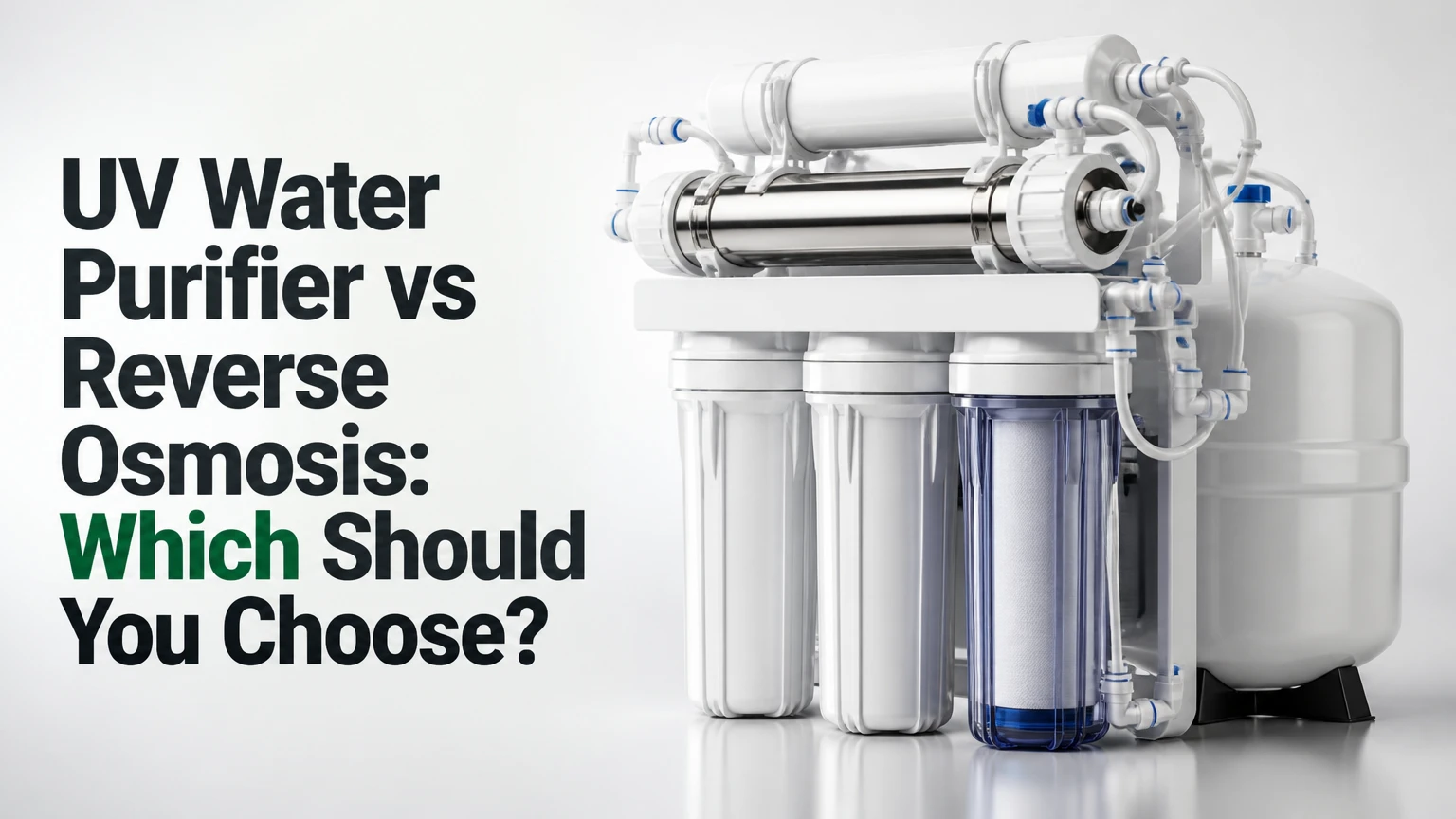
A UV water purifier is usually better for microbiological risk in clear, low-mineral water, while reverse osmosis is better for dissolved salts, metals, nitrate, fluoride, and high total dissolved solids. UV disinfects without removing contaminants; RO separates many contaminants from water but wastes some feed water and requires more maintenance.
Key Facts at a Glance
UV light inactivates bacteria, viruses, and protozoa; it does not reduce lead, arsenic, nitrate, hardness, or TDS.
Reverse osmosis removes many dissolved contaminants, including salts and several heavy metals, but performance depends on pressure, temperature, membrane condition, and pretreatment.
Clear water is necessary for effective UV treatment because suspended particles can shield microorganisms from the light.
A typical residential RO system sends 1-4 gallons of concentrate to the drain for each gallon of treated water, although efficient systems can perform better.
UV and RO do different jobs, so a properly designed RO plus UV system can be appropriate for contaminated well water.
A laboratory water report should determine the treatment choice; TDS alone cannot identify every health-relevant contaminant.
UV Water Purifier vs Reverse Osmosis: The Core Difference
The core difference is the treatment objective. A UV water purifier applies ultraviolet-C energy to inactivate microorganisms, whereas a reverse osmosis system uses pressure and a semipermeable membrane to reduce dissolved and suspended contaminants.
| Attribute | UV water purifier | Reverse osmosis system | Decision meaning |
|---|---|---|---|
| Primary action | Microbial inactivation | Membrane separation | Choose by contaminant class |
| Removes dissolved salts | No | Usually yes | RO fits brackish or high-TDS water |
| Inactivates microbes | Yes, with adequate dose | Variable, depending on integrity and design | UV adds a dedicated disinfection barrier |
| Retains calcium and magnesium | Yes | No, or greatly reduces them | UV preserves original mineral content |
| Wastewater | Usually none | Typically 1-4 gallons per gallon produced | RO has a water-use penalty |
| Electricity | Lamp and controller, commonly 10-60 watts | Pump and controls, commonly 30-150 watts | Both need reliable power |
| Storage | Usually unnecessary | Tank or high-flow tankless design | RO output may be slower |
| Main maintenance | Lamp, quartz sleeve, prefilter | Prefilters, membrane, postfilter, tank sanitation | RO has more service points |
What Does UV Remove From Water?
A UV water purifier does not remove material from water. UV-C energy damages microbial nucleic acids, preventing organisms from reproducing, but sediment, metals, minerals, pesticides, and dissolved gases remain chemically present.
The U.S. Environmental Protection Agency explains that ultraviolet treatment disinfects water through exposure to UV energy, while pretreatment controls turbidity and particles that interfere with exposure. Effective systems therefore use a sediment filter before the UV chamber, and many homes add activated carbon for taste, odor, and selected organic compounds.
UV treatment also depends on delivered dose, not merely on a glowing lamp. Dose depends on intensity, contact time, flow rate, lamp age, sleeve cleanliness, and water clarity. A high-flow fixture paired with an undersized UV chamber can pass water too quickly for the required dose.
What Does Reverse Osmosis Remove?
Reverse osmosis reduces many dissolved ions and molecules by forcing pressurized water through a thin-film composite membrane. The membrane permits some water molecules through while rejecting a concentrated stream containing salts and other contaminants.
The EPA defines reverse osmosis as “a water treatment process that removes contaminants from water by using pressure to force water molecules through a semipermeable membrane.” RO commonly reduces sodium, chloride, sulfate, lead, copper, arsenic, fluoride, nitrate, and total dissolved solids, but actual rejection varies by membrane, pH, temperature, pressure, and contaminant chemistry.
RO is not identical to sterilization. A healthy membrane rejects many microorganisms, but a post-membrane storage tank, faucet, or poorly maintained housing can permit regrowth. A final UV stage can provide an additional microbial barrier when the source water has a known biological risk.
How Do UV and RO Systems Work?
UV water treatment uses energy, while reverse osmosis uses separation. The difference determines the required pretreatment, the contaminants addressed, the pressure requirements, and the maintenance schedule.
How Does UV Water Treatment Work?
A typical UV system follows this sequence:
- Sediment filtration: Removes sand, rust, silt, and suspended particles.
- Optional carbon filtration: Reduces chlorine, odors, and some organic chemicals.
- UV chamber exposure: Passes clear water around a UV lamp inside a quartz sleeve.
- Treated distribution: Sends disinfected water to the faucet or building plumbing.
A common low-pressure mercury lamp emits UV-C near 254 nanometers, although newer systems may use different lamp technologies. The lamp does not “kill” every organism in the conventional sense. It damages genetic material so bacteria, viruses, and protozoa cannot reproduce effectively.
Quartz sleeve scale is a frequent field failure. Calcium carbonate deposits reduce transmitted UV intensity even when the lamp remains illuminated. Replace the lamp according to the manufacturer’s operating-hour schedule, commonly around 9,000 hours or annually, and clean the sleeve when inspection shows deposits.
How Does Reverse Osmosis Work?
A typical under-sink RO system follows this sequence:
- Sediment cartridge: Protects carbon filters and the membrane from particulate loading.
- Carbon cartridges: Reduce chlorine and chloramine according to the cartridge rating.
- Booster pump, when needed: Raises pressure if household pressure is too low.
- RO membrane: Produces permeate, or treated water, and concentrate, or drain water.
- Storage tank or direct-flow module: Holds or produces treated water.
- Post-carbon filter: Polishes taste before dispensing.
- Remineralization cartridge, optional: Adds selected minerals and changes taste and pH.
A membrane’s advertised “0.0001 micron” figure should not be treated as a literal universal pore measurement. RO membranes are dense polymer barriers, and rejection results from solution-diffusion, charge effects, and membrane chemistry rather than a simple sieve with uniform holes.
RO performance requires sufficient feed pressure. Many residential systems operate best around 50-80 psi, while low-pressure homes may need a booster pump. Cold water also reduces production rate, so a system rated at a particular gallons-per-day figure will not deliver that rate under every household condition.
Which Contaminants Need UV, RO, or Both?
No purifier should be selected from TDS alone. TDS indicates the concentration of conductive dissolved material, but it does not identify whether the dissolved material is harmless calcium or hazardous nitrate.
| Contaminant or concern | UV result | RO result | Better treatment path |
|---|---|---|---|
| E. coli and other bacteria | Inactivates with adequate dose | Often rejects, but verify integrity | UV, or RO plus UV |
| Viruses | Inactivates with adequate dose | Often rejected, but not a sterilization guarantee | UV, or validated RO plus UV |
| Protozoa | Inactivates with adequate dose | Often rejected | UV for biological assurance |
| Lead | No reduction | Often substantially reduces | Certified RO or lead-specific filter |
| Arsenic | No reduction | Depends on arsenic form and membrane | Test first, then certified RO or specialty media |
| Nitrate | No reduction | Often reduces | Certified RO or anion exchange |
| Fluoride | No reduction | Often reduces | Certified RO |
| Hardness and scale minerals | No reduction | Reduces | RO or water softening, depending on use |
| Chlorine taste | No direct reduction | Carbon pretreatment reduces it | Activated carbon |
| PFAS | No reliable reduction | Some membranes reduce PFAS | Certified PFAS-rated treatment |
| Sediment and rust | No removal | Prefilters remove larger particles | Sediment filtration |
| Hydrogen sulfide odor | No reliable reduction | Variable | Oxidation, aeration, or specialty media |
Does UV Remove TDS?
UV does not remove TDS. A UV purifier leaves dissolved minerals, salts, metals, and other soluble material in the treated water, so a TDS meter should show little change before and after UV exposure.
RO usually lowers TDS substantially, but a low post-RO TDS reading does not prove removal of every contaminant. Some substances require separate certification or treatment, and a TDS meter cannot detect many organic chemicals or microbial organisms.
Which System Uses Less Water and Electricity?
UV normally uses less water because the treatment process does not create a concentrate stream. RO uses more water because the membrane must carry rejected contaminants away from its surface, although wastewater ratios vary widely between models and operating conditions.
| Operating factor | UV system | Conventional tank RO | Efficient tankless RO |
|---|---|---|---|
| Typical treated flow | 5-30 gallons per minute whole-house | 20-100 gallons per day | 400-1,200 gallons per day rating |
| Water recovery | Approximately 100% | Commonly 20-50% | Commonly 50-75% |
| Drain water per gallon treated | Approximately 0 gallons | Approximately 1-4 gallons | Approximately 0.3-1 gallon |
| Output delay | Seconds | Tank refill may take 1-3 hours | Usually immediate at rated flow |
| Typical power draw | 10-60 watts | 30-150 watts with pump | 50-200 watts with pump |
| Mineral change | Minimal | Major reduction | Major reduction |
A household that drinks and cooks with 3 gallons of RO water daily could send roughly 1,095-4,380 gallons to the drain annually under a 1:1 to 4:1 operating ratio. Some households reuse concentrate for toilet flushing or laundry, but concentrate should not be used where elevated salts could damage plants or appliances.
What Does Each System Cost to Own?
Typical U.S. residential purchase prices range from $150-$500 for many UV point-of-use systems and $250-$1,500 for installed RO systems. Whole-house UV equipment, plumbing alterations, booster pumps, storage, pretreatment, and water testing can raise the total substantially.
| Ownership item | UV purifier | Tank RO | Tankless RO |
|---|---|---|---|
| Typical equipment price | $150-$500 | $250-$900 | $400-$1,500 |
| Professional installation | $150-$600 | $200-$700 | $250-$800 |
| Sediment or carbon replacement | $30-$150 annually | $40-$150 annually | $50-$200 annually |
| Lamp or membrane replacement | $60-$200 yearly lamp | $40-$150 membrane every 2-5 years | $60-$250 membrane every 2-5 years |
| Water test before purchase | $50-$300 typical | $50-$300 typical | $50-$300 typical |
| Typical annual operating cost | $90-$350 | $120-$350 | $150-$450 |
Manufacturer schedules take priority over generic intervals. Replace UV lamps annually when specified, even if visible light remains, because visible illumination does not confirm adequate UV-C output. Replace RO carbon filters every 6-12 months in many homes, and test membrane performance with a calibrated TDS meter or laboratory sample.
Which System Type Fits Your Installation?
System architecture matters as much as treatment technology. A point-of-use purifier treats one faucet, while a point-of-entry system must meet the peak flow demand of showers, toilets, appliances, and outdoor fixtures.
| Installation type | Best fit | Typical capacity or limitation | Main caution |
|---|---|---|---|
| Under-sink UV | Clear municipal or well water at one faucet | Faucet flow, commonly 0.5-2 gallons per minute | Requires sediment control and electricity |
| Whole-house UV | Microbial risk throughout a property | Commonly 5-30 gallons per minute | Size for peak flow, not average flow |
| Under-sink tank RO | Drinking and cooking water | Tank commonly 2-4 gallons | Occupies cabinet space and produces concentrate |
| Tankless RO | Higher demand and limited cabinet space | Commonly 400-1,200 GPD rating | Needs power, pressure, and drain connection |
| Countertop RO | Renters or temporary housing | Manual reservoir filling | Does not treat shower or appliance water |
| Portable UV pen | Clear water during travel or emergencies | Bottle-sized batches | Does not clarify cloudy water or remove chemicals |
A UV whole-house system cannot protect against lead from plumbing or nitrate from a well. An under-sink RO system cannot protect a shower from microbial contamination. Match the installation point to the exposure route.
Which Should You Choose?
The correct choice depends on source water, verified contaminants, pressure, flow, budget, and tolerance for wastewater. The following personas provide a practical decision rule.
Choose UV for Clear Municipal Water With Microbial Concern
Choose UV when a laboratory report shows low dissolved contaminants but the property has a credible microbial risk, such as a private well or vulnerable distribution line. Add sediment filtration first, and use activated carbon if chlorine taste or odor is a separate concern.
For ordinary compliant municipal water, UV may provide limited additional value unless a building-specific risk exists. Ask the utility for its annual water-quality report, then test at the tap if the property has old plumbing or a known service-line concern.
Choose RO for High TDS, Salty, or Chemically Contaminated Water
Choose reverse osmosis when water has high dissolved solids, salty or bitter taste, hardness-related scaling, or laboratory-confirmed nitrate, fluoride, or selected metal contamination. RO is generally a point-of-use solution for drinking and cooking, not a sensible way to treat every gallon used in a home.
RO cannot correct every well-water problem by itself. Iron, manganese, hydrogen sulfide, hardness, sediment, and chlorine or chloramine may require pretreatment to protect the membrane.
Choose RO Plus UV for a Contaminated Private Well
Choose an RO plus UV design when testing identifies both dissolved chemical contaminants and biological risk. A typical arrangement uses well pretreatment, sediment filtration, carbon where compatible, RO for dissolved contaminants, and UV at the final drinking-water point.
The sequence must reflect the water report. For example, iron fouling can overwhelm a membrane, while inadequate carbon can expose a thin-film composite membrane to chlorine. A local water-treatment professional should size flow, pressure, pretreatment, and disinfection dose together.
Choose Countertop RO for a Renter or Apartment Resident
A countertop RO unit fits renters who need lower dissolved solids without permanent plumbing. It can be useful when the kitchen faucet water is chemically unpleasant but building-wide treatment is unavailable.
Countertop RO does not eliminate the need for cartridge replacement or cleaning. Confirm that the reservoir, product-water pathway, and dispensing vessel can be sanitized, and measure the actual wastewater ratio rather than trusting a laboratory rating.
Choose Neither Until You Test Unknown Water
Unknown private-well water should be tested before buying a purifier. At minimum, test for coliform bacteria and E. coli, nitrate, pH, hardness, iron, manganese, arsenic, lead, and TDS; expand the panel based on local geology, agriculture, fuel storage, or nearby industry.
A water test is more informative than a high or low TDS number. TDS can identify a dissolved-load problem, but only a contaminant-specific test can establish whether the water contains nitrate, arsenic, or a microbial hazard.
What Problems Do UV and RO Systems Commonly Have?
UV systems fail when flow is too high, water is cloudy, the lamp is old, the quartz sleeve is scaled, or the controller cannot verify output. RO systems fail when filters clog, pressure is inadequate, the membrane is chemically damaged, the tank loses air charge, or the drain valve remains open.
| Symptom | Likely cause | Corrective action | Prevention |
|---|---|---|---|
| UV alarm sounds | Lamp failure or low output | Shut off treated-water use and replace lamp | Annual lamp replacement |
| UV water remains cloudy | Sediment bypass or inadequate prefilter | Replace or resize sediment stage | Monitor turbidity |
| UV flow is weak | Clogged prefilter or scaled housing | Replace cartridge and clean sleeve | Scheduled service |
| RO tastes like tap water | Exhausted carbon or membrane | Test rejection and replace failed stage | Six-to-twelve-month filter service |
| RO produces slowly | Low pressure or cold feed water | Measure pressure and inspect filters | Booster pump where required |
| RO drains continuously | Faulty shutoff valve or check valve | Inspect valves and drain routing | Correct installation |
| RO tank has little output | Lost air charge or waterlogged bladder | Service or replace tank | Annual pressure check |
| Biofilm appears at faucet | Unsanitary tank or postfilter | Sanitize system and replace filter | Clean installation and service |
What Is the Most Common UV Mistake?
The most common UV mistake is treating bulb illumination as proof of disinfection. A lamp can glow while its effective germicidal output is too low because of age, sleeve scale, ballast failure, excessive flow, or sensor malfunction.
Use a UV system with a visible or audible output alarm when possible. Never send cloudy water through a UV chamber without effective pretreatment, because suspended particles can block exposure to microorganisms.
What Is the Most Common RO Mistake?
The most common RO mistake is postponing carbon-filter replacement. Chlorine can damage many thin-film composite membranes, and a membrane that has lost rejection may continue producing clear, pleasant-tasting water.
Measure feed and product TDS before concluding that the membrane works. A useful field calculation is:
Rejection percentage = (feed TDS – product TDS) ÷ feed TDS × 100
The result is a screening tool, not a substitute for laboratory contaminant testing.
Are There Better Alternatives?
Activated carbon is often the best first treatment for chlorine, taste, and odor, but carbon does not provide broad dissolved-salt removal. Ultrafiltration can remove particles and many microorganisms while retaining minerals, yet it does not reliably reduce dissolved salts, nitrate, or fluoride. Boiling can inactivate pathogens during an emergency, but boiling does not remove metals or salts and can concentrate nonvolatile contaminants.
Look for product certification rather than broad advertising claims. NSF, ANSI, and WQA certification may address particular contaminant-reduction claims, so confirm the exact standard and contaminant listed for the model rather than assuming that certification covers every hazard.
How Should You Maintain the Chosen System?
Maintain UV by replacing the lamp on schedule, cleaning the quartz sleeve, changing prefilters, checking alarms, and confirming that the flow rate remains within the rated limit. Maintain RO by changing sediment and carbon cartridges, sanitizing the tank and housings, checking pressure, inspecting the drain flow, and measuring membrane rejection.
Keep RO and UV equipment on cold-water lines only. Hot water can damage membrane materials, cartridges, tubing, and housings. During a power outage, a UV system cannot provide its designed disinfection dose, so use an approved emergency treatment method until power returns.
FAQ
Does RO water need UV treatment?
RO water does not automatically need UV treatment. Add UV when source water has a meaningful microbial risk, the RO system includes a storage tank that needs an additional barrier, or a validated treatment design requires final disinfection. For treated municipal water with no biological concern, UV may add little practical value.
Is UV water safer than RO water?
Neither UV nor RO is universally safer. UV is stronger against biological hazards, while RO is stronger against many dissolved contaminants. A properly maintained, certified system matched to the laboratory water report is safer than an incorrectly selected purifier with impressive marketing specifications.
Can UV work without electricity?
A powered UV purifier cannot work without electricity because the lamp and controller need power. Battery-powered UV pens can treat small volumes of clear water, but they require correct dose, mixing, battery capacity, and transparent water. They do not remove chemical contamination, sediment, or metals.
Does reverse osmosis remove beneficial minerals?
Reverse osmosis removes much of the calcium, magnesium, sodium, and other dissolved mineral content along with unwanted dissolved substances. Mineral removal is not automatically harmful, because dietary minerals mainly come from food, but some users prefer a remineralization cartridge for taste and water chemistry.
How often should a UV lamp be replaced?
Many residential UV lamps require replacement every 12 months, even when the lamp still produces visible light. Actual timing depends on the manufacturer’s rated operating hours, commonly about 9,000 hours, and the controller’s output monitoring. Clean the quartz sleeve whenever scale reduces transmission.
How can I reduce RO wastewater?
Select a system with a published recovery ratio, maintain correct feed pressure, replace clogged prefilters, and verify that the automatic shutoff valve works. Reuse suitable concentrate for toilet flushing or cleaning where local water chemistry permits, but do not assume every drain stream is safe for plants or appliances.
The Bottom Line
UV water purifier vs reverse osmosis is not a contest between two interchangeable technologies. Choose UV for clear water with biological risk and minimal mineral change; choose RO for dissolved salts, high TDS, nitrate, fluoride, or certified metal reduction; choose RO plus UV only when testing demonstrates both chemical and microbial treatment needs. Test the water first, then size and certify the system for the actual contaminant.