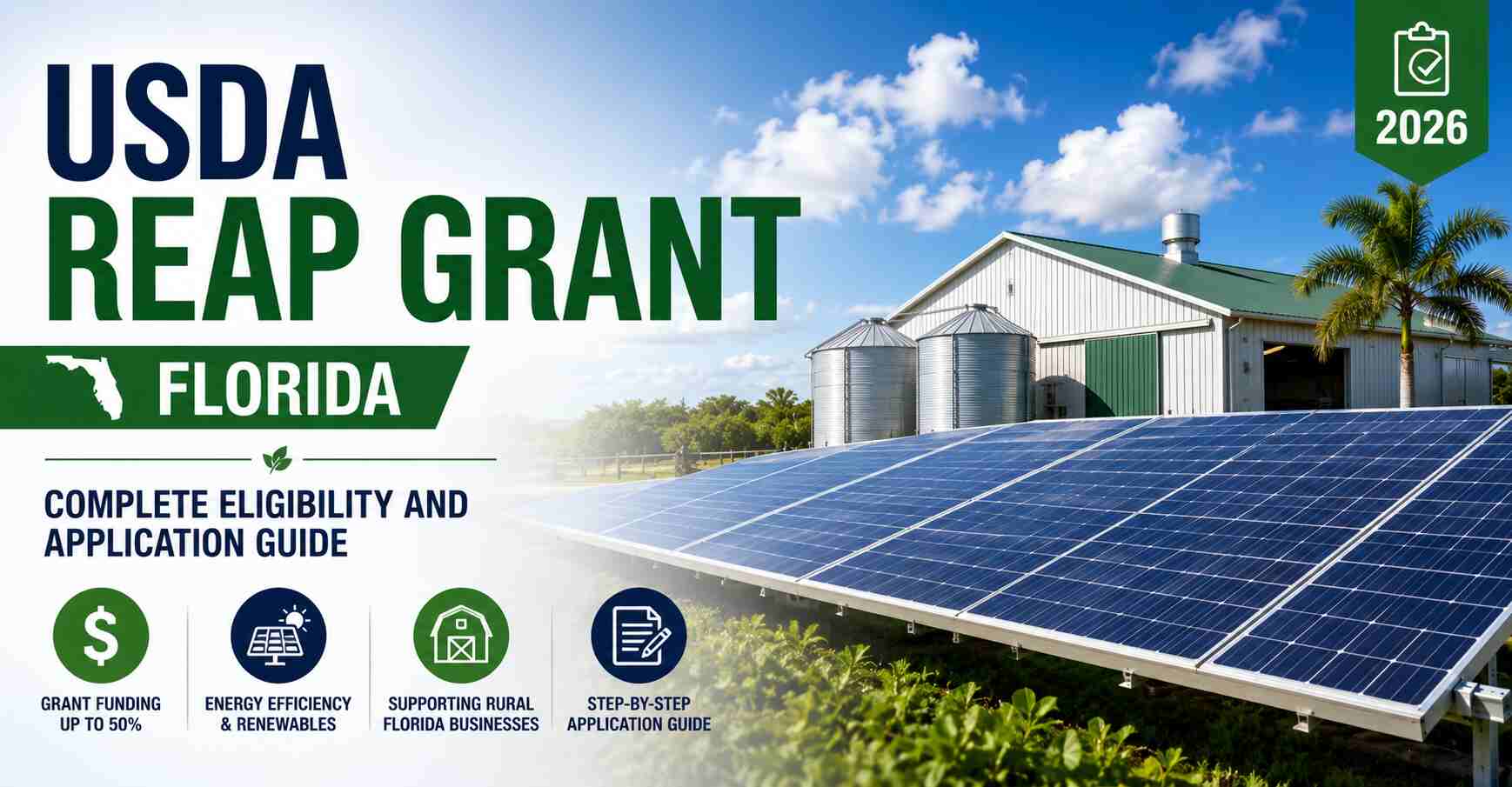
Upgrading your agricultural operation or rural enterprise with renewable energy or high efficiency equipment is a massive financial undertaking. Fortunately, the United States Department of Agriculture provides a highly lucrative solution to help you transition smoothly. The USDA Rural Energy for America Program offers substantial grants and guaranteed loans designed to offset installation costs for clean energy systems and power efficiency improvements. If you operate a Florida agribusiness or a rural commercial company, understanding the exact Florida USDA REAP eligibility criteria is the first critical step toward securing this essential funding.
Florida agriculture faces unique challenges, from rising utility costs cooling packing houses to the heavy energy demands of massive irrigation systems. This comprehensive guide provides in depth research on applicant rules, project requirements, the competitive scoring system, and strategies to maximize your funding potential. Our goal is to give you actionable advice to navigate the application process and secure funding for your enterprise.
What is the USDA Rural Energy for America Program?
The USDA energy grant Florida program helps rural businesses and agricultural producers lower their overhead by transitioning to clean, reliable energy. Whether you own a massive citrus grove in Central Florida, operate a sprawling ornamental nursery in the Panhandle, or run an aquaculture facility on the coast, this program helps reduce energy costs while promoting environmental sustainability.
Unlike standard federal loans, these are direct cash grants that do not need to be repaid, provided you meet all operational requirements. The program blends traditional farm bill funding with recent legislative investments to offer unprecedented financial support. However, securing these funds requires strict adherence to federal guidelines, meticulous documentation, and a clear understanding of your organizational structure.
Who Qualifies? Florida USDA REAP Eligibility Rules
There are two primary tracks for applicants to qualify for the USDA REAP grant in Florida. You must fit neatly into one of these two definitions to move forward in the process.
Track 1: Agricultural Producers
If your primary business is farming, ranching, or agriculture, you fall into this category. The strict federal requirement dictates that at least 51 percent of your gross income must come directly from agricultural production. This production includes growing crops, raising livestock, harvesting timber, or operating aquaculture farms. You will need to provide three years of tax returns to verify this income threshold.
A major advantage for agricultural producers is the geographical exemption. Your farm or agricultural facility does not need to be located in a strictly defined rural area. You can operate in an urban or suburban Florida county, provided your project directly supports your agricultural production and you meet the 51 percent income threshold. This exemption is incredibly valuable for urban greenhouses and farms operating near expanding Florida cities.
Track 2: Rural Small Businesses
If your enterprise involves processing, packaging, or support services that do not meet the 51 percent direct farm income rule, you can still apply as a rural small business. However, you must meet two rigid criteria.
First, you must qualify as a small business under the standard Small Business Administration size guidelines for your specific industry. Second, your physical business address must be located in a USDA defined rural area. The USDA classifies a rural area as any city, town, or unincorporated region with a population of 50,000 residents or fewer. You must verify your exact business address on the official USDA Rural Development property eligibility map before you begin your application.
Eligible Projects and Funding Caps for Florida Agribusinesses
You cannot use these funds for general farm repairs, buying new tractors, or constructing standard storage buildings. The grants exclusively cover renewable energy systems and energy saving upgrades.
Eligible projects include solar photovoltaic installations, wind turbines, biomass energy systems, and geothermal installations. For energy efficiency, you can upgrade to high efficiency HVAC units, replace old greenhouse heating systems, install modern LED lighting, or swap out inefficient irrigation pumps. Ineligible expenses include standard building construction, residential energy systems attached to your primary home, and any application preparation fees. Furthermore, the USDA will not reimburse any equipment purchased before they receive your complete application.
The funding structure dictates specific project minimums and maximums. Qualified Florida applicants can receive grants covering up to 50 percent of their total eligible project costs.
How to Maximize Funding: Stacking REAP with Federal Tax Credits
One of the most powerful financial strategies for a Florida agribusiness is clean energy grant stacking. The REAP grant alone can cover up to 50 percent of your eligible project costs. However, the financial benefits do not stop there. You can also claim the base 30 percent Federal Investment Tax Credit for solar and renewable energy installations.
Because your agribusiness operates in Florida, you might qualify for additional bonus tax credits if your facility sits in a designated energy community or a specific low income geographic area. When you combine the USDA grant with the federal tax credit, you drastically reduce your out of pocket expenses. In many cases, Florida agribusinesses can offset 80 percent of their total solar investment.
Navigating the REAP Grant Scoring System
Because funding is limited, the application process is a highly competitive grant competition. The USDA scores every application on a strict 100 point scale. Funds are distributed to the highest scoring projects first until the state budget pool is fully exhausted. To win an agribusiness solar grant Florida allocation, you must understand exactly how the state energy office awards points.
- Quantity of Energy Generated or Saved: The USDA awards up to 25 points to projects that produce substantial renewable energy or drastically cut existing power consumption. You must prove these numbers through your technical reports.
- Environmental Benefits: Projects that demonstrably lower greenhouse gas emissions or improve local environmental conditions can earn up to 15 points.
- Commitment of Funds: You secure up to 15 points by providing bank statements or official lender letters proving you have the remaining project funds completely secured and ready to spend.
- Size of Request: The program heavily favors localized operations. Projects requesting smaller grant amounts automatically receive up to 15 baseline points.
- Previous Winners: First time applicants who have never utilized the program receive up to 15 priority points over businesses that have previously won.
- Simple Payback Period: The faster your generated energy savings offset your initial equipment costs, the higher your score. Excellent payback periods earn up to 15 points.
Step by Step USDA REAP Application Florida Process
Proper preparation separates successful applications from immediate rejections. Follow these structured steps to ensure your Florida rural small business energy grant application is flawless and ready for approval.
Step 1: Secure Mandatory Federal Registrations
You cannot submit an application without an active registration in the System for Award Management. Navigate to the official SAM website and request a Unique Entity ID. This process is entirely free but can take several weeks to clear federal background checks. Additionally, agricultural producers must establish a formal customer record and farm number with their local Florida Farm Service Agency office. Missing this step is a primary reason for early application rejection.
Step 2: Obtain Technical Reports and Energy Audits
Every energy efficiency project requires a formal energy audit performed by a certified third party professional. This audit establishes your current baseline power usage and mathematically validates your projected savings.
Renewable energy projects require a specific technical report. The complexity depends on your total project cost. Projects under 80,000 dollars require a basic tier one report which you can often complete using vendor specifications. Projects between 80,000 dollars and 200,000 dollars require a tier two report with a detailed line item budget. Massive projects exceeding 200,000 dollars demand a tier three comprehensive engineering document verified by a licensed professional engineer.
Step 3: Complete Form RD 4280 and Budget Paperwork
The core of your application package involves filling out specific USDA paperwork. Form RD 4280 is the primary document required for all standard applications. You will also need to submit three consecutive years of historical business tax returns to prove your financial viability, verify your agricultural income threshold, or confirm your SBA size status. Finally, you must include precise vendor quotes detailing exact equipment costs.
Understanding Essential Environmental Reviews
Before final approval, every project must pass a strict environmental review conducted by the federal government. If your project involves significant ground disturbance, such as digging deep trenches for ground mounted solar arrays or pouring heavy concrete foundations, the USDA must verify the construction will not disrupt historical tribal lands, endanger local wildlife species, or negatively impact protected Florida wetlands.
Conversely, roof mounted solar arrays or internal lighting upgrades generally qualify for a categorical exclusion. Because these projects do not disturb new ground, they pass the environmental review phase much faster. You must factor these review timelines into your overall construction schedule.
Quarterly Application Deadlines and Florida Contacts
Historically, the program operated on semi annual batches, but the USDA now reviews applications in quarterly competitive pools. The primary deadlines officially close on the final business day of March, June, September, and December. If your application misses the funding cutoff in one quarter due to extreme competition, the USDA will automatically roll it into the next quarterly evaluation pool for reconsideration within the same fiscal year.
Before you invest substantial capital in certified audits or engineering designs, you must speak directly with the Florida USDA state energy coordinator. The Florida State Office, located in Gainesville, manages the distribution of these funds across the state. Contacting their office allows you to confirm your specific rural eligibility status, ask questions about eligible equipment, and verify current funding availability for Florida agricultural energy grants.
Conclusion
Securing a USDA energy grant Florida award requires meticulous preparation, strict adherence to federal eligibility rules, and a deep understanding of the competitive scoring rubric. Whether you operate a traditional crop farm, a coastal aquaculture facility, or a rural commercial enterprise, the financial benefits of offsetting up to 50 percent of your clean energy upgrades are immense. By thoroughly verifying your applicant track, securing your SAM registration early, providing robust technical documentation, and stacking your grant with federal tax credits, you perfectly position your agribusiness for outstanding long term financial success.
Next Step
Are you ready to transform your operation, slash your monthly utility bills, and lower your overhead costs? Contact your local Florida USDA State Energy Coordinator today to verify your property eligibility, or reach out to a certified clean energy consultant to begin drafting your project technical reports and secure your funding application!