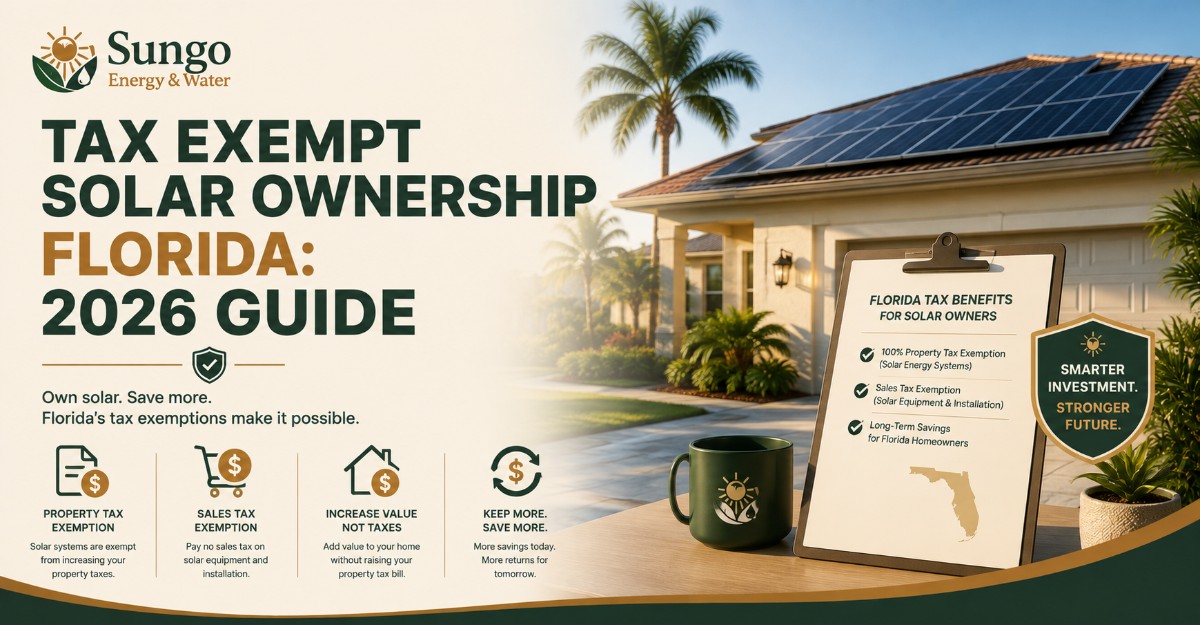
Tax exempt solar ownership in Florida means qualifying solar equipment can be purchased without Florida sales and use tax, while qualifying residential solar value is excluded from the home’s property-tax assessment. These protections remain available in 2026, but they are separate from the federal Residential Clean Energy Credit, which ended for expenditures made after December 31, 2025.
Tax-Exempt Solar Ownership at a Glance
Qualifying Florida solar systems and integrated components are exempt from state sales and use tax.
Residential property appraisers generally cannot include solar-created value in the home’s assessed value.
The residential property-tax benefit does not normally require Form DR-501 or another annual solar application.
Commercial renewable-energy property generally receives an 80% ad valorem exemption, not the residential exclusion.
Cash purchases, solar loans, and leases can receive state-level protection, but the owner, contract, and property type affect the result.
Section 25D does not cover residential clean-energy expenditures made after December 31, 2025.
What Is Tax Exempt Solar Ownership in Florida?
Tax exempt solar ownership in Florida describes two state tax protections, not a special form of property title. The first removes sales and use tax from qualifying solar systems. The second prevents qualifying renewable-energy equipment from increasing the assessed value of residential real property for ad valorem taxation.
Ownership still matters for financing, warranties, liens, maintenance, federal tax incentives, and resale. A homeowner who pays cash normally owns the equipment outright. A borrower generally owns a financed system subject to the lender’s contractual security rights. Under a lease, the solar company normally owns the equipment while the homeowner purchases the right to use it.
Florida’s state exemptions do not erase the purchase price, loan interest, lease payments, permit fees, insurance costs, or utility charges. They also do not guarantee that a system will save money. Production, electric rates, roof condition, contract pricing, and the homeowner’s expected ownership period remain central to the financial result.
Which Florida Solar Tax Exemptions Apply?
Florida provides a sales and use tax exemption for eligible solar-energy systems and a separate property-assessment benefit for renewable-energy devices. The protections have different legal tests, administrators, records, and consequences.
Tax provision
Residential treatment
Nonresidential treatment
Main authority
Solar sales and use tax
Qualifying system exempt
Qualifying system exempt
Section 212.08, Florida Statutes
Added real-property value
Solar-related increase excluded
Generally assessed under commercial rules
Section 193.624
Renewable equipment treated as tangible personal property
Usually not the central residential issue
80% of assessed value exempt when statutory conditions apply
Section 196.182
Federal Section 25D credit
0% for expenditures after December 31, 2025
Not applicable to business property
Internal Revenue Code Section 25D
Federal Section 48E credit
Claimed by qualifying business owner, not homeowner-lessee
Base credit generally 6%, potentially 30% when requirements are satisfied
Internal Revenue Code Section 48E
Florida law defines eligible renewable-energy devices broadly enough to include photovoltaic modules, inverters, wiring, structural supports, controls, and qualifying power-conditioning or storage devices. Conventional backup equipment or property that would have been required without the renewable-energy system may fall outside the definition. the Florida Sales-Tax Exemption Work?
Florida exempts qualifying solar-energy systems and their components from sales and use tax when the equipment collects, transfers, converts, stores, or uses solar energy. The Florida Department of Revenue states that the exemption is available to both individuals and companies. st document the exempt sale. The customer should therefore review the equipment list, contract, invoice, and payment schedule before paying the final balance.
The Department of Revenue identifies qualifying categories such as:
Solar collectors and photovoltaic equipment
Pumps, controls, and solar-energy management equipment
Photovoltaic power-conditioning equipment
Energy-storage units integrated into a qualifying system
Hardware and accessories integral to solar operation
A mixed-purpose product does not become fully tax-exempt merely because it contains a small solar component. Florida’s guidance gives products such as solar patio lights, calculators, and novelty goods as examples where the solar equipment cost cannot be separated from the total product cost. Exemption Cover County Discretionary Surtax?
A qualifying exempt transaction should not be treated as taxable merely by separating Florida’s 6% state rate from a county discretionary surtax. Florida discretionary sales surtax ordinarily follows the taxability of the underlying transaction.
The practical checkpoint is the complete tax line. A qualifying solar invoice should not contain a state sales-tax charge followed by an unexplained county surtax charge on the same exempt equipment. Buyers should request a written tax explanation when an invoice shows either amount.
How Does the Residential Property-Tax Benefit Work?
A Florida property appraiser may not consider an increase in a residential property’s just value caused by a qualifying renewable-energy source device installed on or after January 1, 2013. The protection excludes solar-created value from the assessment calculation rather than issuing the homeowner a cash refund. assume a home would have a just value of $450,000 without solar and $475,000 with solar. If the entire $25,000 difference qualifies under Section 193.624, the appraiser should calculate the relevant assessment without adding that $25,000 solar-related increase.
This rule does not freeze the home’s total property-tax bill. Taxes may still change because of millage rates, reassessment events, additions unrelated to solar, changes in exemptions, or Save Our Homes rules.
Florida’s Department of Revenue describes the rule as follows: “This benefit does not require an application.” eowners File Form DR-501?
No. Form DR-501 is Florida’s application for homestead and related exemptions, not a solar property-tax application. The Department of Revenue specifically states that the renewable-energy assessment benefit under Section 193.624 does not require an application. hould still retain:
The signed solar contract
Final itemized invoices
Permit and inspection records
Equipment model numbers
Permission-to-operate documentation
Evidence of the installation date
Photographs and system plans
Correspondence with the property appraiser
Contact the county property appraiser if the notice of proposed property taxes appears to include solar-created value. Florida property taxation is locally administered, so the county office determines the parcel’s assessment and processes disputes. he Commercial Property-Tax Treatment?
Qualifying renewable-energy devices treated as tangible personal property generally receive an exemption equal to 80% of assessed value under Section 196.182. That rule differs from the residential real-property exclusion under Section 193.624. n example
Likely property classification
Protected portion
Main issue to verify
Rooftop system on an owner-occupied house
Residential real property
Solar-related assessment increase excluded
Installation date and qualifying equipment
Rooftop array on a retail building
Commercial real or personal property
Often 80% for qualifying renewable device value
County classification
Ground-mounted business system
Real property plus tangible personal property
Statutory treatment may differ by component
Parcel, equipment, and ownership
Third-party system on commercial property
Property owned by developer
Usually 80% where Section 196.182 applies
Lease structure and tax-return reporting
Utility-scale solar project
Specialized commercial property
Project-specific assessment
Statutory exclusions and local treatment
Commercial owners should not assume the residential 100% exclusion applies to every component. The county appraiser, project structure, installation date, equipment ownership, and classification of each asset can change the calculation.
Does Ownership Change Florida Tax Exemption Status?
Florida’s state tax protection is based primarily on qualifying equipment, use, property classification, and statutory conditions. Ownership structure still affects who purchases the equipment, who owns the asset, who reports commercial property, who receives federal benefits, and what happens when the property is sold.
Decision factor
Cash purchase
Solar loan
Solar lease
Residential PPA
Equipment owner
Homeowner
Usually homeowner
Solar company
System provider
Upfront payment
Full contract price
Down payment often $0-$5,000
Often $0
Often $0
Monthly obligation
None after purchase
Principal and interest
Fixed or escalating rent
Payment per kWh
Florida sales tax
Exempt if equipment qualifies
Exempt if equipment qualifies
Provider’s qualifying purchase or lease can be exempt
Structure-specific
Residential assessment increase
Excluded if statutory rules apply
Excluded if statutory rules apply
Solar-created value generally remains protected
Depends on lawful structure
Section 25D after 2025
Unavailable
Unavailable
Homeowner cannot claim
Homeowner cannot claim
Home sale
Usually simplest
Loan or lien must be addressed
Assumption or buyout may be required
Assignment or buyout may be required
Long-term cost
Lowest when price is competitive
Includes interest and possible dealer fee
Depends on term and escalator
Depends on energy rate and escalator
Is Cash Ownership the Best Long-Term Option?
Cash ownership usually produces the lowest lifetime financing cost when the system is properly priced, appropriately sized, and kept long enough to recover the purchase price. The homeowner receives the energy savings directly and controls future repair, removal, and sale decisions.
Cash is not automatically the best use of capital. A roof replacement within several years can add removal and reinstallation costs. A homeowner planning to move soon may not recover the full purchase price through utility savings or resale value.
The strongest cash proposal has a transparent equipment price, no financing markup, realistic production assumptions, identifiable warranties, and a payback calculation that excludes the expired federal homeowner credit.
Do Solar Loans Qualify for the State Exemptions?
A solar loan normally does not eliminate Florida’s equipment or residential assessment protections. The homeowner commonly owns the system while repaying a lender, although the contract may create a lien, Uniform Commercial Code filing, or other security interest.
The hidden variable is often the dealer fee. A lender may advertise a low interest rate while increasing the financed contract price by thousands of dollars. Compare the cash price, financed principal, annual percentage rate, payment schedule, prepayment terms, and total of payments.
Loan comparison item
Proposal A
Proposal B
Why it matters
Cash system price
$24,000
$24,000
Base equipment value
Financed principal
$31,200
$24,000
Reveals possible dealer fee
Interest rate
3.99%
8.49%
Rate alone is incomplete
20-year total payments
About $45,400
About $50,000
Compare full cost
Early payoff amount after year 3
Contract-specific
Contract-specific
Important for refinancing or sale
The figures above are illustrations, not statewide price quotes. Obtain an amortization schedule and written payoff policy before signing.
How Does a Solar Lease Affect Ownership?
A solar lease gives the customer the right to use a system owned by another company. The provider may handle monitoring, repairs, and equipment warranties, but the homeowner accepts a long-term payment and transfer agreement.
A lease can suit a customer who prioritizes predictable service responsibility and low upfront cost. It is less suitable when the contract has a high annual escalator, costly buyout formula, limited roof-work provisions, or difficult buyer-assumption requirements.
Do not assume the provider passes every federal tax benefit to the customer. Lease pricing is a negotiated commercial product. The customer needs to compare total lease payments against projected utility savings, not the provider’s claimed tax-credit percentage.
Are Residential Solar PPAs Prohibited in Florida?
Residential rooftop PPAs are generally unavailable in Florida because selling electricity to the public can place the seller within Florida’s regulated-utility framework. Calling every PPA “expressly prohibited” is less precise than explaining the regulatory barrier.
A true PPA charges the customer for electricity produced, usually in cents per kilowatt-hour. A lease charges for the use of equipment. The contract title is not decisive. Payment mechanics, ownership, risk allocation, and the provider’s legal authority determine the arrangement.
Florida consumers who receive a PPA proposal should ask the provider to identify the legal basis for offering retail electricity at that property. Utility-scale PPAs and wholesale purchase agreements are different transactions and are widely used by Florida utilities. al Solar Incentives Remain in 2026?
The federal Residential Clean Energy Credit under Section 25D is unavailable for expenditures made after December 31, 2025. A homeowner purchasing residential solar in 2026 should therefore calculate economics without a 30% personal federal credit. th qualifying 2025 expenditures may still claim the credit on the applicable 2025 federal return when all legal requirements are met. The payment date, expenditure rules, property qualification, documentation, and tax situation should be reviewed with a qualified tax professional.
Can a Leasing Company Still Claim Section 48E?
A qualifying business owner may claim the Section 48E Clean Electricity Investment Credit for eligible facilities or energy-storage technology, but 30% is not automatic. The statutory base percentage is generally 6%, with a potential increase to 30% when prevailing-wage and registered-apprenticeship requirements or an applicable exception are satisfied. solar facilities, federal legislation introduced accelerated termination rules tied to when construction begins and when the facility is placed in service. IRS Notice 2025-42 addresses a July 4, 2026, beginning-of-construction deadline for determining whether specified termination rules apply. hould not treat Section 48E as a guaranteed 30% discount because:
The provider, not the homeowner-lessee, claims the business credit.
The project must satisfy eligibility and ownership rules.
The 30% rate may require wage and apprenticeship compliance.
Solar construction and placed-in-service deadlines can apply.
Foreign-entity restrictions and prohibited-assistance rules may affect eligibility.
The provider has no universal duty to pass the full tax value to the customer.
Domestic content is generally a potential bonus, not the basic test for receiving the standard 30% rate. IRS guidance describes a possible 10-percentage-point investment-credit increase for eligible projects satisfying domestic-content requirements and applicable wage or size conditions. Batteries Tax-Exempt in Florida?
A storage device can qualify when it is an integral component of a qualifying solar-energy system. Florida Department of Revenue guidance includes energy-storage units among eligible components, while Section 193.624 includes power-conditioning and storage devices that store or use solar energy. battery purchased only for grid charging presents a less certain state sales-tax case than a battery installed and documented as part of a solar-energy system. The product’s technical capability alone does not settle the tax result. The invoice, system design, actual use, certification, and relationship to solar generation matter.
Battery configuration
Sales-tax position
Property-tax position
Documentation priority
Battery installed with new solar
Strongest qualification case
Usually included in residential solar treatment
Unified plans and invoice
Battery added to an existing solar array
Potentially qualifying
Potentially protected
Evidence of integration
Solar-ready battery with no solar connection
Uncertain
Fact-specific
Written tax determination
Portable backup power station
Usually weaker qualification case
Usually personal property
Product use and classification
Generator plus battery hybrid
Solar components may qualify separately
Conventional backup may be excluded
Itemized component pricing
Never rely on a salesperson’s verbal statement that every battery is automatically exempt. Request an itemized invoice and written explanation identifying the qualifying statutory category.
How Much Can the Florida Exemptions Save?
Sales-tax savings equal the taxable price that would otherwise apply multiplied by the applicable sales-tax rate. Property-tax savings equal the excluded solar-created assessment value multiplied by the combined local millage rate.
Consider a qualifying $26,000 residential system. At a hypothetical 6% state sales-tax rate, the immediate state-tax avoidance is $1,560. If an additional $20,000 of solar-created value would otherwise enter the assessment and the applicable millage were 18 mills, the avoided annual tax would be approximately $360.
Example system price
6% sales tax avoided
Excluded assessment value
Annual tax avoided at 18 mills
$15,000
$900
$12,000
$216
$20,000
$1,200
$16,000
$288
$26,000
$1,560
$20,000
$360
$35,000
$2,100
$27,000
$486
$50,000
$3,000
$40,000
$720
These figures are mathematical illustrations. An installation’s contract price does not automatically equal its contribution to just value. County millage rates also vary by location and taxing authority.
How Do You Verify the Exemptions Before Buying?
Verify the equipment, invoice, ownership agreement, property type, and federal assumptions before signing. Most tax disputes begin with vague product descriptions or a proposal that combines equipment, roofing, electrical work, financing charges, and unrelated upgrades into one price.
Step 1: Confirm the Property and Customer Type
Identify whether the site is residential, commercial, nonprofit, governmental, or mixed-use. Residential real property and commercial tangible personal property receive different ad valorem treatment.
Step 2: Confirm the Equipment Qualification
Request manufacturer names, model numbers, system plans, and the installer’s written explanation of why each major component qualifies. Confirm that storage, controls, accessories, and structural equipment are integral to solar operation.
Step 3: Review the Tax Line
The final proposal and invoice should identify the exempt equipment and show no unexplained Florida sales tax on qualifying items. Roofing, tree work, electrical upgrades unrelated to solar, and other nonqualifying services should be separately described.
Step 4: Separate Federal and State Incentives
Require the proposal to list each incentive by legal name. A 2026 homeowner proposal should not subtract Section 25D from the customer’s net cost.
Step 5: Inspect Financing and Transfer Terms
Review the cash price, financed principal, annual percentage rate, total payments, lien provisions, lease escalator, buyout schedule, roof-work terms, and home-sale process.
Step 6: Retain the Complete Project File
Keep the contract and tax records for as long as the system affects the property, plus any legally required retention period. Future buyers, lenders, insurers, appraisers, and tax authorities may request them.
What Happens When You Sell the Home?
A paid-off homeowner-owned system usually creates the fewest contractual obstacles because no separate provider must approve an assignment. The seller should still provide permits, warranties, production records, and proof that no solar debt or lien remains.
A financed system may require repayment, lender consent, or loan transfer. A leased system may require buyer qualification, contract assumption, prepayment, or buyout.
System status at sale
Typical closing requirement
Main delay risk
Seller’s best preparation
Paid-off owned system
Proof of ownership
Missing permits or warranty records
Assemble project file
Secured solar loan
Payoff or lender-approved transfer
Lien release timing
Order payoff early
Unsecured solar loan
Debt handled under loan terms
Debt-to-income effect
Confirm payoff policy
Solar lease
Buyer assumption or buyout
Buyer rejection or approval delay
Obtain transfer package
PACE assessment
Address assessment through closing
Tax-bill and mortgage restrictions
Consult lender and title agent
A property-tax exemption does not remove a lender’s lien, lease obligation, or PACE assessment. Tax status and contractual title are separate legal issues.
Which Ownership Option Should You Choose?
Direct ownership usually fits homeowners who expect to remain in the property long enough to recover the system cost and who can obtain a transparent price. A lease may fit customers who accept a long contract in exchange for lower upfront cost and provider-managed maintenance.
Retirees and Fixed-Income Households
A retiree should not choose a lease solely because the federal homeowner credit ended. The decision should compare cash reserves, expected occupancy, monthly savings, escalator risk, roof age, maintenance responsibility, and estate or transfer plans.
A prepaid lease or competitively priced cash purchase may outperform a monthly escalating lease. The household’s tax liability is less relevant in 2026 because new homeowner expenditures no longer qualify for Section 25D.
Homeowners Planning to Move Within Seven Years
Short-horizon owners should be conservative. A purchased system may not recover its transaction cost before sale, while a lease can create an assumption or buyout requirement.
Request a resale analysis using three scenarios: sale after three years, five years, and seven years. Include outstanding debt, expected energy savings, removal costs, transfer fees, and any prepaid amount.
Commercial Property Owners
Commercial owners need a project-specific tax analysis. Section 48E, depreciation, interest deductions, transferability, domestic-content bonuses, wage requirements, and Florida’s 80% property exemption can interact.
The customer should obtain advice from a tax professional who can review the entity, placed-in-service date, basis, project output, ownership, financing, and construction records.
Common Mistakes and How to Correct Them
Claiming a 30% Homeowner Credit in 2026
Remove Section 25D from the proposal and recalculate the payback period. The IRS states that the credit is unavailable for expenditures made after December 31, 2025. -501 as a Solar Application
Do not file DR-501 solely to obtain the Section 193.624 assessment benefit. Contact the county appraiser with the installation records if the solar-created value appears in the assessment. Every Lease as a Discounted 30% Project
Ask whether the project owner expects a 6% base credit, a 30% increased credit, or another amount. Require the provider to explain which federal requirements support the assumption.
Focusing Only on the Monthly Payment
Compare the cash price, financed principal, total payments, annual escalation, end-of-term value, early payoff, transfer requirements, and expected utility savings. A low first-year payment can hide a high lifetime cost.
Assuming Every Battery Qualifies
Confirm whether the battery stores solar energy, is integrated into the system, appears in the plans, and is separately itemized. Request written tax treatment for grid-only or portable storage.
Ignoring Roof and Insurance Constraints
Solar tax savings cannot compensate for a roof that needs replacement, an uninsurable installation, or a system that violates structural requirements. Complete roof, electrical, structural, and insurance reviews before execution.
Expert Insights for Florida Solar Buyers
First, property-tax exclusion is not the same as guaranteed resale value. Section 193.624 limits assessment treatment. It does not require a buyer or appraiser to add the full system price to the home’s market value.
Second, financing price matters more than the advertised interest rate. A low-rate solar loan can cost more than a higher-rate loan when the first proposal embeds a large dealer fee in the financed principal.
Third, tax qualification follows facts and documentation. Equipment names such as “solar battery” or “energy hub” do not control the result. Integration, actual use, statutory definitions, invoices, and property classification provide the stronger evidence.
Limitations of Florida’s Solar Tax Protection
Florida’s exemptions reduce tax friction, but they do not guarantee low electric bills, net-metering eligibility, insurance approval, uninterrupted backup power, or profitable ownership. The exemptions also do not protect customers from overpriced systems, inaccurate production forecasts, high loan fees, escalating leases, roof-removal charges, or difficult transfer provisions.
Tax laws can change, and county property appraisers administer assessments locally. Homeowners should confirm unusual property, battery, mixed-use, trust, business-use, or third-party ownership situations with the relevant county office and qualified tax or legal advisers.
Frequently Asked Questions
Does Florida charge sales tax on solar-panel installation labor?
Labor incorporated into a qualifying solar-system transaction should be reviewed with the complete contract because Florida tax treatment depends on the nature of the transaction and how taxable and exempt items are sold. Require separate descriptions for roofing, tree removal, unrelated electrical work, and solar equipment rather than accepting one undifferentiated line.
Can a landlord receive Florida’s residential solar exemption?
Section 193.624 applies to qualifying renewable-energy devices installed on residential real property and is not written solely as a homestead exemption. Rental ownership, multifamily classification, business use, and equipment ownership can create additional issues, so the owner should confirm the parcel’s treatment with the county property appraiser.
Does the exemption expire when the house is sold?
The residential assessment rule attaches to qualifying renewable-energy equipment and residential property treatment, not to one owner’s federal tax return. A sale can still trigger broader assessment changes under Florida law, so the buyer should not assume the seller’s entire tax bill will continue unchanged.
Can an installer refund incorrectly charged solar sales tax?
An installer that charged tax in error may be able to correct the invoice and issue a refund under Florida procedures. Send a written request identifying the exempt equipment, invoice, payment, and applicable solar exemption. Escalate unresolved cases to the Florida Department of Revenue or a Florida tax professional.
Does net metering determine tax-exempt status?
Net metering and tax exemption are separate legal subjects. Net metering governs utility billing for customer generation exported to the grid. Florida’s tax provisions focus on qualifying equipment, property assessment, installation dates, ownership, and use. A system’s interconnection status may provide evidence of solar use, but it is not the only qualification test.
Is solar still financially worthwhile without Section 25D?
Solar can remain worthwhile when the installed price, production, utility rate, roof life, financing cost, insurance effect, and expected ownership period produce acceptable savings without a federal homeowner credit. Every 2026 proposal should show cash flow, payback, and lifetime cost using a 0% Section 25D assumption.
Conclusion
Tax exempt solar ownership in Florida still provides two meaningful state protections in 2026: qualifying solar systems can avoid Florida sales and use tax, and qualifying residential solar-created value is excluded from the property-tax assessment. Florida’s property-tax benefit generally requires no separate solar application.
The federal landscape is different. Section 25D ended for expenditures after December 31, 2025, while Section 48E remains a conditional business incentive rather than an automatic 30% homeowner discount. Compare the equipment price, ownership, financing, battery integration, federal assumptions, roof condition, and transfer terms before choosing cash, a loan, or a lease.