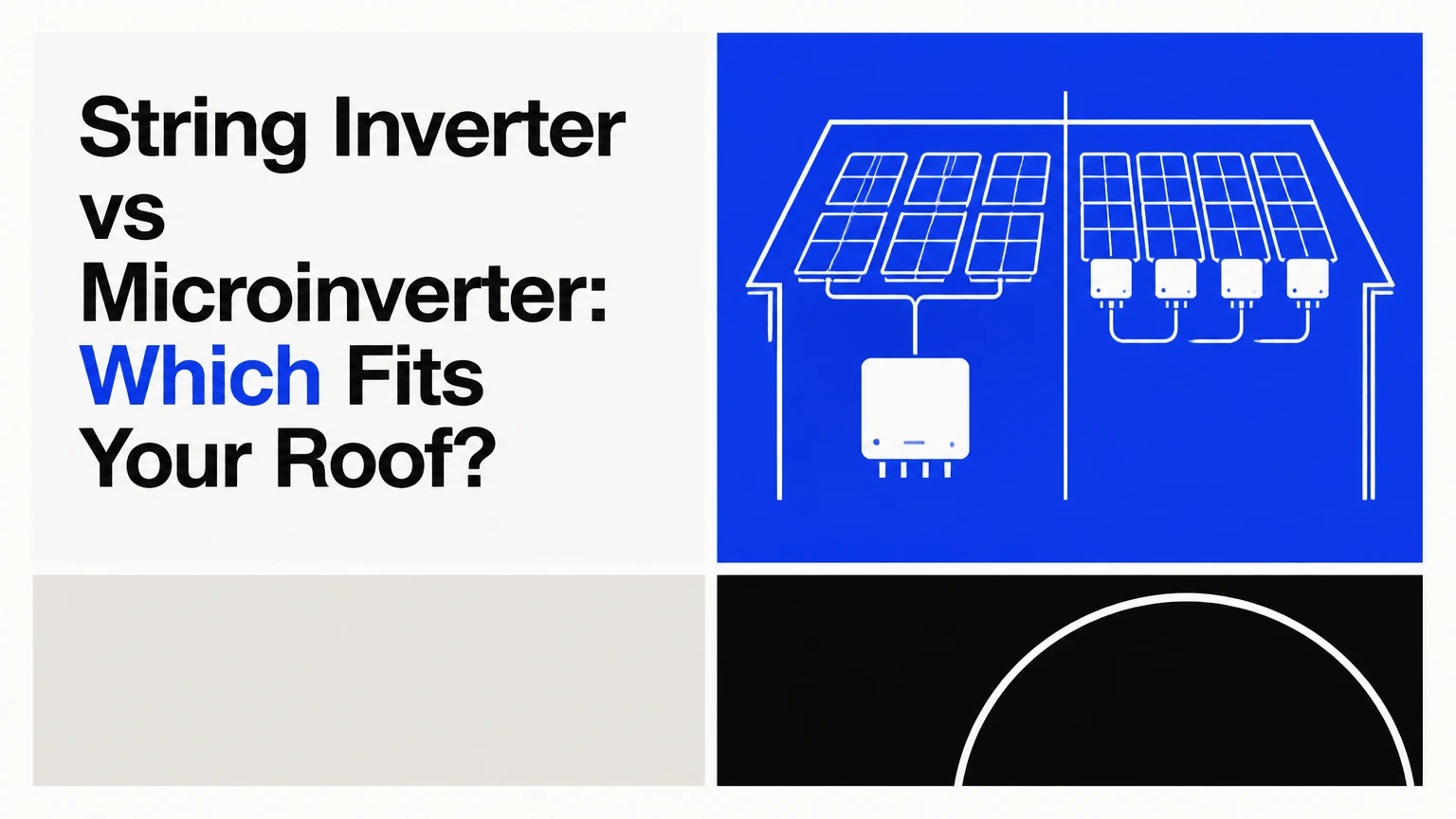
A string inverter usually costs less and works best on a simple, unshaded roof with consistent panel orientation. A microinverter costs more but independently optimizes each panel, making it better for shade, multiple roof planes, detailed monitoring, and future expansion. Battery design, local electrical rules, and installer quality can change the final choice.
Key Facts at a Glance
- A string inverter converts electricity from one or more panel strings at a central wall-mounted unit.
- A microinverter converts each panel’s DC output into AC electricity beneath the panel.
- Partial shade affects a string system more severely when panels share one MPPT circuit.
- Microinverters generally carry equipment warranties near 25 years, while many string inverters carry 10-12 years.
- A typical microinverter system costs about $1,500-$3,000 more than a comparable string system before incentives.
- A string inverter often integrates more directly with DC-coupled battery storage.
What Is the Difference Between a String Inverter and a Microinverter?
The main difference is where DC-to-AC conversion and maximum power point tracking occur. A string inverter performs both functions centrally for a group of panels, while a microinverter performs them separately at each panel. The architecture changes shade response, wiring, maintenance access, monitoring detail, battery configuration, and replacement cost.
Solar panels produce direct current, or DC. Homes and the utility grid generally use alternating current, or AC. The inverter synchronizes solar production with grid voltage and frequency, manages safety functions, and limits output when the grid cannot accept more power.
EnergySage summarizes the physical distinction directly: “Microinverters are installed on each individual solar panel.” A string inverter instead receives high-voltage DC from panels connected in series. The best architecture depends less on a headline efficiency number than on roof geometry, obstruction patterns, storage plans, and service access.
How Does Each System Move Electricity?
A string inverter system typically follows this path:
- Each photovoltaic module produces DC electricity.
- Modules connect in series to form a string.
- Panel voltages add together, often producing several hundred volts DC.
- The string travels through DC conductors to the inverter.
- The central inverter tracks the string’s operating point and converts DC to AC.
- AC electricity enters the service equipment and household circuits.
A microinverter system follows a different path:
- Each panel produces low-voltage DC.
- A dedicated microinverter tracks that panel’s maximum power point.
- The microinverter converts the panel’s DC output into grid-compatible AC.
- AC branch wiring combines the outputs from multiple panels.
- A trunk cable carries the combined AC power to the electrical panel.
- Monitoring equipment reports production by module or inverter.
The common “holiday lights” comparison is useful but incomplete. A panel problem does not always reduce every panel in a string to the same output because bypass diodes, multiple MPPT inputs, and modern string designs can limit the effect. The real issue is that panels sharing an MPPT circuit cannot always operate at their individual optimum.
Which Architecture Wins on the Important Criteria?
Neither architecture wins every criterion. String inverters lead on initial hardware cost and often on battery integration, while microinverters lead on panel-level control, complex roofs, monitoring, and long equipment warranties.
| Decision criterion | String inverter | Microinverter | Practical winner |
|---|---|---|---|
| Typical residential hardware cost | $1,200-$2,000 for an 8 kW central unit | $3,000-$4,400 for about 20 units | String inverter |
| Common equipment warranty | 10-12 years, sometimes extendable | About 25 years | Microinverter |
| Panel-level MPPT | One tracker per string or input | Usually one tracker per panel | Microinverter |
| Roof DC voltage | Commonly 300-600 V, model limits up to 1,000 V | Usually below 60 V DC at module input | Microinverter |
| Central conversion efficiency | Commonly 97%-99% peak | Commonly 96%-98% peak per unit | String inverter in ideal conditions |
| Shade and mismatch response | Depends on string design and optimizer use | Independent panel operation | Microinverter |
| Service location | Wall, garage, or equipment area | Beneath each panel | String inverter |
| Battery pathway | Straightforward DC coupling with compatible equipment | Usually AC coupling or a separate battery inverter | String inverter |
Peak efficiency is not annual energy yield. A 98% efficient string inverter on a uniformly sunlit roof can outperform a microinverter system with more conversion stages, but a shaded east-west roof may produce more annual energy with panel-level optimization.
How Does Shade Change the Decision?
Microinverters are usually the safer choice when shade moves across individual modules during the day. A chimney shadow covering one panel does not directly force neighboring microinverters to operate at the shaded panel’s power level.
String systems can still work under moderate shade when designers separate roof planes across independent MPPT inputs or use module-level power optimizers. A single string across north, east, and west roof sections is poor practice because those sections receive different irradiance and operate at different voltage-current points.
| Roof condition | Typical string result | Typical microinverter result | Recommended design |
|---|---|---|---|
| South roof, no shade, one plane | High annual yield | High annual yield with higher cost | String inverter |
| East and west planes, no shade | Requires separate MPPT inputs | Independent operation | Either, after electrical design |
| Chimney shade on two modules | Localized string losses possible | Loss remains near shaded modules | Microinverter or optimizers |
| Tree shade moving across array | Greater mismatch risk | Better module-level response | Microinverter |
| Three roof planes with different pitches | Complex string design | Straightforward module placement | Microinverter |
| Heavy shade across most panels | Both systems lose production | Both systems lose production | Shade mitigation first |
No inverter eliminates shade. A microinverter prevents one shaded module from directly controlling another module, but it cannot create sunlight or recover energy blocked by a tree.
Which System Is More Efficient?
String inverters generally post slightly higher peak conversion efficiency, often around 97%-99%, while microinverter efficiency commonly falls around 96%-98% depending on model and operating load. Those figures describe conversion hardware, not the complete system’s annual production.
Microinverters can recover energy through independent MPPT when modules have different orientations, temperatures, soiling levels, or shade exposure. String inverters can equal or exceed that performance on a well-designed, uniform array because they use fewer conversion stages and keep the main electronics in a cooler, accessible location.
Clipping requires separate analysis. If a 400 W panel feeds a microinverter limited to IQ-rated output below the module’s peak, the system may clip during high irradiance. Moderate DC-to-AC oversizing is normal, but the designer should model annual clipping rather than assume any clipping is unacceptable.
What Are the Main Solar Inverter Architectures?
Residential solar systems use standard string inverters, string inverters with DC optimizers, microinverters, and hybrid battery inverters. These categories differ in where MPPT occurs, where conversion occurs, and how storage connects.
| Architecture | MPPT location | DC-to-AC conversion | Typical use case | Main constraint |
|---|---|---|---|---|
| Standard string | Central inverter, per string input | Central wall unit | Simple, unshaded roof | Shared-string mismatch |
| String plus DC optimizers | Beneath each panel | Central inverter | Shade or mixed module conditions | Still has central conversion |
| Microinverter | Beneath each panel | At each panel | Complex roofs and expansion | More roof electronics |
| Hybrid string inverter | Central inverter | Central hybrid unit | Solar plus DC battery | Battery and PV must match |
| AC-coupled storage system | Solar inverter and battery inverter | Two conversion paths | Existing solar retrofit | Additional conversion losses |
A DC optimizer is not a microinverter. The optimizer changes the panel’s DC operating point but sends DC onward to a central inverter. That distinction matters for rapid shutdown, battery wiring, service procedures, and failure diagnosis.
How Much Do String and Microinverter Systems Cost?
For a typical new 8 kW residential installation, a string inverter may add roughly $1,200-$2,000 in central inverter hardware, while microinverters may add about $3,000-$4,400 for approximately 20 panels. Total installed prices vary with labor, permitting, roof access, electrical upgrades, panel count, and local market conditions.
| Cost item for a typical 8 kW system | String architecture | Microinverter architecture | Typical difference |
|---|---|---|---|
| Inverter hardware | $1,200-$2,000 | $3,000-$4,400 | $1,500-$3,000 higher for micros |
| Central equipment mounting | $300-$800 | $100-$400 for trunk equipment | $200-$500 lower for micros |
| DC conduit and disconnects | $500-$1,500 | $250-$900 | $250-$600 lower for micros |
| Roof-level inverter labor | $500-$1,200 | $1,000-$2,000 | $500-$800 higher for micros |
| Typical architecture premium | Baseline | $1,500-$3,000 | Microinverter premium |
| Central replacement reserve | $1,500-$3,500 around years 10-15 | Lower early replacement exposure | Depends on warranty |
These are typical planning ranges, not bids. Utility interconnection, a main-panel upgrade, steep roofing, battery equipment, and regional labor can exceed the inverter architecture difference.
A fair lifecycle comparison includes replacement. A $1,500 string inverter replaced in year 12 may still be financially preferable if its lower initial cost produces enough savings and the system remains easy to service. A 25-year microinverter warranty reduces that replacement risk, although labor, shipping, diagnosis, and warranty administration can still create costs.
Which System Works Better With Batteries?
String inverters usually have the simpler battery pathway for a new installation when the storage system is DC-coupled. Solar DC can enter a hybrid inverter, charge the battery, and convert to AC for household loads without an unnecessary solar AC-to-DC round trip.
Microinverter arrays normally produce AC on the roof, so a battery system uses AC coupling or a separate battery inverter. AC coupling is practical and common, especially for retrofits, but each conversion stage introduces some energy loss and requires coordinated controls for backup operation.
| Battery situation | String inverter fit | Microinverter fit | Design note |
|---|---|---|---|
| New solar and battery installed together | Strong DC-coupled option | Usually AC-coupled | Compare round-trip efficiency |
| Battery added to existing solar | Requires compatible retrofit equipment | Common AC-coupled pathway | Confirm inverter compatibility |
| Whole-home backup | Hybrid inverter can manage transfer | Needs approved battery inverter and controls | Loads panel may be required |
| Partial-home backup | Straightforward with load management | Straightforward with AC coupling | Size backed-up circuits |
| Future battery uncertain | Choose battery-ready model | Leave AC-coupling space and capacity | Avoid assuming later compatibility |
Neither a string inverter nor a microinverter grid-tied system powers a home during a utility outage by itself. Backup requires an approved battery, transfer equipment, islanding controls, and a design that keeps the solar system electrically separated from the failed grid.
Which System Is Safer and Easier to Maintain?
Microinverters reduce the length of high-voltage DC wiring on a building and can simplify rapid-shutdown compliance, but they put more active electronics on the roof. String inverters place the main electronics in an accessible location but can send hundreds of volts of DC through rooftop and wall conduit.
The National Electrical Code rapid-shutdown requirements, including NEC 2017 and later revisions adopted by local jurisdictions, affect both architectures. A string system may need module-level shutdown equipment or a listed inverter design, while many microinverter systems include shutdown behavior within the architecture. The authority having jurisdiction determines the accepted installation.
| Maintenance factor | String inverter | Microinverter |
|---|---|---|
| Number of conversion units | 1-3 central units for many homes | Approximately 1 per panel |
| Primary service location | Ground-level wall or garage | Roof beneath module |
| Single-unit replacement access | Usually quick and low-risk | Panel removal may be required |
| Fault visibility | Whole-system or string-level | Panel-level monitoring |
| Roof electronic exposure | Low | High |
| High-voltage DC distance | Roof to inverter location | Short module connection |
| Typical diagnosis | Central error code and string testing | App data plus roof-side testing |
A practical rule is to value service access more heavily than sales diagrams. A microinverter failure can be electrically localized, yet physical access may require lifting a module, disconnecting wiring, replacing the unit, and resealing the mounting area.
When Should You Choose a String Inverter?
Choose a string inverter when the roof has one or two consistent planes, little shade, a tight budget, and a likely need for DC-coupled storage. A central inverter also suits owners who prefer one accessible service point and do not need panel-level production data.
Best Fit: Simple Roof and Lowest Initial Cost
A south-facing roof with matching panel azimuth, no recurring shade, and enough space for one or two strings is the classic string-inverter application. Ask the installer to show the string map, MPPT allocation, voltage at minimum temperature, and voltage at maximum temperature.
Best Fit: New Solar With a Large Battery
A compatible hybrid string inverter can reduce the complexity of adding a battery at the same time as solar. Confirm battery voltage, usable capacity, backup output, generator compatibility, and whether the inverter supports the required operating mode.
Best Fit: Ground-Level Service Preference
A string inverter is easier to inspect, replace, and reset without roof access. The trade-off is that a central failure can stop the entire array, whereas a single microinverter failure normally affects one module.
When Should You Choose Microinverters?
Choose microinverters when shade, multiple orientations, panel-level monitoring, long equipment coverage, or incremental expansion has greater value than the lowest initial price. Microinverters are particularly useful when the roof cannot provide a clean, uniform string layout.
Best Fit: Complex or Shaded Roof
Microinverters fit arrays split across east, south, west, and differently pitched roof sections because every module can operate independently. They do not make heavily shaded sites economical automatically, so an installer should model tree growth and seasonal shadow paths first.
Best Fit: Future Panel Expansion
Microinverter systems can simplify adding panels later because the new modules receive their own conversion units. Expansion still requires checking trunk-cable capacity, branch-circuit limits, service-panel capacity, racking space, permits, and the monitoring gateway.
Best Fit: Detailed Monitoring
Panel-level monitoring can reveal soiling, connector faults, shading, and one underperforming module before the total system output makes the problem obvious. Monitoring data is diagnostic evidence, not proof that every reported watt-hour is revenue-grade.
What Can Go Wrong With Either Architecture?
The most expensive design mistake is selecting an inverter before mapping roof planes, shade, battery plans, and electrical constraints. A correctly sized product on the wrong architecture can produce lower lifetime value than a more expensive system designed around the site.
| Failure mode | Likely architecture | Diagnostic sign | Corrective action |
|---|---|---|---|
| One roof plane shares an unsuitable string | String | Production falls after shade arrives | Reconfigure strings or add optimizers |
| Central inverter shuts down | String | Entire array reports zero output | Check grid, disconnects, fault codes, and wiring |
| One module reports zero | Microinverter | Neighboring modules produce normally | Inspect connector, breaker, module, and inverter |
| Excessive clipping | Either | Output plateaus at inverter limit | Compare module DC rating with AC rating |
| Roof electronics overheat | Microinverter | Repeated thermal derating | Restore manufacturer air gap and mounting position |
| Gateway loses communications | Microinverter | Production data disappears while power may continue | Check gateway, network, breakers, and line noise |
| Battery will not accept solar | Either | Storage remains idle during sun | Check firmware, operating mode, CT sensors, and compatibility |
Expert Insight: Optimize Strings Are Not a Universal Middle Ground
DC optimizers improve mismatch control, but they retain central-inverter dependency and central conversion. They can be a strong compromise for partial shade, yet they do not provide the same physical architecture or roof-level AC output as microinverters.
Expert Insight: Warranty Length Is Not Total Reliability
A 25-year microinverter warranty does not guarantee zero service visits. Roof access, labor exclusions, discontinued models, communications hardware, and installer workmanship can determine the practical cost of a failure.
Expert Insight: Panel Matching Matters More Than Brand Slogans
A string design should keep modules on one MPPT electrically and geometrically compatible. Mixing different orientations, module counts, or current characteristics within one string can waste more energy than the nominal efficiency gap between inverter categories.
How Do You Troubleshoot a String or Microinverter System?
Start with safety and system monitoring rather than opening energized equipment. Homeowners can record symptoms and check approved user-accessible indicators, but qualified electricians should test DC circuits, disconnects, insulation resistance, and grid faults.
| Symptom | More likely cause | Safe homeowner check | Professional follow-up |
|---|---|---|---|
| Whole system at zero | Grid outage, central fault, disconnect | Utility status and inverter display | Electrical and inverter diagnostics |
| Output drops at a predictable time | Seasonal or moving shade | Compare shadow timing | Shade survey and string analysis |
| One panel at zero | Module, connector, or microinverter fault | Review monitoring data | Roof-side voltage and connector testing |
| Gateway offline | Internet, breaker, or communications issue | Router and gateway indicators | Network and power-line diagnosis |
| Battery not charging | Control, CT sensor, or compatibility fault | Battery operating mode | Installer firmware and wiring checks |
Do not remove panel covers, disconnect high-voltage DC, or bypass rapid-shutdown equipment. Inverter fault codes, installation diagrams, and monitoring timestamps give a technician more useful information than repeated resets.
What Should You Ask an Installer Before Deciding?
Request a design-specific comparison rather than two generic equipment quotes. The proposal should identify the roof planes, module count, string lengths, MPPT assignments, inverter clipping estimate, shade assumptions, rapid-shutdown method, and battery pathway.
Use this checklist:
- What annual production does each architecture predict using the same panels and shade model?
- Which modules share an MPPT, and what happens when one is shaded?
- What is the DC-to-AC ratio and modeled annual clipping?
- Who pays labor if a covered microinverter or string inverter fails?
- What equipment remains compatible if the inverter model is discontinued?
- Can the system expand by two or five modules without replacing the inverter?
- Does the battery use DC coupling, AC coupling, or a hybrid arrangement?
- What backup loads operate during a grid outage?
- Which rapid-shutdown equipment and code edition apply locally?
- Where are disconnects, gateways, and serviceable components located?
A quote that lists only panel wattage and inverter brand omits the design facts that determine performance.
Which Should You Choose?
Choose a string inverter for a uniform, unshaded roof when upfront cost, accessible service, and DC battery integration matter most. Choose microinverters for complex roof geometry, moving shade, panel-level monitoring, long equipment coverage, or gradual expansion. Choose an optimized string system when shade exists but a central inverter and battery strategy remain priorities.
The correct answer to string inverter vs microinverter is therefore site-specific, but not vague. Map the roof first, model annual production second, compare battery and replacement costs third, and then select the architecture that reduces the largest long-term risk.
Frequently Asked Questions
Do microinverters produce more electricity than string inverters?
Microinverters can produce more annual energy when panels have different orientations, partial shade, or meaningful mismatch. A string inverter can produce equal or greater energy on a uniform, unshaded array because central conversion efficiency is often slightly higher. Production depends on the complete design, not the inverter category alone.
Can I add panels later to a string inverter system?
You can add panels only when the inverter has electrical capacity, the new modules fit its voltage and current limits, and the string design remains compliant. Otherwise, adding modules may require a second inverter, a larger inverter, or a redesign. Microinverters usually make small additions simpler, subject to branch-circuit and service limits.
Are microinverters worth the extra money?
Microinverters can justify a typical $1,500-$3,000 premium when shade, roof complexity, monitoring, or expansion produces measurable value. They are harder to justify on a simple, unobstructed roof with immediate DC-coupled storage. Compare modeled annual kilowatt-hours and lifecycle service costs rather than accepting a universal payback claim.
Do microinverters eliminate high-voltage electricity?
Microinverters eliminate long runs of high-voltage DC from the roof to a central inverter, but their AC output is still hazardous and must meet electrical code. The exact voltage and rapid-shutdown behavior depend on the listed equipment, local rules, and system design. Qualified installers must handle all energized work.
Which inverter type lasts longer?
Microinverter equipment commonly carries a 25-year warranty, while string inverter warranties commonly cover 10-12 years, although extensions are available. Warranty duration is not identical to physical lifespan. Heat, moisture, loading, installation quality, replacement labor, and model support affect actual lifetime service costs.
Can either system run my home during a blackout?
A standard grid-tied string inverter or microinverter system shuts down during a utility outage to prevent backfeeding. Backup requires a compatible battery or other approved grid-forming equipment, transfer controls, and designated backed-up loads. Ask for the complete outage operating diagram before treating solar capacity as emergency power.