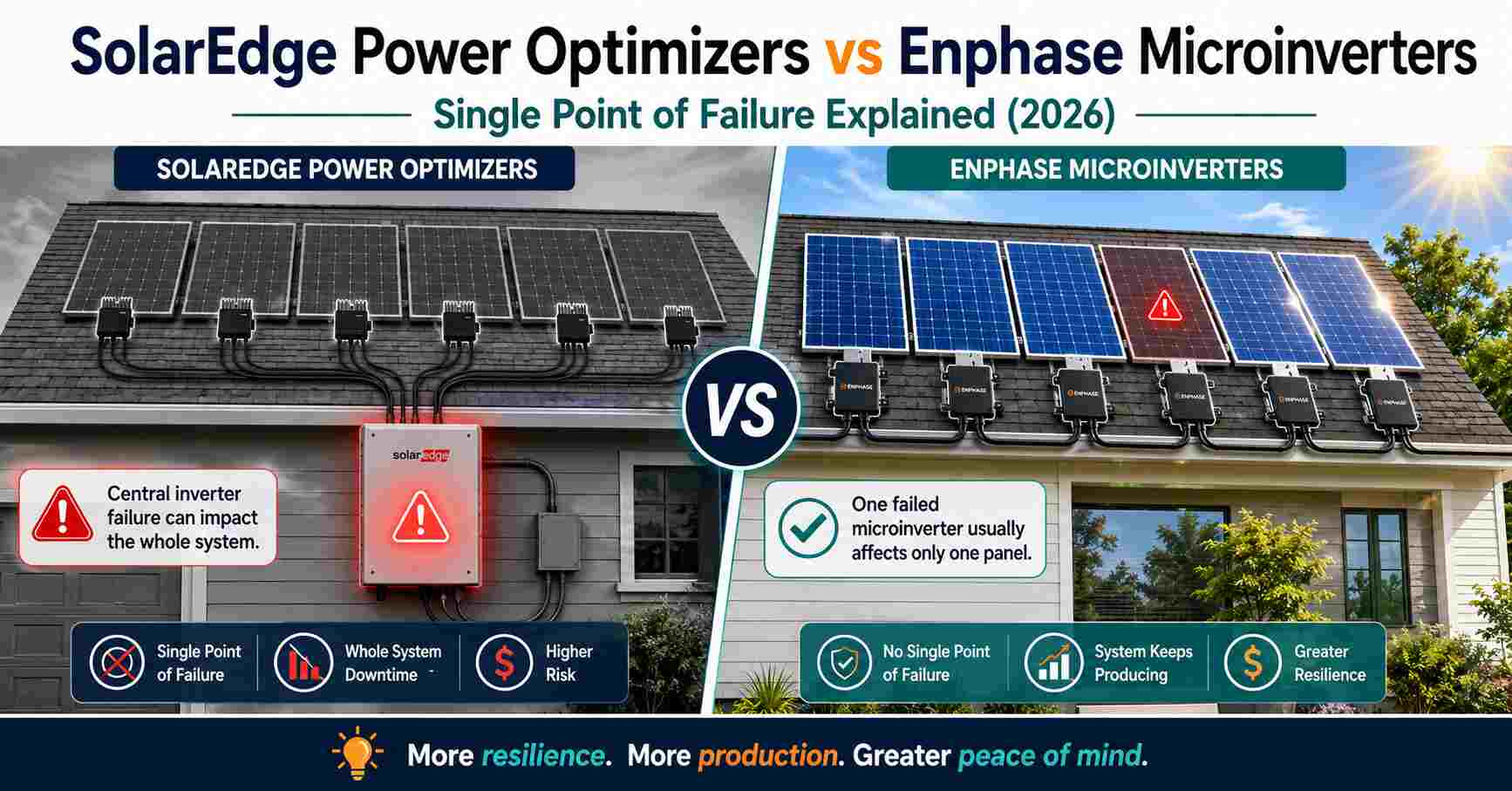
Every installer selling Enphase will tell you the same line: SolarEdge puts one box between your roof and your power bill, and if that box dies, you get nothing. Every installer selling SolarEdge will counter that you are putting twenty pieces of electronics on a hot roof under glass and hoping none of them fail.
Both statements are true. Neither is the whole story.
This guide breaks down what genuinely fails in each architecture, how long you are actually down, what the repair costs when the warranty covers parts but not labor, and which of the two systems fits your specific roof. The parts most comparison articles skip, including the shared components in an Enphase system that nobody mentions and the roof-access labor bill that makes microinverter repairs expensive, are covered here in full.
How Each Architecture Handles a Component Failure
The difference comes down to where DC power becomes AC power.
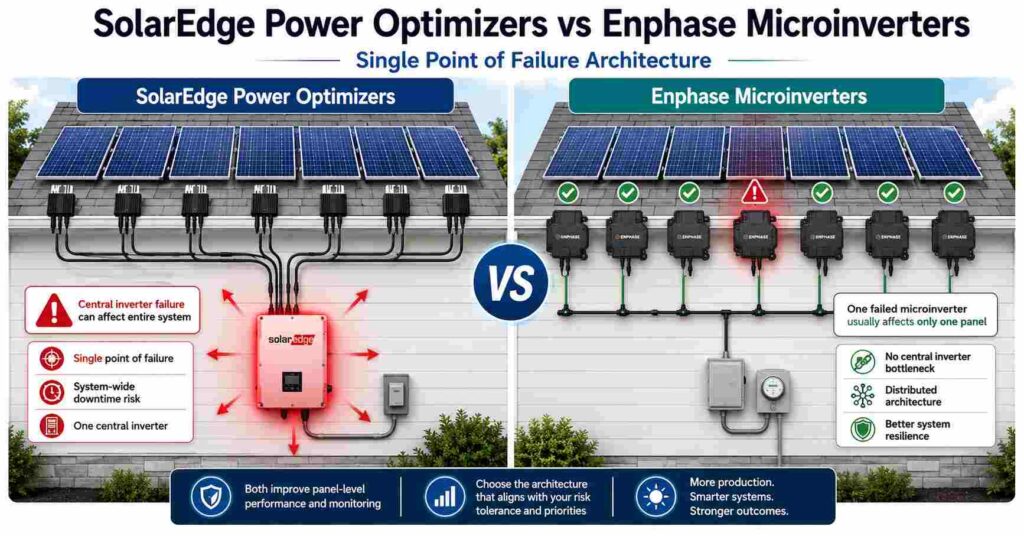
Enphase microinverters convert DC to AC underneath each individual panel. Each unit is an independent power plant that feeds 240V AC onto a shared branch circuit. One unit failing removes one panel from production. On a 20-panel array, that is a 5 percent loss, or roughly $7 to $9 per month on a typical bill.
SolarEdge power optimizers do not convert anything to AC. They condition DC at the module level, track maximum power point per panel, then send high-voltage DC down to one central inverter for conversion. An optimizer failure removes one panel. A central inverter failure removes the entire array.
That asymmetry is real, and it is the single strongest argument in favor of Enphase.
What Actually Takes a SolarEdge System Offline
Central inverter failure is not the only scenario, but it is the one that matters. Common causes include capacitor degradation from thermal cycling, DC arc fault detection lockouts, firmware corruption, and surge damage from nearby lightning strikes. When it happens, production drops to zero until a replacement unit ships and a technician installs it.
Typical timeline: 2 to 10 business days for warranty processing and shipping, plus scheduling. Some owners report faster turnarounds under active service contracts. Some report multi-week waits during peak season.
What Enphase Owners Still Share (The Part Nobody Mentions)
Enphase is decentralized at the conversion layer, not throughout the entire system. Several components remain shared:
- The AC branch circuit and trunk cable. Microinverters daisy-chain onto a shared cable. A damaged connector, a rodent chew, or a water-intruded junction takes down every panel downstream of the fault, not just one.
- The IQ Combiner and branch breakers. A tripped or failed breaker kills the entire branch. This is a common cause of “my whole system is dark” posts from Enphase owners.
- The IQ Gateway. This one does not stop production, but it stops monitoring, which means you may not learn about a dead microinverter for weeks.
- The main service panel and utility connection. Identical exposure on both systems.
The accurate framing is not “Enphase has no single point of failure.” It is that Enphase moves the highest-consequence failure point from a single expensive box to a set of cheaper, more distributed ones, while leaving some shared infrastructure in place.
Warranty Coverage: Where the Real Cost Difference Hides
| Component | Enphase | SolarEdge |
|---|---|---|
| Panel-level unit | 25 years (IQ8 series) | 25 years (optimizers) |
| Central inverter | Not applicable | 12 years standard, extendable to 20 or 25 for a fee |
| Labor coverage | Parts only; labor via installer workmanship warranty | Parts only; labor via installer workmanship warranty |
| Typical out-of-pocket replacement | $0 in year 13 | $1,800 to $3,500 in year 13 if unextended |
Two details matter more than the headline numbers.
First, extend the SolarEdge warranty at purchase. The extension to 20 or 25 years typically costs a few hundred dollars at the time of install and is far cheaper than an out-of-warranty replacement. Many quotes leave it off by default. Ask for it explicitly.
Second, warranty means parts, not labor. Most installer workmanship warranties run 5 to 25 years and vary enormously. Once that lapses, a homeowner pays labor on either brand.
The Manufacturer Solvency Question
Here is a factor missing from nearly every comparison article: a 25-year warranty is only as strong as the company behind it. Both Enphase and SolarEdge went through severe revenue contraction and restructuring in 2024 and 2025, and SolarEdge in particular saw significant workforce reductions and leadership turnover. Neither company’s long-term financial position should be treated as guaranteed. Before you sign, check current financial reporting for both manufacturers and ask your installer what happens to your warranty claim if the manufacturer cannot honor it. Some installers now offer their own bundled coverage for exactly this reason.
The Repair Cost Comparison Nobody Puts in the Brochure
This is where the conventional wisdom flips, and it is the strongest argument for SolarEdge.
A SolarEdge inverter replacement is ground-level work. The unit is mounted on a wall or in a garage. A qualified technician swaps it in two to four hours. No roof access, no panel removal, no flashing disturbed. Labor is typically $400 to $900.
An Enphase microinverter replacement is roof work. The technician must remove the panel above the failed unit, which means breaking the array, handling glass at height, and reseating mounting hardware. Truck roll plus labor commonly runs $300 to $600 for a single unit, and that cost repeats each time one fails. Steep pitches, tile roofs, or three-story homes push it higher.
The honest arithmetic: SolarEdge concentrates risk into one high-consequence, low-cost-to-service event. Enphase distributes risk into many low-consequence, higher-cost-per-incident events. If you keep the system 25 years and three microinverters fail, you may spend more on service calls than a single inverter swap would have cost.
What Real Owners Report
Recurring themes from long-running homeowner discussions on r/solar and installer forums, summarized rather than quoted:
- Enphase owners overwhelmingly report not noticing individual microinverter failures until monitoring flagged them, which validates the redundancy argument.
- SolarEdge owners who experienced inverter failure report the outage itself as manageable but describe RMA and scheduling delays as the real pain point.
- A consistent complaint against older Enphase generations (M190, M215, M250) involved elevated failure rates. IQ7 and IQ8 units report substantially better field performance, so treat pre-2018 anecdotes as poor evidence for current hardware.
- Installer quality appears in nearly every failure thread. Poor connector seating, undersized conduit, and skipped surge protection cause more real-world downtime than brand choice.
That last point deserves emphasis. Your installer’s workmanship warranty and business longevity will affect your 25-year experience more than the SolarEdge versus Enphase decision will.
Downtime Cost Model: 8 kW System, 20 Panels
Assume 11,000 kWh per year and $150 per month in offset bills.
| Failure event | Production lost | Monthly cost | Urgency |
|---|---|---|---|
| One Enphase microinverter | 5 percent | About $7.50 | Low, batch with other work |
| One SolarEdge optimizer | 5 percent | About $7.50 | Low |
| SolarEdge central inverter | 100 percent | About $150 | High |
| Enphase AC branch fault | 50 percent or more | $75 or more | Moderate to high |
A three-week SolarEdge inverter outage costs roughly $110 in lost savings. Meaningful, but not catastrophic. The stronger case against the central inverter is not the lost kilowatt-hours. It is what happens when a battery is attached.
Batteries Change the Risk Calculation Completely
- Enphase uses AC coupling. The IQ Battery has its own internal microinverters. If the rooftop hardware fails during a storm, the battery still discharges and backs up your critical loads.
- SolarEdge Home uses DC coupling. The battery routes through the same central inverter as the panels. One inverter failure disables solar generation and battery backup simultaneously.
If you are buying backup power for outage resilience, particularly for medical equipment, well pumps, or refrigeration, the DC-coupled single point of failure is a genuine reliability concern rather than a marketing talking point. DC coupling buys 2 to 3 percent better round-trip efficiency. That is a poor trade against losing backup entirely.
Roof Geometry: Where SolarEdge Loses on Performance
SolarEdge requires a minimum string length, typically 8 or more optimizers, to reach the startup voltage the central inverter needs. Small dormers, four-panel east faces, and heavily fragmented arrays can fall below that threshold or force awkward string design. Enphase has no such constraint because each panel operates independently at low voltage.
Simple, single-plane, unshaded roof: architectures perform nearly identically, and SolarEdge saves roughly $2,000 to $2,400 upfront on an 8 kW system.
Complex or shaded roof: Enphase wins on both harvest and design flexibility.
Decision Framework
Choose Enphase if: your roof has multiple planes or shading, you are adding battery backup, you experience frequent outages, you intend to stay 15 or more years, or you simply do not want to think about the system again.
Choose SolarEdge if: your roof is a single unshaded plane, your grid is reliable, upfront cost is the priority, you are likely to move within 10 years, your roof is steep or tile (making microinverter service expensive), and you extend the inverter warranty at purchase.
Five Questions to Ask Before You Sign
- What is your workmanship warranty term, and does it cover roof-access labor for microinverter replacement?
- If I choose SolarEdge, what does the 25-year inverter warranty extension cost today?
- What is your average RMA turnaround for this manufacturer over the past year?
- Is DC surge protection included at the inverter and combiner?
- What happens to my warranty coverage if the manufacturer becomes insolvent?
Conclusion
The single point of failure argument is real but frequently oversold. SolarEdge does concentrate total-system risk in one central inverter, and that risk becomes serious when a DC-coupled battery is part of the design. Enphase genuinely eliminates that concentration, but it is not failure-free, it shares AC infrastructure, and every repair is roof work at roof-work prices.
The right answer depends on your roof geometry, your grid reliability, your battery plans, and your time horizon. For complex roofs, battery backup, and long-term ownership, Enphase earns its premium. For a simple roof on a stable grid with a warranty extension purchased upfront, SolarEdge remains the better value.
Next Step
Bring the five questions above to your next quote conversation and ask for both a SolarEdge and an Enphase design with a 25-year total cost of ownership breakdown, including warranty extensions and estimated service labor. Any installer unwilling to produce that comparison is not the installer you want maintaining your system for the next quarter century. Request your side-by-side comparison today.