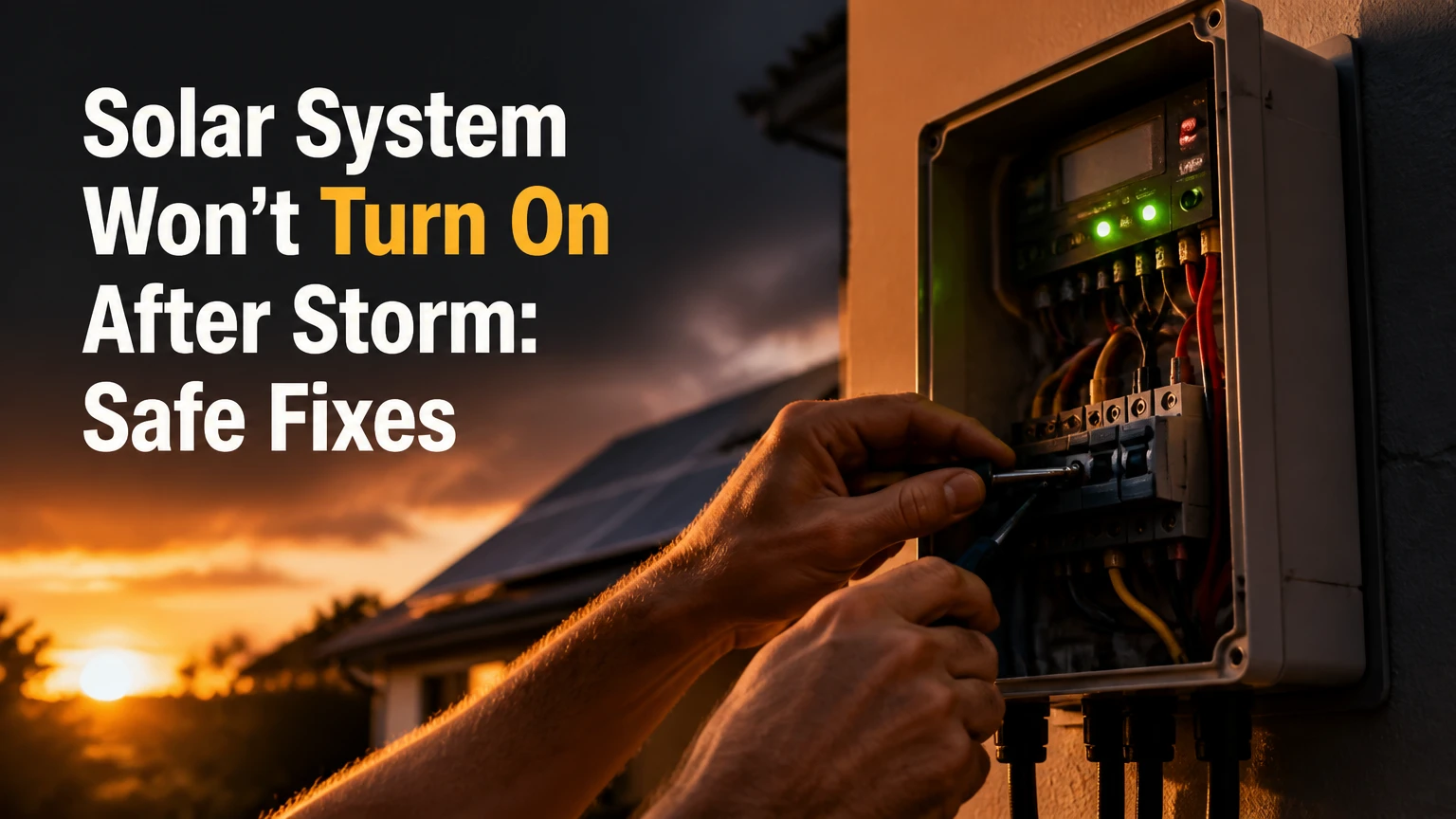
A residential solar system that won’t turn on after a storm is usually in a protective shutdown, not suffering from failed panels. Grid loss, unstable utility voltage, moisture, lightning surge damage, or a tripped inverter safety function can stop production. Check the grid and inverter status first, then reset only labeled exterior controls once and only when no damage is visible.
Key Facts at a Glance
- A standard grid-tied inverter must shut down during a utility outage to prevent anti-islanding hazards for line workers.
- A solar inverter may wait about 5 minutes after stable grid power returns before producing electricity, although the exact delay depends on its firmware and utility settings.
- A blank inverter display usually indicates missing AC supply, a disconnected communication path, a failed power supply, or a fully shut-down unit.
- An isolation or ground-fault message after rain can indicate moisture in connectors, junction boxes, or array wiring.
- Repeatedly resetting a tripped breaker can worsen an arc fault, ground fault, or surge-damaged component.
- A battery-backed system can power selected loads during an outage only if the battery, backup gateway, inverter, and critical-load panel remain operational.
Why Did the Solar System Shut Down After the Storm?
A solar system shuts down after a storm because the inverter detects an unsafe grid condition or an internal electrical fault. The inverter converts panel DC electricity into synchronized AC electricity, and that conversion requires acceptable grid voltage and frequency unless a properly designed battery system creates an isolated backup circuit.
The anti-islanding requirement is the central mechanism. IEEE 1547 and UL 1741 require certified grid-interactive inverters to stop energizing the utility circuit when the grid disappears or falls outside permitted limits. The U.S. Department of Energy summarizes the consumer outcome directly: “If your solar system is connected to the grid, it will automatically shut off during a power outage.”
That behavior protects utility crews, but it creates a common misunderstanding. Bright sunlight does not restart a conventional grid-tied system while the utility circuit is dead. After power returns, the inverter checks the grid, waits through its reconnection timer, and then resumes production if no fault remains.
How long should a grid-tied inverter take to restart?
A grid-tied inverter commonly takes 5 minutes after stable utility power returns, but the actual delay can range from roughly 1-15 minutes because settings differ by manufacturer, utility interconnection rule, and fault history. A longer delay is expected when voltage continues fluctuating after storm repairs.
Do not judge recovery during the first few minutes after the neighborhood power returns. Check the inverter display at 15-minute intervals instead of repeatedly switching breakers. A persistent fault after 30 minutes of stable grid power deserves documentation and professional diagnosis.
Which Solar System Type Do You Have?
System architecture determines whether a storm-related grid outage should leave the home without solar power. The inverter label, battery cabinet, transfer equipment, and electrical panel usually reveal the system type.
| System type | Grid outage response | Typical storm fault | Homeowner expectation |
|---|---|---|---|
| Grid-tied string inverter | Shuts down completely | Grid fault, surge damage, AC breaker trip | No solar power during outage |
| Grid-tied microinverters | Each module stops exporting | Gateway, branch circuit, or grid fault | Roof panels may produce DC, but home receives no AC |
| Hybrid inverter with battery | Isolates backup loads | Battery BMS lockout, gateway fault, low state of charge | Selected circuits may remain powered |
| Off-grid inverter and controller | Continues if hardware survives | DC fuse, charge controller, water, lightning | Grid status has no effect |
Can solar panels power the house when the grid is down?
Standard grid-tied solar panels cannot power household circuits during a grid outage because the inverter must disconnect from utility lines. A hybrid inverter with an approved transfer switch, battery, and backup-load configuration can power designated circuits, but it normally cannot supply every household circuit without suitable capacity.
The distinction matters after a storm. A homeowner may see sunlight and assume the panels should run a refrigerator or well pump. The panels generate DC electricity, while household appliances require controlled AC output from an operating inverter. Backup systems also impose limits based on battery energy, inverter surge rating, and the circuits installed in the backup panel.
| Architecture | Required backup hardware | Typical restored loads | Main limitation |
|---|---|---|---|
| Standard grid-tied | None | 0 circuits during outage | Anti-islanding shutdown |
| Hybrid battery system | Battery, gateway, transfer controls | Refrigerator, lights, internet, selected outlets | Limited kW and kWh |
| Whole-home backup | Large battery bank, service-rated transfer equipment | Most household circuits | High installation cost |
| Off-grid system | Battery bank and charge controller | Loads within inverter rating | No utility fallback |
Is the Solar System Actually Off, or Is Monitoring Down?
A monitoring failure does not necessarily mean solar generation has stopped. Storm power interruptions often reboot the home router, damage an internet modem, or interrupt cellular communication while the inverter continues operating.
A monitoring app usually reports “communication failure” when it cannot reach the inverter, whereas “system fault,” “inverter fault,” or a named error code indicates a detected electrical condition. Confirm production through the inverter screen, utility net meter, or a clamp-based energy monitor rather than relying on the app alone.
What does a blank inverter screen mean?
A blank inverter screen usually means the inverter has no permitted AC input, its DC source is unavailable, its display is asleep, or its internal low-voltage supply has failed. A blank screen after a storm is more concerning when the home has power, labeled solar breakers are on, and the display remains dark in daylight.
Use a flashlight only to read exterior labels. Do not remove the inverter cover. Internal capacitors and DC conductors can retain hazardous voltage even after external switches are off.
| Observation | More likely explanation | Safe next check | Escalation trigger |
|---|---|---|---|
| App offline, inverter normal | Wi-Fi or cellular outage | Check router and local display | App remains offline for 24 hours |
| Blank display, house has power | AC breaker, isolator, or inverter supply | Inspect labeled exterior controls | Display stays blank after one approved reset |
| Red fault light | Electrical or hardware fault | Photograph code and LED state | Red light returns after reset |
| No production at night | Normal behavior | Check again in daylight | No production in clear daylight |
What Can You Safely Check After a Storm?
A homeowner can verify utility status, read exterior displays, inspect accessible labels, and look for obvious damage from ground level. A homeowner should not climb onto a wet roof, open an inverter, handle exposed conductors, or test photovoltaic wiring without appropriate training and equipment.
Follow this sequence:
- Confirm utility power. Check whether neighbors have electricity, inspect the utility outage map, and verify whether the home’s main service has power. A neighborhood outage explains a complete shutdown on a standard grid-tied system.
- Wait for stable restoration. Allow 15 minutes after utility power returns, then read the inverter. Record the time, LED colors, operating state, and exact alphanumeric code.
- Check the home electrical panel. Look for a clearly labeled solar AC breaker or solar subpanel. If a breaker is visibly tripped and there is no smell, smoke, heat, water, or damage, follow the equipment manual and reset it once.
- Inspect from ground level. Look for cracked glass, displaced panels, hanging cable, damaged conduit, water around the inverter, scorch marks, or debris. Use binoculars instead of a ladder.
- Stop when a fault remains. A recurring trip, arc-fault message, isolation fault, burning odor, melted plastic, or water inside equipment requires an installer or licensed electrician.
The success checkpoint is a normal operating state after the manufacturer’s reconnection delay. The common mistake is treating every trip as a harmless nuisance and forcing the same breaker repeatedly.
Should you perform a hard reset?
A hard reset is appropriate only when the manufacturer or installer provides a documented sequence for that exact inverter and battery combination. Generic internet sequences are unsafe because some systems require a gateway, rapid-shutdown controller, battery disconnect, or communication bus to be shut down in a specific order.
Never reset a system showing smoke, fire damage, water intrusion, exposed wiring, arc fault, ground fault, or a repeated breaker trip. For a healthy-looking system, follow the manual exactly, observe its waiting period, and avoid opening sealed equipment. Many systems need 5-10 minutes without power, but the correct duration and restart order are model-specific.
What Do Post-Storm Solar Error Messages Mean?
Post-storm error messages identify the condition the inverter detected, but code numbers are not universal across SMA, Fronius, SolarEdge, Enphase, Growatt, Tesla, and other brands. The model number and exact message must accompany any diagnosis.
| Message family | Common examples | Likely storm-related cause | Correct response |
|---|---|---|---|
| Grid fault | Vac failure, utility loss, grid overvoltage | Outage or unstable voltage | Wait for stable utility power |
| Isolation fault | ISO fault, insulation resistance, earth fault | Wet connector, damaged cable, junction box leak | Keep off and call technician |
| Arc fault | AFCI, arc detected, arc fault | Wind-damaged insulation or loose connection | Do not reset repeatedly |
| Relay or hardware fault | Relay check, device fault, internal error | Surge-damaged relay or control board | Photograph code and arrange service |
| Battery fault | BMS, overvoltage, undervoltage, isolation | Battery protection lockout or damaged wiring | Use battery manual and installer support |
An isolation fault after heavy rain can clear when equipment dries, but drying does not prove the system is safe. Moisture can return with the next rain event, and insulation testing is required to locate leakage.
An arc-fault indication deserves the strictest response. Electricity can jump across damaged insulation, creating heat without producing an obvious external mark. Keep the system in its current safe state and request a qualified inspection.
How Do Lightning, Hail, Wind, and Floodwater Cause Failure?
Storm damage reaches solar equipment through several different paths, and the visible panels are not always the failed component. Lightning can induce voltage on long DC and AC conductors, hail can fracture module glass, wind can stress racking and connectors, and floodwater can contaminate equipment below the array.
| Storm mechanism | Common damaged component | Visible clue | Usual service action |
|---|---|---|---|
| Lightning surge | Inverter board, SPD, gateway | Burn mark or sudden device fault | Electrical diagnosis and surge review |
| Hail | Module glass, frame, junction box | Cracks, white impact marks, hot spots | Insulation and module testing |
| High wind | Racking, cable clips, connectors | Lifted panel, hanging cable, loose conduit | Roof and attachment inspection |
| Driving rain | DC connectors, junction boxes | Isolation fault after wet weather | Drying, connector replacement, testing |
| Floodwater | Inverter, battery, disconnects | Waterline, corrosion, residue | De-energization and component replacement |
Panels can appear intact while a connector underneath has separated or a string cable has been pulled against a sharp edge. Conversely, a hairline glass crack may not stop production immediately but can permit moisture entry and create later insulation faults.
Do not spray, wash, dry with a heat gun, or reseal electrical equipment yourself. Water-damaged electrical components may remain unsafe after the exterior looks dry.
When Should You Call a Solar Technician?
Call a qualified solar installer, licensed electrician, or manufacturer service provider when a fault persists after stable grid restoration, a breaker trips again, or any storm damage is visible. Call emergency services for smoke, fire, arcing, a burning odor, or an energized damaged cable.
Provide the service company with the inverter brand and model, error code, photographs from ground level, storm date, utility restoration time, and monitoring screenshots. This information reduces the first visit from a general inspection to a targeted diagnostic appointment.
What will solar repair cost?
Typical United States post-storm costs range from $150-$400 for diagnostic labor, $400-$1,000 for common corrective repairs, $1,200-$3,500 for inverter replacement, and $200-$550 for one conventional module replacement. Regional labor rates, roof access, equipment availability, permits, and insurance handling can move the final invoice substantially.
| Service or component | Typical cost range | Typical time | Main price variable |
|---|---|---|---|
| Diagnostic visit | $150-$400 | 1-3 hours | Travel and testing depth |
| DC connector or fuse repair | $250-$800 | 2-5 hours | Roof access and string count |
| Surge protection replacement | $300-$900 | 2-4 hours | AC, DC, or both sides |
| String inverter replacement | $1,200-$3,500 | 4-8 hours | Capacity, compatibility, permits |
| Single panel replacement | $200-$550 | 3-6 hours | Module type and roof access |
| Battery or gateway service | $500-$2,000+ | 3-8 hours | Brand, warranty, and fault type |
These are typical planning figures, not a guaranteed quote. Manufacturer warranty coverage may pay for a failed inverter while excluding diagnostic labor, crane access, roof work, or storm-related damage. Homeowners insurance may cover hail, wind, or lightning, subject to the policy deductible and exclusions.
What Evidence Should You Save for a Claim?
Photograph the inverter display before clearing any code, capture the monitoring timeline, save the utility outage record, and record the storm date and time. Keep damaged components available until the insurer or manufacturer confirms disposal.
A useful claim packet contains:
- Inverter and battery serial numbers
- Installation invoice and commissioning records
- Error-code photographs with timestamps
- Utility outage-map screenshots
- Roof and equipment photographs from a safe location
- Technician diagnosis and insulation-test results
- Replacement estimate with labor separated from materials
- Weather or lightning reports when available
The monitoring log can establish whether production stopped during the storm or after utility restoration. That distinction helps separate a grid event from a surge claim or equipment defect.
How Can You Prevent Another Storm Shutdown?
You cannot prevent a standard grid-tied system from shutting down during an outage, because that shutdown is a required safety function. You can reduce equipment damage and improve recovery by using correctly rated surge protection, secure wiring, weatherproof enclosures, monitoring redundancy, and a battery system sized for the loads that matter.
Ask an installer to verify:
- AC and DC surge protective devices are present, correctly rated, and connected to an effective grounding system.
- Exterior connectors are fully mated, supported, and kept off roofing surfaces.
- Rapid-shutdown equipment and the inverter firmware match the permitted system design.
- Battery backup circuits exclude high-demand loads unless inverter capacity supports them.
- Insurance documentation identifies solar modules, inverters, batteries, labor, and roof-related work.
A battery is not a universal storm solution. A small battery may run a refrigerator and internet equipment for several hours but cannot necessarily start a well pump, air conditioner, or electric resistance heater.
FAQ
Will solar restart by itself after the storm?
A compliant grid-tied inverter usually restarts automatically after utility voltage and frequency return to acceptable limits and its reconnection timer expires. Allow about 5-15 minutes, then check the operating state. A continuing fault, blank display, or repeated trip indicates a problem beyond normal automatic recovery.
Why did solar stop when my house still had electricity?
A solar system can stop while the house remains powered because the utility may have voltage outside the inverter’s permitted range, the solar AC breaker may be open, or the inverter may detect an internal fault. Household power confirms service availability, not that the solar circuit is safe or synchronized.
Can rain alone stop a solar inverter?
Rain can stop a solar inverter when moisture enters a connector, junction box, conduit, or damaged cable and lowers insulation resistance. Light rain should not permanently disable intact equipment. If an isolation fault appears only during wet weather, a technician should locate the leakage rather than repeatedly resetting the inverter.
Is a red inverter light always a failed inverter?
A red inverter light is not always proof of permanent hardware failure because manufacturers use LED colors differently. The exact message, LED pattern, model, and operating state matter. Photograph the display and consult the model manual; do not infer a diagnosis from color alone.
Does homeowners insurance cover a solar system after lightning or hail?
Homeowners insurance often covers storm damage to permanently installed solar equipment when the policy includes the system under dwelling or other covered property, but deductibles, exclusions, labor, roof access, and equipment age vary. Ask the insurer to confirm coverage in writing before authorizing non-emergency replacement.
Should I turn solar off before another storm?
Do not shut down a functioning solar system solely because ordinary severe weather is forecast unless the installer, utility, or manufacturer instructs you to do so. Use the system’s labeled emergency shutdown procedure for fire, flooding, exposed wiring, or official emergency direction, and never climb onto the roof during storm conditions.
The Bottom Line
A solar system won’t turn on after a storm most often because a grid-tied inverter is correctly waiting for safe utility conditions or has detected a fault caused by voltage instability, moisture, wind, hail, or surge damage. Confirm the grid, record the inverter message, inspect only accessible labeled controls, and stop after one authorized reset. Persistent faults, visible damage, water, arc-fault messages, and repeated breaker trips require a qualified technician.