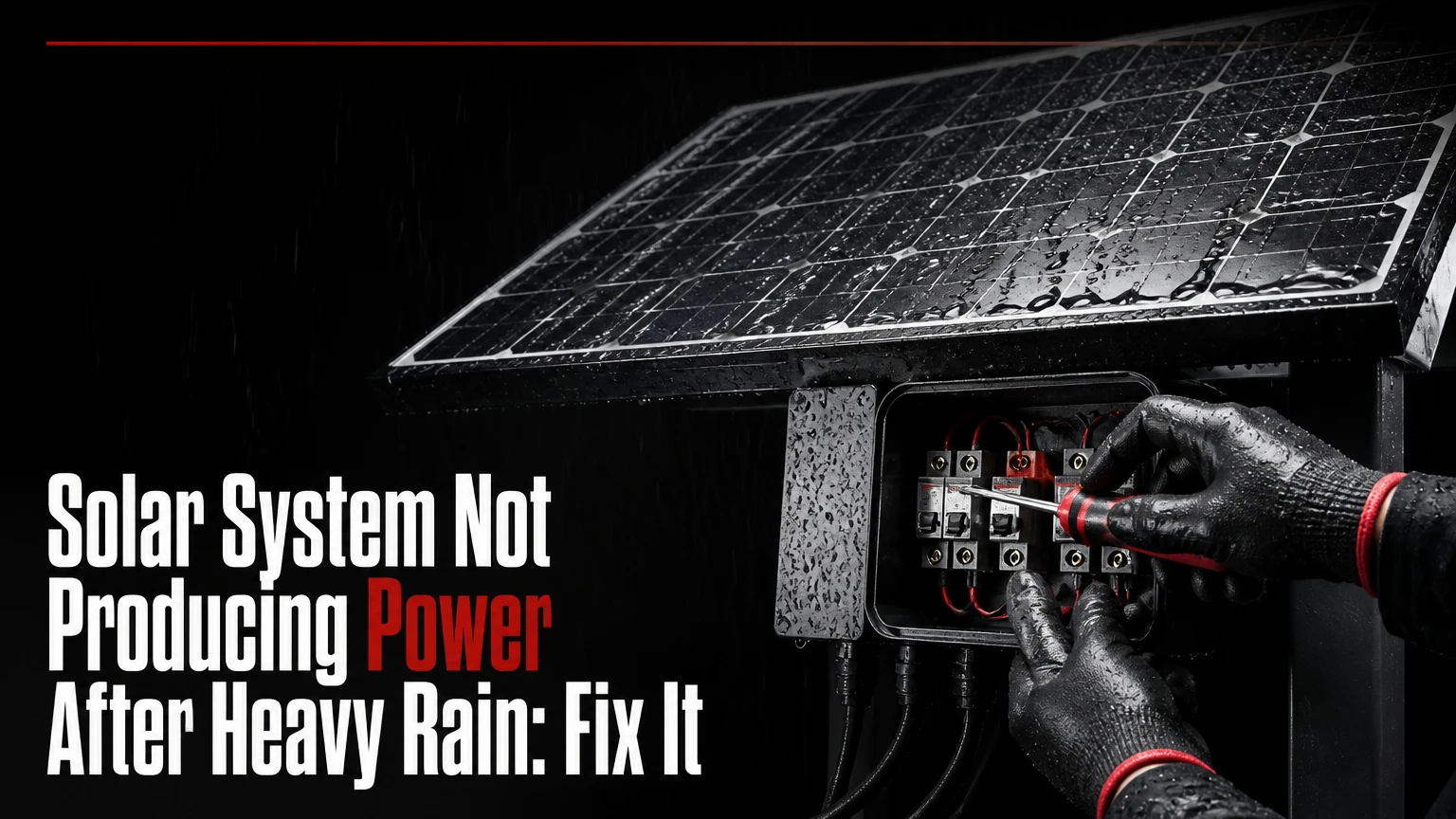
A solar system not producing power after heavy rain has usually entered a protective shutdown because moisture lowered insulation resistance, triggered a ground-fault check, or damaged a grid-side component. Check the inverter message and switchboard from a dry, safe location, but do not open equipment or touch rooftop wiring because photovoltaic DC voltage remains dangerous in daylight.
Key Facts at a Glance
- A low-Riso or isolation fault means current may be leaking between a DC conductor and grounded equipment.
- One wet connector can stop every module on a string-inverter circuit, while a microinverter system may lose only one or several panels.
- A breaker or RCD should be reset once only, and only when the switchboard is dry and there is no visible damage.
- A clear, dry day may restore a moisture-related fault, but repeated rain failures indicate a defect that needs testing.
- A homeowner should read and record the inverter code, time, weather, and monitoring data before restarting anything.
- Insulation-resistance testing requires suitable electrical instruments and a qualified solar electrician, not a household multimeter.
Why Does a Solar System Stop After Heavy Rain?
A solar system stops after heavy rain when water creates an unintended electrical path, or when storm conditions cause a separate AC, communication, or equipment failure. The inverter detects unsafe insulation resistance between the photovoltaic DC circuit and ground, then disconnects generation to reduce shock, fire, and equipment risks.
Solar modules still produce DC voltage when light reaches them, even if the inverter has stopped exporting electricity. The U.S. Department of Energy summarizes the operating principle as, “Solar panels generate electricity when sunlight hits them.” An inverter shutdown therefore does not make wet rooftop conductors safe.
Common moisture entry points include:
- Cracked insulation from ultraviolet exposure, rodents, or abrasion.
- Poorly seated or mismatched MC4 connectors.
- Junction boxes with damaged seals.
- Cable loops resting in roof runoff.
- Conduit entries that face upward or lack proper glands.
- A panel backsheet crack or failed module junction box.
- Condensation inside an outdoor inverter, optimizer, or battery cabinet.
Rain can also expose faults that are not caused by water alone. A loose terminal, failing surge-protection device, lightning strike, utility outage, or damaged roof array may appear immediately after the same storm.
What Does Low Riso or an Isolation Fault Mean?
Low Riso means the measured resistance between an energized DC circuit and ground has fallen below the inverter’s configured safety limit. The abbreviation usually refers to insulation resistance, but the exact alarm name and threshold vary by manufacturer, inverter topology, system voltage, and local electrical rules.
The AI Overview’s common “1 MΩ threshold” should not be treated as a universal rule. Some inverters use voltage-dependent calculations, manufacturer-specific limits, or different startup criteria. A qualified technician follows the inverter manual and applicable standards rather than forcing a reset based on a generic number.
IEC 62446-1:2016+A1:2018 includes photovoltaic-system verification and documentation practices, including electrical testing relevant to commissioning and maintenance. The standard supports measured verification, not guesswork based on whether the roof looks dry.
What Should You Check First?
Check the monitoring app, inverter display, and switchboard without touching rooftop equipment. The first objective is to separate a normal weather-related production drop from a protective shutdown, grid failure, tripped AC protection, or permanent component damage.
Step 1: Confirm There Is Enough Sunlight
Look at the production graph during a dry period with usable daylight. Heavy cloud, early morning shade, snow, and storm darkness can reduce output without creating a fault.
| Observation | Likely interpretation | Safe homeowner action |
|---|---|---|
| Zero output at night | Normal inverter behavior | Compare again during daylight |
| Low output under dark storm clouds | Weather limitation | Check production after clear sunlight |
| Zero output in bright sun | Shutdown, grid, or equipment fault | Read code and inspect switchboard |
| Output returns briefly, then stops | Recurring moisture or thermal fault | Save logs and arrange testing |
Do not compare today’s output with a sunny summer day unless you account for irradiance, shading, temperature, and system clipping. A weather-normalized monitoring graph is more useful than the instantaneous wattage shown on an app.
Step 2: Record the Exact Inverter Message
Write down the code, warning text, indicator color, date, time, and whether the message appeared at startup or during operation. Photographing the display preserves transient information that may disappear after the inverter dries or reboots.
| Message or symptom | What it commonly points toward | What it does not prove |
|---|---|---|
| “Isolation fault” or “Low Riso” | DC insulation leakage | The exact connector or module location |
| “Ground fault” | Leakage to grounded metal or earth | That the ground conductor itself failed |
| “Grid fault” or “AC voltage” | Utility or AC-side condition | A wet rooftop DC fault |
| Red fault light | Active inverter alarm | The specific failed component |
| Grey panel in monitoring app | Panel, microinverter, or communication loss | A complete array shutdown |
Error-code meanings differ across Fronius, SMA, SolarEdge, Enphase, Huawei, GoodWe, and other platforms. Search the exact model manual or give the code to the installer. Do not infer “Error 31” or another number without identifying the brand and firmware family.
Step 3: Check the Switchboard From a Dry Floor
Look at the solar supply breaker, inverter AC isolator, main switch, and RCD from a dry location. If a device is visibly damaged, wet, hot, burning-smelling, or repeatedly tripping, leave it off and contact an electrician.
A single reset is reasonable only when the switchboard is dry, there is no visible damage, and the manufacturer’s instructions permit it. If the breaker or RCD trips immediately, leave it off. Repeatedly closing a protective device can energize a fault and increase fire or shock risk.
Step 4: Inspect Only From Ground Level
Use binoculars or a camera from the ground to look for displaced modules, hanging cable, broken glass, exposed conductors, water pooling, damaged conduit, and debris. Do not climb onto a wet roof, move panels, disconnect plugs, open an inverter, or enter a flooded equipment area.
Call emergency services if smoke, fire, arcing, burning odor, or damaged utility equipment is present. Keep people away from the array and cable routes until the site is assessed.
How Long Should You Wait for the System to Dry?
A moisture-related solar fault may clear after several hours of dry weather, but a safe observation period is generally one daylight cycle, not a guaranteed 24-48 hour cure. If the alarm persists through the next dry day, returns with every rain event, or involves visible damage, schedule a qualified solar electrician.
The “80% recover after drying” figure has no dependable universal basis across brands, climates, system ages, and failure types. Drying can hide deteriorated insulation without repairing it. A cable that passes an inverter check on a sunny afternoon may fail again during overnight condensation.
Use this decision rule:
- Record the original alarm.
- Leave a repeatedly tripping protective device off.
- Allow normal drying without spraying or opening equipment.
- Check output during the next clear daylight period.
- Arrange service if the system remains offline or the alarm recurs.
| Drying outcome | Recommended response | Typical urgency |
|---|---|---|
| Output returns and no alarm recurs | Keep records and monitor the next rainfall | Routine inspection |
| Output returns, then fails after dew | Request insulation testing | Within days |
| Alarm remains after one dry day | Stop troubleshooting and book service | Prompt appointment |
| Breaker or RCD trips again | Leave it off and call an electrician | Same day if practical |
| Storm damage, smoke, or exposed wire | Isolate the area and seek urgent help | Immediate |
Which Solar System Components Fail Differently?
String inverters usually shut down an entire electrically connected string, microinverters create panel-level or branch-level symptoms, and hybrid systems can fail on either the photovoltaic side or the battery and backup side. The monitoring pattern helps identify the fault domain but cannot replace electrical testing.
| System architecture | Typical rain symptom | First diagnostic clue |
|---|---|---|
| String inverter | Entire array or one string reads zero | Inverter displays low Riso or ground fault |
| String inverter with optimizers | One or more module optimizers disappear, or inverter stops | Module-level map plus inverter alarm |
| Microinverters | Individual panels or an AC branch go offline | App shows specific grey or missing units |
| Hybrid inverter and battery | Solar stops, battery communication fails, or backup changes state | Separate PV, battery, and grid alarms |
A microinverter system is not immune to rain faults. Water can enter a trunk cable, AC connector, roof junction box, or microinverter enclosure. A string system can also lose only one string if the inverter provides separate MPPT inputs.
Hybrid systems require extra caution because battery enclosures may contain stored energy after the PV array shuts down. A battery communication alarm does not automatically mean the battery is damaged, but a flooded, swollen, hot, or mechanically damaged battery needs urgent professional assessment.
What Does a Technician Test?
A solar electrician locates a moisture or insulation fault by isolating circuits and measuring resistance with a photovoltaic-rated insulation tester. The technician normally checks the inverter, DC isolators, strings, connectors, junction boxes, module sections, optimizers, cable routes, and sometimes the AC and battery circuits separately.
A professional workflow may include:
- Reviewing inverter event logs and weather timing.
- Confirming grid voltage and AC protective-device status.
- Inspecting array wiring and connector compatibility.
- Testing positive-to-ground and negative-to-ground insulation.
- Splitting a string to narrow the failing section.
- Checking modules, optimizers, and junction boxes.
- Testing surge-protection devices after lightning or a nearby strike.
- Replacing defective connectors, cable sections, glands, or equipment.
- Repeating the verification test before recommissioning.
A household multimeter is not a substitute for an insulation-resistance tester. Measuring open-circuit voltage may confirm that a string is energized, but it does not reliably reveal insulation leakage under the test conditions used by solar equipment.
Why Can One Connector Shut Down Many Panels?
One connector can shut down many panels because panels wired in series share one electrical path, and a single insulation breach can reduce the measured resistance of the complete string. The inverter responds to the unsafe string result rather than allowing unaffected modules to continue operating.
The failing connector may not be the wettest-looking item. Water can travel along cable strands, enter conduit, collect in a low loop, or reach a module junction box several metres from the visible entry point. Technicians therefore test sections systematically instead of replacing the first connector they see.
Could Heavy Rain Cause a Different Problem?
Heavy rain can cause a grid outage, RCD trip, surge-protection failure, inverter condensation, communication loss, roof damage, or battery shutdown without producing a classic low-Riso alarm. A complete diagnosis begins with the fault message rather than assuming every post-rain failure is an isolation fault.
| Post-storm symptom | Possible cause | Distinguishing check |
|---|---|---|
| Inverter screen is completely blank | AC supply loss, failed inverter, or internal protection | Check AC supply indication only |
| App is offline, but inverter runs | Internet or monitoring gateway fault | Compare local display with app |
| Inverter says grid fault | Utility outage or voltage outside limits | Check household grid power |
| Solar works but battery does not | Battery isolator, communication, or BMS fault | Review separate battery alarm |
| Output is reduced, not zero | Cloud, shading, one string loss, or module damage | Compare MPPT and module data |
A storm can also leave the array operational while damaging the home’s network equipment. Monitoring loss does not equal generation loss. If safe, compare the inverter’s local production reading with the online portal before booking an array repair.
Is It Safe to Reset the Inverter?
Reset an inverter only according to its manufacturer instructions and only when there is no water ingress, visible damage, burning smell, or repeated protective-device trip. A reset can clear a temporary communication or grid event, but it cannot repair wet insulation and may erase useful diagnostic context.
The U.S. National Electrical Code includes photovoltaic provisions for equipment, wiring, disconnects, and rapid shutdown, while UL 1741 covers safety requirements for many inverters and converters. Those frameworks do not make homeowner access to energized rooftop DC circuits safe.
Never:
- Open the inverter enclosure.
- Unplug MC4 connectors under load.
- Remove a panel or optimizer.
- Megger a string without knowing equipment limits.
- Spray panels, connectors, or inverters with a hose.
- Reset a breaker repeatedly.
- Work near a flooded battery or submerged conduit.
- Walk on modules or a wet roof.
How Much Does Repair Usually Cost?
Typical residential service costs are about $150-$300 for diagnostic attendance and testing, while complete repairs commonly range from $200 to more than $3,000 depending on access, parts, array size, and whether the inverter or battery needs replacement. These are practitioner ranges, not regulated prices, and regional labor rates can differ substantially.
| Repair category | Typical cost range | Typical site time |
|---|---|---|
| Diagnostic visit and insulation test | $150-$300 | 1-3 hours |
| Connector, gland, or short cable repair | $200-$500 | 1-3 hours |
| Optimizer, junction box, or extended cable repair | $400-$900 | 2-5 hours |
| Inverter or several-module replacement | $1,000-$3,000+ | 3-8 hours or return visit |
Roof access, scaffolding, battery isolation, emergency call-out periods, and permit requirements can increase the invoice. A technician may charge for diagnosis even when the eventual repair is covered by warranty.
Ask for the written report to identify:
- The measured fault and test method.
- The affected string, module, or device.
- Photographs of the defect.
- Parts and labor separately.
- Whether the work includes recommissioning tests.
- Warranty and workmanship coverage.
- Any roof or electrical compliance issue discovered.
Do not approve a complete inverter replacement solely because the system shows a ground-fault message. A low-cost connector or cable defect can produce the same shutdown behavior.
What Warranty Evidence Should You Preserve?
Save inverter event logs, monitoring graphs, photographs, installation documents, invoices, serial numbers, and the date of the storm before the system is repaired. Warranty providers often need evidence connecting the failure to a covered component rather than weather damage, poor installation, rodents, or external impact.
Product warranties commonly cover modules, inverters, optimizers, and batteries for different periods. Workmanship warranties depend on the installer and jurisdiction. A module’s 10, 15, or 25-year product warranty does not automatically cover labor, roof access, water damage, or a separately failed connector.
Ask the installer whether the system was commissioned with documented insulation, polarity, voltage, and protective-device checks. IEC 62446-1 documentation can help establish what was tested at handover and provide a baseline for later fault diagnosis.
How Can You Prevent Rain-Related Shutdowns?
Prevent rain-related shutdowns by keeping DC connectors supported and sealed, routing cables away from standing water, protecting roof penetrations, and having recurring alarms investigated before insulation damage spreads. Preventive maintenance is more effective than repeatedly waiting for a wet connector to dry.
A qualified installer or maintenance technician should verify:
- Connectors are the correct mating type and fully engaged.
- Cable loops do not form water traps.
- DC cables are not lying directly in abrasive roof runoff.
- Conduit glands face downward or shed water correctly.
- Junction boxes and isolators have intact seals.
- Modules have no cracked glass or damaged backsheets.
- Rodents cannot reach unprotected wiring.
- Drainage does not discharge over electrical equipment.
- Inverter and battery enclosures have manufacturer-required clearances.
- Post-repair insulation and functional tests are recorded.
Practitioner Insight: Recurrent Rain Faults Are Diagnostic Evidence
A system that recovers after drying is not necessarily healthy. Repeated failure after rain or morning dew strongly suggests insulation degradation, poor connector assembly, trapped water, or condensation, because a healthy sealed circuit should not depend on rapid evaporation to remain within its operating limits.
Practitioner Insight: The First Alarm Has More Value Than the Final Alarm
The first low-Riso event, startup time, and weather condition often identify the fault pattern better than a later generic “inverter stopped” message. Record the earliest code before resetting because some inverters replace the original event with a secondary shutdown notice.
Practitioner Insight: Panel Washing Is Not Fault Repair
Rain can clean dust from modules while leaving cable and junction-box defects untouched. Washing a hot array after a shutdown can add thermal stress and water pressure to an existing breach, so cleaning should wait until the electrical fault is resolved.
What Should Different System Owners Do?
A grid-tied homeowner can usually wait through one normal dry daylight cycle if no protective device is tripping and there is no visible damage. A battery-dependent or off-grid owner should use the approved bypass or backup procedure and keep the suspected wet generation circuit isolated rather than improvising a manual reconnection.
| Owner situation | Best immediate approach | Avoid |
|---|---|---|
| Standard grid-tied home | Record code, check switchboard, monitor next clear day | Rooftop inspection |
| Home with critical medical loads | Follow documented backup plan and call service promptly | Repeated inverter resets |
| Hybrid battery system | Check separate battery and inverter alarms | Opening battery enclosure |
| Off-grid property | Use approved generator or alternate source | Connecting wet DC equipment |
| Landlord or property manager | Preserve records and contact installer | Authorizing undocumented DIY repair |
An emergency power source can maintain essential loads, but it does not make a failed photovoltaic circuit safe. Keep backup operation separate from diagnosis unless the system documentation gives a specific, tested switching procedure.
When Should You Call an Electrician?
Call a qualified solar electrician immediately for smoke, arcing, burning odor, exposed conductors, a flooded inverter or battery, repeated RCD trips, broken modules, or a damaged roof array. Arrange prompt service when a low-Riso or ground-fault alarm remains after the next dry daylight period or returns during every wet-weather event.
Use the installer first when the system is under workmanship warranty and the installer remains available. Use an independent licensed electrician with photovoltaic experience when the installer cannot respond, the fault involves household AC protection, or the original company has closed.
Give the technician:
- Inverter make, model, and serial number.
- Exact error code and indicator color.
- Storm date and approximate shutdown time.
- Whether the breaker or RCD tripped.
- Monitoring screenshots before and after rainfall.
- Photos taken from ground level.
- Any history of earlier rain or dew failures.
- Battery model and alarm, if applicable.
FAQ
Can Solar Panels Work Again After Rain?
Solar panels can continue producing DC electricity immediately after rain, but the inverter may keep the array disconnected until its safety checks pass. If output returns during the next clear period and no alarm recurs, monitor the system. If the same shutdown follows later rain, request insulation testing rather than treating recovery as a permanent repair.
Why Does Solar Power Stop at Night or on Cloudy Days?
Solar power stops at night because photovoltaic modules receive insufficient light to produce useful energy, while dense cloud can reduce output sharply during daytime. A genuine post-rain fault is more likely when the system produces zero power in bright sun, displays an alarm, or remains offline after neighboring electrical equipment has recovered.
Can a Tripped RCD Stop Solar Generation?
A tripped RCD can stop solar generation by removing the inverter’s AC supply, and the inverter may then report a grid or AC error. Reset the RCD once only if the switchboard is dry and undamaged. An immediate second trip means the circuit should remain off until an electrician investigates.
Does Rain Damage Solar Panels?
Rain alone rarely damages correctly installed solar panels, but storm debris, hail, flooding, failed seals, roof movement, and lightning can damage modules or electrical connections. Cracked glass, delamination, damaged backsheets, and water inside a junction box require professional assessment because visual drying does not restore electrical insulation.
Will Solar Panels Work During a Power Outage?
Most grid-tied solar systems stop during a utility outage to prevent unintentional energization of the network. A compatible hybrid inverter, battery, transfer system, and approved backup circuit are required for outage power. Rain-related inverter alarms should not be bypassed by disconnecting grid protection or changing settings without qualified assistance.
Should You Replace the Inverter After a Rain Shutdown?
You should not replace an inverter solely because it shut down after rain. A wet connector, cable, module, isolator, surge-protection device, or grid condition can produce the same symptom, so a technician should inspect logs and perform circuit-level tests first. Replacement becomes reasonable when testing confirms internal water damage or a failed covered component.
The Bottom Line
A solar system not producing power after heavy rain is often protecting itself from low insulation resistance, but the same symptom can come from a tripped RCD, grid outage, communication failure, storm damage, or battery fault. Record the exact alarm, check the switchboard once from a dry location, wait through one clear daylight cycle, and call a qualified solar electrician when the fault persists, repeats, or involves visible damage.