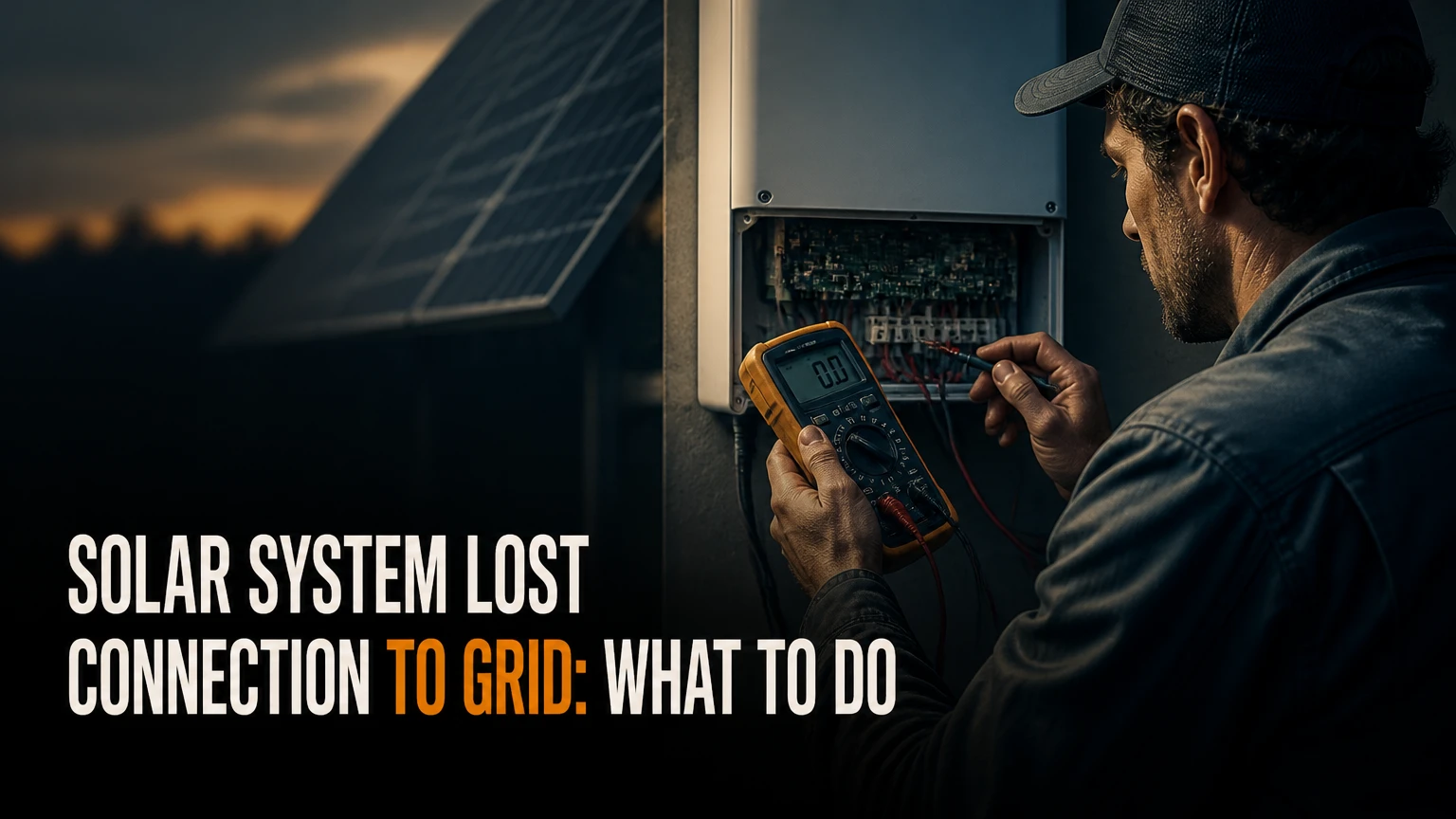
A solar system lost connection to grid status usually means a grid-tied inverter detected missing or abnormal utility voltage and stopped supplying electricity. A standard grid-tied system without a battery will not power the home during that outage, while a properly designed hybrid system can isolate from the utility and run selected circuits from stored energy.
Key Facts at a Glance
- A grid-tied inverter must stop exporting power when utility voltage disappears.
- Anti-islanding protection protects utility workers from energized distribution lines.
- A solar array can receive sunlight during an outage and still produce no usable household power.
- Many residential inverters wait about 5 minutes of stable grid conditions before reconnecting.
- A tripped solar breaker should be reset once only; repeated trips require professional diagnosis.
- Battery backup requires an inverter, isolation equipment, battery storage, and approved load wiring.
What Solar System Lost Connection to Grid Means
A solar system lost connection to grid event is an interruption between the utility supply and the inverter’s monitored AC input. The interruption can be a neighborhood outage, a tripped photovoltaic breaker, an open exterior disconnect, damaged wiring, abnormal voltage or frequency, or an inverter protection fault.
The symptom often appears as “Grid Lost,” “AC Disconnected,” “No Grid,” “Utility Loss,” or “Island Detected” in an inverter app. Monitoring communication can also fail while the utility connection remains healthy, so an offline app does not prove that the solar array itself lost grid power.
| Observed symptom | Likely condition | First safe check |
|---|---|---|
| Neighbors also have no electricity | Utility outage | Utility outage map or phone status |
| Home has power, inverter says Grid Lost | Solar breaker, disconnect, wiring, or voltage issue | Main panel and inverter message |
| App is offline, inverter lights are normal | Internet or cellular monitoring failure | Local inverter indicators |
| Breaker trips immediately after reset | Short circuit, ground fault, or equipment failure | Leave breaker off and call installer |
| Production returns after several minutes | Normal anti-islanding reconnection | Review event history and voltage alerts |
The phrase “grid-tied blackout” describes the result, not necessarily the cause. A blackout affects the utility network, whereas an inverter can report grid loss because one phase, one conductor, or the measured voltage falls outside its allowed range.
Why Grid-Tied Solar Shuts Down
A standard grid-tied solar inverter shuts down because anti-islanding protection prevents the system from energizing a separated section of utility wiring. The inverter measures AC voltage, frequency, phase behavior, and sometimes active detection signals; when those values indicate abnormal grid conditions, it stops exporting electricity.
The National Electrical Code, NFPA 70 Article 705.40, states: “Upon loss of utility voltage, all interactive inverters shall automatically cease to supply power to the utility system.” UL 1741 evaluates inverter safety functions, while IEEE 1547-2018 defines interconnection and abnormal-condition behavior used by utilities and equipment manufacturers.
Worker safety is the primary reason. A damaged line that utility crews believe is de-energized could become hazardous if distributed generators continued feeding it. Grid stability is another reason, because a lone inverter cannot normally establish a controlled voltage and frequency reference for an isolated household network.
The shutdown is therefore intentional. Turning the inverter off and on does not bypass the protection, and a standard grid-tied inverter cannot be converted into an outage power source through software alone.
Why sunlight does not keep ordinary solar running
Solar panels generate direct-current electricity, but household circuits require alternating-current power with a controlled voltage and frequency reference. The utility normally provides that reference. Without it, a conventional grid-following inverter has no approved basis for energizing the home.
Clouds are not the main reason for the shutdown. A battery inverter or grid-forming inverter can manage changing solar output, but it requires isolation hardware, control software, and sufficient energy storage.
How Each Solar Architecture Responds
Solar system architecture determines whether a grid failure produces total shutdown, limited daytime power, or automatic backup. The key distinction is whether the installation can safely disconnect from the utility and create its own stable AC network.
| System architecture | Blackout behavior | Main hardware | Typical usable backup |
|---|---|---|---|
| Grid-tied, no battery | Shuts down until utility power returns | String inverter or microinverters | 0 hours during outage |
| Grid-tied with sunlight backup | Supplies limited dedicated loads in sunlight | Backup-capable microinverters or inverter outlet | Daylight-only, product-limited |
| Hybrid with battery | Disconnects utility and powers selected loads | Hybrid inverter, battery, gateway, transfer equipment | 4-48 hours, load dependent |
| Off-grid solar | Continues operating independently | Off-grid inverter, battery, charge controller, generator | Continuous if energy budget works |
Grid-tied without storage
A conventional grid-tied array provides no outage power, even if the panels are producing strongly at noon. The inverter remains off until acceptable utility voltage and frequency return, then reconnects after its programmed verification period.
This design is usually the lowest-cost option and often produces the best energy-bill payback where outages are rare. It is unsuitable for refrigeration, medical equipment, internet service, or heating during a blackout unless those loads have a separate backup source.
Sunlight backup systems
Some systems provide a dedicated daytime outlet or limited backup circuit without a large battery. Enphase IQ8-based installations and certain SMA systems can support product-specific sunlight backup configurations, but the exact output depends on inverter model, commissioning, wiring, and connected load.
Sunlight backup is narrow in scope. Cloud movement can reduce available power, and the system usually cannot support a whole home, motor startup, overnight loads, or stable operation after sunset.
Hybrid battery systems
A hybrid system detects utility loss, opens an approved isolation path, and forms a local AC network from the battery inverter. Solar panels can then recharge the battery or supply loads within the inverter’s power and energy limits.
A critical-load subpanel commonly includes a refrigerator, lighting, communications equipment, garage door opener, and medical devices. Whole-home backup requires higher continuous and surge ratings, larger conductors, and possibly a service-rated transfer device.
Off-grid systems
An off-grid system never relies on utility voltage, so a utility outage does not change its operating state. The battery bank must cover nighttime demand and several low-sun days, while a generator often supplies resilience during prolonged winter or storm conditions.
Off-grid design is more demanding than adding a battery to an existing grid-tied array. Designers must account for seasonal solar yield, battery temperature, generator compatibility, well-pump starting current, and the consequences of battery depletion.
How to Diagnose a Lost Grid Connection
A homeowner can safely verify utility status, read the inverter display, and inspect accessible breaker positions, but should not remove covers or test energized conductors. The diagnostic sequence takes about 10-20 minutes when the fault is visible and requires an installer when the grid is available but the inverter remains offline.
Step 1: Confirm utility power
Check whether neighboring homes and non-solar circuits have electricity. Use the utility outage map, but remember that an outage map can lag behind a local transformer or service fault.
If the neighborhood is without power, leave the solar equipment alone. The shutdown is expected, and the inverter should restart after utility service stabilizes.
Step 2: Read the inverter or monitoring app
Record the exact event message, timestamp, and any voltage or frequency value. “Grid Lost” points toward utility sensing or disconnection, while “AC Voltage High,” “AC Voltage Low,” “Frequency Out of Range,” “Isolation Fault,” and “Arc Fault” indicate different investigation paths.
Do not clear an error before recording it. Event history often disappears after a reboot or makes the installer’s diagnosis less precise.
Step 3: Inspect the solar breaker
Locate the dedicated solar breaker in the main electrical panel. A tripped breaker may sit halfway between ON and OFF, so move it fully OFF, then fully ON once.
If the breaker trips immediately, smells hot, makes noise, or will not latch, turn it off and stop. Repeated resets can worsen an arc, short circuit, or overheating connection.
Step 4: Check the accessible AC disconnect
Some installations have a visible AC disconnect near the meter, inverter, or exterior wall. Confirm that its handle is in the labeled ON position, but do not open the enclosure or bypass a lockout.
A disconnect that repeatedly moves, will not stay on, or shows heat damage requires a qualified solar electrician.
Step 5: Wait through the reconnection period
After utility power becomes stable, many residential inverters wait approximately 5 minutes before resuming operation. The actual delay can vary with manufacturer firmware, utility settings, and the fault type.
The inverter may reconnect in stages. Microinverters can report staggered production, and a string inverter may take additional minutes to ramp output after its self-test.
| Error message | Common interpretation | Homeowner response | Professional trigger |
|---|---|---|---|
| Grid Lost | Utility voltage absent or not sensed | Confirm grid and breaker status | Grid is normal for 10 minutes |
| AC Voltage High | Utility or circuit voltage above limit | Do not adjust equipment | Repeats during sunny production |
| AC Voltage Low | Low utility voltage or long conductors | Record time and conditions | Repeats under normal utility service |
| Isolation Fault | DC leakage or insulation problem | Keep system off if instructed | Any recurring fault |
| Arc Fault | Possible DC arcing condition | Follow inverter shutdown instructions | Immediate service call |
What Causes Repeated Grid Disconnects?
Repeated grid disconnects usually result from abnormal AC voltage, loose connections, a failed disconnect, inverter temperature, utility disturbances, or an incorrectly configured interconnection profile. A single storm outage is normal; daily “Grid Lost” events indicate a system or grid-quality problem.
High voltage can occur when a long service run or lightly loaded transformer raises voltage during strong solar production. The inverter may shut down even though household appliances appear normal. A utility voltage investigation, conductor assessment, or inverter setting review may resolve the problem, but the installer must not disable required limits.
Other failure modes include corrosion in an exterior disconnect, a failing breaker, firmware incompatibility, rodent damage, water intrusion, and communications loss. A monitoring outage is less serious than an AC fault, but the distinction requires local inverter indicators.
A counterintuitive field rule is that replacing an inverter may not fix repeated high-voltage trips. If the utility voltage is outside the approved range, a new inverter will often report the same condition.
How Long Does Reconnection Take?
Most residential solar inverters reconnect after roughly 5 minutes of acceptable grid voltage and frequency, but “exactly 300 seconds” is not universal. The inverter must complete its own checks, and some utilities or firmware versions apply different timing for different abnormal conditions.
A short voltage dip can restart the timer. A system may therefore remain offline longer than five minutes during unstable restoration, even when the utility appears to have returned.
| Reconnection factor | Typical residential value | Effect on restart |
|---|---|---|
| Stable-grid verification | About 300 seconds | Delays export after restoration |
| Inverter self-test | 10-60 seconds | Adds startup time |
| String inverter ramp-up | 1-10 minutes | Gradually restores production |
| Microinverter reporting | 2-15 minutes | Staggers app updates |
| Battery transfer event | 10-100 milliseconds | Depends on gateway and load design |
Can Solar Panels Run During a Blackout?
Solar panels can run during a blackout only when the system includes approved islanding and backup controls. Ordinary grid-tied panels and inverters cannot power the home, while a hybrid inverter can support circuits after disconnecting the home from the utility.
A battery-free sunlight-backup system may provide daytime power through a dedicated outlet, but it is not equivalent to whole-home backup. Output can fall sharply under clouds, and the system normally stops after sunset because no stored energy remains.
A battery system also has limits. A 13.5-kilowatt-hour battery does not deliver 13.5 kilowatt-hours to appliances in every circumstance because reserve settings, inverter losses, temperature, and maximum discharge power reduce usable energy.
Battery Backup, Generator, or Both?
Battery backup is usually quieter and faster, a generator usually supports longer outages, and a combined system provides the broadest resilience. The right choice depends on outage duration, fuel access, motor loads, noise tolerance, and whether solar can recharge the battery.
| Backup option | Transfer or startup | Typical endurance | Best-fit loads |
|---|---|---|---|
| Lithium battery | 10-100 milliseconds | 4-48 hours | Refrigeration, lighting, electronics |
| Portable generator | 30 seconds to manual start | 8-24 hours per fuel cycle | Selected high-power appliances |
| Standby generator | 10-30 seconds | Days with fuel supply | Pumps, HVAC, whole-home loads |
| Battery plus generator | Battery first, generator support | Multi-day operation | Medical, heating, and storm resilience |
Generators need fuel, ventilation, maintenance, and correct transfer equipment. A portable generator must never connect through a household receptacle, and carbon monoxide can accumulate indoors, in garages, or near windows.
Battery systems need fire-code-compliant placement, temperature management, and a defined load plan. A battery with inadequate surge power may shut down when a well pump, compressor, heat pump, or air conditioner starts.
Which Backup Configuration Fits Your Situation?
A standard grid-tied system fits a homeowner who wants energy-bill savings and experiences infrequent outages. A hybrid battery system fits a household with frequent storms, essential medical equipment, food-storage concerns, or a need for automatic service continuity.
| User situation | Recommended architecture | Typical capacity or feature | Main limitation |
|---|---|---|---|
| Rare outages, lowest upfront cost | Grid-tied without battery | 5-10 kW solar | No outage power |
| Refrigerator and internet backup | Hybrid essential-load system | 10-15 kWh battery | Limited high-power loads |
| Medical equipment and heating | Hybrid plus generator | 20-40 kWh plus generator | Higher installation cost |
| Remote property | Off-grid solar | 20-60 kWh storage | Seasonal energy shortage |
| Whole-home air conditioning | Large hybrid or generator | 10-15 kW inverter output | High surge and cooling demand |
Route essential loads separately when possible. A critical-load panel often extends runtime more effectively than purchasing a second battery, because water heaters, EV chargers, electric ranges, and central air conditioning can consume several kilowatt-hours quickly.
What Backup Solar Costs
Adding battery storage to an existing solar installation typically costs $10,000-$20,000 in the United States before incentives, while a new 10-kilowatt solar system with approximately 13.5 kilowatt-hours of storage commonly falls near $22,000-$35,000. Actual pricing depends on equipment, labor, permitting, service upgrades, and regional electrical rates.
These are typical planning ranges, not quotes. A main-panel replacement, trenching, complex roof access, fire-code enclosure, or utility export study can move the project above them.
| Project scope | Typical installed cost | Typical installation time | Common added requirement |
|---|---|---|---|
| One battery retrofit | $10,000-$20,000 | 1-2 days | Compatible inverter or gateway |
| 10 kW solar plus 13.5 kWh battery | $22,000-$35,000 | 3-5 days | Permit and utility approval |
| Critical-load subpanel | $1,500-$4,000 | 4-8 hours | Load rewiring |
| Main service upgrade | $3,000-$8,000 | 1-2 days | Utility coordination |
Inverter replacement commonly occurs around 10-15 years, although warranty terms differ. Lithium iron phosphate batteries are often designed for roughly 10-15 years or thousands of cycles, while photovoltaic modules commonly carry 25-30-year performance warranties.
The financial value of storage depends on avoided outage losses and tariff structure, not simply on annual solar production. A battery can improve resilience while reducing bill savings if it is rarely cycled or poorly matched to time-of-use rates.
Which Rules Control Reconnection?
UL 1741 equipment certification, IEEE 1547 interconnection behavior, the National Electrical Code, and the local utility’s approved settings control grid reconnection. The exact values for voltage, frequency, ride-through, export control, and timing depend on the equipment listing and jurisdiction.
Utilities may require an approved interconnection profile, rapid-shutdown compliance, visible disconnects, production meters, or permission to operate. A homeowner should not change grid-support settings to stop nuisance trips without written utility and installer authorization.
Three-phase commercial systems add phase-balance, larger protection, and often medium-voltage requirements. Their troubleshooting cannot safely follow a residential five-step checklist.
Mistakes That Create Repeat Shutdowns
The most damaging mistake is repeatedly resetting a breaker that trips immediately. Other avoidable problems include assuming the monitoring app is the grid connection, ignoring a recurring voltage alert, expecting a battery to run every appliance, and disabling firmware or grid-protection settings.
A battery should be sized by both energy and power. Refrigerators, pumps, compressors, and heat pumps can require several times their running wattage during startup, so a battery with adequate kilowatt-hours may still have inadequate inverter surge capacity.
Installers also see poor load planning after battery retrofits. A homeowner may back up a 5-ton air conditioner and electric water heater on a small essential-load system, leaving no energy for refrigeration overnight.
When Is a Professional Required?
Call a qualified solar installer or licensed electrician when the solar breaker trips again, the inverter reports isolation or arc fault, conductors or equipment smell burnt, water enters an enclosure, the grid is normal but the system remains offline, or the inverter shows repeated voltage and frequency faults.
Do not remove inverter covers, disconnect live photovoltaic connectors, climb onto the roof, bypass anti-islanding protection, or use a generator through a wall outlet. Solar modules can produce hazardous DC voltage whenever illuminated, including during a utility outage.
Before calling, collect the inverter model, serial number, exact error code, event time, breaker position, utility status, and recent weather conditions. Those details reduce diagnostic time and help separate a utility-quality problem from an equipment failure.
Frequently Asked Questions
Will solar work when the utility meter is off?
A standard grid-tied solar system will not operate when the utility meter is disconnected or de-energized. A hybrid system can operate only if its backup gateway or transfer equipment isolates the home from the utility and the battery inverter has been commissioned for islanded operation.
Why does my solar inverter say grid lost when my house has power?
A solar inverter can report grid loss while the house remains energized if the solar breaker or exterior disconnect is open, one conductor is damaged, or voltage falls outside the inverter’s permitted range. Monitoring the inverter locally and checking for repeated voltage alerts helps distinguish a circuit fault from a utility event.
Can I reset a solar inverter myself?
You can usually reset an accessible solar breaker once, after confirming that the utility is operating and following the manufacturer’s instructions. Do not repeatedly reset a breaker, open electrical covers, disconnect DC connectors, or bypass a fault. A persistent error requires qualified service.
How many batteries do I need to run a refrigerator?
A typical efficient refrigerator may use about 1-3 kilowatt-hours per day, but startup surge and other connected loads determine inverter size. One 10-15 kilowatt-hour home battery can usually support refrigeration with lighting and communications for a limited period, subject to reserve and temperature settings.
Is a generator compatible with a battery solar system?
A generator can be compatible with a battery solar system when the inverter, transfer equipment, grounding method, and generator controls support that configuration. Compatibility is model-specific. An installer must prevent backfeed and coordinate generator starting, battery charging, and solar curtailment.
Does a larger solar array prevent grid-loss shutdowns?
A larger solar array does not prevent a standard grid-tied inverter from shutting down during an outage. Array size affects energy production, while outage operation requires an island-capable inverter, isolation equipment, and usually battery storage or a properly integrated generator.
The Bottom Line
A solar system lost connection to grid event is normally a required anti-islanding shutdown, not proof that the panels failed. Confirm utility status, record the inverter message, check accessible breaker and disconnect positions, reset a tripped breaker only once, and allow about five minutes after stable service returns.
A grid-tied system without storage will remain unavailable during a blackout. Sunlight backup offers limited daytime power, while a hybrid battery system can run designed circuits after safely separating the home from the utility. Choose equipment according to outage duration, load surge, medical needs, and budget rather than panel capacity alone.