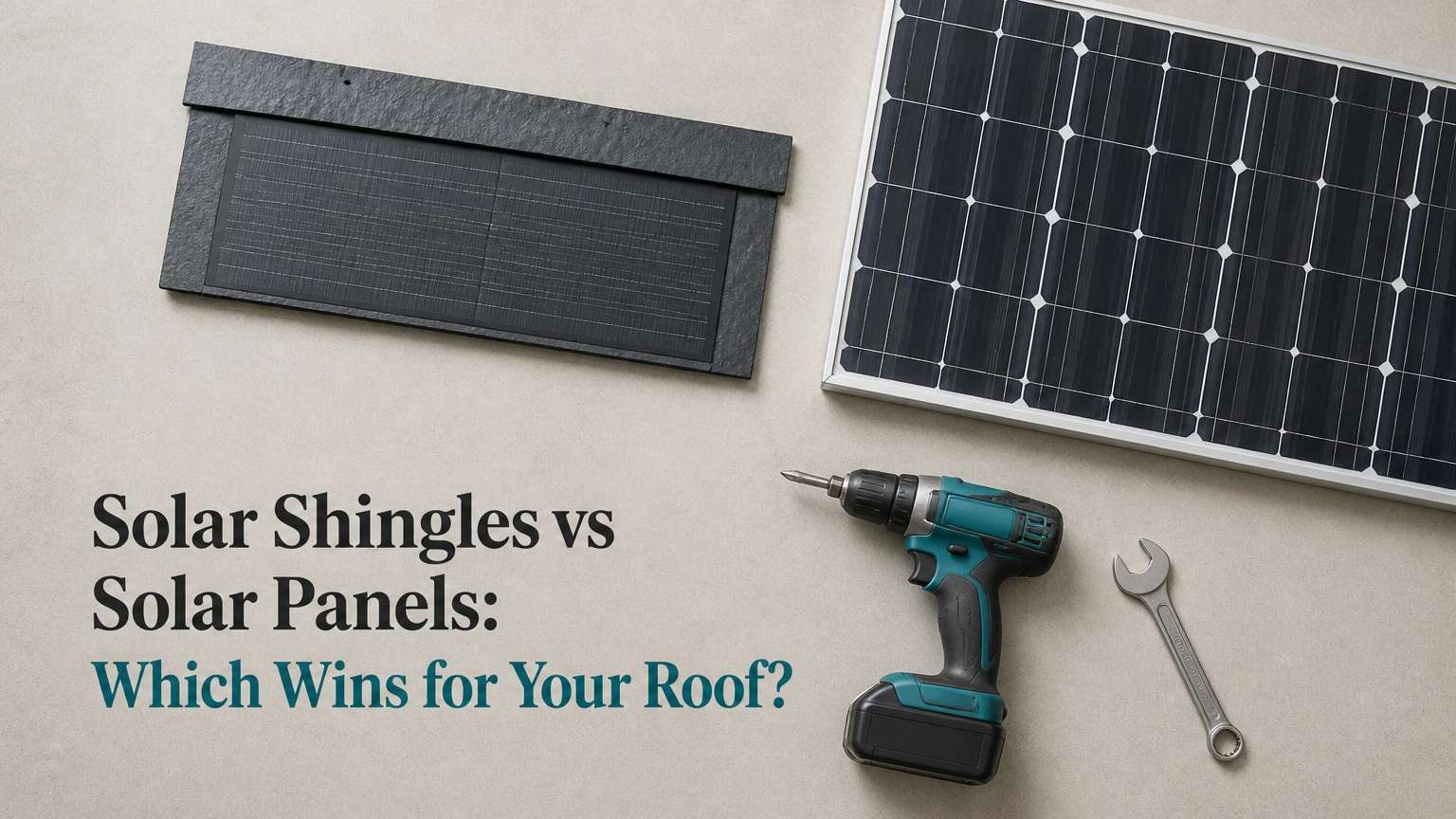
Solar shingles are the better architectural solution when a home needs a new roof, while traditional solar panels usually deliver more electricity at a lower cost and produce the stronger financial return. The right choice depends mainly on roof age, usable roof area, shade, local electricity rates, appearance rules, and whether maximum energy production or roof integration matters most.
Key Facts at a Glance
- Traditional solar panels typically cost less per watt and produce more power per square foot than solar shingles.
- Solar shingles replace roofing materials, while solar panels attach above a separate finished roof.
- A sound roof with 10 or more useful years remaining usually favors conventional panels.
- A planned reroof, new build, or strict appearance requirement can justify solar shingles.
- Solar shingle efficiency and serviceability vary substantially by manufacturer and product generation.
- A roof layout with hips, valleys, dormers, or shade can matter more than the published efficiency rating.
What Is the Structural Difference?
Traditional solar panels are separate photovoltaic modules mounted above roofing, whereas solar shingles are photovoltaic roofing products installed within the roof surface. Panels use rails, clamps, roof attachments, and flashing; solar shingles use an engineered roofing assembly that combines active tiles or shingles with inactive matching sections.
The distinction affects nearly every later decision. A panel array can usually be removed without replacing the entire roof. Solar shingles require roofing and electrical work to remain coordinated across the roof deck, underlayment, wiring paths, flashing, and finished surface.
Solar panels commonly use framed glass modules attached to aluminum racking. The rack lifts the module above the roof, creating an air channel that can improve heat dissipation. Solar shingles sit flush or nearly flush with the roof plane, although the thermal behavior depends on the product’s construction, ventilation, mounting details, and climate.
How Do Both Systems Generate Electricity?
Both systems use photovoltaic semiconductor cells to convert sunlight into direct-current electricity. An inverter changes DC electricity into alternating current for household loads, grid export, or battery charging.
A panel or shingle does not produce usable household power by itself. The complete system also includes module wiring, overcurrent protection, disconnects, grounding, an inverter, monitoring equipment, and utility interconnection. Battery systems add storage equipment and often a backup-load panel.
Solar shingles are not automatically less reliable because they use a different electrical principle. Their practical disadvantage often comes from lower wattage per roof area, more difficult access, proprietary components, or a roof layout that leaves many sections inactive.
Solar Shingles vs Solar Panels: Which Performs Better?
Traditional solar panels normally win on power density, tilt flexibility, product choice, and cost per installed watt. Solar shingles can perform well on a suitable roof, but their output depends heavily on how much of the roof is active, how the roof faces the sun, and whether dormers, hips, chimneys, and setbacks consume usable area.
| Performance factor | Traditional panels | Solar shingles | Decision effect |
|---|---|---|---|
| Typical module efficiency | 20%-24% | 14%-20% | Panels need less active area |
| Typical residential unit output | 350-460 W | 70-200 W per active unit | Shingles require many units |
| Roof ventilation | 4-6 inch rack gap, typical | Flush or low-profile assembly | Panels often run cooler |
| Tilt adjustment | Rack options available | Roof pitch is fixed | Panels handle imperfect roofs better |
| Shade response | Microinverters or optimizers available | Product-specific electronics | Compare the exact electrical design |
| Inactive roof area | Separate array footprint | Matching inactive tiles may be required | Complex roofs can reduce shingle output |
Published efficiency is only one part of annual generation. The National Renewable Energy Laboratory’s PVWatts model accounts for orientation, tilt, weather, system losses, temperature, and shading because nameplate wattage alone cannot predict household energy production.
A 7-kilowatt panel array and a 7-kilowatt shingle system can produce similar annual electricity if both have equivalent site conditions. The panels generally reach that capacity using less roof area and with more equipment choices. That distinction matters on small roofs or homes with high electricity consumption.
How Does Shade Change the Decision?
Shade affects both technologies, but module-level power electronics can limit the damage from partial shading. A chimney shadow across one panel does not necessarily reduce every panel’s output when microinverters are used, while a product with shared strings can experience broader losses.
No electrical architecture defeats shade. A tree that covers a south-facing roof from 10 a.m. to 2 p.m. can remove a substantial portion of daily production, regardless of whether the roof uses panels or shingles.
Ask the installer for an hourly shade analysis, not a verbal statement that the roof is sunny. The analysis should identify tree growth, chimney shadows, neighboring buildings, roof-plane azimuth, and seasonal sun angles.
How Much Do They Cost?
In the United States, a typical residential panel installation often falls near $2.50-$3.50 per watt before incentives, while solar shingles commonly fall near $5-$7 per watt when roofing work and specialized labor are included. Local labor, roof complexity, electrical upgrades, financing, and the selected product can move either range substantially.
| Example project | Panel system, typical gross cost | Solar shingle project, typical gross cost | Main cost assumption |
|---|---|---|---|
| 6 kW system | $15,000-$21,000 | $30,000-$48,000 | Existing roof for panels |
| 8 kW system | $20,000-$28,000 | $40,000-$64,000 | Moderate roof complexity |
| 10 kW system | $25,000-$35,000 | $50,000-$80,000 | Larger energy requirement |
| Roof replacement alone | $8,000-$25,000 | Included in shingle total | Asphalt roof, size and region vary |
| Battery addition | $10,000-$20,000 | $10,000-$20,000 | Storage size and backup scope vary |
These are typical planning ranges, not quotes. A panel comparison must include the cost of a roof replacement if the existing roof cannot outlast the array. Conversely, a solar shingle comparison should subtract the roof covering cost that the homeowner would have paid anyway.
The federal residential clean energy credit has historically allowed eligible homeowners to claim 30% of qualifying clean-energy costs, but tax eligibility, project rules, and future legislation require confirmation with the Internal Revenue Service or a qualified tax professional. State rebates, utility incentives, sales tax treatment, and net-metering rules differ by location.
Why Can a Lower-Priced Panel Quote Still Be More Expensive?
A low panel quote can become expensive when it excludes reroofing, service-panel replacement, tree work, engineering, permit fees, or battery equipment. A solar shingle quote can look unusually high when it includes a complete premium roof that should be separated into roofing and energy components.
Request an itemized proposal with these lines:
- Roofing tear-off, deck repair, underlayment, flashing, and ventilation.
- Active solar units, inactive roofing units, inverter, wiring, and monitoring.
- Structural engineering, permits, utility fees, and electrical-panel work.
- Battery, backup circuits, financing fees, and warranty extensions.
- Sales tax, incentives, estimated annual production, and escalation assumptions.
Which Has Better ROI?
Traditional solar panels usually provide the better ROI because their lower installed price and higher power density reduce the cost of each kilowatt-hour produced. Solar shingles can approach a reasonable return when the homeowner already needs a roof replacement, has a high electricity rate, and places substantial value on the integrated appearance.
A simple payback calculation is:
Simple payback = net project cost divided by first-year bill savings
For example, a $24,000 panel project producing $2,400 in first-year savings has a simple payback of 10 years before financing, maintenance, degradation, and future rate changes. A $52,000 solar roof with the same annual savings has a 21.7-year simple payback, although part of that cost replaces a conventional roof.
| ROI variable | Panel effect | Shingle effect | What to verify |
|---|---|---|---|
| Net project cost | Usually lower | Usually higher | Itemized cash price |
| Annual production | Often higher per area | Roof geometry can limit output | PVWatts or equivalent model |
| Roof replacement credit | Usually separate | Often embedded | Cost of equivalent roof |
| Electricity rate | Higher rates improve payback | Same benefit | Current tariff and escalation |
| Export compensation | Can materially reduce savings | Same rule | Utility net-metering terms |
| Financing APR | Interest can extend payback | Large balance magnifies impact | Cash price and loan APR |
| Module degradation | Commonly about 0.25%-0.5% annually | Product-specific | Performance warranty |
The correct comparison is the incremental cost of solar over the roof you would otherwise buy. If a homeowner needs a $18,000 roof and chooses a $52,000 solar roof, the energy-and-integration premium is approximately $34,000, not $52,000.
Which Is Better for an Existing Roof?
Solar panels are usually better for an existing roof that is structurally sound and has at least 10-15 years of expected service remaining. Roof-mounted panels preserve the current roof covering and can be removed later for reroofing.
Solar shingles make less financial sense when they require discarding a recently installed roof. Removing a healthy roof covering creates a large sunk cost that extra electricity production rarely recovers quickly.
A roofing contractor should inspect decking, flashing, valleys, penetrations, ventilation, granule loss, curling, soft areas, and previous leak repairs. Solar installers often assess structural capacity but may not provide a complete roofing diagnosis.
When Are Solar Shingles the Better Choice?
Solar shingles are strongest for new construction, major reroofing, architecturally controlled neighborhoods, and homeowners who accept a higher energy cost for a low-profile roof. Solar shingles also fit projects where conventional modules would conflict with design requirements or an approved historic appearance.
| Homeowner situation | Better starting option | Reason | Important condition |
|---|---|---|---|
| Roof is 5 years old | Panels | Avoids premature reroofing | Confirm roof warranty |
| Roof needs replacement now | Solar shingles or panels | Both can use the reroof event | Compare total roof cost |
| New luxury construction | Solar shingles | Integrated architectural finish | Reserve roof area early |
| High annual electricity demand | Panels | More watts per square foot | Check roof capacity |
| Strict HOA appearance rules | Solar shingles | Lower visual profile | Obtain written approval |
| Heavy roof shade | Neither without mitigation | Shade controls output | Model trees and obstructions |
| Limited certified installers | Panels | Wider labor market | Confirm local service support |
Solar shingles are not a universal substitute for panels. They are a roofing decision with an electrical system attached, so the roof design must be evaluated before selecting equipment.
Which Technologies Are Used?
Current residential solar panels are predominantly monocrystalline silicon modules, including PERC and newer n-type TOPCon designs. Polycrystalline modules remain technically usable but are uncommon in new residential installations because they generally deliver lower efficiency in the same footprint.
Solar shingles use several architectures. Rigid glass products, such as the Tesla Solar Roof, combine active photovoltaic tiles with inactive glass roofing tiles. Nailable products, such as GAF Energy Timberline Solar, integrate solar components into roofing strips designed for deck attachment. Thin-film products may use CIGS materials and have different weight, wiring, and efficiency characteristics.
| Product architecture | Named example | Typical installation method | Main trade-off |
|---|---|---|---|
| Framed silicon module | Qcells, REC, Maxeon | Rail-mounted above roof | Visible hardware and roof penetrations |
| Rigid glass solar tile | Tesla Solar Roof | Integrated roof assembly | High cost and proprietary service |
| Nailable solar shingle | GAF Energy Timberline Solar | Nailed with roofing workflow | Product availability and layout limits |
| Thin-film solar shingle | CertainTeed Solstice examples | Low-profile roof integration | Typically lower power density |
| Inactive matching tile | Tesla Solar Roof | Installed beside active tiles | Adds roof coverage without generation |
Brand availability changes by country, installer network, product generation, and certification status. Homeowners should compare the exact data sheet, not a brand category.
How Do Warranties and Lifespan Compare?
Traditional panels commonly carry 25-30-year performance warranties, while solar shingles often carry approximately 25 years of energy-performance coverage and a separate roofing or product warranty. Warranty length does not reveal how quickly a failed unit can be identified, removed, and replaced.
| Warranty component | Traditional panels, typical | Solar shingles, typical | Buyer question |
|---|---|---|---|
| Product warranty | 12-25 years | 10-25 years | Who pays labor for replacement? |
| Power warranty | 25-30 years | About 25 years | What output remains at year 25? |
| Inverter warranty | 10-25 years | 10-25 years | Is extension included? |
| Roof workmanship | 5-15 years | 10-25 years, product-specific | Who handles leaks? |
| Transferability | Often transferable | Product-specific | Does resale preserve coverage? |
| Service network | Broad for major panels | Narrower for integrated systems | Who stocks replacement units? |
The warranty should identify the manufacturer, installer, labor obligation, response time, exclusions, monitoring requirements, and treatment of discontinued products. A 25-year warranty with no local service pathway can be less useful than a shorter warranty backed by an established contractor.
Which Installation Is More Disruptive?
Traditional solar panels generally take 1-3 installation days after design, permitting, and utility approval, while a solar shingle project commonly takes 5-10 or more working days because it includes roof removal, underlayment, roofing installation, electrical integration, and inspections.
| Project stage | Traditional panels | Solar shingles | Typical duration |
|---|---|---|---|
| Roof and structural assessment | Required | Required | 1-7 days |
| Permit and utility approval | Required | Required | 2-8 weeks |
| Roof tear-off | Usually absent | Usually required | 1-2 days |
| Mounting or roofing installation | 1-2 days | 3-8 days | Project-dependent |
| Electrical commissioning | Same day to 2 days | 1-3 days | Equipment-dependent |
| Utility permission to operate | Required | Required | 1-4 weeks |
Panel installers must locate rafters, flash roof attachments, install rails, clamp modules, route conductors, and commission the inverter. Solar roof crews must coordinate roofing courses, active-unit placement, roof penetrations, wire pathways, connectors, and electrical inspection.
The fastest project is not always the safest project. A rushed roof integration can create leaks or make future fault tracing difficult.
What Breaks and How Is It Repaired?
Solar panel repairs are generally easier because the failed module, optimizer, or microinverter remains accessible above the roof. Solar shingle repairs can require product-specific diagnostic tools, partial tile removal, roofing repair, and an installer trained in both electrical and roofing work.
Common failure points include inverters, connectors, wiring, cracked glass, water intrusion, monitoring gateways, roof flashing, and storm damage. Solar shingles add a further concern: a fault may be distributed across many connected units beneath the finished roof surface.
What Should You Ask an Installer?
Ask for evidence that the installer can complete both the roof and electrical scopes. A general roofer without photovoltaic experience may install the covering correctly but lack commissioning and diagnostic skills; a solar crew without roofing expertise may create waterproofing problems.
Use this checklist:
- What is the installer’s electrical license and roofing license status?
- Which crew handles the roof deck, flashing, wiring, and commissioning?
- What is the company’s local service response time?
- Are replacement units stocked within the region?
- Which party pays labor during a warranty repair?
- How will the roof be repaired after a leak or storm event?
- What annual production estimate uses shade and roof-plane data?
- Does the proposal separate equivalent roof cost from solar cost?
- What happens if the selected product is discontinued?
- How are batteries, emergency circuits, and utility disconnects handled?
How Do Batteries and Backup Power Affect the Choice?
Battery backup depends more on inverter architecture and electrical design than on whether the roof uses panels or shingles. Both technologies can support storage, but the exact battery, inverter, transfer equipment, and critical-load panel must be compatible with the selected product.
A grid-connected system usually shuts off during an outage unless it includes approved islanding equipment and storage. A battery system sized for refrigeration, lighting, internet equipment, and a gas-fired furnace has different requirements from a system expected to run heat pumps, electric water heaters, or vehicle charging.
Request a load calculation rather than accepting a generic battery size. A 10-kilowatt-hour battery may cover selected overnight loads, while whole-home backup may require multiple batteries and a higher-capacity inverter.
When Are Solar Panels the Better Choice?
Choose traditional panels when the roof is healthy, output per dollar matters, electricity demand is high, or future repair flexibility has priority. Panels also fit homeowners who want multiple manufacturer options, a broad installer market, and the ability to replace one module without disturbing the roof.
Panels are not ideal for every property. Visible rails, raised modules, roof penetrations, and potential HOA restrictions can outweigh their economic advantage for a design-led project.
When Are Solar Shingles a Poor Fit?
Solar shingles are a poor fit for a recently replaced roof, a heavily shaded property, a roof with inadequate usable area, or a location without trained service contractors. They are also risky when a proposal provides no production model, no separate roof-cost line, or vague warranty labor terms.
A homeowner should reject a solar roof proposal if the installer cannot explain active versus inactive roof sections. The finished surface may look uniform while only part of the roof generates electricity.
Expert Rules That Prevent Expensive Mistakes
Rule 1: Compare the energy premium, not the total roof price. Subtract the cost of the conventional roof from each project before calculating the solar premium. This avoids making an integrated roof appear even less competitive than it is.
Rule 2: Size from annual consumption, then test roof geometry. A household using 12,000 kilowatt-hours per year may need roughly 8-10 kilowatts in a moderate solar resource, but hips, valleys, setbacks, and shade can prevent that capacity from fitting on a shingle roof.
Rule 3: Treat serviceability as a financial attribute. A failed panel can often be isolated and replaced from above the roof. A failed integrated tile may require electrical diagnosis, roofing access, and a manufacturer-specific replacement, so labor coverage deserves a monetary value.
Frequently Asked Questions
Do Solar Shingles Increase Home Value?
Solar shingles may improve appeal for buyers who value a uniform roof design, but a guaranteed resale premium should not be assumed. Appraisers and buyers typically need documented system ownership, transferable warranties, production records, and comparable local sales before assigning value to the system.
Can Solar Shingles Be Installed on Any Roof?
Solar shingles require a roof design, pitch, structure, ventilation plan, and weatherproofing assembly approved for the specific product. Complex hips, shaded planes, steep slopes, poor decking, and inadequate fire or wind ratings can make a conventional panel array more practical.
Are Solar Shingles More Durable Than Solar Panels?
Durability depends on the certified product and exposure conditions. Solar shingles can provide roofing protection and may have strong wind or impact ratings, while raised panels remain exposed above the roof. Compare wind, hail, fire classification, temperature, and roof workmanship ratings rather than relying on appearance.
Can Solar Panels Be Added Later to a Solar Shingle Roof?
Additional panels may be technically possible, but the inverter, roof warranty, electrical capacity, and mounting details must support the modification. Drilling or altering an integrated roof without manufacturer approval can compromise waterproofing and warranty coverage.
Do Solar Shingles Work During a Power Outage?
Solar shingles usually stop supplying household circuits during a grid outage unless the system includes compliant backup equipment, storage, and islanding controls. The same limitation applies to most grid-tied panel systems, so outage protection must appear explicitly in the contract.
How Often Do Solar Panels and Solar Shingles Need Cleaning?
Both systems often need little routine cleaning in regions with regular rainfall, but dust, pollen, bird droppings, snow, and low roof pitch can reduce output. Monitor production first, use manufacturer-approved cleaning methods, and avoid walking on either modules or fragile roofing surfaces.
The Bottom Line
Solar shingles vs solar panels is primarily a choice between integrated roofing and lower-cost electricity generation. Traditional solar panels usually win for ROI, output density, repair access, and product availability. Solar shingles can be the better choice for a new build or necessary reroof when architectural integration, HOA compliance, and a flush roof profile justify the additional cost.
Compare both proposals against the cost of the roof you would otherwise install. Confirm annual production, usable roof area, shade losses, warranty labor, installer service coverage, battery compatibility, and local incentives before signing.