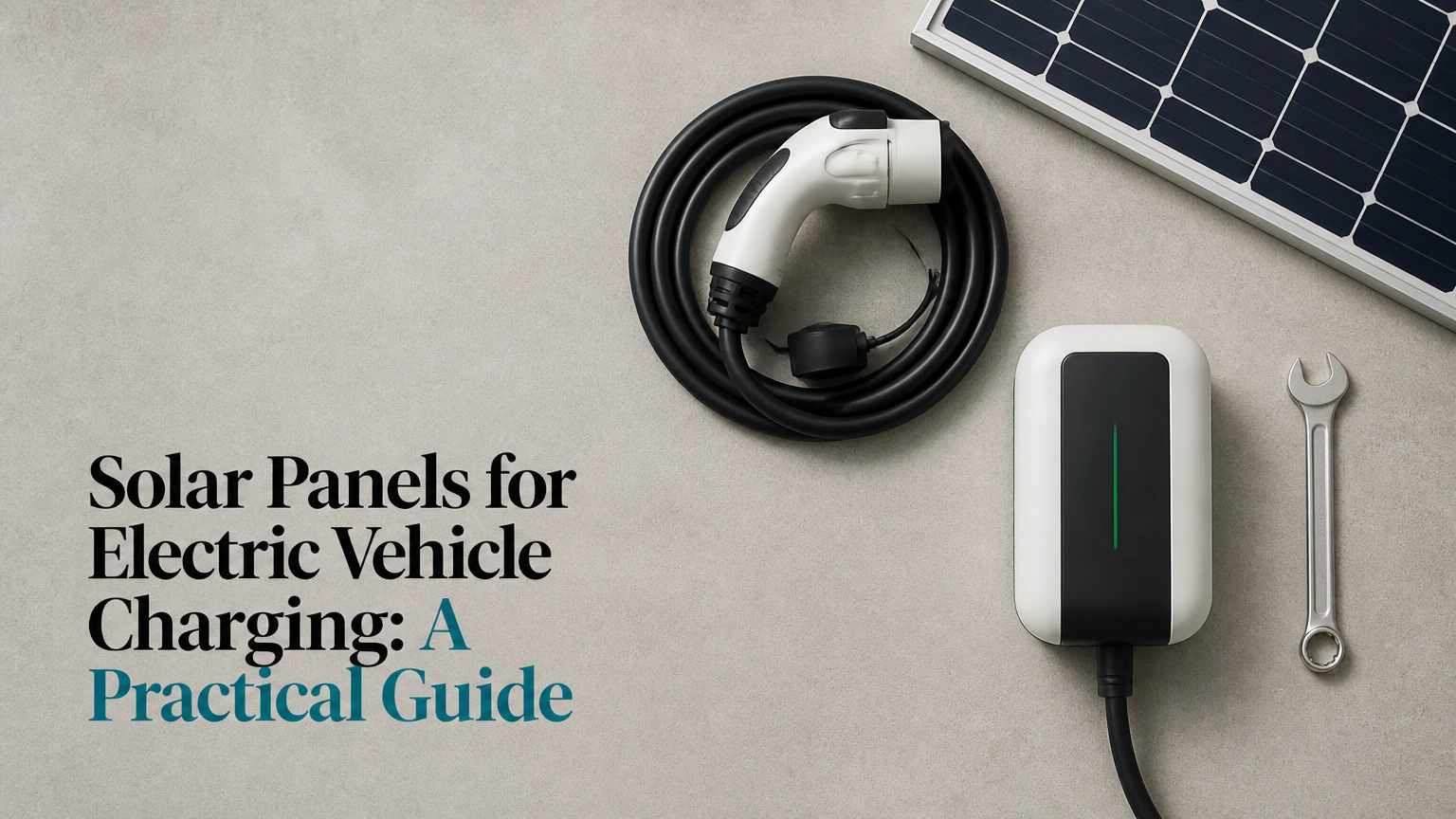
Solar panels for electric vehicle charging convert sunlight into electricity that an inverter, electrical panel, and EVSE deliver to an electric vehicle. A grid-connected system can offset charging with daytime solar exports, while a battery system can shift solar energy into evening hours. The right design depends on mileage, climate, roof space, utility rates, and charger power.
Key Facts at a Glance
- A typical EV uses about 3-4 miles per kilowatt-hour, so 40 miles of driving requires approximately 10-13.3 kWh before charging losses.
- A 3 kW solar array can produce about 9-15 kWh on a representative day with 3-5 peak sun hours, before local and system losses.
- Seven to eight modern 400-450 watt panels provide roughly 3 kW of nameplate capacity.
- A 9.6 kW Level 2 charger typically adds about 25-30 miles of range per hour, but solar output rarely stays at 9.6 kW for an entire session.
- Grid-tied solar is usually the lowest-cost design; a home battery becomes more valuable when export credits are low or evening electricity rates are high.
- Standard rooftop solar normally shuts down during a utility outage unless the system includes approved backup equipment and energy storage.
How Do Solar Panels for Electric Vehicle Charging Work?
Solar EV charging follows this energy path: photovoltaic panels produce direct current, an inverter converts it to alternating current, an EVSE controls delivery, and the vehicle’s onboard charger converts AC back to DC for the traction battery. The home can use solar electricity first, export surplus, or store it in a stationary battery.
The EVSE is a control and safety device, not the component that normally converts household AC into battery DC. In an AC Level 2 installation, that conversion occurs inside the vehicle. DC fast charging uses off-board power electronics, but a home solar array generally does not connect directly to a residential DC fast charger because the equipment, service capacity, and cost are substantially higher.
The U.S. Department of Energy describes solar energy as “the most abundant energy resource on earth.” That resource is intermittent, however. Solar panels generate the most electricity around midday, while many vehicles return home after work. A smart charger, a time-of-use tariff, or a stationary battery determines whether the system uses solar directly or shifts its value to another time.
AC-Coupled and DC-Coupled Designs
| Design | Energy path | Typical use | Main limitation |
|---|---|---|---|
| AC-coupled rooftop solar | PV to inverter to panel to EVSE | Existing home solar retrofit | Two conversion stages can reduce delivered energy |
| DC-coupled solar and battery | PV to hybrid inverter to battery or EV system | New solar-plus-storage installation | Requires compatible inverter and controls |
| Grid-tied solar | PV to inverter to household loads or grid | Lowest-cost offset strategy | No charging during a normal grid outage |
| Off-grid solar | PV to charge controller or inverter to battery to EVSE | Remote property with no utility service | Large winter battery and array requirement |
How Many Solar Panels Does an EV Need?
A typical electric vehicle needs approximately one solar-panel kilowatt of capacity for every 3-5 kWh of daily driving energy in many moderate-sun locations, but the exact requirement changes with mileage, weather, roof orientation, and system losses. A 40-mile daily commute commonly needs 7-10 panels, not a universal fixed number.
Use this sizing sequence:
- Convert driving distance into vehicle energy:
Daily driving miles ÷ EV efficiency in miles per kWh = driving kWh - Add charging and inverter losses, typically 10-20 percent for a practical planning estimate.
- Divide the result by local peak sun hours and a performance ratio, often 0.75-0.85.
- Compare the result with available roof area and the rest of the home’s electricity demand.
For example, a vehicle driven 40 miles per day at 3.5 miles per kWh uses 11.4 kWh. Adding 15 percent charging losses produces about 13.1 kWh. In a location with four peak sun hours and an 0.8 performance ratio, the array calculation is 13.1 ÷ 3.2, or approximately 4.1 kW. That equals about ten 420-watt panels.
| Daily driving | EV efficiency | Energy including 15% losses | Array at 4 peak sun hours and 0.8 ratio |
|---|---|---|---|
| 20 miles | 4.0 mi/kWh | 5.8 kWh | 1.8 kW |
| 40 miles | 3.5 mi/kWh | 13.1 kWh | 4.1 kW |
| 60 miles | 3.2 mi/kWh | 21.6 kWh | 6.8 kW |
| 100 miles | 3.0 mi/kWh | 38.3 kWh | 12.0 kW |
These figures describe annual or representative-day energy, not guaranteed daily charging. A cloudy winter day can produce far less than the average. Oversizing the array, retaining grid service, or adding storage prevents the vehicle from depending on perfect weather.
How to Size the Solar Array
Size solar panels against total annual household consumption, not only the EV, when the roof and budget permit. A vehicle may add 3,000-5,000 kWh of annual demand for a moderate commuter, while a heat pump, electric water heater, or second EV can add similar load.
A panel’s 400-450 watt rating is a laboratory nameplate value under standard test conditions. Real output falls because of temperature, wiring, inverter conversion, orientation, snow, dust, partial shade, and the difference between winter and summer sunlight. NREL’s PVWatts tool is useful for location-specific production estimates because it models tilt, azimuth, system losses, and weather data rather than relying on panel wattage alone.
| Planning input | Typical value | Effect on design |
|---|---|---|
| Residential panel rating | 400-450 W | About 2.0-2.25 m² per panel |
| EV efficiency | 3-4 mi/kWh | Lower efficiency increases array size |
| Peak sun hours | 3-5 hours/day | Regional production changes sharply |
| Solar performance ratio | 0.75-0.85 | Accounts for practical system losses |
| Annual panel degradation | About 0.25-0.5%/year | Later-year production declines gradually |
| Level 2 charger output | 7.2-11.5 kW typical | Determines charging speed and circuit demand |
A practitioner rule matters here: size the array for energy, but size the charger and wiring for power. A 4 kW array may produce enough daily energy for a commuter while producing only 1-3 kW during much of the charging window. A fixed 9.6 kW charger will then import grid electricity unless its current is reduced or its controls follow surplus solar.
Which Charger Features Matter?
A solar-compatible EV charger should support adjustable current, scheduled charging, real-time energy monitoring, and dynamic load management. Solar tracking is useful because it can increase or decrease charging current as surplus production changes, although the minimum current and the vehicle’s communication behavior limit how closely the charger can follow every cloud.
At 240 volts, a 40-amp circuit supplies 9.6 kW in theory, but continuous loads are commonly planned at 80 percent of circuit rating under the U.S. National Electrical Code. A 40-amp EV charging load therefore commonly uses a 50-amp circuit, subject to local code and the equipment listing. An electrician must verify conductor size, breaker compatibility, disconnect requirements, grounding, and panel capacity.
| Charger configuration | Circuit example | Approximate power | Approximate range added |
|---|---|---|---|
| Portable Level 2 | 240 V, 16 A | 3.8 kW | 10-15 mi/hour |
| Residential Level 2 | 240 V, 32 A | 7.7 kW | 20-25 mi/hour |
| Residential Level 2 | 240 V, 40 A | 9.6 kW | 25-30 mi/hour |
| Higher-output Level 2 | 240 V, 48 A | 11.5 kW | 30-35 mi/hour |
Vehicle acceptance rate matters as much as EVSE output. A vehicle limited to 7.2 kW cannot charge faster because an 11.5 kW wall unit is installed. Solar-aware charging also works best when the car remains connected during daylight hours, which makes home charging less convenient for commuters who leave before sunrise and return after sunset.
Which System Type Fits Your Home?
Grid-tied solar is the best default for a homeowner who can charge during the day or receives reasonable export credit. Solar-plus-battery is better when the car returns after solar production, evening electricity is expensive, or the utility pays substantially less for exports than it charges for imports.
| System type | Typical added cost | Night charging | Outage behavior | Best fit |
|---|---|---|---|---|
| Grid-tied solar | $7,500-$12,500 for 3-5 kW | Grid or export-credit offset | Normal PV shuts down | Daytime charging and low-cost entry |
| Solar plus home battery | $15,500-$26,500 added to solar | Stored solar | Backup possible with approved equipment | Low export value and outage needs |
| Solar carport | $12,000-$22,000 typical | Grid or battery dependent | Depends on inverter design | Shaded or unsuitable roof |
| Off-grid solar | $40,000 or more in difficult cases | Battery dependent | No utility backup | Remote locations without service |
A battery is not automatically the greenest or cheapest addition. Battery round-trip losses commonly consume around 10 percent of stored energy, and residential batteries often need replacement sooner than solar modules. Battery value improves when it avoids high evening rates, preserves backup power, or captures solar that would otherwise receive a low export credit.
What Happens When the Sun Is Down?
An EV can charge at night with solar panels, but only indirectly. A grid-tied system exports daytime solar and imports electricity at night, while a battery system stores daytime production and later supplies the EVSE after accounting for storage and inverter losses.
Net metering rules determine the financial result. A utility that credits exports near the retail rate can provide inexpensive virtual storage. A utility that pays a low avoided-cost rate makes direct daytime charging or battery storage more attractive, particularly under time-of-use pricing.
A home battery also needs a reserve policy. A 60-100 kWh EV battery can consume several times the capacity of a 10-15 kWh stationary battery, so unrestricted vehicle charging can remove backup energy intended for refrigeration, heating, medical equipment, or communications. Configure the energy management system with a home reserve, commonly 20-40 percent depending on household priorities.
Bidirectional Charging and Vehicle Backup
Vehicle-to-home charging can reduce dependence on a stationary battery, but only compatible vehicles, bidirectional EVSE, inverters, and utility rules support it. A vehicle with a large battery does not automatically function as a home generator. The installation needs islanding protection and controls that prevent electricity from energizing utility lines during an outage.
What Does Solar EV Charging Cost?
A typical U.S. residential solar EV charging project costs about $8,300-$14,500 for a dedicated 3-5 kW array and Level 2 charger before incentives, while a full home solar system with storage can exceed $30,000. Roof complexity, electrical upgrades, structural work, trenching, and local labor produce large regional differences.
| Component | Typical cost range | Installation time | Replacement horizon |
|---|---|---|---|
| 3-5 kW solar array | $7,500-$12,500 | 1-2 days | 25-30 years |
| Level 2 EVSE and wiring | $800-$2,000 | 3-6 hours | 5-10 years |
| 10-15 kWh home battery | $8,000-$14,000 | 1 day | 10-15 years |
| Solar carport structure and PV | $12,000-$22,000 | 3-5 days | 25 years |
| Main panel or service upgrade | $2,000-$5,000 typical | 1-2 days | 20 or more years |
Federal, state, utility, and local incentives change frequently. The U.S. Inflation Reduction Act created credits for qualifying clean-energy and alternative-fuel equipment, but eligibility depends on installation date, property location, equipment requirements, income rules, and tax circumstances. Verify current rules with the IRS, state agencies, and the utility before using an incentive in a payback calculation.
Compare solar charging with the electricity rate, not with a public charger’s headline price alone. A home system may reduce energy cost over many years, but financing charges, inverter replacement, roof work, maintenance, and low export compensation can extend payback. Public charging remains practical for renters and drivers who cannot install dedicated equipment.
What Is the Installation Process?
A typical rooftop solar and EV charging project takes 6-16 weeks from design through utility approval, although physical installation may take one to three days. The most important success factor is coordinated electrical design, because the solar breaker, EVSE circuit, battery inverter, and existing household loads must fit the service and local code.
- Audit energy use and mileage. Record monthly utility consumption, daily driving distance, EV efficiency, charging location, and future loads such as a heat pump or second vehicle.
Checkpoint: You have annual household kWh and annual EV kWh estimates.
Common mistake: Using battery capacity as annual driving demand. - Assess the site. Check roof age, structural condition, azimuth, tilt, tree shade, snow or wind exposure, and cable routing. Use a carport or ground mount when roof shading makes production unpredictable.
Checkpoint: The design identifies usable panel area and shade losses.
Common mistake: Designing from roof area without checking setbacks. - Evaluate electrical capacity. Confirm service size, panel rating, spare breaker positions, grounding, voltage, and the EVSE’s continuous current. A 200-amp service is common, but it is not universally required because load calculations and energy management can reduce upgrade needs.
Checkpoint: A licensed electrician confirms the load calculation.
Common mistake: Assuming an empty breaker position means adequate capacity. - Choose controls and storage. Select adjustable-current EVSE, solar monitoring, load management, and a battery reserve strategy. Specify whether the charger prioritizes solar surplus, low-rate grid electricity, or departure-time readiness.
Checkpoint: The charging priorities are written into the commissioning plan.
Common mistake: Buying a high-power charger with no way to reduce current. - Obtain permits and interconnection approval. Submit electrical, structural, and single-line documents to the authority having jurisdiction and utility. Approval timing commonly ranges from two to ten weeks.
Checkpoint: Equipment is installed only after required approvals.
Common mistake: Assuming permission to install equals permission to export power. - Install, inspect, and commission. Mount racking and panels, install the inverter, wire the EVSE, label equipment, test protective devices, and confirm monitoring data.
Checkpoint: The system records solar production, household consumption, EV load, and grid import separately.
Common mistake: Finishing installation without testing solar-following behavior under changing output.
Who Benefits Most From Solar EV Charging?
Homeowners with daytime parking, an unshaded roof, stable utility ownership, and annual driving above roughly 8,000 miles usually receive the clearest operational benefit. Drivers who park elsewhere all day may need a battery, workplace charging, or a different rate plan to use their solar effectively.
| User situation | Recommended design | Reason | Limitation |
|---|---|---|---|
| Daytime home parking | Grid-tied PV with solar-aware EVSE | Directly uses midday generation | Car must remain connected |
| Night-shift driver | PV, battery, and scheduled EVSE | Stores solar until vehicle returns | Battery adds cost and losses |
| Shaded or historic roof | Solar carport or ground mount | Avoids poor roof production | Requires land and structural permits |
| Renter or apartment resident | Shared solar, workplace charging, or utility program | Avoids permanent property work | No dedicated on-site generation |
| Frequent traveler | Grid-tied PV with modest charger | Annual offset matters more than daily matching | Public charging remains necessary |
Solar charging is not a good substitute for reliable public or workplace charging when a driver regularly travels beyond the vehicle’s planned range. An off-grid EV system is also a poor fit for most suburban homes because winter overcapacity and battery costs can exceed the value of utility connection.
What Problems Reduce Solar Charging Performance?
An EV may draw grid electricity during sunshine because the charger’s fixed power exceeds current solar output, household loads consume the generation, or the system is exporting rather than directing surplus to the car. Reduce the charging current, enable solar-following mode, and inspect the monitoring data before replacing equipment.
| Symptom | Likely cause | Diagnostic check | Practical fix |
|---|---|---|---|
| Grid import during sunny charging | EVSE power exceeds PV surplus | Compare EV load with solar and home load | Reduce amperage or enable surplus mode |
| Production falls on hot afternoons | Module temperature raises voltage losses | Compare output with ambient temperature | Preserve rear ventilation and check design |
| One roof section underperforms | Shade, soiling, or mismatch | Compare module or string monitoring | Remove shade source or use module-level electronics |
| Battery empties before morning | EV has no reserve rule | Review battery discharge history | Set home reserve and EV charging priority |
| Charger stops randomly | GFCI, communication, or wiring issue | Read EVSE fault code and inspect circuit | Use a licensed electrician and approved reset procedure |
| Solar system shuts off in outage | Standard grid-tied anti-islanding behavior | Check inverter outage mode | Add approved backup inverter and battery |
Partial shade deserves special attention. A shaded panel does not always reduce every panel in the array by the same amount, because bypass diodes, string layout, module-level power electronics, and shade movement determine the result. The practical rule is to model shade by time of day and season, rather than assuming a single percentage loss.
The Bottom Line
Solar panels for electric vehicle charging can supply a substantial share of EV energy, but the best design matches solar production with driving schedules and utility pricing. Start with a grid-tied array and adjustable Level 2 EVSE when daytime charging or fair export credit is available; add a battery for evening charging, backup requirements, or poor export economics. Size energy in kWh, size wiring in amps, and verify the design with a licensed installer.
Frequently Asked Questions
Can a 2 kW solar system charge an electric vehicle?
A 2 kW solar system can supply roughly 6-10 kWh on a representative day with 3-5 peak sun hours before losses, which may provide approximately 18-35 miles for an efficient EV. It will not maintain a high-power Level 2 session continuously, so grid assistance or slower, solar-aware charging may be necessary.
Do solar panels charge an EV faster than a wall outlet?
Solar panels do not automatically charge an EV faster than a wall outlet. Charging speed depends on EVSE output, circuit capacity, vehicle acceptance rate, and available solar power. A 9.6 kW grid-connected Level 2 charger can charge faster than a small solar array, while solar energy can reduce operating cost rather than increase maximum speed.
Should I install solar panels before buying an EV?
Install solar before buying an EV only when the roof, electrical service, and expected energy demand justify the system independently. If an EV purchase is imminent, include its estimated annual mileage in the solar design so the inverter, roof layout, and service calculation do not require an expensive expansion later.
Can solar panels charge an EV during a power outage?
Standard grid-tied solar panels cannot charge an EV during a utility outage because the inverter normally disconnects to prevent unsafe backfeed. Charging during an outage requires an approved backup inverter, battery or other stable energy source, compatible EVSE, transfer controls, and enough stored or real-time power for the vehicle.
Is a solar carport better than rooftop solar?
A solar carport is better than rooftop solar when the roof is shaded, structurally unsuitable, too small, or oriented poorly. Rooftop solar usually costs less when suitable roof space already exists. A carport adds steel or timber structure, drainage, foundation, snow and wind design, lighting, and potentially separate planning approval.