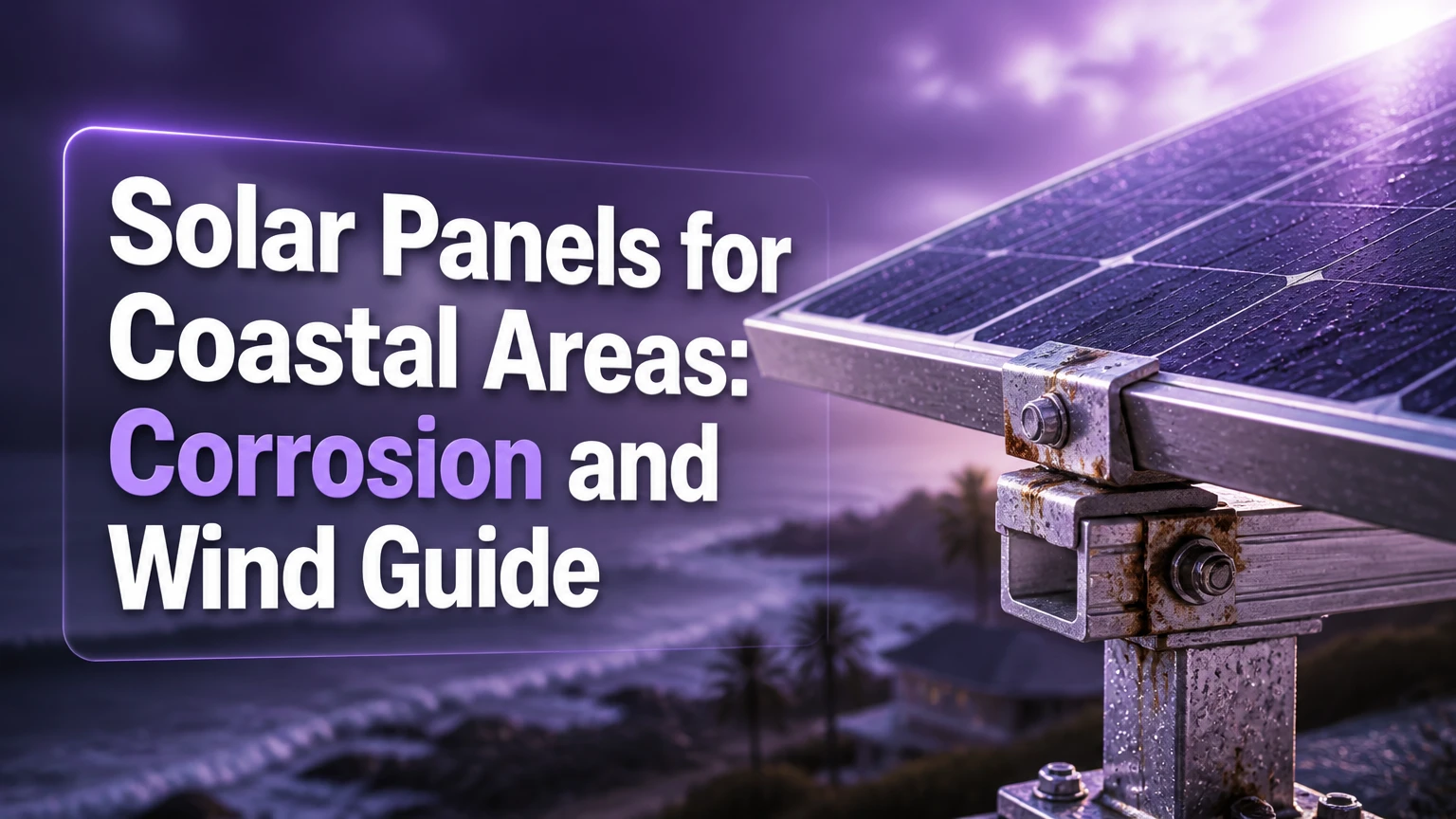
Solar panels for coastal areas can provide reliable 25- to 30-year service when the module, racking, electrical hardware, and roof attachments are specified for salt exposure and local wind loads. The best system is not defined by a “marine-grade” label alone; IEC 61701 test evidence, corrosion-compatible materials, code-compliant engineering, and sheltered equipment placement matter more.
Key Facts at a Glance
- Salt mist attacks aluminum frames, fasteners, connectors, junction boxes, and inverter circuit boards, not only the visible module surface.
- IEC 61701 evaluates a photovoltaic module’s resistance to salt mist; the test result does not replace site-specific wind, roof, or electrical design.
- Glass-glass modules reduce backsheet moisture exposure, but they add weight and do not prevent corrosion in mounting hardware.
- Coastal wind design follows the applicable building code, such as ASCE 7 in the United States, rather than a universal 140-180 mph rule.
- A typical coastal residential system costs about 5-20% more than a comparable inland installation when extra hardware, engineering, and access are required.
- Fresh-water rinsing can restore output lost to salt and sand, but high-pressure washing and abrasive tools can damage seals and glass coatings.
What Are Solar Panels for Coastal Areas?
Solar panels for coastal areas are photovoltaic modules and balance-of-system components selected for salt-laden air, high humidity, wind uplift, intense ultraviolet exposure, and site-specific weather. The photovoltaic cells still convert sunlight into direct current in the usual way, while the surrounding materials must limit moisture ingress, corrosion, electrical leakage, and mechanical fatigue.
A coastal system therefore includes more than the panel. Rails, clamps, roof flashing, grounding conductors, DC connectors, conduit, inverter enclosures, and battery cabinets all need compatible corrosion protection. A premium module installed with ordinary fasteners can still develop an early failure.
The U.S. Department of Energy describes the basic principle directly: “Solar panels use the sun’s energy to generate electricity.” Coastal engineering protects the electrical path that makes that conversion useful over decades. Salt deposits can also reduce light transmission, especially where spray dries repeatedly on a low-tilt array.
How severe is the coastal exposure?
Distance from the shoreline is a useful starting point, not a reliable corrosion boundary. Prevailing wind, surf direction, elevation, dunes, vegetation, nearby docks, salt ponds, and whether the roof faces open water can change exposure substantially.
| Site condition | Typical exposure | Design response | Inspection interval |
|---|---|---|---|
| Inland, over 5 km from surf | Low to moderate salt aerosol | Standard premium PV, anodized rails, compatible fasteners | Every 12-24 months |
| Coastal suburb, 500 m-5 km | Moderate salt and wind | Salt-mist-tested modules, sealed connectors, code-rated racking | Every 6-12 months |
| Seafront, 0-500 m | High salt spray and uplift | Enhanced corrosion system, sheltered inverter, engineered attachments | Every 3-6 months |
| Direct spray, pier, island, or boat | Extreme wetting and vibration | Marine-specific equipment and custom structural design | Monthly to quarterly |
These ranges are screening categories, not legal classifications. An installer should document the site’s wind speed, exposure category, roof geometry, distance from breaking surf, and history of hurricane or cyclone damage before selecting equipment.
How Do Coastal Solar Systems Resist Salt and Moisture?
Coastal photovoltaic systems resist damage through several layers: module encapsulation, tempered glass, protected frames, sealed junction boxes, compatible metal interfaces, and carefully routed wiring. No layer is permanent if saltwater remains trapped against a connector or if dissimilar metals create a galvanic cell.
Sunlight passes through front glass into silicon cells, which produce DC electricity. Encapsulant surrounds the cells and limits moisture movement. The junction box collects current at the rear, DC connectors carry it through the array, and an inverter changes it into AC power for the building.
Polyolefin elastomer, commonly called POE, generally has lower moisture permeability than conventional EVA encapsulant and can reduce risk from moisture-related degradation mechanisms. Glass-glass construction removes the polymer backsheet from the rear boundary, although edge seals and junction boxes remain potential entry points. A sealed enclosure also protects against humidity, but “IP68” describes water and dust ingress testing for a product, not guaranteed survival in direct ocean spray.
Which module construction is better?
Glass-glass modules usually provide the strongest moisture barrier for fixed buildings, while glass-backsheet modules can reduce roof weight and simplify handling. The correct choice depends on roof loading, hail exposure, module warranty, installer capability, and the actual salt environment.
| Module construction | Typical mass | Moisture boundary | Main advantage | Main limitation |
|---|---|---|---|---|
| Glass-glass, monofacial | 21-28 kg/module | Front and rear glass | Strong moisture resistance | Higher roof load and handling cost |
| Glass-glass, bifacial | 23-32 kg/module | Front and rear glass | Rear-side gain on reflective roofs | Gain may be below 5% on dark roofs |
| Glass-backsheet, premium polymer | 18-23 kg/module | Front glass plus polymer backsheet | Lower weight and easier installation | Backsheet aging remains a concern |
| Flexible ETFE marine module | 2-8 kg/module | Laminated polymer layers | Low mass for boats and curved surfaces | Shorter life and lower mechanical protection |
Glass-glass does not automatically mean “marine grade.” Ask for the product’s salt-mist test result, rear-edge seal design, warranty exclusions, and installation requirements. Some dual-glass modules also require specific clamps and cannot be mounted with generic hardware.
Which Materials and Ratings Matter Most?
Coastal solar material selection should prioritize the complete assembly rather than one highly rated panel. Anodized aluminum rails, 316 stainless-steel fasteners, sealed PV connectors, UV-resistant cable, and isolated dissimilar-metal interfaces form a more dependable combination than an expensive module paired with incompatible hardware.
The aluminum frame naturally forms an oxide layer, but chloride can attack cut edges, scratches, poorly sealed channels, and trapped joints. Type 316 stainless steel contains molybdenum and generally resists chloride pitting better than 304 stainless steel. It still can corrode in stagnant saltwater, especially where deposits remain wet.
Copper grounding conductors also require care. Copper touching aluminum can accelerate galvanic corrosion when an electrolyte such as saltwater is present. Listed bonding devices, tin-plated lugs, stainless hardware, isolation washers, and manufacturer-approved transition fittings prevent direct incompatible contact.
| Component | Preferred coastal specification | Avoid | Reason |
|---|---|---|---|
| PV frame | Anodized 6005-T5 or equivalent aluminum | Uncoated cut aluminum | Chloride attacks exposed edges |
| Rails | Anodized structural aluminum with drainage | Enclosed salt-trapping channels | Standing moisture accelerates pitting |
| Fasteners | 316 stainless steel | Unverified 304 or plated steel | Chloride can undermine weaker finishes |
| DC connectors | Same-brand, listed mating pairs, IP-rated | Mixed-brand MC4-style parts | Poor fit increases resistance and leakage |
| Cable | UV-rated PV wire, correctly supported | Unsupported cable loops | Water pooling and abrasion damage insulation |
| Bonding | Listed bimetallic transition hardware | Copper directly against aluminum | Galvanic corrosion can compromise continuity |
What does IEC 61701 actually tell you?
IEC 61701 is a salt-mist corrosion test for photovoltaic modules, and its severity class indicates the laboratory exposure level achieved by the tested product. IEC 61701 evidence is useful, but it does not certify the roof structure, inverter, connectors, fasteners, or installation as a complete coastal system.
The AI Overview’s statement that Level 5 or Level 6 is universally “non-negotiable” overstates the standard. The correct severity level depends on local exposure and the manufacturer’s documented application guidance. A module tested at a high severity does not eliminate the need for corrosion-compatible racking or regular washing.
| IEC 61701 consideration | What it evaluates | What it does not evaluate | Buyer action |
|---|---|---|---|
| Salt-mist severity | Module resistance to corrosive salt atmosphere | Roof uplift resistance | Request test level and report |
| Test duration and cycling | Laboratory exposure sequence | Twenty-five-year field life | Compare warranty and field history |
| Module construction | Frame, glass, encapsulant, electrical interfaces | Inverter circuit boards | Specify protected inverter location |
| Product certification | Tested product configuration | Modified installation details | Match clamps and mounting instructions |
The International Electrotechnical Commission standard should be read with the module datasheet. “Salt mist tested” without a severity level, test edition, or certificate is weak evidence.
Which Cell Technology Performs Best Near the Ocean?
N-type TOPCon and heterojunction modules are often strong choices for hot coastal roofs because their temperature coefficients and efficiency can improve energy yield in heat. P-type PERC remains usable and can be cheaper, but cell architecture alone does not determine salt resistance or total lifetime.
Hot module temperatures reduce voltage and power. A module with a temperature coefficient of -0.29% per degree Celsius loses less power above its reference temperature than one rated at -0.35% per degree. Actual yield also depends on shading, tilt, soiling, ventilation, and inverter clipping.
| Cell technology | Typical module efficiency | Typical power temperature coefficient | Coastal decision |
|---|---|---|---|
| N-type TOPCon | 21-23% | -0.29 to -0.32%/°C | Strong default for hot roofs |
| HJT | 21-23.5% | -0.24 to -0.28%/°C | High heat performance, higher price |
| P-type PERC | 19-22% | -0. thirty to -0.36%/°C | Budget option with mature supply |
| Flexible thin-film | 10-17% | Product-specific | Useful where weight matters most |
The table’s PERC coefficient contains a typographical ambiguity if written as “-0. thirty”; the typical range is -0.30 to -0.36%/°C. Buyers should verify the exact datasheet value rather than choose from cell branding.
N-type technology can reduce long-term degradation associated with some p-type architectures, but a low degradation warranty does not prove resistance to saltwater. Frame, encapsulant, edge seal, and connector quality remain separate purchasing decisions.
How Should a Coastal Array Be Designed and Installed?
A coastal solar installation should begin with a structural and exposure assessment, followed by module and hardware selection, roof attachment design, electrical protection, and commissioning. A typical residential project takes 4-8 weeks for engineering and permitting, then 2-4 installation days, although hurricane-zone reviews can extend the schedule.
Step 1: Document the site
Record roof age, roof covering, slope, rafter or truss layout, distance from breaking surf, prevailing wind direction, nearby trees, and flood exposure. A roof near the sea may need replacement before solar if its remaining service life is below the planned 25-30-year array life.
Step 2: Calculate wind uplift
The engineer should use the governing local code, such as ASCE 7 in the United States, including roof zone, building height, exposure category, topographic effects, and basic wind speed. Do not substitute a generic 225-290 km/h panel figure for an attachment calculation.
Panels may survive a specified positive or negative pressure while the roof attachment fails first. Extra rail attachments, shorter cantilevers, edge-zone setbacks, and direct structural connections often matter more than a higher module pressure rating.
Step 3: Select compatible components
Specify the module test documentation, rail alloy, fastener grade, connector brand, cable type, inverter enclosure, and bonding method together. The installer should provide a materials schedule that identifies every metal touching another metal.
Step 4: Anchor the racking
Attach rails to rafters, trusses, or an engineered structural substrate using listed flashing and fasteners. Ballasted systems need special review because ballast can increase roof load and may shift during extreme wind; flat-roof membrane warranty conditions also restrict attachment methods.
Step 5: Protect wiring and electronics
Keep cables off the roof, avoid low loops, cap unused connectors, and seal conduit entries with listed fittings. Place string inverters inside a garage or on a shaded, sheltered wall when practical. Microinverters reduce high-voltage DC run length, but their under-module location can expose electronics to heat and salt.
Step 6: Commission and document
Test insulation resistance, polarity, grounding continuity, open-circuit voltage, operating current, monitoring communication, and torque records. Photograph connectors, flashing, bonding points, and roof penetrations before the array is energized.
How Much Do Coastal Solar Panels Cost?
A coastal residential installation typically costs 5-20% more than a comparable inland system, while direct waterfront, hurricane engineering, difficult roof access, and premium glass-glass equipment can push the premium toward 25%. Local labor, incentives, battery size, roof repair, and electrical service upgrades create larger differences than the panel label alone.
| System size | Inland installed range | Coastal installed range | Typical installation period |
|---|---|---|---|
| 5 kW | $10,000-$16,000 | $11,000-$19,000 | 1-2 days |
| 8 kW | $15,000-$23,000 | $16,000-$27,000 | 2-3 days |
| 10 kW | $18,000-$22,000 | $22,000-$28,000 | 2-4 days |
| 15 kW | $27,000-$36,000 | $30,000-$44,000 | 3-5 days |
These are typical pre-incentive U.S. planning ranges, not quotations. A 10 kW coastal price may include $1,000-$3,000 for engineering and corrosion-resistant hardware, but a roof replacement or service-panel upgrade can add several thousand dollars.
The financial case should use lifetime energy, not initial watts alone. A higher-priced system can make sense when it avoids early connector, frame, or backsheet replacement, but no installer can guarantee zero corrosion or a precise 30-year output without site-specific evidence.
Coastal Versus Standard Solar Systems: Which Is Better?
Coastal-engineered solar is the safer choice within direct salt-spray zones and exposed hurricane regions, while a premium conventional system may be adequate several kilometers inland when the inverter is protected and the racking uses compatible materials. The decision should compare exposure, code design, warranty terms, and maintenance rather than marketing categories.
| Criterion | Coastal-engineered system | Premium inland system | Budget standard system |
|---|---|---|---|
| Module construction | Glass-glass, salt-mist-tested | Glass-backsheet, documented materials | Basic glass-backsheet |
| Racking fasteners | 316 stainless steel | 316 or verified coated steel | 304 or unspecified |
| Inverter placement | Indoor or NEMA 4X sheltered | NEMA 4X outdoor wall | NEMA 3R outdoor wall |
| Wind design | Site-specific code calculation | Site-specific code calculation | Generic rail layout risk |
| Typical 10 kW cost | $22,000-$28,000 | $19,000-$25,000 | $18,000-$22,000 |
| Maintenance inspection | Every 3-6 months waterfront | Every 6-12 months | Every 12 months |
| Best location | 0-500 m or direct spray | 500 m-5 km with shielding | Low-salt inland site |
The most important comparison is not TOPCon versus PERC. It is a documented, compatible installation versus an unspecified assembly exposed to salt and uplift.
What Maintenance Do Coastal Arrays Need?
Coastal photovoltaic arrays commonly need visual inspection every 3-6 months near open water and at least annual inspection in lower-exposure suburbs. Cleaning frequency ranges from monthly during severe spray or construction dust to every 6-12 months at cleaner, steeper sites.
Rinse modules with low-pressure fresh water during cool conditions, preferably early morning or late afternoon. Use a soft, nonabrasive brush only when necessary, and follow the module manufacturer’s cleaning instructions. Do not use saltwater, pressure washers, harsh detergents, or metal scrapers.
Track monthly energy yield against weather-adjusted expectations. A gradual drop may indicate salt film, shading, or seasonal irradiance changes; a sudden drop often warrants an electrical or monitoring diagnosis.
Which maintenance checks have the highest value?
| Check | Frequency near surf | Failure signal | Corrective action |
|---|---|---|---|
| Glass and frame inspection | Quarterly | White deposits, pitting, chips | Fresh-water wash and technician review |
| Connector and cable check | Every 6 months | Discoloration, sagging, brittle insulation | Replace matched listed components |
| Rail and fastener check | Every 6-12 months | Rust staining, loose clamps | Torque or replace under manufacturer rules |
| Inverter enclosure check | Quarterly | Salt film, fan alarm, corrosion | Clean exterior, relocate if feasible |
| Production comparison | Monthly | More than 5-10% unexplained loss | Check soiling, shade, faults, and monitoring |
An expert rule of thumb is to inspect the underside first. The visible glass can look clean while salt deposits remain around clamps, connector bodies, cable clips, and frame drainage channels.
What Coastal Solar Problems Occur Most Often?
The most common coastal failures are salt deposits, connector corrosion, galvanic attack, inverter exposure, roof attachment movement, and moisture-related insulation faults. These problems often begin at small interfaces where water remains trapped, then progress through electrical resistance, heat, leakage, or mechanical loosening.
| Symptom | Likely cause | Immediate safe action | Technician repair |
|---|---|---|---|
| Gradual 5-15% output loss | Salt crust or sand film | Compare monitoring and rinse safely | Inspect soiling and shading |
| Sudden production loss | Tripped inverter or DC fault | Follow shutdown procedure | Test strings and insulation |
| Ground-fault alarm | Wet connector or damaged cable | Do not reconnect repeatedly | Replace faulted cable or connector |
| Brown or white metal deposits | Galvanic or chloride corrosion | Photograph without disturbing | Replace hardware with compatible parts |
| Cracked module or repeated alarm | Wind movement, impact, thermal stress | Isolate affected equipment | Replace module and inspect rails |
Never open an energized inverter or disconnect a wet DC connector. DC arcs can continue in sunlight, and repeated resetting can worsen equipment damage. A qualified solar electrician should perform insulation and connector tests.
The AI Overview correctly identifies salt crusting and inadequate mechanical support as important causes. Its recommendation to add a rail is not universal, however; rail count, clamp position, attachment spacing, and roof structure must follow the module and racking engineering documents.
Are Microinverters Better Near the Ocean?
Microinverters can improve panel-level monitoring and limit the effect of one failed module or shaded section, but they are not automatically more durable in marine air because each unit remains beneath a hot, exposed module. A sheltered string inverter generally offers easier service and less salt exposure when the building layout allows indoor placement.
| Architecture | DC voltage on roof | Coastal advantage | Coastal limitation |
|---|---|---|---|
| String inverter | Up to 1,000-1,500 V | Electronics can stay indoors | One inverter fault affects a string |
| Microinverter | Typically 30-60 V AC output per module | Panel-level isolation and monitoring | Many exposed electronics under modules |
| DC optimizer plus string inverter | High-voltage string DC | Module-level optimization | More roof electronics and connectors |
| Off-grid controller | System-specific, often 12-600 V DC | Flexible battery integration | Requires protected battery location |
Microinverters suit roofs with multiple orientations, intermittent palm-tree shade, and a service preference for panel-level monitoring. They are less attractive when replacement access is difficult or the product warranty excludes severe salt exposure.
What About Boats and Off-Grid Marine Systems?
Boat solar requires marine equipment, vibration-resistant mounting, low weight, and careful cable routing rather than simply residential coastal panels. Flexible ETFE modules can fit curved decks and biminis, but they usually have lower efficiency, less impact protection, and a shorter practical service life than framed glass modules.
Bonded mounts must be compatible with the vessel surface and removable without damaging waterproofing. Charge controllers, batteries, fuses, and inverters belong in dry, ventilated compartments with correctly sized conductors and overcurrent protection. A household rooftop inverter is not a substitute for a marine-rated off-grid controller.
Flexible modules are not ideal for high-traffic decks, permanent buildings, or installations where long warranty life matters more than weight. Framed modules are usually better on a rigid boat arch when their mass and wind area are acceptable.
How Do You Choose an Installer?
Choose an installer who can provide structural calculations, product certificates, a corrosion-compatible bill of materials, and a maintenance plan before contract signing. Coastal experience should be demonstrated through documented projects and detailed engineering, not a claim that the crew has installed panels near water.
Ask these questions:
- Which local wind code and exposure category will govern the design?
- What IEC 61701 severity level and certificate does the module have?
- Which exact fastener, rail, clamp, lug, and connector materials are specified?
- Where will the inverter and battery be installed relative to direct spray?
- What roof condition and remaining life were documented?
- Which warranty exclusions apply to salt, flooding, wind, and corrosion?
- What inspection and cleaning schedule is included?
- How will copper, aluminum, stainless steel, and galvanized parts be isolated?
A useful practitioner rule is to reject any proposal that names only the panel brand. Coastal reliability belongs to the system bill of materials and the attachment calculation.
Frequently Asked Questions
Can ordinary solar panels work near the coast?
Ordinary panels can work near the coast when exposure is mild, equipment is sheltered, and the installation uses compatible hardware. Direct spray, salt ponds, islands, and seafront roofs justify salt-mist-tested modules and more frequent inspections. The panel datasheet and local engineering documents matter more than the word “coastal” in a sales description.
Do solar panels corrode from salt air?
Solar panels can corrode from salt air, especially at aluminum edges, fasteners, frames, junction boxes, connectors, and damaged coatings. Tempered glass itself is comparatively resistant, but trapped chloride deposits create conductive moisture paths and accelerate galvanic attack between dissimilar metals. Fresh-water washing and drainage reduce the exposure time.
Is a 6000 Pa panel rating enough for hurricanes?
A 6000 Pa module load rating is not enough by itself for hurricane design. The roof system must satisfy local code calculations for uplift, attachment spacing, roof zones, building height, exposure, and edge conditions. A strong module can fail if clamps, rails, flashing, or roof framing do not transfer the calculated loads.
How often should coastal solar panels be cleaned?
Coastal solar panels should typically be rinsed every 1-3 months in direct spray and every 6-12 months several kilometers inland, with adjustments for rainfall, tilt, nearby construction, and visible deposits. Use low-pressure fresh water and nonabrasive methods. A production drop of 5-10% without weather or shade changes justifies an inspection.
Does rain remove salt from solar panels?
Rain does not reliably remove salt from solar panels because light rainfall can dissolve deposits and leave concentrated residue after evaporation. Wind-driven spray and dust can also create a film that remains after several showers. A low-pressure fresh-water rinse provides more dependable cleaning than assuming rainfall will restore the glass surface.
Should coastal homes use batteries?
Coastal homes should use batteries when backup power, time-of-use savings, or weak-grid operation justify their cost, but battery placement deserves separate flood and corrosion analysis. Install batteries in a dry, elevated, code-compliant location away from direct spray, with manufacturer-approved temperature and ventilation conditions. Solar panels alone do not provide backup during a grid outage.
The Bottom Line
Solar panels for coastal areas are a sound investment when salt exposure, wind uplift, roof condition, electrical compatibility, and maintenance are designed as one system. Choose documented IEC 61701 performance, glass-glass or premium glass-backsheet modules as appropriate, anodized aluminum, 316 stainless steel, matched connectors, protected electronics, and code-compliant attachments. The most expensive coastal mistake is not buying the wrong cell technology; it is installing an otherwise ordinary system without an exposure-specific design.