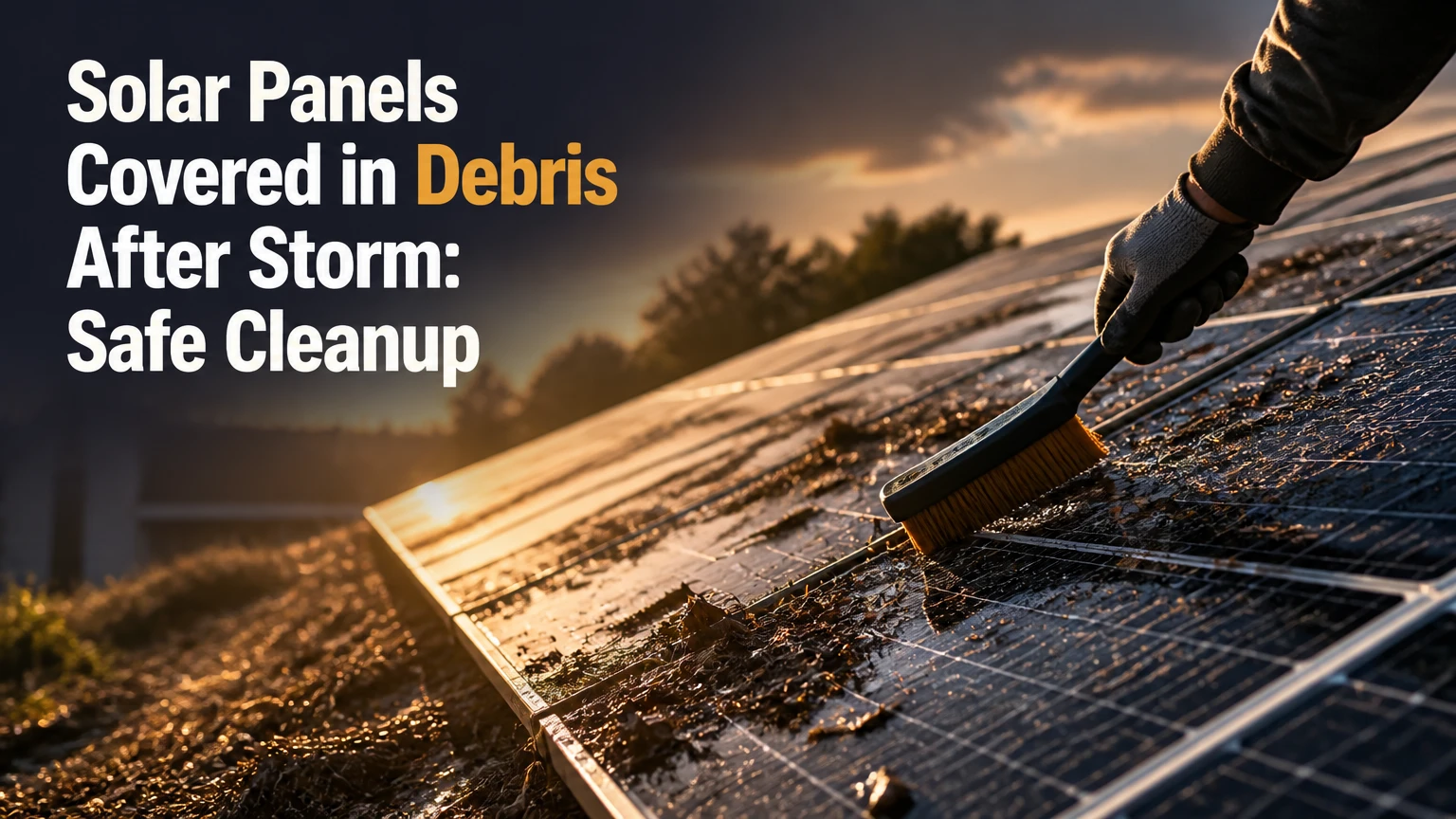
Solar panels covered in debris after storm conditions should be inspected for cracks, loose wiring, displaced mounts, and water intrusion before anyone cleans them. If the modules are intact and safely accessible, cool-period rinsing with soft, nonabrasive tools usually removes leaves, mud, droppings, and dust; damaged or roof-mounted systems should be handled by a qualified solar professional.
Key Facts at a Glance
Storm debris can reduce photovoltaic output by 10-30% in typical residential soiling cases, while mud, ash, or dense foliage can cause substantially larger losses.
A cracked module, exposed conductor, loose connector, damaged roof attachment, or inverter isolation fault changes cleaning from a maintenance task into an electrical-safety issue.
Solar cells in a string share current, but a 10% shaded area does not automatically reduce the entire string by 50%; the result depends on bypass diodes, shade location, inverter design, and irradiance.
Cold water can stress hot tempered glass, but a panel does not automatically shatter when rinsed with cool water; temperature difference, existing damage, glass condition, and water volume determine the risk.
Professional residential cleaning typically costs about $150-$350, while a basic ground-mount DIY setup commonly costs $50-$150.
A clean panel that still produces poorly may have storm damage, a tripped inverter, a wet connector, a failed bypass diode, or a system-level grid problem.
How Should You Handle Solar Panels Covered in Debris After Storm?
Handle storm-covered solar panels in seven stages: isolate hazards, document damage, follow the system shutdown procedure, remove loose dry material, rinse during a cool period, clean remaining contamination with soft tools, and verify production after restart. The deciding factor is safe access, not the amount of debris.
A ground-mounted array at waist height may be suitable for cautious homeowner cleaning when no damage is visible. A steep roof, wet roof surface, multi-story elevation, overhead utility line, cracked glass, or exposed conductors requires professional service. Solar modules can produce DC electricity whenever light reaches them, even when the inverter is switched off, so an AC shutdown alone does not make rooftop conductors harmless.
What debris is covering the solar array?
Identify the material before choosing a tool or water treatment. Dry leaves and loose twigs need gentle removal, while wet mud contains grit that can scratch glass during brushing. Wildfire ash may contain corrosive or conductive compounds, and coastal salt deposits can remain after water evaporates.
| Debris type | Main risk | Correct first action | Avoid |
|---|---|---|---|
| Dry leaves and twigs | Physical shading, blocked drainage, nesting material | Photograph, then lift or sweep gently | Dragging branches across glass |
| Wet mud and sand | Abrasion, heavy shading, dried mineral crust | Rinse loose grit with low-pressure water | Dry scrubbing gritty mud |
| Wildfire ash | Fine contamination, possible corrosive residue | Wear respiratory protection and arrange careful rinsing | Blowing ash toward people or air intakes |
| Salt spray or flood residue | Corrosion and conductive deposits | Fresh-water rinse after damage inspection | Leaving salt to crystallize |
| Bird droppings and sap | Localized shading, hardened residue | Soak during a cool period, then use a soft pad | Scraping with a blade |
| Broken glass or roofing material | Laceration, electrical damage, puncture risk | Keep clear and call a technician | Touching or sweeping fragments |
Why Does Storm Debris Reduce Solar Output?
Storm debris reduces solar output by preventing light from reaching photovoltaic cells and by creating electrical mismatch between cells or modules. A shaded cell can force current through a bypass diode or operate under reverse-bias stress, but the actual loss depends on shade geometry, cell wiring, diode layout, and inverter architecture.
Traditional modules contain cell substrings protected by bypass diodes. A leaf covering one substring may bypass that portion, causing a step change in voltage rather than shutting down every cell in the module. A string inverter can then show a larger loss across a series-connected string when one module limits current, although module-level power electronics can localize some effects.
The “10% shade causes 50% string loss” rule is not a dependable engineering calculation. A narrow shadow across cell interconnects can be severe, while broad partial coverage may trigger a bypass diode with a more limited voltage loss. Persistent localized shade can also create hotspots, where a poorly illuminated cell dissipates electrical power as heat.
Which system design changes the impact?
| System architecture | Debris effect | Useful diagnostic | Typical post-cleaning action |
|---|---|---|---|
| String inverter | One weak module can affect string current | Compare string voltage and current | Installer tests the affected string |
| Power optimizers | Module-level operating data may identify a weak panel | Check module map and optimizer alerts | Technician tests flagged module |
| Microinverters | Each module usually reports separately | Compare individual AC production | Inspect only low-producing modules first |
| Rapid-shutdown system | Shutdown improves emergency response, not cleaning access | Check shutdown indicator and manual | Follow manufacturer procedure |
| Battery-coupled system | Battery may continue supplying loads | Check backup operating mode | Use documented battery and PV shutdown |
Is It Safe to Clean Storm-Damaged Solar Panels?
Cleaning is unsafe when storm damage exposes conductors, cracks module glass, loosens racking, floods equipment, or leaves a wet and unstable roof. Do not spray, touch, brush, or walk near those conditions; photograph the area from a safe position and contact the installer, licensed electrician, or emergency service as appropriate.
A module can remain electrically energized in daylight after an inverter shutdown. Connectors, homeruns, combiner boxes, and damaged junction boxes can retain dangerous DC potential, and water intrusion can create an isolation fault or arc risk after the array appears dry.
What requires a stop-work decision?
Stop immediately if you see:
- Cracked, shattered, lifted, or visibly delaminated glass.
- Exposed copper, pulled connectors, crushed conduit, or hanging cables.
- Bent rails, displaced clamps, loose modules, or roof penetrations.
- Floodwater near inverters, batteries, disconnects, or combiner boxes.
- Smoke, melted plastic, arcing sounds, burning odor, or repeated fault codes.
- A wet roof, lightning activity, unsafe ladder position, or nearby overhead lines.
Keep people away from damaged equipment. Do not rely on rubber gloves, household circuit breakers, or a phone app as proof that the array is electrically safe. PPE and electrical isolation procedures must match the equipment and local rules.
How Do You Clean Storm Debris From Solar Panels?
Clean intact, safely accessible modules during a cool, calm period with a soft solar brush, clean water, and a nonabrasive squeegee. Remove loose material before wet cleaning, rinse grit away before wiping, and never use a pressure washer, metal tool, abrasive pad, or ladder position that requires stepping on the modules.
Before you start
| Requirement | Typical specification | Why it matters |
|---|---|---|
| Cleaning time | 45-120 minutes for 15-25 ground-accessible modules | Allows rinsing and inspection without rushing |
| Water | 20-80 liters for a residential array | Reduces repeated mineral-laden drying |
| Brush | Soft nylon or microfiber head, 25-40 cm wide | Limits scratches and point loading |
| Pole | Telescoping, nonconductive, 2-6 meters | Keeps the operator off panels |
| Water quality | Preferably below 50 ppm TDS | Reduces mineral spotting |
| Weather | Cool glass, low wind, no lightning | Lowers thermal and access risk |
Step 1: Photograph the array and inspect from the ground
Record the module layout, inverter display, monitoring status, debris pattern, visible cracks, and displaced hardware before moving anything. Photograph serial numbers and storm damage for a possible insurance claim.
Success checkpoint: Every module and cable route has a safe visual assessment, or the inaccessible areas are marked for a professional.
Common mistake: Starting at the dirtiest panel and missing a broken connector hidden beneath leaves.
Step 2: Follow the manufacturer’s shutdown procedure
Use the installation manual and the labels on the equipment. Many systems require AC and DC disconnect operations in a specific order, while batteries, rapid-shutdown devices, and backup systems add separate steps. Do not invent a universal sequence.
Success checkpoint: The inverter status, disconnect indicators, and monitoring instructions confirm the intended shutdown state.
Common mistake: Assuming the AC breaker removes DC voltage at the modules. It does not.
Step 3: Remove loose dry debris without scraping
From a safe ground position, use a soft brush or a gloved hand to lift leaves and twigs. Work from the upper edge toward the lower edge, and do not push branches across the glass or pull on attached cables.
Success checkpoint: Loose material is removed without contact between hard debris and the glass surface.
Common mistake: Using a roof rake, broom with exposed metal fasteners, or stiff bristles that trap grit.
Step 4: Rinse away grit with low-pressure water
Rinse from the upper edge downward using a normal garden hose with a gentle fan pattern. The goal is to float sand and ash off the surface, not force water into connectors. Avoid directing water at junction boxes, cable connectors, inverter vents, or damaged areas.
Success checkpoint: Loose particles drain away and no gritty film remains under the cleaning head.
Common mistake: Wiping dry mud before rinsing, which can create fine scratches and permanent-looking haze.
Step 5: Soak and wipe stubborn contamination
Let bird droppings, sap, and dried mud soften for several minutes. Use clean microfiber, a soft sponge, or a solar-rated squeegee with light pressure; use a small amount of pH-neutral, biodegradable soap only when plain water fails, then rinse thoroughly.
Success checkpoint: The glass is free of visible deposits when viewed at a low angle, without streaks or residue.
Common mistake: Applying bleach, ammonia, laundry detergent, solvent, vinegar concentrate, abrasive cream, or a razor blade. These can damage coatings, seals, frames, or nearby roofing.
Step 6: Allow the array to drain and dry
Let water run off naturally or use a clean, soft squeegee. Do not use a leaf blower near loose connectors or blast water into module edges. Hard-water deposits become more difficult to remove after repeated evaporation.
Success checkpoint: No white mineral film, soap streak, pooled water, or new fault indication appears.
Common mistake: Cleaning in direct midday sun, where rapid evaporation leaves minerals before the operator can rinse them.
Step 7: Restart according to the system manual
Reverse the documented shutdown procedure only after the array and surrounding equipment are dry and undamaged. Check inverter status, production power, daily energy, and module-level data where available.
Success checkpoint: The inverter reports normal operation and output rises in proportion to available sunlight.
Common mistake: Treating a fault code as a cleaning issue and repeatedly cycling the system.
Which Solar Panel Cleaning Method Fits the Situation?
Ground-accessible DIY cleaning costs the least, while professional cleaning is the safer choice for roofs, steep pitches, heavy contamination, and suspected damage. Robotic brushes suit large commercial arrays, whereas fixed sprinklers work best when recurring light dust justifies their water use and maintenance.
| Method | Typical cost | Best access condition | Main limitation |
|---|---|---|---|
| DIY hand cleaning | $50-$150 equipment | Ground mount or safe single-story access | Fall and electrical risk remain |
| Professional service | $150-$350 residential | Roofs, steep arrays, storm damage screening | Appointment delays after regional storms |
| Robotic cleaning | $2,000-$5,000+ system | Large, flat commercial rows | Upfront cost and equipment maintenance |
| Fixed sprinkler system | $2,000-$5,000+ residential setup | Frequent light dust in dry climates | Water use, mineral deposits, nozzle failure |
| Water-fed service contract | $0.10-$0.40 per square foot, typical | Commercial sites with repeat soiling | Ongoing operating expense |
Professional crews may use reverse-osmosis or deionized water, but equipment quality and fall protection matter more than a premium cleaning label. Automated equipment is also a poor solution for broken glass, displaced modules, thick wet mud, or debris that must first be inspected manually.
How Much Time and Water Does Cleanup Require?
A 15-25-panel ground-mounted array usually takes 1-2 hours for a careful homeowner, while a professional crew may complete active cleaning in 30-60 minutes. Water demand commonly ranges from 20-80 liters, depending on panel count, debris thickness, rinse method, and whether purified water is used.
| Array or condition | Active DIY time | Professional time | Typical water volume |
|---|---|---|---|
| 8-12 cleanable modules | 30-60 minutes | 20-35 minutes | 10-30 liters |
| 15-25 modules, light debris | 60-120 minutes | 30-60 minutes | 20-80 liters |
| 25-40 modules, mud or ash | 2-4 hours | 60-120 minutes | 60-160 liters |
| 100-kilowatt commercial array | Not usually practical | 2-8 labor hours | 500-2,000 liters |
| Heavy salt or mineral residue | Add 30-90 minutes | Add 20-60 minutes | 25-100% above baseline |
These are typical planning ranges, not guarantees. A steep roof, restricted hose access, cold weather, ash respiratory controls, or insurance documentation can extend the job substantially.
What Water and Tools Should You Use?
Use clean, low-mineral water and a soft brush or microfiber squeegee designed for photovoltaic glass. Water under approximately 50 ppm total dissolved solids reduces spotting, but higher-TDS water is not automatically dangerous if the array is rinsed and dried correctly; it mainly increases residue risk.
| Supply | Recommended value or feature | Acceptable use | Avoid |
|---|---|---|---|
| Hose pressure | Gentle household flow, no pressure-washer nozzle | Rinsing intact glass | 1,000-3,000 psi pressure washing |
| Brush hardness | Soft nylon or microfiber | Loose debris and softened deposits | Wire, stiff polypropylene, metal |
| Cleaner chemistry | Plain water or pH-neutral soap | Small areas of sap or droppings | Bleach, solvents, acids, ammonia |
| Water TDS | Preferably under 50 ppm | Spot-minimized final rinse | Repeated untreated well-water drying |
| Cloth | Clean microfiber without grit | Edge and frame wiping | Dirty rags or paper towels |
| Pole | Nonconductive, stable telescoping pole | Ground-level arrays | Aluminum pole near exposed conductors |
A water softener is not the same as deionization. Softened water can replace calcium with sodium and still leave dissolved solids. If spotting is severe, a purified final rinse is more useful than simply adding detergent.
Why Can Clean Panels Still Produce Less Power?
Clean panels can produce less power because storm damage, low irradiance, inverter faults, grid limits, temperature, or one failed module may remain after debris removal. Compare the monitoring data with the same weather and time period, rather than comparing a cloudy post-storm day with a clear pre-storm day.
| Symptom after cleaning | Likely cause | Safe homeowner check | Required escalation |
|---|---|---|---|
| Entire system reads zero | AC trip, inverter fault, grid outage | Read display without opening equipment | Installer or electrician |
| One module is low | Cracked glass, optimizer fault, residual shade | Compare module map | Qualified technician |
| One string is low | Wet connector, damaged cable, mismatch | Review string trend only | Solar service professional |
| Isolation fault appears | Water ingress or insulation damage | Stop operation if instructed | Licensed electrician |
| Output drops only at noon | Heat, grid curtailment, clipping | Compare irradiance and temperature | Installer if abnormal |
| White haze remains | Mineral scale or soap residue | Inspect at a low angle | Reclean or hire service |
An isolation fault after rain or washing deserves special caution. Turn the system off according to its documented emergency procedure if safe to do so, keep away from the equipment, and arrange professional testing of insulation resistance, connectors, junction boxes, and cable routing.
What Changes After Hail, Flooding, Lightning, or Wildfire?
Hail, flooding, lightning, and wildfire ash require damage triage before ordinary cleaning. Hail can create invisible cell cracks, floods can contaminate electrical equipment, lightning can damage surge protection, and ash can combine with moisture to form corrosive or conductive deposits.
Hail and high wind
Inspect from the ground for chipped glass, dents in frames, shifted clamps, twisted rails, and modules that no longer align. Do not assume an intact-looking surface is electrically healthy. A technician can use insulation tests, current-voltage tracing, electroluminescence imaging, or infrared inspection to find hidden faults.
Floodwater
Do not energize submerged or water-intruded inverters, batteries, disconnects, or combiner boxes. Floodwater can carry salts and contaminants that remain after drying, so equipment may require replacement rather than a rinse.
Lightning
Lightning-related symptoms include a dead inverter, repeated restart attempts, surge-protection alerts, communication failure, and multiple module-level faults. Have the system inspected before cleaning, especially when lightning struck the building or nearby utility infrastructure.
Wildfire ash
Wear suitable respiratory protection and avoid dry sweeping that redistributes fine ash. A professional should evaluate roof safety, air quality, water runoff, and possible chemical contamination before wet cleaning.
How Often Should Panels Be Cleaned After a Storm?
Clean panels after a storm when debris remains visibly attached, production falls beyond weather-related variation, or contamination can dry into a hard residue. Light dust often needs no immediate intervention after rain, while mud, ash, salt, sap, and bird waste justify prompt inspection and cleaning.
A practical schedule is:
- Inspect after every major wind, hail, flood, lightning, or wildfire event.
- Clean visible heavy debris before it dries, provided the array is safe.
- Recheck production within the next clear daylight period.
- In dusty or coastal environments, review soiling monthly and clean when losses exceed the site’s financial threshold.
- Avoid a fixed quarterly schedule if local rainfall already removes light dust.
Rain is not a universal cleaning service. Rainwater may soften dust, but it can leave muddy edges, bird-dropping residue, salt crystals, and ash films. Roof pitch, rainfall intensity, local dust, and panel frame design determine whether natural washing is sufficient.
Is Professional Cleaning Worth the Cost?
Professional cleaning is financially worthwhile when the expected energy loss exceeds the service price or when roof access creates meaningful injury risk. A simple decision estimate is: expected lost energy in kilowatt-hours multiplied by the value of electricity, compared with cleaning and access costs.
| Scenario | Estimated loss | Energy value example | Cleaning decision |
|---|---|---|---|
| 6 kW array, 15% loss for 2 weeks | 15-30 kWh | $3-$12 at $0.20-$0.40/kWh | Usually wait if safe rainfall is imminent |
| 6 kW array, 40% loss for 2 months | 120-180 kWh | $24-$72 at $0.20-$0.40/kWh | Compare service price and roof risk |
| 12 kW array, thick mud after storm | 100-250 kWh over 1 month | $20-$100 at $0.20-$0.40/kWh | Cleaning often has measurable value |
| Commercial array with recurring dust | Site-specific | Contract tariff or avoided purchases | Model monthly soiling threshold |
The financial estimate excludes safety, warranty, insurance, and damage-prevention value. A $200 service can be rational even when recovered electricity is worth less if it avoids a roof fall or identifies a storm-damaged module before a warranty deadline.
What Are the Most Common Cleanup Mistakes?
The most expensive mistakes are treating damaged equipment as dirty equipment, scraping grit across glass, and assuming shutdown eliminates all module voltage. Each mistake has a safer correction that preserves evidence and limits additional damage.
- Pressure washing the modules: High pressure can damage seals and drive water toward electrical interfaces. Use a gentle hose stream and professional inspection for compromised equipment.
- Cleaning hot glass with a large temperature difference: Thermal stress can worsen existing chips or cracks. Clean when the glass is cool, but do not assume cool water automatically destroys tempered glass.
- Using household chemicals: Bleach, abrasive powders, strong acids, and solvents can harm coatings and seals. Start with water and use only a manufacturer-compatible pH-neutral cleaner when needed.
- Walking on the modules: Foot loading can create microcracks that do not appear immediately. Use ground-based tools or certified roof-access methods.
- Using hard water without a final rinse: Evaporated minerals form a light-scattering film. Use purified water or remove residue during a cool, wet cleaning session.
- Restarting after a fault code: An isolation or ground fault can indicate damaged insulation. Stop cycling the system and call a qualified professional.
FAQ
Can rain clean solar panels after a storm?
Rain can remove loose dust but often fails to remove dried mud, bird droppings, sap, salt, or wildfire ash. A low-pitched array in a dusty location may retain a measurable film after rainfall, so inspect the glass and compare production after the next clear day rather than assuming rain restored performance.
Can I clean solar panels from a ladder?
A ladder may be suitable for reaching a low ground-mounted structure, but leaning a ladder against roof-mounted modules or working from a wet roof creates fall and equipment risks. A telescoping nonconductive pole is safer for ground-level cleaning; professional access is appropriate when both feet cannot remain securely supported.
Do solar panels need cleaning after every storm?
Solar panels do not need cleaning after every storm if inspection shows only light dust and normal production. Heavy leaves, mud, ash, salt, or bird waste should be removed when the array is safely accessible, because dried contamination is harder to remove and can produce persistent localized shading.
Can hail damage solar panels without cracking the glass?
Hail can damage cells and electrical connections without producing an obvious crack across the front glass. Reduced module output, new hotspot behavior, frame dents, or inverter alerts may reveal concealed damage, which requires electrical or infrared testing rather than more cleaning.
Should I file an insurance claim before cleaning?
Photograph the array, roof, inverter displays, debris, and damage before cleaning whenever an insurance claim may be relevant. Notify the insurer and installer promptly, preserve damaged components if removal becomes necessary, and keep invoices and production records showing the system’s condition before and after the storm.
How long can debris remain on solar panels?
Loose leaves should be removed promptly because wind can abrade glass and wet organic material can retain moisture. Mud, ash, salt, and droppings should not be left to bake through multiple sunny days when safe cleaning is possible, although electrical and structural inspection always takes priority.
The Bottom Line
Solar panels covered in debris after storm conditions need inspection before washing, not automatic cleaning. If the array is intact and safely reachable, use a cool-period rinse, soft nonabrasive tools, low-mineral water, and the manufacturer’s shutdown procedure. If glass, wiring, racking, roof access, flooding, ash, or inverter faults raise a safety concern, stop and use a qualified solar professional.