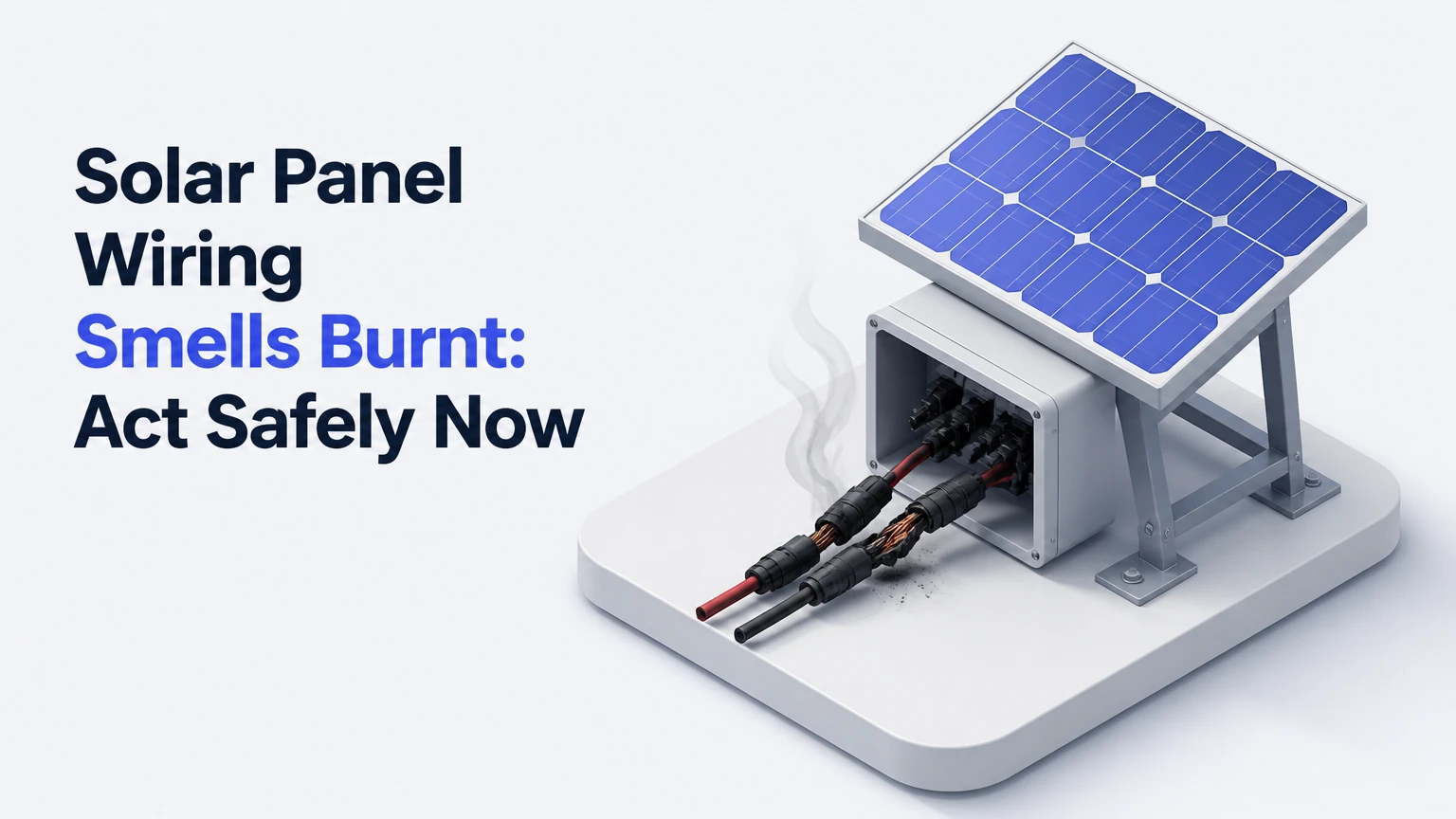
Solar panel wiring that smells burnt indicates overheating insulation, a high-resistance connection, electrical arcing, or a failing component, and the condition can develop into a photovoltaic fire. Stop normal operation, follow the system’s labeled shutdown procedure without touching exposed conductors, keep enclosures closed, and contact a licensed solar electrician immediately.
Key Facts at a Glance
- A burning plastic, chemical, ozone, or metallic odor near a solar array, inverter, combiner box, or battery is an electrical warning sign.
- Solar modules can produce dangerous DC voltage in daylight, even when the inverter is switched off.
- A loose photovoltaic connector can create localized resistance heating without causing an immediate breaker trip.
- Do not unplug MC4 connectors, open an inverter, reset a tripped breaker, or spray water on a hot component.
- A typical professional diagnostic visit costs $150-$300, while repairs range from about $100 for a small cable repair to several thousand dollars for inverter replacement.
- A solar technician should identify and correct the root cause, then document electrical tests and thermal findings before re-energizing the system.
What Should You Do First?
A homeowner who smells burning from solar panel wiring should remove people from the immediate area, avoid contact with the equipment, and use only the shutdown controls identified on the installation labels or manufacturer’s manual. If smoke, flames, crackling, visible sparks, or rapidly increasing heat are present, evacuate and call emergency services from a safe location.
For a normal odor without visible fire, many grid-tied systems use an AC isolator or breaker and a DC isolator, but the correct order varies by equipment design and local code. Follow the site-specific placard rather than assuming every installation uses the same sequence. Do not climb onto the roof to reach a switch.
A shutdown command does not guarantee that rooftop conductors are dead. Sunlight can keep module and string conductors energized, and some systems retain stored energy in capacitors or batteries. Treat every exposed PV conductor as live until a qualified person verifies isolation with appropriate instruments.
Safe Emergency Sequence
- Move away from the smell source. Keep children, pets, and combustible materials away from the inverter, roof access point, battery, and electrical panels.
- Check for fire from a distance. Do not open a hot inverter, combiner box, junction box, or battery cabinet.
- Use labeled isolation controls only. Operate the AC and DC controls exactly as the installer’s shutdown label specifies.
- Do not touch wiring or connectors. Burned insulation can expose energized metal and may collapse when moved.
- Call a licensed solar technician. Report the odor location, smoke, alarm codes, time of day, weather, and whether generation stopped.
- Call emergency services for flames or smoke. Tell responders that the property has photovoltaic panels and, if applicable, battery storage.
A fire department may need to treat rooftop PV equipment as energized in daylight. Do not assume that a main service disconnect eliminates voltage at the modules.
Why Solar Panel Wiring Smells Burnt
Solar panel wiring smells burnt because heat or electrical discharge decomposes polymer insulation and nearby plastic components. A loose terminal, incompatible connector, damaged cable, overloaded conductor, failed bypass diode, or inverter fault can create a hot spot that produces an acrid odor before visible damage appears.
Electrical heating follows (P=I^2R): heat rises with the square of current and directly with resistance. A connector that develops twice its former contact resistance produces twice the heat at the same current, while a current increase has a much larger effect. The heat may remain concentrated inside a crimp or terminal rather than warming the whole cable evenly.
Photovoltaic cable commonly uses cross-linked polyethylene or similar outdoor-rated insulation. UL 4703 PV wire products can have conductor operating ratings around 90°C, with higher short-duration ratings under specified conditions, but those ratings describe permitted operation, not a universal temperature at which every installation smells. Odor can begin at different temperatures depending on polymer, contamination, airflow, and nearby plastics.
Arc faults add another mechanism. A gap, damaged conductor, wet contamination path, or loose contact can allow current to jump through air or across carbonized material. DC arcs can persist because photovoltaic current does not naturally pass through zero each half-cycle as alternating current does.
Which Solar Components Commonly Cause the Odor?
The strongest smell location often narrows the fault category, but it does not prove the failed part. A roof odor points toward module leads, connectors, junction boxes, cable management, or a rooftop optimizer, whereas an inverter or battery odor points toward terminals, fans, busbars, relays, circuit boards, or internal power electronics.
| Smell location | Likely components | Typical warning signs | Safe homeowner action |
|---|---|---|---|
| Roof or array edge | MC4-style connectors, module leads, clips, junction boxes | Brown plastic, sagging cable, melted connector housing | Observe from ground; do not climb or unplug |
| Combiner box | String fuses, terminals, surge protection devices | Hot enclosure, tripped fuse, arc-fault alarm | Keep enclosure closed and isolate per label |
| Inverter | DC terminals, AC terminals, fans, relays, capacitors | Error code, fan noise, discoloration, shutdown | Read display from a distance; do not remove cover |
| Battery cabinet | Busbars, lugs, contactors, battery modules | Heat alarm, swelling, smoke, rapid shutdown | Leave cabinet closed; call installer and emergency services for smoke |
| Interior electrical panel | Breaker, isolator, cable lug, conduit termination | Warm panel, buzzing, tripping, odor indoors | Keep clear; call an electrician immediately |
Can an MC4 Connector Cause a Burnt Smell?
An MC4-style connector can cause a burnt smell when the plug is incompletely seated, incorrectly crimped, contaminated, damaged, or paired with a connector that is not approved as compatible. A small contact area increases resistance, and the resulting heat can melt the connector housing while the circuit continues producing power.
The term MC4 is often used generically, but connectors from different manufacturers are not automatically interchangeable. The original Staubli MC4 system has specified components and assembly requirements; a visually similar connector may have a different contact geometry, sealing arrangement, or certification. A technician should replace the complete affected connector pair with a listed, compatible product and use the manufacturer’s crimping method.
A connector replacement alone is incomplete if the cable was overheated, the crimp tool was wrong, or the terminal torque caused the original failure. The technician should inspect adjacent cable, measure string electrical behavior, verify polarity, and check for heat damage at the module and inverter ends.
Can Undersized Solar Cable Overheat?
Undersized PV cable can overheat when its ampacity is below the circuit’s design current after correction factors for ambient temperature, rooftop conditions, grouping, conduit, and installation method. Cable size must also account for voltage drop, short-circuit current, conductor material, insulation rating, and local electrical code.
A later array expansion can create an undersized condition even when the original installation was compliant. Parallel strings increase current, while long cable runs increase voltage drop and resistive loss. A technician should calculate the complete circuit rather than judging cable size by appearance.
Can a Solar Inverter Smell Burnt Without a Roof Fault?
A solar inverter can smell burnt without a roof wiring fault because AC terminals, DC input terminals, cooling fans, relays, capacitors, surge protection devices, and printed circuit boards can overheat internally. An inverter odor often coincides with a fault code, reduced output, repeated shutdown, unusual fan behavior, or discoloration around cable entries.
Do not open an inverter to locate the smell. Internal capacitors may retain hazardous energy after shutdown, and opening the enclosure can defeat touch protection, compromise the warranty, and expose a person to both AC and DC hazards.
How Can You Narrow Down the Fault Safely?
Safe diagnosis uses location, system data, and professional testing in that order. Homeowners can record symptoms from the ground and read monitoring information, but string testing, insulation-resistance testing, connector replacement, torque verification, and thermal imaging belong to qualified personnel.
Step 1: Record the Symptom
Write down when the odor began and whether the system was producing power. Note whether the smell is strongest at the roof, inverter, battery, indoor panel, or cable entry, and record recent storms, roof work, animals, system expansion, or breaker trips.
The pattern matters. Odor during high sun suggests a load-related thermal fault, while odor after rain can indicate moisture intrusion or contamination. A persistent smell at night suggests stored-energy equipment, a recently heated component, or a non-solar source.
Step 2: Read Monitoring Data
Monitoring applications can reveal sudden production loss, one underperforming string, inverter shutdown, ground-fault detection, arc-fault detection, insulation alarms, or battery temperature warnings. Save screenshots with timestamps before the technician arrives.
Monitoring data cannot certify that wiring is safe. A system can produce normal energy while a connector develops a dangerous localized hot spot, and an arc-fault detector may not recognize every high-resistance connection.
Step 3: Perform a Ground-Level Visual Check
From the ground, look for hanging cables, detached clips, melted connector bodies, brown module backsheets, scorch marks, cracked conduit, animal damage, and debris near the array. Binoculars or a zoom camera are safer than roof access.
Do not lift panels, touch cable, move a connector, remove a cover, or use a drone near energized electrical infrastructure without appropriate authorization and operating controls. A visual check identifies evidence, not the electrical cause.
Step 4: Arrange Professional Testing
A solar electrician may use a calibrated torque tool, insulation-resistance tester, multimeter, clamp meter, IV-curve tracer, and infrared camera. Thermal imaging can locate a high-resistance connection under load, but an infrared image alone does not prove the fault mechanism.
| Diagnostic method | Finds or confirms | Typical setting | Homeowner suitability |
|---|---|---|---|
| Visual inspection | Melted polymer, rodent damage, loose cable support | Ground and equipment exterior | Ground observation only |
| Monitoring review | Arc-fault, ground-fault, low output, battery alarm | Mobile app or inverter display | Safe if read remotely |
| Infrared thermography | Relative hot spots at terminals and modules | Operating system under controlled conditions | Professional use |
| Insulation-resistance test | Leakage between conductors and earth | Isolated PV strings | Qualified technician |
| Torque and connector inspection | Loose lugs, poor crimps, incompatible plugs | De-energized equipment | Qualified technician |
What Are the Main Causes and Their Signatures?
The most common field causes are poor terminations, connector incompatibility, cable damage, water ingress, inadequate cable support, and component failure. Repeated heating and cooling can worsen a marginal connection because metal expands and contracts, while wind movement can stress unsupported leads and plugs.
| Root cause | Electrical mechanism | Common evidence | Required correction |
|---|---|---|---|
| Loose terminal | Contact resistance creates concentrated heat | Discoloration at lug, odor under high load | Isolate, inspect, torque or replace |
| Poor crimp | Reduced contact area raises resistance | Pull-out, darkened contact, melted plug | Cut back damaged cable and recrimp correctly |
| Connector mismatch | Contact geometry or seal fails | Uneven housing, moisture, heat marks | Replace with approved matching pair |
| Rodent or UV damage | Insulation breach enables leakage or arcing | Bite marks, cracks, exposed conductor | Replace damaged PV cable and protect route |
| Water ingress | Corrosion and leakage increase resistance | Green copper, moisture, tripped protection | Replace seals or enclosure and damaged parts |
| Overloaded circuit | Current exceeds conductor or terminal capacity | Warm cable run, design mismatch | Recalculate and redesign circuit |
| Failed component | Internal semiconductor or relay overheats | Inverter or optimizer fault code | Component or equipment replacement |
An expert rule of thumb is that a single melted connector is evidence about the installation process, not merely about that connector. The mating part, cable crimp, conductor insulation, and upstream protection deserve inspection because replacing one plastic shell can leave the same failure path in place.
Is It Safe to Reset the System or Unplug the Connector?
Resetting a tripped breaker while a burnt smell remains is unsafe because the protective device may be interrupting an active fault. Unplugging a PV connector is also unsafe because separating a DC connector under load can create an arc, damage the contacts, and ignite nearby material.
A homeowner may follow the manufacturer’s emergency shutdown procedure when the controls are accessible without approaching smoke, heat, exposed conductors, or a roof hazard. A homeowner should not remove dead fronts, open junction boxes, pull fuses, separate connectors, test voltage, or tighten terminals.
| Action | Electrical risk | Warranty risk | Correct alternative |
|---|---|---|---|
| Reset breaker repeatedly | High arc and fire risk | Possible claim dispute | Leave isolated and call technician |
| Separate connector in sunlight | Persistent DC arc | Connector warranty loss | Have a qualified person isolate and replace |
| Open inverter cover | Stored energy and shock | Warranty invalidation | Record display code externally |
| Spray water on equipment | Shock, damage, thermal shock | Water damage dispute | Use emergency services for fire |
| Climb onto roof | Fall plus energized conductors | Roof damage liability | Photograph from ground |
How Much Does Solar Wiring Repair Cost?
Typical solar electrical diagnostics cost $150-$300, while a localized connector or cable repair often costs $100-$400 before difficult roof access, permit, replacement hardware, or emergency rates. Inverter replacement can cost approximately $800-$2,500 for a string inverter, with larger hybrid or commercial equipment costing more.
Prices vary by region, roof pitch, travel distance, access equipment, system voltage, and whether the contractor must remove modules. A quote that lists only “replace connector” may not include the diagnostic work needed to identify why the connector overheated.
| Service | Typical price range | Typical labor time | Cost drivers |
|---|---|---|---|
| Diagnostic inspection | $150-$300 | 1-3 hours | Thermal scan, string tests, travel |
| Local cable repair | $100-$400 | 1-4 hours | Cable length, roof access, damage extent |
| Connector replacement | $150-$250 per string | 1-3 hours | Connector count and module removal |
| Combiner repair | $250-$900 | 2-5 hours | Fuses, terminals, surge devices |
| String inverter replacement | $800-$2,500 | 3-8 hours | Inverter size, commissioning, permits |
| Battery fault service | $300-$2,000+ | 2-8 hours | Manufacturer protocol and parts |
Emergency attendance may occur within 1-4 hours in areas with specialist availability, but that is not a universal service standard. A routine wiring repair commonly takes 2-5 labor hours when the fault is localized and roof access is straightforward.
Should You Repair Solar Wiring Yourself?
Homeowners should limit their role to emergency isolation according to the labeled procedure, ground-level observation, documentation, and arranging a qualified repair. Solar wiring is not a suitable DIY repair when the system can generate DC voltage, includes a battery, requires rooftop access, or has melted insulation.
A licensed solar electrician can preserve evidence, select listed components, calculate conductor capacity, verify torque, test insulation, and recommission the system. The original installer should be contacted first when a workmanship warranty may cover installation defects, which commonly run for 5-10 years but depend on the contract.
| Situation | DIY observation | Professional requirement | Best decision |
|---|---|---|---|
| Odor, no smoke, grid-tied array | Read app and inspect from ground | Full electrical diagnosis | Isolate and book service |
| Melted roof connector | Photograph from distance | Cable and connector replacement | Do not climb |
| Off-grid inverter | Read alarms externally | DC and battery isolation | Use installer or qualified electrician |
| Active smoke or flames | Evacuate only | Fire department and solar specialist | Call emergency services |
| Recent installation | Preserve photos and invoice | Warranty inspection | Contact installer first |
The limitation is important: a thermal camera, clamp meter, or online wiring diagram does not make live PV work safe for an unqualified person. Diagnostic equipment can identify a symptom while missing a dangerous source, especially when the fault is intermittent.
What Changes at Night, in Rain, or With Batteries?
Nighttime reduces or eliminates module output, but it does not make the entire solar installation safe. Batteries, inverter capacitors, AC supplies, and some auxiliary circuits can remain energized, while a component that overheated during daylight may retain heat and continue releasing odor.
Rain increases concern rather than reducing it. Water can enter a damaged connector, conduit, junction box, or roof penetration, and wet conditions increase shock and slip hazards. Do not approach rooftop equipment during rain or wash a suspected hot spot.
Battery storage changes the emergency plan because lithium-ion battery cabinets can contain substantial stored energy independent of sunlight. A battery alarm, swelling, hissing, smoke, rapidly rising temperature, or solvent odor requires distance, evacuation when appropriate, and emergency services trained to handle energy-storage incidents.
How Do You Confirm the Repair Worked?
A repair is complete only when the failed part and the initiating cause have been corrected, electrical tests pass, and the system operates without abnormal heat or alarms. A technician should provide the replaced component details, test results, torque records where applicable, photographs, and recommissioning status.
The acceptance checks should include:
- Correct polarity and string configuration.
- Insulation resistance appropriate to the system and applicable code.
- Connector type and crimp compatibility.
- Terminal torque documented against manufacturer specifications.
- No damaged cable, backsheets, conduit, or cable clips remaining.
- Monitoring restored without arc-fault, ground-fault, or insulation alarms.
- Thermal scan showing no unexplained hot connection under load.
- Inverter and battery manufacturer procedures followed.
A new smell after repair is not normal commissioning. Shut the system down according to its labeled procedure and report recurrence immediately, because repeated odor often indicates an unresolved upstream connection, overloaded circuit, or damaged cable segment.
How Can You Prevent a Repeat Fault?
Preventive maintenance combines correct component selection, mechanical support, periodic inspection, and recorded electrical data. The National Electrical Code, local amendments, equipment instructions, and applicable standards such as IEC 62548 determine installation requirements; an installer should apply the rules for the specific jurisdiction and system design.
Use PV cable listed for the installation, approved connector families, proper crimp dies, strain relief, weather seals, and manufacturer-specified torque. Keep cables off sharp roof edges and hot surfaces, avoid tight bends, and prevent connectors from resting in pooled water.
Commercial systems benefit from documented operation and maintenance inspections at least annually, with more frequent checks in harsh coastal, agricultural, high-wind, or rodent-prone environments. Residential systems need inspection after storms, roof work, animal intrusion, inverter alarms, or unexplained production loss.
An experienced maintenance rule is to compare thermal patterns across similar strings rather than searching only for a dramatic red image. A moderate temperature difference at one connector can matter more than a uniformly warm module because resistance heating is often localized.
Frequently Asked Questions
Can a burnt solar smell disappear on its own?
A burnt smell can fade when sunlight decreases or a protective device disconnects the circuit, but the underlying defect remains unsafe. Cooling can hide a high-resistance connector until the next period of strong generation. Leave the system isolated according to its labeled procedure and arrange professional diagnosis rather than treating odor disappearance as a repair.
Why does solar wiring smell like ozone?
Ozone has a sharp, metallic, or bleach-like odor and can accompany electrical arcing or corona discharge. The smell may also come from overheated plastic, so odor alone cannot identify the fault. Crackling, buzzing, visible tracking, or an arc-fault alarm increases the urgency and requires immediate isolation without opening equipment.
Can solar panels catch fire from bad wiring?
Solar panels and their wiring can contribute to a fire when a persistent arc, overheated connector, damaged cable, or failed electrical component ignites nearby polymers, roofing, or debris. The panel itself may not be the original fault. Fire risk increases when combustible material is close to equipment and protection or installation defects prevent fault interruption.
Does a solar isolator stop all electricity?
A solar isolator can disconnect one circuit section without making every conductor in the installation dead. Modules can generate voltage in daylight on the array side, batteries can remain energized, and inverter capacitors can retain charge temporarily. Only qualified personnel using the correct procedure and test equipment should verify electrical isolation.
Does home insurance cover burnt solar wiring?
Home insurance and installer warranties may cover different parts of a solar wiring incident. Coverage can depend on fire cause, installation compliance, maintenance records, exclusions, and whether the equipment is included in the policy. Photograph damage from a safe location, preserve invoices and alarm records, and notify the insurer without disturbing the evidence.
Who should repair a burnt solar connector?
A licensed solar electrician or qualified photovoltaic service contractor should repair a burnt connector because the work requires DC isolation, compatible listed connectors, correct crimping, cable assessment, and post-repair testing. Contact the original installer first if a workmanship warranty or manufacturer service agreement remains active.
The Bottom Line
Solar panel wiring smells burnt because a connection, conductor, module component, inverter, battery, or protection device is overheating or arcing. Treat the odor as a potential fire and shock hazard: follow the labeled AC and DC shutdown procedure, do not touch or open equipment, do not reset breakers, and call a qualified professional. A proper repair identifies the root cause, replaces all heat-damaged parts, verifies insulation and torque, and confirms safe operation before re-energizing the system.