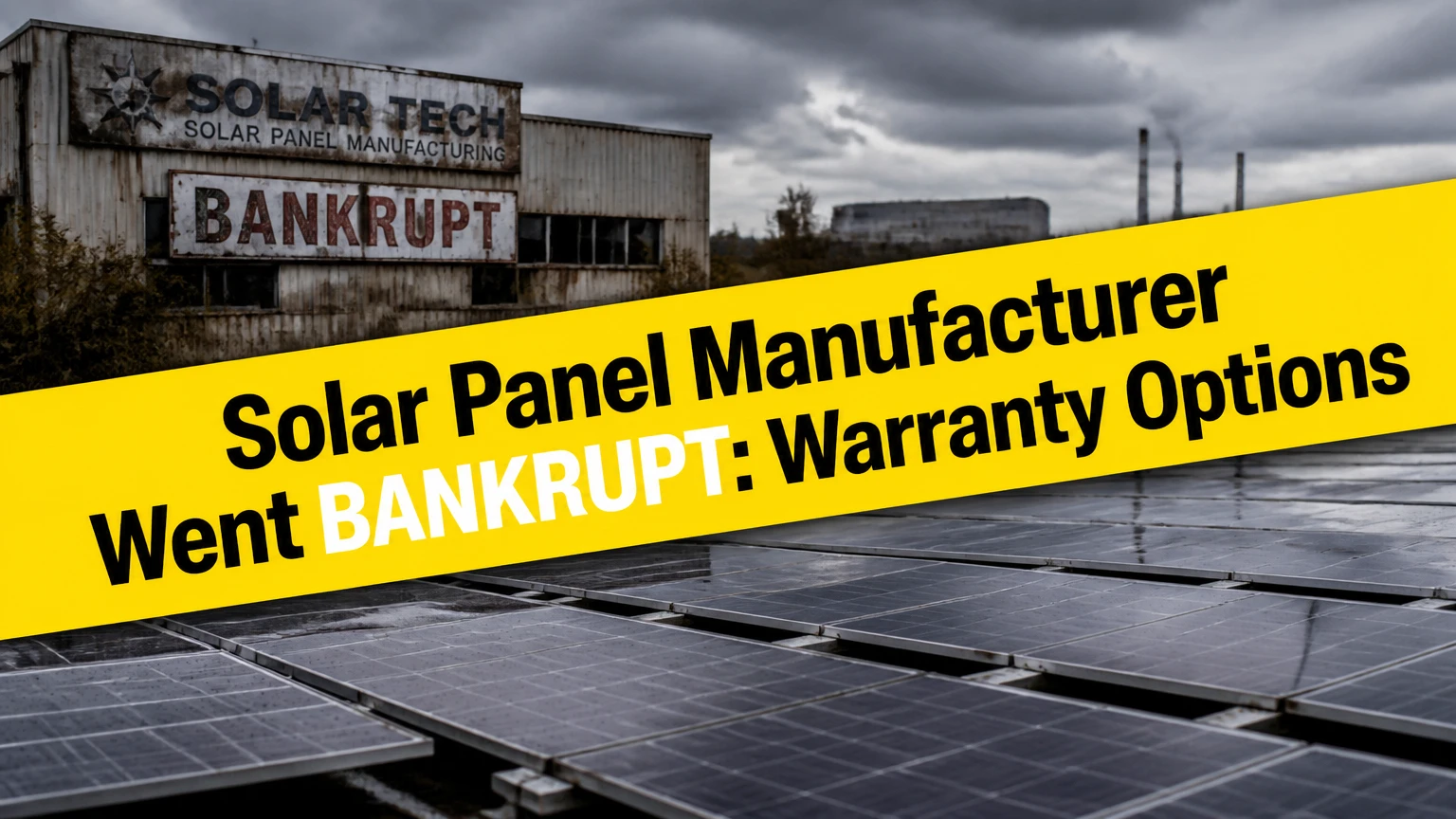
When a solar panel manufacturer went bankrupt, the factory warranty may become difficult or impossible to enforce, but bankruptcy does not automatically cancel every warranty right. Check the installer contract, inverter status, insurance policy, third-party coverage, bankruptcy case, and financing agreement before paying for replacement equipment.
Key Facts at a Glance
- A manufacturer bankruptcy can affect product and performance claims without automatically ending installer workmanship coverage.
- A solar panel product warranty covers equipment defects, while a performance warranty covers promised output over a stated period.
- Homeowners insurance generally covers listed solar equipment against covered perils, not manufacturing defects or gradual degradation.
- A bankruptcy proof of claim may produce a distribution, but unsecured consumer claims often recover little or nothing.
- A failed inverter can mimic panel failure, so monitoring data and electrical testing should come before panel replacement.
- A replacement module must match the system’s electrical design, certification, mounting, and rapid-shutdown requirements.
What Does a Solar Bankruptcy Do to Your Warranty?
A solar manufacturer bankruptcy changes who can process a warranty claim and whether money, inventory, or service personnel remain available. A court-approved sale may transfer selected warranties to a successor, while liquidation may leave consumers with an unsecured claim against an estate.
The Federal Trade Commission defines a warranty as “a promise from a manufacturer or seller to stand behind its product.” That promise is a contract, not a guarantee that funds or replacement inventory will exist after insolvency. The bankruptcy filing type matters: Chapter 11 may preserve operations or sell assets, while Chapter 7 usually liquidates them.
Do not assume the warranty is void, and do not assume it remains fully usable. Look for the bankruptcy court docket, debtor notices, successor warranty announcements, and the exact warranty exclusions. A warranty administrator, insurer, installer, distributor, or parent company may still have obligations.
Which warranty may still apply?
Product and performance warranties usually belong to the manufacturer, whereas workmanship warranties usually belong to the installer. The practical result depends on the contract language, claim date, bankruptcy case, and continuing business operations.
| Coverage type | Typical term | Usually covers | Bankruptcy effect |
|---|---|---|---|
| Product warranty | 10-25 years | Defects, junction boxes, frames, materials | Claim handling may stop or transfer |
| Performance warranty | 25-30 years | Minimum rated output, often 80-90% | Measurement and payment may become impractical |
| Workmanship warranty | 1-10 years | Roof penetrations, wiring, mounting labor | Often remains with a solvent installer |
| Inverter warranty | 5-25 years | Inverter hardware and sometimes labor | Usually separate from panel bankruptcy |
| Labor or service plan | 5-30 years | Diagnosis, removal, replacement labor | Depends on administrator or insurer |
A performance warranty normally guarantees power output under defined testing conditions, not “80% efficiency.” Efficiency and output are different attributes. The warranty may require an approved test, degradation calculation, serial-number verification, and proof that shading or installation did not cause the shortfall.
What Should You Do in the First 48 Hours?
In the first 48 hours, preserve evidence, determine whether production actually fell, and prevent an electrical or roof hazard. Do not remove panels, reset unknown equipment repeatedly, or order a replacement module before identifying the system architecture.
Download the monitoring history and photograph the inverter display, warning lights, panel labels, roof damage, and visible wiring. Save the original purchase agreement, proposal, equipment schedule, serial numbers, warranty booklet, inspection approval, utility permission to operate, and service invoices.
Then create a failure timeline. Record the last normal production date, weather conditions, utility outages, inverter alerts, roof work, storms, and any production comparison against the same month in prior years. A sudden zero reading often points to an inverter, communications, utility, or rapid-shutdown issue rather than simultaneous panel failure.
A practical first-response checklist
- Check monitoring: Compare daily kilowatt-hours with recent clear days and historical seasonal production.
- Inspect from the ground: Look for broken glass, detached conduit, water intrusion, scorching, or storm debris.
- Do not climb the roof: DC solar circuits can remain energized in daylight, even when the inverter is off.
- Identify every company: Separate the panel brand, inverter brand, installer, lender, lease owner, insurer, and warranty administrator.
- Request written answers: Phone promises are difficult to prove in a warranty dispute.
- Check deadlines: Bankruptcy bar dates, insurance notice periods, and workmanship expiration dates can control recovery.
Could the Inverter Be the Real Problem?
The inverter can be the real problem because it converts solar DC electricity into household AC power and often fails before the modules. A blank monitoring portal does not prove panel failure, since internet, gateway, breaker, firmware, and communications faults can stop data without stopping production.
Check the inverter manufacturer and model separately from the panel manufacturer. Enphase microinverters, SolarEdge optimizers and inverters, SMA inverters, and Tesla equipment have distinct warranty channels, registration rules, and replacement procedures.
A qualified solar electrician can test string voltage, current, insulation resistance, grounding, and rapid-shutdown behavior. The technician should also inspect DC connectors, fuses, combiner boxes, AC breakers, and utility disconnects. Never open energized equipment based only on an online troubleshooting guide.
| Symptom | Likely subsystem | First verification | Typical next action |
|---|---|---|---|
| Entire system shows zero | Inverter, AC breaker, utility, gateway | Inverter status and breaker position | Authorized diagnosis |
| One roof section is low | String, optimizer, connector, shading | String-level monitoring | Electrical testing |
| One microinverter reports offline | Microinverter, cable, gateway | Panel-level portal data | Replace or repair unit |
| Output gradually declines | Soiling, shading, degradation | Production and irradiance comparison | Clean, trim, or test |
| Ground-fault alert appears | Wiring, connector, insulation | Fault history and isolation test | Immediate qualified service |
The often-repeated claim that “90% of sudden failures are inverter-related” is not a dependable universal statistic. Failure rates vary by climate, equipment generation, installation quality, and monitoring method, so use the inverter check as a low-cost diagnostic priority rather than as proof.
What Should You Ask the Installer?
Ask the installer whether the workmanship warranty covers labor only or also includes replacement equipment, and request the answer with the relevant contract clause. An installer is not automatically required to provide a free panel because the panel manufacturer failed.
Use these questions:
- Does the workmanship warranty remain active for my installation date?
- Does coverage include diagnosis, roof access, removal, disposal, rewiring, and commissioning?
- Does the contract make the installer responsible for manufacturer warranty administration?
- Do you have new old stock, refurbished stock, or an approved electrical substitute?
- Is your company an approved service provider for the original equipment?
- Will a replacement affect my utility interconnection or monitoring system?
- What labor, trip, permit, and inspection fees apply?
Installer obligations may also arise from a state contractor license, consumer-protection law, express promises in the sales contract, or a separate production guarantee. Those rights are location-specific. A written refusal is useful if you later pursue a regulator complaint, arbitration, insurer claim, lender remedy, or bankruptcy claim.
What if the installer still operates?
A solvent installer is usually the fastest practical route because it knows the array layout and may have replacement inventory. However, do not let the installer substitute a different module until it confirms voltage, current, dimensions, connector compatibility, racking, fire classification, and electrical code requirements.
Get a written quote even when labor is supposedly covered. It should identify the failed component, diagnostic method, replacement model, labor warranty, permit responsibility, and expected production change.
Which Replacement Coverage Options Exist?
The best recovery path depends on whether the failure is a covered peril, a workmanship defect, an equipment defect, or ordinary degradation. Installer coverage is usually the first option to investigate, insurance is strongest for storm damage, and self-funded replacement is the fallback when no solvent warranty provider remains.
| Option | Typical cost | Covers | Main limitation |
|---|---|---|---|
| Installer workmanship claim | $0-$300 diagnostic | Labor, roof work, wiring if contract applies | May exclude the panel itself |
| Third-party service plan | $350-$700 upfront when available | Parts and labor under plan terms | Legacy enrollment is often unavailable |
| Home insurance claim | Deductible often $500-$2,500 | Hail, wind, fire, lightning, named perils | Excludes defect and normal degradation |
| Bankruptcy proof of claim | $0 filing fee in many cases | Potential estate distribution | Unsecured recovery is uncertain |
| Self-funded replacement | $800-$2,500 per module installed | Diagnosis, equipment, labor | You pay immediately |
| Full system repower | $10,000-$30,000+ typical residential range | New modules and possibly inverter | Usually excessive for isolated failures |
Third-party protection is not interchangeable with a factory warranty. Read exclusions for pre-existing failures, roof access, monitoring, labor caps, insolvency, transferable ownership, and the company’s financial backing. A plan advertised as 30 years may contain annual limits or service conditions that materially reduce its value.
What Does Homeowners Insurance Cover?
Homeowners insurance commonly covers solar panels treated as part of the dwelling when a covered event damages them, but the policy does not usually pay for manufacturing defects, failed electronics, aging, or lost production. Coverage, deductibles, exclusions, and equipment limits vary by insurer and state.
The Insurance Information Institute advises homeowners to tell their insurer about solar installations because added value may affect coverage limits. Ask whether roof-mounted and ground-mounted equipment are covered, whether detached structures have separate limits, and whether replacement-cost or actual-cash-value settlement applies.
Before filing, document the cause of damage and obtain the insurer’s claim instructions. A storm claim may require prompt notice, photographs, weather records, a professional inspection, and mitigation to prevent further damage. Do not discard the failed module before the adjuster or manufacturer representative authorizes disposal.
Insurance is not a substitute for equipment coverage. A $1,000 deductible can make a single $900 repair uneconomic, while a hail event affecting ten modules may justify a claim.
How Do You File a Bankruptcy Claim?
File a proof of claim with the bankruptcy court or claims agent named in the official case notice before the bar date. Include the warranty, invoice, model and serial numbers, failure evidence, installer correspondence, repair estimate, and a defensible dollar amount.
Start with the manufacturer’s exact legal name, not merely its brand. Search the federal PACER system, the court’s public docket, the company website, and notices sent to registered warranty holders. Some cases use a claims agent such as Kroll, Epiq, or Stretto, but use only the agent identified in the official court documents.
A consumer may claim the reasonable cost of a covered repair, subject to contract terms, offsets, priority rules, and proof requirements. Do not claim the full theoretical 25-year warranty value without evidence. Bankruptcy courts may treat the claim as contingent, unliquidated, disputed, or unsecured.
| Claim item | Evidence to attach | Typical valuation basis | Risk |
|---|---|---|---|
| Failed module | Technician report and photographs | Installed replacement cost | Defect may be disputed |
| Lost output | Monitoring records and contract | Contractual production formula | Speculative estimates rejected |
| Labor | Itemized service quote | Local market labor rate | Contract may exclude labor |
| Diagnostic fee | Paid invoice | Actual reasonable expense | Coverage may require preapproval |
| Future performance | Warranty degradation schedule | Discounted contractual amount | Often too contingent |
Filing a claim does not guarantee payment or preserve a factory service relationship. Read every court notice, update your address, and keep the claim number. A bankruptcy attorney can assess priority and deadlines when the expected amount is substantial.
How Much Does Replacement Cost?
A single residential panel replacement typically costs about $800-$2,500 installed when diagnosis, roof access, permitting, electrical work, and disposal are included. The panel itself may cost $200-$600, while labor, mobilization, compatibility work, and administrative requirements often determine the final invoice.
A like-for-like replacement is not always the cheapest solution. A discontinued 250-watt module may cost more than a newer 400-watt module, yet the newer module may require string redesign, extra roof space, different clamps, or a separate microinverter.
| Cost component | Typical range | Main price driver | Often overlooked |
|---|---|---|---|
| Panel or module | $200-$600 | Wattage, availability, certification | Used-equipment risk |
| Diagnostic visit | $150-$400 | Travel and testing scope | Monitoring may not identify hardware |
| Roof labor | $250-$800 | Access, flashing, height | Removal and reinstall time |
| Electrical redesign | $200-$1,000 | String or inverter limits | Connector and voltage mismatch |
| Permit and inspection | $0-$500 | Jurisdiction and scope | Utility approval |
| Disposal and freight | $50-$300 | Weight and distance | Broken-glass handling |
These are typical U.S. residential planning ranges, not guaranteed quotes. Obtain at least two written estimates and ask whether the installer will warranty the substitute module. A replacement that lowers array voltage can cause inverter startup problems, while one that exceeds current or voltage limits can create a safety and equipment issue.
Can You Use a Used or Different Panel?
A used or different panel can work only when a qualified designer confirms electrical and physical compatibility with the inverter, string, racking, connectors, rapid-shutdown equipment, and local code. Matching wattage alone is insufficient.
For a string inverter, the replacement’s operating voltage, open-circuit voltage, operating current, short-circuit current, temperature coefficient, dimensions, connector type, and fuse rating matter. The design must also remain within the inverter’s minimum startup voltage and maximum DC voltage at the site’s lowest expected temperature.
Microinverters reduce some string-matching constraints because each module has an individual conversion device, but the new module still must fit the microinverter’s input voltage and current window. Power optimizers have their own compatibility rules.
| Attribute to compare | Original example | Why it matters | Verification source |
|---|---|---|---|
| Rated power | 330 W | Affects array output | Module datasheet |
| Vmp | 34.2 V | Determines operating string voltage | Module datasheet |
| Voc | 41.0 V | Controls cold-weather maximum | Datasheet and site design |
| Imp | 9.65 A | Must fit inverter input range | Inverter documentation |
| Dimensions | 1,650 x 992 mm | Controls racking and roof fit | Manufacturer drawing |
| Connector | MC4-compatible | Prevents unsafe mating | Connector certification |
Do not splice incompatible connectors or install unlisted adapters. The National Electrical Code and local amendments may require listed components, rapid-shutdown compliance, grounding continuity, and inspection.
What Technical Workarounds Are Safe?
Safe workarounds depend on the inverter architecture and must be designed by a qualified solar electrician. Bypassing a dead module in a series string is not a universal repair, because removing a module can violate inverter voltage requirements, leave unused conductors energized, or defeat rapid-shutdown functions.
With microinverters, one failed module generally reduces output from that module while the other modules continue operating, provided the failed equipment does not create a fault. With string inverters, one module or connector fault can reduce or interrupt an entire string.
Secondary-market sourcing can help when the exact model is discontinued. Verify the serial number, electrical datasheet, certification label, glass and frame condition, warranty transferability, and seller return policy before purchase. Keep the invoice for insurance and estate documentation.
The safest temporary action is often isolation by an authorized technician, followed by a planned replacement. An owner should not leave cracked glass, exposed conductors, burned connectors, or water-damaged equipment in service.
What If Both Companies Failed?
When both the manufacturer and installer closed, combine four recovery channels: the bankruptcy estate, homeowners insurance, the lender or lessor, and a licensed replacement contractor. The lender or lessor may still owe maintenance under a lease or power-purchase agreement even when the equipment maker has disappeared.
A financed purchase usually leaves the borrower responsible for loan payments unless the finance contract provides a defect remedy, dealer-performance condition, or applicable consumer-law defense. A lease or power-purchase agreement is different because the system owner may remain responsible for repairs and production guarantees.
| Ownership arrangement | Equipment owner | First contact | Payment risk |
|---|---|---|---|
| Cash purchase | Homeowner | Installer and insurer | Repair is homeowner-funded |
| Solar loan | Usually homeowner | Lender and installer | Loan may continue during dispute |
| Lease | Lessor | Lease provider | Provider may owe maintenance |
| Power purchase agreement | Provider | PPA company | Production terms control |
| Home sale transfer | Buyer or contract assignee | Warranty administrator | Transfer rules may apply |
Do not stop loan or lease payments without legal advice. A missed payment can cause credit damage or default even when a separate warranty dispute exists.
How Can New Buyers Protect the Warranty?
New buyers reduce insolvency risk by separating manufacturer durability from actual serviceability. A financially strong brand helps, but the installer’s service capacity, contract terms, warranty administrator, and equipment ownership structure matter just as much.
Ask for the manufacturer’s legal entity, U.S. warranty address, claim procedure, financial backing for any insured plan, installer labor term, transfer rules, exclusions, and response-time commitment. Require the contract to identify who pays for diagnosis, shipping, roof access, removal, disposal, replacement, and recommissioning.
A third-party plan should name the covered equipment, term, limits, insolvency treatment, administrator, cancellation terms, and exclusions. Treat “30-year warranty” as an invitation to inspect the document, not as proof of 30 years of practical service.
Contract protections worth requesting
- Installer workmanship coverage of at least 10 years.
- Separate labor coverage for manufacturer warranty replacements.
- A production guarantee with a defined measurement method.
- Transferability after a home sale.
- A service-response period, such as 10 business days.
- Equipment serial numbers recorded at commissioning.
- A written process for manufacturer insolvency or successor changes.
- No requirement to pay a second diagnostic fee for covered failures.
Common Mistakes That Increase the Loss
- Replacing panels before testing the inverter: A failed gateway or AC disconnect can make a healthy array appear dead.
- Treating a warranty booklet as proof of collectability: The document establishes terms, but an insolvent debtor may lack inventory or funds.
- Buying by wattage alone: Voltage, current, dimensions, connectors, and cold-weather limits control compatibility.
- Ignoring a bankruptcy bar date: A valid claim filed late may be barred from distribution.
- Assuming insurance covers defects: Insurance responds primarily to covered external perils, not ordinary product failure.
- Stopping finance payments informally: Loan and lease contracts can impose separate default consequences.
- Allowing unsafe temporary bypasses: A de-energized-looking array can retain hazardous DC voltage in daylight.
FAQ
Does a solar panel warranty transfer when I sell my house?
A solar panel warranty may transfer with the property, but the contract controls the process. Some manufacturers require registration within 30-90 days, proof of ownership, or a transfer fee, while installer workmanship terms may be nontransferable. Give the buyer the equipment schedule, monitoring credentials, warranty documents, and transfer confirmation.
Can I sue a bankrupt solar manufacturer?
You may be able to pursue a claim, but bankruptcy usually channels collection through the bankruptcy court and automatic stay. Filing a proof of claim is often the necessary first step. A lawsuit may require court permission and may not improve recovery if the estate lacks assets or insurance.
Does a performance warranty pay for lost electricity?
A performance warranty may provide replacement, repair, credits, or a calculated payment, depending on its terms. It rarely pays every retail utility charge. The contract may exclude shading, snow, downtime caused by the inverter, grid outages, monitoring gaps, and normal degradation.
How long does a bankruptcy warranty claim take?
A bankruptcy claim can take several months to multiple years because the court must resolve assets, objections, priority claims, and distributions. A simple warranty claim may be acknowledged quickly but remain unpaid until the estate completes its distribution schedule.
Should I replace a working system because the manufacturer failed?
Do not replace working panels solely because the manufacturer failed. Preserve monitoring records, confirm insurance coverage, identify the inverter warranty, and budget for eventual repairs. A full repower makes more sense when repeated failures, obsolete inverters, roof work, or severe production loss justify the added cost.
The Bottom Line
When a solar panel manufacturer went bankrupt warranty options become uncertain, begin with diagnosis and documentation rather than immediate replacement. Confirm whether the inverter, installer workmanship agreement, insurance policy, third-party plan, lease provider, or bankruptcy estate can respond, then obtain a code-compliant repair estimate.
A factory warranty may be difficult to collect, but it is not automatically erased by a bankruptcy filing. The strongest practical recovery usually comes from a solvent installer or separate coverage, while a proof of claim preserves a possible estate distribution. Match every substitute panel to the system design, protect against electrical hazards, and keep written records throughout the process.