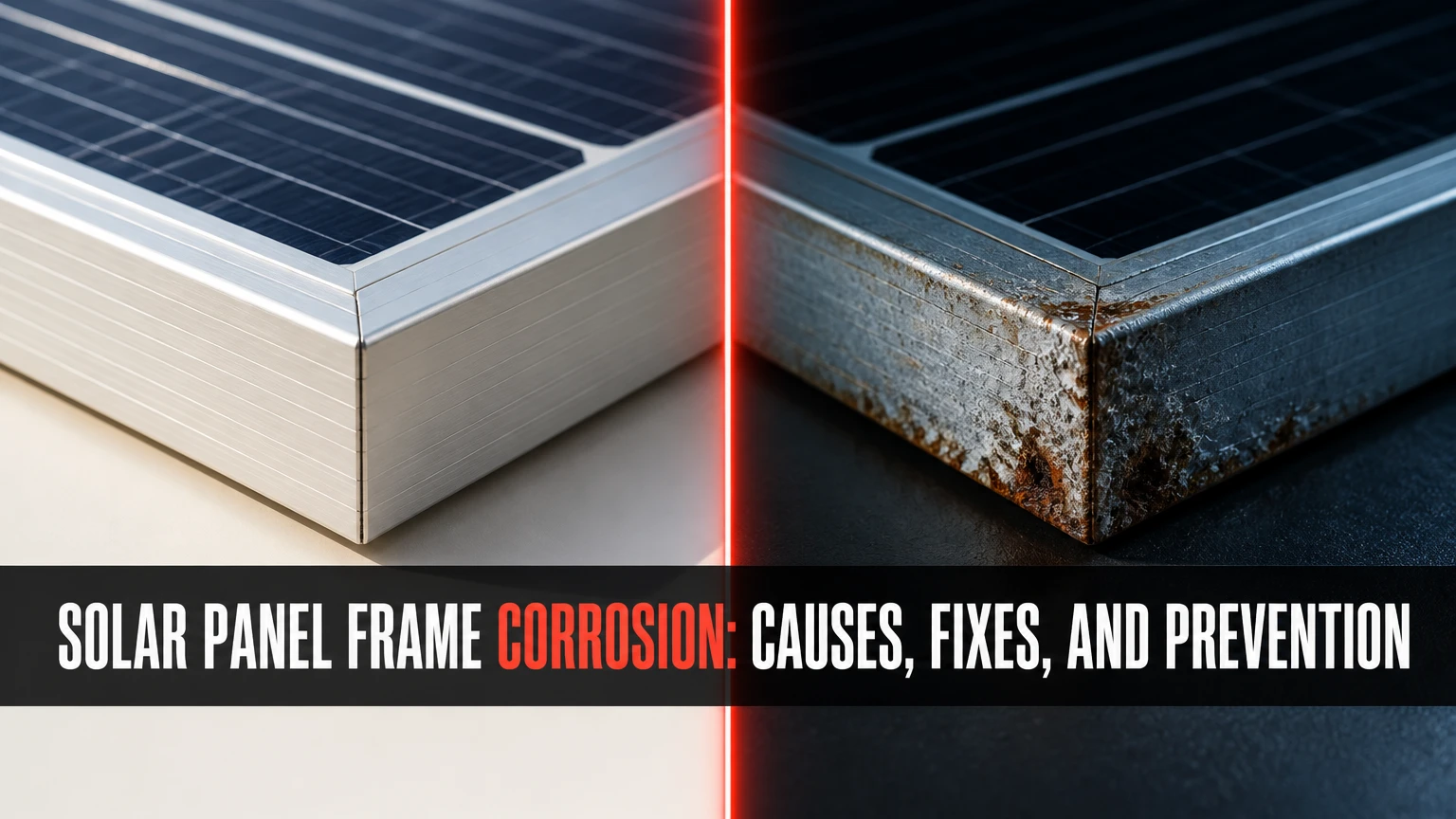
Solar panel frame corrosion is the electrochemical deterioration of an aluminum PV module frame after moisture, salts, pollutants, damaged coatings, or dissimilar-metal contacts disrupt its protective oxide layer. Minor chalking may remain cosmetic, but pitting, joint attack, and loss of cross-section can weaken clamps, grounding paths, and module support.
Key Facts at a Glance
- Most PV frames use extruded aluminum alloys such as 6005A-T6, 6063-T5, or related manufacturer-specific grades.
- Aluminum normally protects itself with a thin, adherent oxide film, but chloride, trapped moisture, high-pH cleaners, and abrasion can destabilize that protection.
- White powder usually contains aluminum hydroxide or oxide corrosion products, not iron rust.
- Stainless steel is more noble than aluminum, but 316 stainless steel is not immune to chloride pitting.
- A fixed galvanic-voltage limit, such as 0.15 V, cannot by itself approve or reject a joint; geometry, area ratio, electrolyte duration, coating, and bonding design also matter.
- A frame with deep pits, cracked corners, loose clamps, or compromised grounding requires qualified engineering review before continued operation.
What Is Solar Panel Frame Corrosion?
Solar panel frame corrosion is localized or general aluminum attack that changes the frame surface and may eventually remove load-bearing material. The most visible signs are white powder, gray chalking, blistered coating, dark staining, pits, or corrosion that tracks outward from a bolt, clamp, drain hole, or grounding point.
PV module frames are commonly extruded aluminum because aluminum combines low mass, useful stiffness, manufacturability, and natural atmospheric corrosion resistance. Alloy designation alone does not establish performance. A 6005A-T6 profile with a sound anodized finish, correct drainage, and compatible hardware can perform very differently from a scratched profile installed beside copper in a salt-spray environment.
The term “aluminum rust” is understandable but technically imprecise. Aluminum does not form the red iron oxides associated with steel rust. Its corrosion products commonly include hydrated aluminum oxides and hydroxides, which can appear white, gray, or chalky.
Why does aluminum normally resist corrosion?
Aluminum resists ordinary atmospheric corrosion because oxygen quickly forms a compact oxide film on exposed metal. The film is self-limiting in relatively clean, near-neutral conditions, but chloride ions can penetrate weak points and support localized dissolution.
The protective film is not a thick armor layer. Scratches, cut edges, aggressive cleaners, stagnant water, and galvanic contacts create conditions where the exposed substrate becomes anodic. Repeated wetting and drying can concentrate salts at the same joint, making a small defect more damaging than a larger defect that drains and dries quickly.
How Does Corrosion Develop on a PV Frame?
Aluminum frame corrosion develops through coupled anodic and cathodic reactions in a thin electrolyte film. Aluminum at the anodic site releases electrons, while oxygen reduction occurs at a cathodic site; water and dissolved salts complete the electrical path.
The simplified anodic reaction is:
[ \text{Al} \rightarrow \text{Al}^{3+} + 3e^- ]
A simplified cathodic reaction in neutral, aerated moisture is:
[ \text{O}_2 + 2\text{H}_2\text{O} + 4e^- \rightarrow 4\text{OH}^- ]
The resulting aluminum ions and hydroxide ions form hydrated corrosion products:
[ \text{Al}^{3+} + 3\text{OH}^- \rightarrow \text{Al(OH)}_3 ]
Chloride does not need to be consumed to cause damage. Chloride ions can concentrate in pits, destabilize passive films, and support continued localized attack while the surrounding surface appears relatively intact.
Which corrosion types affect solar panel frames?
| Corrosion type | Typical PV location | Visible evidence | Main consequence |
|---|---|---|---|
| Pitting | Coastal lower edges, scratches, cut ends | Pinholes, cavities, dark centers | Cross-section loss beneath a small surface defect |
| Crevice | Beneath clamps, washers, dirt, and trapped tape | Narrow white or dark tracks | Persistent wetness and oxygen concentration differences |
| Galvanic | Aluminum touching copper, carbon steel, or stainless hardware | Attack around contact joint | Accelerated aluminum loss near the dissimilar metal |
| Filiform | Beneath damaged organic paint or powder coating | Thread-like branching lines | Coating delamination and moisture migration |
| General surface attack | Polluted or chemically contaminated rooftops | Uniform dulling or chalking | Finish degradation, usually slower section loss |
| Intergranular attack | Susceptible alloy, heat treatment, or severe exposure | Layered cracking or exfoliation | Potential structural weakening, uncommon in sound PV profiles |
Filiform corrosion is more associated with coated aluminum exposed to humidity and coating defects than with every anodized PV frame. Crevice corrosion is often more relevant in field arrays because clamps, dirt, tape, and poorly drained profiles can retain electrolyte for hours.
Why Does Solar Panel Frame Corrosion Happen?
The main causes are chloride exposure, trapped moisture, dissimilar-metal contact, damaged surface treatment, chemical contamination, and poor drainage. A coastal site increases risk, but inland systems can corrode when dust, fertilizer, industrial fallout, or alkaline wash water creates a persistent electrolyte.
| Cause | Typical exposure | Risk mechanism | Practical control |
|---|---|---|---|
| Sea salt | Within several kilometers of surf, depending on wind | Chloride concentration during drying | Compatible hardware, drainage, inspections, rinsing |
| Copper contact | Bare conductor or incompatible lug | Aluminum becomes the anode | Listed bimetallic connector or approved bonding hardware |
| Stainless contact | Clamp, bolt, washer, or rail | Galvanic coupling in wet joints | Manufacturer-approved interface and water exclusion |
| Alkaline cleaner | Concrete dust, cement wash, caustic detergent | Passive film dissolution | Neutral cleaner, thorough rinse, no standing solution |
| Abrasion | Wire brush, drill, clamp movement | Exposes fresh aluminum | Nylon tools and controlled clamp installation |
| Trapped water | End channels, tape edges, blocked drains | Long electrolyte residence time | Open drainage paths and correct profile orientation |
| Industrial fallout | Sulfur, acids, metal dust, fertilizer | Conductive and chemically aggressive deposits | Site-specific coating and wash schedule |
| Bird droppings | Repeated deposits near frame joints | Salts and acids retain moisture | Gentle spot cleaning and joint inspection |
A counterintuitive field rule is that drainage often matters more than the nominal distance from the sea. A sheltered coastal roof with clean, sloped profiles may outperform a farther inland array where dust and alkaline runoff remain under clamps.
Does corrosion reduce solar panel power output?
Frame corrosion usually does not reduce photovoltaic output directly at first. It can reduce output indirectly if corrosion loosens the module, damages junction-box or cable interfaces, compromises grounding, creates glass stress, or causes water ingress and laminate failure.
A superficial white deposit on an external frame does not prove electrical degradation. Conversely, normal power readings do not prove structural safety. Mechanical retention and protective bonding require separate checks.
How Do Dissimilar Metals Attack an Aluminum Frame?
Galvanic corrosion occurs when aluminum contacts a more noble conductive material while an electrolyte connects the metals. The aluminum becomes the anodic member, and attack concentrates where the aluminum is electrically connected, especially when a small aluminum area is coupled to a large stainless or copper area.
| Contact pair | Relative field concern | Common PV example | Required design response |
|---|---|---|---|
| Aluminum and copper | High at wet direct contacts | Bare grounding conductor on frame | Listed bimetallic terminal or approved bonding clip |
| Aluminum and 304 stainless | Moderate to high in chloride exposure | Fastener in coastal clamp | Isolate where specified, prevent water traps |
| Aluminum and 316 stainless | Lower than 304 in many marine uses | Marine-grade clamp hardware | Still inspect for chloride pitting and crevices |
| Aluminum and galvanized steel | Variable as zinc coating ages | Steel rail and aluminum frame | Follow racking manufacturer compatibility details |
| Aluminum and carbon steel | High after coating damage | Uncoated bolt or damaged rail | Replace incompatible hardware and restore coating |
| Aluminum and anodized aluminum | Usually low | Frame-to-aluminum rail interface | Maintain coating and drainage at the joint |
Galvanic severity depends on more than electrode potential. The cathode-to-anode area ratio, joint wetness, chloride concentration, temperature, coating condition, and electrical path can change the result substantially. Therefore, universal rules such as “under 0.15 V is safe” are not reliable substitutes for a qualified compatibility design.
A direct copper wire fastened to an aluminum frame is a known failure pattern. The correct remedy is not simply adding a washer. The bonding component must be listed or approved for the exact conductor, frame, rail, environment, and installation method.
Which Materials and Coatings Resist Corrosion Best?
Anodized aluminum is the normal first choice for PV frames because it preserves low mass and provides a stable surface treatment. Powder-coated aluminum can provide a thicker barrier for architectural applications, while stainless steel may suit selected brackets or extreme chemical zones, but each choice has limitations.
| Option | Typical specification or grade | Suitable environment | Main limitation | Relative cost planning |
|---|---|---|---|---|
| Anodized aluminum | 10-25 µm finish, manufacturer specified | Inland, commercial, many utility sites | Scratches and cut edges need protection | 1.0x baseline |
| Powder-coated aluminum | 60-120 µm coating, system dependent | Architectural BIPV and urban rooftops | Chips can permit underfilm corrosion | 1.1-1.3x |
| 6005A-T6 aluminum | Structural extruded profile | Common module and rail applications | Performance depends on finish and joint design | 1.0-1.2x |
| 6063-T5 or T6 aluminum | Formable architectural extrusion | Frames and non-extreme exposures | Not automatically marine grade | 1.0-1.2x |
| 5052-H32 aluminum | Sheet and fabricated marine components | Enclosures and selected floating components | Not a typical high-strength extruded frame replacement | 1.2-1.6x |
| 316 stainless steel | Fasteners, brackets, selected structures | Saline hardware locations | Can pit in stagnant chloride water; heavier | 1.5-3.0x |
| Fiber-reinforced polymer | Pultruded or molded profile | Specialized floating or corrosive sites | Different stiffness, fire, and bonding design | 1.5-3.5x |
The AI Overview’s claim that 25 µm Type III anodizing is mandatory in marine environments is too broad. “Type III” commonly refers to hard anodizing under aerospace or industrial specifications, while architectural anodizing classifications and project requirements use different systems. PV buyers should specify the applicable standard, measured coating thickness, sealing quality, alloy, and exposure category rather than relying on a thickness number alone.
The aluminum industry recognizes that corrosion performance depends on environment and alloy condition. The Aluminum Association states, “Aluminum is highly resistant to corrosion,” but that statement describes the normal passive condition, not a guarantee against chloride pitting or galvanic attack.
Is stainless steel better than aluminum for solar frames?
Stainless steel is not automatically better than aluminum for a solar frame. Stainless steel provides high strength and useful chloride resistance in suitable grades, but its greater mass, thermal behavior, cost, and crevice-pitting risk can make a full steel frame a poor choice.
316 stainless is more appropriate than 304 stainless in many saline applications because molybdenum improves resistance to chloride attack. Neither grade is immune. A wet crevice under a washer can pit 316, particularly where salt deposits concentrate and oxygen renewal is limited.
How Should a PV Frame Be Inspected?
A PV frame should be inspected first without disturbing the module, then tested for structural and bonding concerns when visual evidence warrants it. Inspection should document defect location, length, pit depth, joint materials, drainage, moisture history, and whether the damage reaches a load-bearing corner or clamp seat.
Step 1: Photograph and map the evidence
Record module row, module serial number, frame side, joint type, and defect dimensions. Photograph white deposits before cleaning because washing can remove evidence needed to identify a leak path or galvanic joint.
Step 2: Check the frame and joints
Look for lifting coating, powder, pits, swollen corners, cracks, loose clamps, blocked drain paths, dark contact stains, and corrosion around grounding hardware. Do not scrape aggressively or remove a bonding device from an energized array.
Step 3: Identify every contacting metal
Record frame alloy if available, rail metal, fastener grade, washers, clips, lugs, grounding conductors, and sealants. A joint that looks electrically continuous may still use an incompatible direct copper-to-aluminum contact.
Step 4: Test bonding separately
A qualified technician can use a low-resistance ohmmeter or micro-ohmmeter to measure bonding continuity against the system design. Resistance results depend on probe placement, parallel paths, anodizing penetration, and test current, so a low reading does not establish structural integrity.
Step 5: Measure section loss when needed
Ultrasonic thickness measurement can help on accessible profiles, but thin, irregular, anodized, or contaminated aluminum requires an experienced operator and a suitable reference condition. Deep pits near corners, clamp seats, or grounding points justify engineering review.
Step 6: Classify the condition
| Condition | Typical evidence | Immediate decision |
|---|---|---|
| Cosmetic oxidation | Light chalking, no pits, sound coating | Clean, document, monitor |
| Active surface corrosion | Powder, coating lift, shallow scattered pits | Identify cause and repair finish or joint |
| Joint corrosion | Attack around clamp, bolt, lug, or rail | Stop repeated wetting and review compatibility |
| Structural concern | Deep pits, cracks, thin wall, loose corner | Qualified engineer decides repair or replacement |
| Electrical safety concern | Damaged bonding clip, burned lug, open path | Qualified electrical technician isolates and corrects |
| Module damage | Frame distortion, glass stress, laminate moisture | Manufacturer or engineer evaluates module replacement |
Can a Corroded Solar Frame Be Repaired?
A corroded frame can be repaired only when corrosion is superficial, the profile remains dimensionally sound, and the manufacturer or engineer accepts the repair method. Deep pitting, corner cracking, clamp-seat loss, distorted profiles, or compromised bonding generally favor module or structural replacement.
For minor damage, a qualified technician can remove loose corrosion products with a nonmetallic nylon abrasive, wash with a manufacturer-approved neutral cleaner, rinse with low-mineral water, and dry the joint completely. Touch-up coating may slow recurrence, but it does not restore lost aluminum thickness or recreate factory anodizing.
Do not use zinc-chromate primer by default. Chromate coatings can present health and disposal restrictions, and many products are unsuitable for an anodized aluminum surface or a PV frame warranty. Use a coating system explicitly approved for the alloy, existing finish, exposure, and manufacturer repair procedure.
| Remediation | Typical planning cost per affected module | Typical duration | Appropriate use |
|---|---|---|---|
| Cleaning and documentation | $5-$25 | 15-45 minutes | Surface deposits without section loss |
| Bonding hardware replacement | $20-$80 | 30-90 minutes | Failed or incompatible clip or lug |
| Joint disassembly and isolation | $40-$150 | 1-3 hours | Galvanic or crevice attack with sound frame |
| Module replacement | $150-$500 plus module | 1-3 hours | Damaged frame, glass, or laminate |
| Engineered rack correction | $150-$350 per module typical | 2-6 hours | Repeated structural or clamp failures |
| Large-array remediation | $75-$300 per module typical | Days to weeks | Access, testing, and row-level corrective work |
These are typical planning ranges, not universal prices. Roof access, shutdown requirements, replacement-module availability, engineering documentation, and local labor can move the total substantially. The $150-$350 range sometimes quoted for field correction excludes major lifting, scaffolding, electrical isolation, and replacement hardware.
How Can Corrosion Be Prevented?
Corrosion prevention starts with a compatible material stack, positive drainage, controlled fastening, and a maintenance plan matched to the site. Coating thickness alone cannot compensate for a copper-to-aluminum contact, a trapped-water joint, or a damaged frame corner.
Specify the complete material system
Request the frame alloy, temper, surface treatment, coating thickness or class, fastener grade, bonding method, and environmental suitability. IEC 61215 and IEC 61730 address PV module design qualification and safety, but a passed module test does not replace project-specific compatibility review for an unusual coastal, industrial, or floating installation.
Build joints that drain and isolate
Use manufacturer-approved clips and rails. Preserve designed drainage holes, avoid blocking channels with sealant, and do not improvise EPDM or nylon isolation where the joint requires electrical bonding. Isolation and grounding are separate functions, so a nonconductive washer must never interrupt a required protective-bonding path.
Control installation damage
Use the specified torque and tool. Do not drag frames across rails, enlarge holes without approval, use a steel wire brush on anodizing, or clamp over thick debris. A damaged anodized surface at a wet joint is a predictable initiation site.
Maintain the array by exposure
| Site condition | Typical inspection interval | Cleaning concern | Design priority |
|---|---|---|---|
| Dry inland residential | 12-24 months | Dust and bird deposits | Drainage and sound bonding |
| Desert with dust storms | 6-12 months | Abrasive dust and alkaline deposits | Gentle washing and coating protection |
| Coastal rooftop | 6-12 months | Chloride film and salt concentration | Joint compatibility and frequent evidence review |
| Heavy industrial | 3-6 months | Acidic or sulfur-bearing fallout | Site chemistry and coating specification |
| Floating PV | 3-6 months | Continuous humidity and splash | Marine hardware, crevice control, engineered bonding |
| Agricultural site | 6-12 months | Fertilizer and ammonia deposits | Rinse strategy and chemical exposure review |
Cleaning should use soft water, a soft brush or cloth, and a neutral, manufacturer-approved detergent when needed. Strong acids, caustic alkalis, abrasive pads, and pressure that drives water into connectors can damage finishes or electrical components.
What Should Coastal and Floating Solar Projects Specify?
Coastal projects should prioritize drainage, chloride-resistant hardware, approved bonding components, and documented inspection points rather than selecting a nominal “marine-grade” aluminum label alone. Floating PV projects require a broader review because constant humidity, splash, platform movement, and underwater metals create more persistent electrolytes.
A project within 500 meters of the sea may face severe salt exposure, but wind direction, elevation, surf, shielding, rainfall, and wash frequency determine actual deposition. No universal distance threshold replaces a site corrosion assessment.
For floating systems, separate above-water frame corrosion from submerged anchoring corrosion. Sacrificial zinc anodes may protect specific submerged metallic components under an engineered cathodic-protection design, but they do not solve an above-water galvanic joint or replace protective bonding.
What Does Solar Panel Frame Corrosion Cost?
Minor frame oxidation may cost less than $25 per module to inspect and clean, while module replacement or rack correction commonly reaches $150-$500 per module before access and engineering charges. Coastal failures become expensive when the original defect affects multiple rows, requires shutdowns, or damages modules and bonding infrastructure.
A practical budget should include inspection labor, replacement hardware, access equipment, electrical isolation, engineering review, replacement modules, disposal, and lost generation. A low unit repair estimate can therefore understate the project cost by several times.
Which Corrosion Claims Require Caution?
Several common claims sound precise but lack universal engineering validity. “Stainless steel cannot corrode,” “25 µm anodizing is mandatory,” and “a galvanic voltage below 0.15 V is safe” can produce poor decisions when treated as standalone rules.
The same caution applies to projected failure periods. Coastal aluminum can show severe damage in two to five years under a bad joint design, but a correctly designed and maintained array can avoid that outcome over a much longer service period. Exposure, geometry, coating, alloy, installation quality, and inspection history determine the result.
What is the expert rule of thumb?
Treat corrosion at a joint as a system defect, not a surface-cleaning problem. When attack begins around a clamp, lug, or rail, inspect the electrical path, water path, contacting metals, and mechanical load path together.
That rule prevents a common failed repair: polishing away white powder while leaving the incompatible conductor, blocked drain, or loose clamp that caused the corrosion. Surface appearance improves temporarily, but the electrochemical cell remains.
Frequently Asked Questions
Is white powder on an aluminum solar frame dangerous?
White powder usually indicates aluminum corrosion products and is not automatically an immediate structural emergency. It becomes concerning when deposits recur quickly, surround a grounding connection, accompany deep pits or coating lift, or appear at a frame corner and clamp seat. Photograph the deposit, identify the joint, and obtain qualified inspection before aggressive cleaning.
Can rain stop solar panel frame corrosion?
Rain can remove loose salts, but it cannot reliably stop corrosion. Repeated wetting and drying may concentrate chloride in pits and crevices, while sheltered joints remain wet after surrounding surfaces dry. Correct drainage, compatible metals, intact coatings, and periodic site-appropriate cleaning provide more protection than rainfall alone.
Are solar panel frames waterproof?
Solar panel frames are not sealed waterproof enclosures. The frame supports the laminate and glass, while drainage paths and module construction manage moisture. Water can enter frame joints, clamp interfaces, and damaged seal areas, especially when profiles are installed incorrectly or drains are blocked.
Does anodizing prevent galvanic corrosion?
Anodizing reduces direct exposure of aluminum, but it does not guarantee galvanic protection. Fasteners can breach the coating, grounding clips may intentionally penetrate it, and damaged edges can become anodic. Galvanic control still requires compatible hardware, correct bonding components, drainage, and protection of exposed cut surfaces.
Should a corroded solar panel be replaced immediately?
Immediate replacement is appropriate when corrosion causes frame distortion, cracked corners, deep section loss, loose retention, damaged glass, or an unreliable bonding path. Superficial chalking without pits may be monitored after the cause is corrected. A qualified module or structural professional should make the final decision.
Can I paint over solar frame corrosion?
Painting over loose corrosion does not repair the aluminum or stop the underlying electrolyte. A suitable repair requires cleaning, drying, removal of unstable coating, compatibility assessment, and an approved coating system. Factory anodizing cannot be reproduced reliably with household paint, and unauthorized coating work may affect the module warranty.
Conclusion
Solar panel frame corrosion begins when aluminum passivation is disrupted by chloride, trapped moisture, chemicals, abrasion, or dissimilar-metal contact. The safest response is to identify the corrosion mechanism, inspect the electrical and structural functions separately, and correct the joint or drainage defect before choosing cleaning, repair, or replacement. Exact coating thickness and galvanic voltage figures are not substitutes for a complete design review. For any active Solar panel frame corrosion involving pits, corners, clamps, or grounding hardware, document the evidence and use qualified PV and structural personnel before returning the array to normal service.