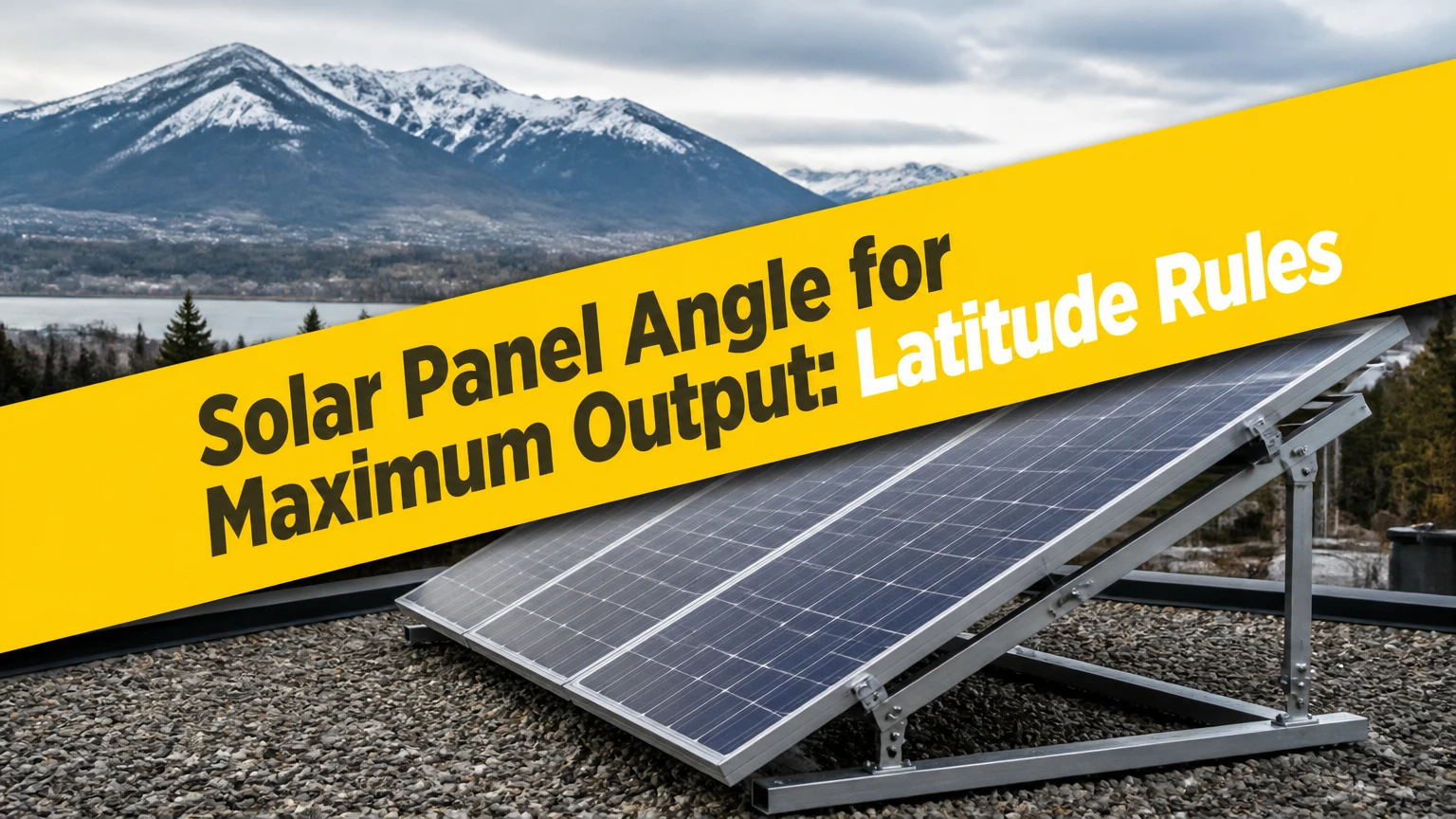
The best solar panel angle for maximum output is usually close to your site’s latitude, with the panels facing the equator: true south in the Northern Hemisphere and true north in the Southern Hemisphere. Latitude is only a starting point. Roof pitch, seasonal electricity demand, shade, snow, local weather, and electricity pricing can make a different tilt more valuable.
Key Facts at a Glance
A fixed solar array commonly starts with a tilt near local latitude for strong annual energy production.
True south is 180 degrees azimuth in the Northern Hemisphere; true north is 0 degrees in the Southern Hemisphere.
A panel produces the most direct-light energy when sunlight strikes its surface nearly perpendicular to the glass.
A practical seasonal adjustment is latitude minus 10-15 degrees in summer and latitude plus 10-15 degrees in winter.
Roof-mounted panels usually perform best economically when installed parallel to a suitable roof slope.
A 5-degree tilt change cannot compensate for tree shade, heavy soiling, poor wiring, or a failing inverter.
What Is the Best Solar Panel Angle for Your Latitude?
For a fixed array intended to maximize annual kilowatt-hours, use local latitude as the first estimate, then refine it with a solar-production model. The latitude rule is simple, but the mathematically optimal angle can be several degrees higher or lower because the sun’s path, cloud cover, temperature, snow, and electricity value vary by location.
| Site latitude | Initial fixed tilt | Summer starting tilt | Winter starting tilt |
|---|---|---|---|
| 10 degrees | 10 degrees | 0-5 degrees | 20-25 degrees |
| 25 degrees | 25 degrees | 10-15 degrees | 35-40 degrees |
| 35 degrees | 35 degrees | 20-25 degrees | 45-50 degrees |
| 45 degrees | 45 degrees | 30-35 degrees | 55-60 degrees |
| 50 degrees | 50 degrees | 35-40 degrees | 60-65 degrees |
The table gives starting points, not stamped engineering specifications. In low latitudes, a latitude-minus adjustment may improve annual output because the sun remains high for much of the year. In the 25-50 degree range, one commonly cited approximation is tilt = 0.76 × latitude + 3.1 degrees, while another practical rule uses latitude itself.
Why does latitude matter?
Latitude determines the sun’s maximum height and its seasonal path above the horizon. At 35 degrees north, for example, the noon sun is much higher in June than in December, so one fixed panel angle must compromise between summer and winter geometry.
Solar designers normally use hourly weather and irradiance data rather than latitude alone. The U.S. Department of Energy’s PVWatts calculator and tools based on the National Renewable Energy Laboratory’s solar resource data can estimate annual output for different tilt and azimuth settings, including local weather patterns and system losses.
A useful engineering rule is to optimize the whole system, not only the panel plane. A theoretically perfect angle that creates winter row shading, difficult maintenance, or high wind exposure can produce less annual energy than a slightly less optimal but practical installation.
Why Does Tilt Affect Solar Output?
Solar panel tilt affects output because it changes the angle of incidence, which is the angle between incoming sunlight and a line perpendicular to the panel surface. Direct irradiance on the panel is often approximated by E = E₀ cos(θ), where θ is the incidence angle, although real modules also experience reflection, diffuse light, temperature effects, and electrical losses.
At an incidence angle of 0 degrees, the cosine term equals 1, so direct light reaches the panel at full geometric intensity. At 30 degrees, the cosine term is about 0.866, representing a theoretical 13.4% geometric reduction before additional glass reflection is considered.
Fixed panels cannot maintain zero incidence all day because the sun moves across the sky. A fixed tilt is therefore an annual compromise that favors some hours and seasons over others. Diffuse skylight also matters, especially in cloudy climates, so a panel does not lose all useful production when direct rays are misaligned.
What is the difference between tilt, azimuth, and incidence angle?
Tilt is the panel’s angle above a horizontal plane. Azimuth is the compass direction toward which the panel faces. Incidence angle describes the relationship between the panel surface and sunlight at a particular moment.
| Term | Definition | Common reference | Main effect |
|---|---|---|---|
| Tilt | Vertical panel angle | 0 degrees horizontal, 90 degrees vertical | Seasonal and midday alignment |
| Azimuth | Horizontal facing direction | 180 degrees true south | Daily production timing |
| Incidence angle | Sunlight angle from panel perpendicular | 0 degrees is ideal | Direct-light capture |
| Solar altitude | Sun angle above horizon | 0 degrees horizon, 90 degrees overhead | Shadow length and exposure |
Azimuth often matters more than a small tilt difference. A south-facing array at 30 degrees may outperform a correctly tilted east-facing array over the full day, but east and west surfaces can produce more useful energy when morning and afternoon demand or export prices matter.
Which Direction Should Solar Panels Face?
Solar panels should face true south in the Northern Hemisphere and true north in the Southern Hemisphere when the objective is usually maximum annual production. The exact target is geographic, not magnetic, so a compass reading must be corrected for local magnetic declination.
A south-facing panel does not require perfect alignment to perform well. An azimuth error of 10-15 degrees commonly produces a smaller annual penalty than persistent shade, poor ventilation, or heavy dirt. At many locations, a southeast or southwest orientation remains practical when it improves roof coverage or shifts production toward a valuable time of day.
| Panel orientation | Typical production timing | Annual-output tendency | Best use case |
|---|---|---|---|
| True south | Late morning to afternoon | Highest in many Northern Hemisphere sites | Annual energy maximum |
| Southeast | Morning-weighted | Often within several percent of south | Morning loads |
| Southwest | Afternoon-weighted | Often within several percent of south | Afternoon loads or exports |
| East-west split | Broad two-sided curve | Site-dependent, often lower peak | Flat commercial roofs |
| True north | Strongest in Southern Hemisphere | Highest in many Southern Hemisphere sites | Annual energy maximum there |
True south is not always the best financial direction. A household with high electricity use at 7 a.m. may value southeast production more than a small annual-output advantage from due south. A commercial building with afternoon cooling demand may prefer southwest-facing modules.
How do you find true south or true north?
Obtain the site’s coordinates, identify the local magnetic declination, and set the array bearing to geographic north or south. A smartphone solar survey app, a site plan, or professional surveying equipment is more reliable than an uncorrected magnetic compass near steel roofing and electrical equipment.
Magnetic declination changes by location and slowly changes over time. The National Oceanic and Atmospheric Administration provides a magnetic field calculator for checking declination in the United States, while local geological or mapping agencies provide equivalent resources elsewhere.
Should Solar Panels Match the Roof Pitch?
Solar panels should usually follow the roof pitch when the roof has suitable orientation, adequate structural capacity, and no significant shading. Flush mounting reduces racking cost, wind exposure, penetrations, and visual height, so a roof with a 20-35 degree slope is often economically preferable to a raised structure that achieves a theoretical optimum.
A roof pitch that differs from the annual optimum does not automatically make solar unsuitable. Production modeling can quantify the difference, and many roofs remain productive at 10-20 degrees or at steeper angles. The installer must also verify roof age, attachment points, drainage, snow loads, wind uplift, fire setbacks, and local permit requirements.
| Roof condition | Typical response | Main benefit | Main limitation |
|---|---|---|---|
| South-facing, 20-35 degrees | Flush mount | Low cost and low wind profile | Fixed seasonal compromise |
| South-facing, under 10 degrees | Low-tilt rack if permitted | Better runoff and viewing angle | Added ballast or penetrations |
| East-west, 10-20 degrees | Split orientation | Longer production window | Lower direct midday peak |
| Flat roof, commercial | Low-tilt east-west rows | Dense layout and manageable wind | More diffuse-light and soiling dependence |
| Steep roof, over 45 degrees | Flush mount with engineering review | Snow shedding and low uplift area | More difficult installation |
Expert insight: Raising panels on a sloped roof can reduce energy rather than increase it when the new tilt creates self-shading, wind restrictions, or a wider row footprint that forces fewer modules onto the roof.
Should You Change the Tilt During the Year?
Changing the tilt twice or four times per year can improve energy capture, especially on an accessible ground mount, but the gain is usually modest compared with adding another module. A practical schedule uses latitude near the spring and autumn equinoxes, latitude minus 10-15 degrees in summer, and latitude plus 10-15 degrees in winter.
The exact benefit depends on latitude, weather, shading, and the amount of labor required. A typical manual adjustment may produce roughly 2-7% more annual energy than a well-chosen fixed angle, while seasonal gains in a particular month can be larger.
| Adjustment schedule | Number of changes | Typical annual gain | Suitable installation |
|---|---|---|---|
| Fixed annual tilt | 0 | Baseline | Most residential roofs |
| Summer and winter | 2 | 2-5% | Accessible ground mounts |
| Four seasonal settings | 4 | 3-7% | Off-grid arrays with manual access |
| Monthly adjustment | 12 | Usually marginally higher | Experimental or staffed sites |
Adjusting panels is not worthwhile when workers must climb a roof, remove hardware, risk damage, or violate an installation warranty. For off-grid systems, winter tilt can have extra practical value because low winter sun, short days, and snow require reliable charging rather than merely higher annual totals.
Which Mounting System Produces the Most Energy?
Dual-axis tracking produces the closest daily alignment with the sun, but fixed mounting usually produces the best residential value because trackers add motors, controls, foundations, maintenance, and wind exposure. Single-axis trackers commonly provide a 15-30% annual energy increase over fixed arrays in suitable climates, while dual-axis systems can provide roughly 25-40% in favorable conditions.
Those ranges are typical planning values, not guaranteed performance claims. The result changes with latitude, tracker backtracking, diffuse cloud cover, row spacing, terrain, wind limits, and whether the comparison uses the same land area or the same module capacity.
| Mounting option | Typical annual gain versus fixed | Typical racking cost | Maintenance profile |
|---|---|---|---|
| Fixed roof mount | 0% baseline | $150-$400 per kilowatt for racking | Low, mostly inspection |
| Adjustable ground mount | 2-7% | $250-$600 per kilowatt | Low, manual changes |
| Single-axis tracker | 15-30% | $800-$1,800 per kilowatt | Motors, bearings, controls |
| Dual-axis tracker | 25-40% | $2,000-$4,000 per kilowatt | Highest mechanical service |
Tracker economics depend on land and labor prices. A utility project may accept a tracker because the extra midday and shoulder-hour energy uses the same module capacity, while a homeowner usually gets a better return from additional fixed modules, shade removal, or a larger inverter.
Are solar trackers worth the cost?
Solar trackers are generally worth evaluating for utility-scale or commercial ground arrays with strong direct sunlight, ample land, and valuable daytime electricity. Trackers are usually poor choices for residential roofs, small off-grid systems, snowy sites, or locations where high wind requires frequent stow positions.
Tracker output also changes with weather. When diffuse skylight dominates, rotating toward the sun provides less benefit because the available light arrives from a broad portion of the sky rather than one strong direction.
How Much Does Panel Angle Matter Compared With Shade?
Shade matters more than small angle errors. A vent, tree, parapet, or neighboring row can reduce output from affected cells and sometimes activate bypass diodes, while a 5-degree tilt difference usually causes a smaller annual penalty than several hours of direct obstruction.
Solar installers should model shade at different seasons and times, not inspect only the noon shadow. Tools such as Solmetric SunEye, Aurora Solar, HelioScope, and NREL’s PVWatts can support different parts of the assessment, although a professional design must verify the final result.
| Problem | Typical energy impact | Diagnostic method | First remedy |
|---|---|---|---|
| 5-degree tilt error | 0.5-3% annual estimate | Production model comparison | Keep practical roof angle |
| 15-degree azimuth error | 1-5% annual estimate | Azimuth simulation | Reorient if inexpensive |
| Morning tree shade | Site-specific, 5-30% affected output | Hourly shade survey | Trim, relocate, or redesign |
| Heavy dust or bird residue | 2-20% site-dependent | Visual inspection and before-after test | Clean safely |
| Inverter clipping | 1-5% annual system loss | Inverter monitoring | Review DC-to-AC ratio |
The percentages in this table are planning ranges, not universal guarantees. Module-level power electronics can reduce mismatch from partial shade, but they cannot restore sunlight blocked by an object.
What Changes for Snow, Heat, Bifacial Panels, and Flat Roofs?
Snow, temperature, rear-side irradiance, drainage, and maintenance access can change the best practical tilt. A steeper panel may shed snow sooner, while a low-tilt bifacial array may gain energy from a bright roof or ground surface; the correct choice requires site-specific modeling rather than a single universal angle.
Module temperature also affects output. Most crystalline silicon modules lose approximately 0.3-0.4% of power for each degree Celsius increase above their rated cell temperature, so a steeper array that improves airflow may outperform a flatter array even when sunlight geometry is similar.
| Situation | Angle or design response | Reason | Important constraint |
|---|---|---|---|
| Frequent snow | Consider 35-60 degrees | Encourages snow sliding | Snow may still remain on frames |
| Hot roof | Preserve rear ventilation | Reduces operating temperature | Do not block fire pathways |
| Bifacial modules | Model rear irradiance | Albedo can add rear-side energy | Avoid opaque close-mounted surfaces |
| Flat commercial roof | Often 5-15 degrees | Limits wind and row spacing | Cleaning and drainage remain necessary |
| Heavy rainfall | At least practical drainage slope | Reduces standing water and residue | No universal self-cleaning threshold |
A tilt below 10-15 degrees is not automatically defective. Rain can clean some arrays at lower angles, but dust, pollen, bird residue, and mineral deposits may remain. The correct minimum depends on module-frame drainage, roof design, local soiling, cleaning access, and manufacturer instructions.
Expert insight: A claim that every panel below 10 degrees will lose 30% is too broad. Soiling losses are measured at the site and can range from negligible after rain to severe in agricultural, desert, or industrial environments.
How Should You Optimize a Flat-Roof Array?
Flat-roof designers should choose tilt, azimuth, row spacing, ballast, drainage, and maintenance access together. A low-tilt east-west layout can fit more capacity into limited roof area, while a higher south-facing tilt may produce more energy per module but requires wider row spacing to prevent winter shading.
The rear row must remain free from shadows during the design hours that matter. In the Northern Hemisphere, low winter sun creates the longest shadows, so spacing based only on summer noon conditions can overestimate production.
Row spacing checklist
- Measure the roof’s usable length, width, parapets, vents, and fire-access paths.
- Model the winter solar altitude for the project latitude.
- Include module height, tilt, row azimuth, and the shadow-casting edge.
- Test morning, noon, and afternoon periods rather than one timestamp.
- Compare annual energy per module with annual energy per square meter.
- Confirm ballast, roof membrane protection, drainage, and wind design with an engineer.
A higher tilt is not automatically better on a commercial roof. Capacity density, wind loading, and inter-row shading can outweigh the theoretical gain from more direct midday exposure.
How Do You Calculate the Angle Step by Step?
Calculate a practical solar panel angle by combining latitude, true azimuth, roof constraints, shading, and production modeling. A basic estimate takes 10-20 minutes, but a permit-ready design requires structural, electrical, fire, and wind review by qualified professionals.
Step 1: Record the site latitude
Use GPS coordinates or a reliable mapping service rather than a broad city-center estimate. Latitude to the nearest 0.1 degree is sufficient for an initial estimate, although professional models use the exact site location and weather file.
Step 2: Set the starting tilt
Use latitude for a fixed annual starting value. Test latitude minus 10-15 degrees for summer-weighted production and latitude plus 10-15 degrees for winter-weighted production.
Step 3: Determine true azimuth
Set the panel direction toward true south north of the equator or true north south of the equator. Correct a magnetic compass for local declination, and keep ferrous roof components away from the measurement.
Step 4: Model nearby alternatives
Compare at least five tilts, such as 15, 25, 35, 45, and 55 degrees when the site permits them. Compare south, southeast, and southwest orientations if the load profile or tariff rewards particular hours.
Step 5: Check shade and row spacing
Use an hourly shade model or solar path survey. Reject any angle that creates persistent row shading or blocks a significant amount of production during valuable hours.
Step 6: Verify construction constraints
Confirm roof condition, attachment structure, wind uplift, snow load, ballast, drainage, fire setbacks, access paths, and equipment clearances. The design is successful when the expected production gain survives these physical constraints.
What Causes Low Output When the Angle Is Correct?
Correct tilt does not guarantee correct production. Low output commonly comes from shading, soiling, high module temperature, inverter clipping, damaged connectors, string mismatch, premature degradation, or a monitoring error.
Use the system monitor to compare actual output with weather-adjusted expected output. A clean, unshaded array producing low voltage may indicate a string or connector problem, while normal voltage with low current can point toward irradiance, shading, soiling, or module faults.
| Symptom | Likely cause | Test | Corrective action |
|---|---|---|---|
| Output drops at one hour daily | Fixed shade | Hourly production graph | Remove or redesign obstruction |
| One string underperforms | Connector or module fault | String voltage and current test | Qualified electrical repair |
| Output falls after dry weather | Soiling | Visual check and safe cleaning | Clean at a cool time |
| Inverter reaches rated AC power | Clipping | Inverter graph on bright days | Assess inverter sizing |
| Winter output collapses | Snow or low sun | Site inspection and weather record | Remove snow safely, review tilt |
| Monitoring shows no data | Communications fault | Inverter status screen | Restore network or gateway |
Do not wash hot modules with cold water or climb a roof without fall protection. Electrical testing, connector repair, and inverter work belong to a qualified solar electrician.
Which Solar Panel Angle Strategy Fits Your Situation?
A fixed roof mount is the best choice for most homeowners, an adjustable ground mount suits hands-on off-grid users, and single-axis tracking deserves consideration for large ground arrays with strong direct sunlight. The right strategy depends on energy value, available area, access, weather, and structural risk.
Homeowner with a pitched roof
Match a suitable roof plane rather than adding an elevated rack solely to chase latitude. Prioritize an unshaded south, southeast, or southwest roof, then compare the modeled output with the cost and risk of structural alterations.
Off-grid cabin or homestead
Use an accessible adjustable ground mount when winter charging is the primary concern. Set the winter angle near latitude plus 10-15 degrees, keep snow clearance practical, and size the battery and array for the lowest-production season rather than annual average energy.
Commercial flat roof
Compare low-tilt south-facing rows with east-west layouts. Include ballast, parapets, maintenance walkways, fire access, roof replacement timing, and the value of morning and afternoon production before choosing the highest annual yield per module.
Utility-scale ground array
Evaluate single-axis tracking when direct normal irradiance is strong and the project has adequate land, wind design, and maintenance capability. Compare lifetime energy revenue, tracker replacement assumptions, and availability losses against fixed-tilt capital costs.
What Are the Most Common Angle Mistakes?
The most expensive angle mistakes are usually design-process errors, not a wrong latitude formula. Installers and owners should correct shade, orientation, drainage, access, and electrical losses before spending heavily on adjustable hardware.
- Using magnetic south as true south: Correct the compass bearing for local declination.
- Optimizing only for noon: Evaluate the complete daily production curve and the tariff.
- Ignoring winter shadows: Model low solar altitude before finalizing row spacing.
- Raising roof panels unnecessarily: Compare the added rack cost and wind load with modeled annual gain.
- Treating latitude as an exact answer: Use it as a starting value, then test local alternatives.
- Mounting completely flat for convenience: Check drainage, residue, cleaning access, and manufacturer requirements.
- Buying trackers for a small roof: Compare their capital and service costs with adding fixed modules.
- Confusing panel angle with inverter efficiency: Tilt changes irradiance; it does not directly improve the inverter’s conversion rating.
Expert rule of thumb: If a proposed angle change costs more than adding approximately 5-10% more module capacity, model both options financially. Additional modules often produce a more reliable return than moving hardware.
FAQ
Is a 30-degree angle good for solar panels?
A 30-degree tilt is a strong practical choice for many locations between roughly 25 and 40 degrees latitude, especially when the array faces the equator and remains unshaded. It is not universally optimal. A site at 50 degrees latitude may favor a steeper annual tilt, while a low-latitude site may favor a flatter one.
Do solar panels work when they are flat?
Solar panels work when flat, but a 0-degree tilt usually increases residue, standing water, and cleaning requirements while reducing direct-light alignment outside limited periods. Flat mounting can be acceptable for temporary systems or carefully designed commercial roofs, provided drainage, maintenance, and soiling are addressed.
What is the best angle for winter solar production?
Winter solar production usually improves when the panel tilt is about 10-15 degrees steeper than local latitude. The steeper orientation better faces the low winter sun and can help snow slide, but it may increase wind loading, row spacing, and structural cost.
Is east-facing solar better than south-facing solar?
East-facing solar is better than south-facing solar when morning production has greater financial or operational value and the east roof has fewer shadows. For maximum annual energy in the Northern Hemisphere, south-facing panels generally remain the stronger baseline, although a southeast or east-west design can better match building demand.
How often should adjustable solar panels be moved?
Adjustable solar panels can be moved twice yearly or once each season. A practical schedule is latitude minus 10-15 degrees in summer, latitude near the equinoxes, and latitude plus 10-15 degrees in winter. More frequent changes usually add labor with only a small extra annual gain.
Can a wrong angle damage solar panels?
A wrong tilt normally reduces energy rather than directly damaging the modules. Damage risks arise when a steep or raised rack creates excessive wind uplift, concentrates snow loads, compromises roof waterproofing, blocks drainage, or causes unsafe maintenance access.
The Bottom Line
The best solar panel angle for maximum output starts near local latitude and pairs with true equator-facing azimuth, but the best installed design is the one that also avoids shade, manages snow and dirt, preserves roof integrity, and matches the value of morning or afternoon electricity. For most homes, a fixed roof mount wins. For accessible ground systems, seasonal adjustment can help. For large, sunny ground arrays, tracking may justify its complexity.