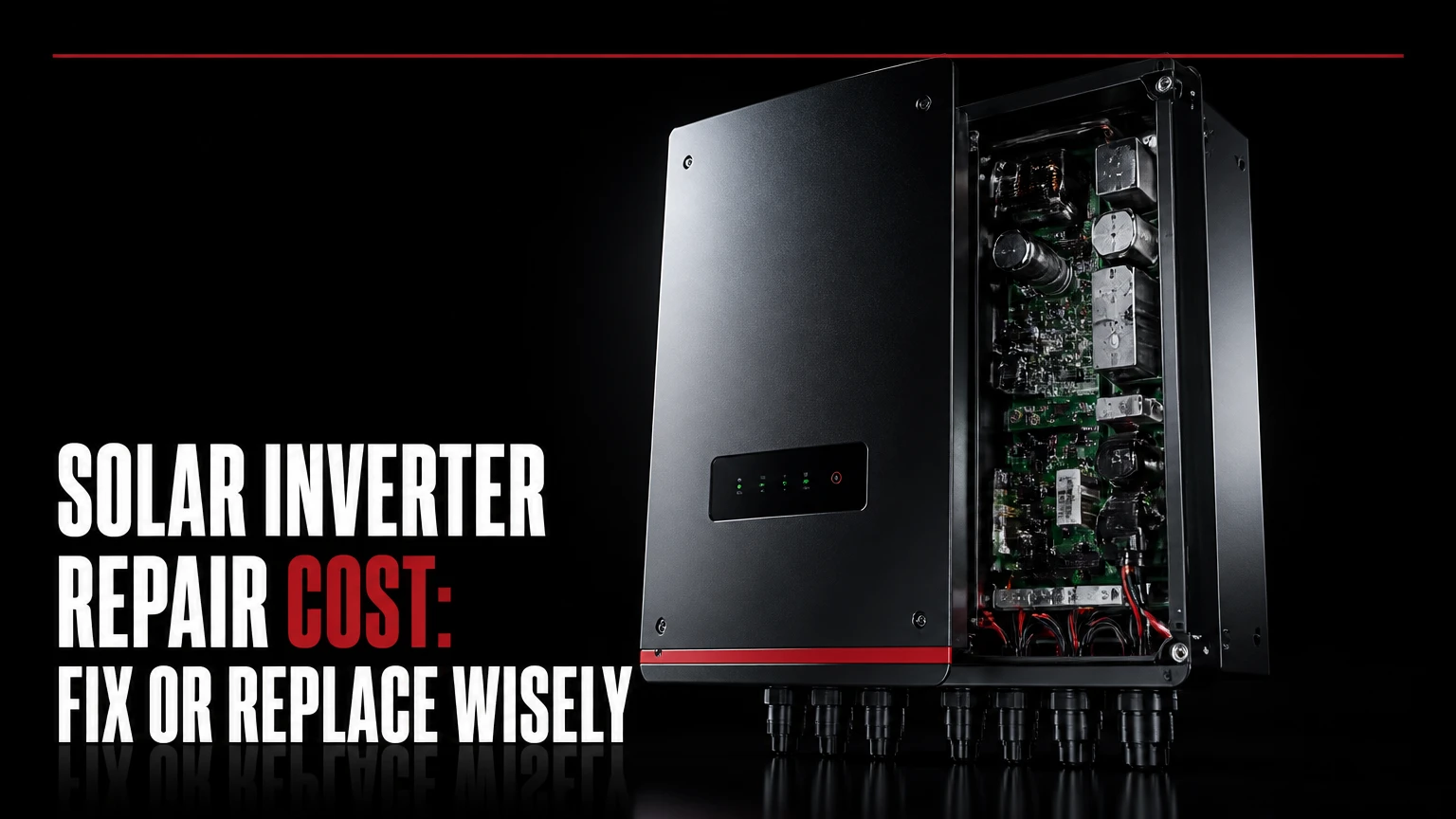
Solar inverter repair cost typically ranges from $150 to $1,500, with many residential service calls landing between $250 and $800. Minor fan, fuse, relay, or wiring repairs cost less, while motherboard, power-stage, battery-control, and water-damage repairs cost more. A complete inverter replacement usually costs $1,500-$5,000 or more, depending on system type, capacity, labor, and permits.
Key Facts at a Glance
- A certified solar technician typically charges $100-$200 per hour, plus a $150-$300 diagnostic or minimum service fee.
- Out-of-warranty string inverter repairs commonly cost $200-$800; motherboard replacement often costs $500-$1,000.
- A single microinverter replacement commonly costs $175-$450 installed, although access, equipment brand, and labor can increase the total.
- Hybrid inverter repairs commonly cost $400-$1,200 because battery charging and backup functions add diagnostic complexity.
- Repairing an inverter older than 10 years is often poor value when the estimate exceeds 40%-50% of replacement cost.
- Homeowners should check the manufacturer and installer warranty before authorizing paid parts or labor.
What Does a Solar Inverter Do?
A solar inverter converts the direct current electricity produced by photovoltaic modules into alternating current used by household circuits and the utility grid. The inverter also controls maximum power point tracking, monitors production, coordinates grid connection, and disconnects during an outage to prevent dangerous islanding.
SolarEdge, SMA, Fronius, Enphase, Tesla, and Generac use different hardware architectures, firmware, monitoring platforms, and warranty terms. The brand and model therefore matter more than the panel wattage when estimating repairability.
A grid-tied inverter cannot normally keep ordinary household circuits energized during a utility outage. Battery-backed systems can provide backup power, but only when the inverter, battery, transfer equipment, and critical-load panel are designed to operate together.
How Does the Inverter Convert Solar Power?
Solar panels produce variable DC voltage and current. The inverter samples that output and adjusts its operating point so the array produces near its maximum available power, then switches the DC waveform into synchronized AC power.
| Inverter function | Component or feature | Typical homeowner symptom | Diagnostic evidence |
|---|---|---|---|
| DC-to-AC conversion | Power transistors and switching bridge | Zero AC production | DC present, AC absent |
| Maximum power tracking | MPPT controller | Low output during full sun | String voltage outside expected range |
| Grid synchronization | Relay, control board, firmware | Grid fault or repeated restart | Normal DC, unstable AC connection |
| Thermal management | Fan, heat sink, temperature sensor | Overtemperature shutdown | High internal temperature |
| System monitoring | Wi-Fi, cellular, Ethernet, gateway | Data missing but production continues | App offline, inverter output normal |
| Safety shutdown | Disconnects and anti-islanding controls | Inverter stops during outage | Grid voltage absent or out of range |
The monitoring portal can identify a production problem without proving that the inverter itself is defective. A failed communication gateway, tripped breaker, damaged Ethernet cable, or internet outage can create an apparent inverter failure while the equipment continues producing electricity.
How Much Does Solar Inverter Repair Cost by Failure?
Solar inverter repair cost depends on the failed component, technician access, replacement-part availability, and warranty coverage. A fan or fuse can fit a $150-$300 service visit, while a control board or power-stage repair can reach $800-$1,500 after diagnosis, labor, and shipping.
The following figures are typical U.S. residential service ranges, not fixed manufacturer prices. Roof height, travel distance, local electrical rates, and system shutdown requirements can move the invoice substantially.
| Failure or service | Parts range | Labor and diagnosis | Typical total |
|---|---|---|---|
| Diagnostic visit and error review | $0-$75 | $150-$400 | $150-$400 |
| Cooling fan replacement | $40-$180 | $150-$350 | $190-$530 |
| Fuse or surge-protection replacement | $10-$150 | $150-$400 | $160-$550 |
| Relay or contactor replacement | $50-$250 | $250-$600 | $300-$850 |
| Capacitor replacement | $50-$250 | $250-$650 | $300-$900 |
| Communication board or gateway | $100-$450 | $200-$600 | $300-$1,050 |
| Main control board | $300-$800 | $250-$650 | $550-$1,450 |
| Power-stage or major electronics repair | $400-$1,000 | $350-$900 | $750-$1,900 |
A quote that only lists “inverter repair” is incomplete. Request the diagnostic finding, part number, labor hours, warranty status, commissioning test, and whether the underlying cause, such as a surge or insulation fault, has been corrected.
What Does a Solar Technician Charge?
A solar technician commonly bills $100-$200 per hour, while a diagnostic visit often has a $150-$300 minimum. The first visit may take 1-2 hours; a second visit is often required when a model-specific board, fan, or communication component must be ordered.
Local pricing differs. A rural homeowner may pay a travel charge of $50-$200, while a metropolitan electrician or solar specialist may use a higher hourly rate. Steep roofs, attic conduit, locked electrical rooms, and utility coordination also increase labor.
| Cost factor | Typical amount or time | Why it changes the invoice |
|---|---|---|
| Diagnostic minimum | $150-$300 | Covers dispatch, testing, and reporting |
| Certified technician rate | $100-$200 per hour | Varies by market and specialty |
| Standard repair labor | 1-3 hours | Includes isolation, replacement, and testing |
| Parts shipping | 3-5 business days | Applies to common current models |
| Backordered or imported part | 2-4 weeks | Older models may require special sourcing |
| Permit or inspection | $0-$500 | Depends on jurisdiction and replacement scope |
| Roof or lift access | $100-$800 | Common with microinverter repairs |
| Utility or monitoring reconfiguration | $0-$400 | Applies to some replacement projects |
Which Inverter Type Costs Least to Repair?
Microinverters usually cost least per failed unit, while string inverters provide the lowest labor cost when one accessible central device fails. Hybrid inverters cost more to diagnose because the technician must test solar input, grid output, battery charging, backup loads, firmware, and transfer controls.
| System type | Typical repair cost | Installed replacement cost | Common failure points |
|---|---|---|---|
| String inverter, 3-10 kW | $200-$800 | $1,500-$3,000 | Fans, capacitors, relays, boards |
| Microinverter, one panel | $175-$450 | $175-$450 per unit | Moisture, grid control, connectors |
| Hybrid inverter, 5-12 kW | $400-$1,200 | $2,500-$5,000+ | Battery controls, firmware, cooling |
| Central commercial inverter | $1,000-$5,000 | $8,000-$30,000+ | Power modules, contactors, filters |
Microinverter replacement estimates often omit access labor. Removing a panel, lifting modules, replacing rooftop equipment, resealing connectors, and commissioning the unit can make the installed price much higher than the hardware price.
The common advice to wait until two or three microinverters fail is not universally sound. If one unit is under warranty, the installer is already mobilized, or the failed unit is producing a measurable safety fault, immediate replacement is usually more rational than delaying service.
Is a Hybrid Inverter More Expensive to Repair?
A hybrid inverter is more expensive to repair because the fault may involve the battery management interface, charge controller, backup transfer relay, firmware, or grid-forming function. A $400-$1,200 repair estimate is typical, but battery replacement, auxiliary panels, and failed wiring are separate costs.
Battery systems add diagnostic dependencies. A low battery state of charge may resemble an inverter failure, while a battery communication error can prevent charging even when the photovoltaic input and grid output work normally.
What Does an Inverter Diagnostic Include?
A proper inverter diagnostic isolates the equipment, examines physical evidence, reads stored faults, measures DC and AC values, and verifies operation after corrective work. Diagnosis should identify the failed subsystem and the initiating cause, not merely clear an error code or replace a fuse.
A typical technician follows this sequence:
- Review production history. The technician compares monitoring data, weather conditions, outage history, and the time the fault began.
- Isolate the system. The AC breaker and DC disconnect are operated according to the manufacturer’s shutdown procedure.
- Inspect the enclosure. Burn marks, corrosion, insect nests, loose terminals, water intrusion, and swollen capacitors provide important evidence.
- Read fault records. The LCD, installer portal, or monitoring gateway may show grid, insulation, arc-fault, overtemperature, or communication codes.
- Measure electrical values. The technician tests string voltage, polarity, insulation resistance, AC voltage, frequency, and current using rated instruments.
- Replace the failed component. The repair may involve a fan, fuse, relay, board, connector, or complete inverter.
- Commission the system. The technician restores power in sequence, confirms grid synchronization, checks production, and documents the result.
OSHA regulation 29 CFR 1910.333 states that exposed energized parts “shall be deenergized before the employee works on or near them,” unless deenergizing creates additional hazards or is infeasible. Solar arrays can continue producing DC voltage in daylight, and inverter capacitors may retain energy after shutdown.
Can a Homeowner Reset a Solar Inverter?
A homeowner can perform limited external checks, such as reading an error code, confirming that the solar breaker is on, and checking whether the monitoring app is offline. A homeowner should not open the enclosure, remove covers, probe terminals, solder capacitors, or bypass disconnects.
| Safe homeowner check | Time required | Stop condition | What to report |
|---|---|---|---|
| Read display or LED pattern | 2-5 minutes | Burning smell or heat | Exact code and light color |
| Check solar AC breaker | 2 minutes | Breaker trips again | Breaker position and repetition |
| Check external DC switch | 2 minutes | Damaged or loose switch | Switch position and visible damage |
| Check monitoring connection | 5-10 minutes | App shows production normally | Last communication time |
| Inspect for obvious water entry | 5 minutes | Wet enclosure or exposed wire | Photograph from a safe distance |
If the manufacturer specifically permits a reset, follow its manual rather than a generic sequence. Repeatedly resetting a tripping breaker can worsen a fault and conceals evidence that a technician needs.
How Does Warranty Coverage Change the Price?
Warranty coverage can reduce parts cost to zero, but labor, travel, diagnosis, shipping, and installer administration may remain payable. String inverter warranties commonly begin around 10 years, microinverter warranties may reach 25 years, and extended warranties differ by manufacturer and registration date.
A warranty claim normally requires the serial number, installation date, error code, monitoring records, installer details, and photographs. The manufacturer may supply a replacement unit while the homeowner pays a local contractor for removal and installation.
| Warranty situation | Parts cost | Homeowner may still pay | Typical out-of-pocket range |
|---|---|---|---|
| Active manufacturer warranty, local installer assists | $0 | Labor or dispatch | $0-$400 |
| Active warranty, installer no longer operates | $0 | Independent labor and travel | $250-$800 |
| Expired standard warranty, extended plan active | $0-$200 | Deductible or labor limit | $100-$500 |
| Out of warranty, common part available | $50-$800 | Parts, labor, diagnosis | $200-$1,200 |
| Warranty denied for surge or water damage | Full price | All repair costs | $300-$1,900 |
Warranty language matters. “Product warranty” may cover defective equipment but exclude labor, while “installation warranty” may cover wiring or mounting workmanship but not an internal electronic failure. A lightning event, rodent damage, unauthorized modification, or water entry may also fall outside standard terms.
Should You Repair or Replace the Inverter?
Repair the inverter when the unit is relatively young, the enclosure is dry, replacement parts are available, and the estimate is below roughly half the installed replacement price. Replace the unit when it is 10 years or older, has repeated major faults, uses discontinued parts, or requires a repair exceeding about 40%-50% of replacement cost.
The percentage rule is a decision aid, not a manufacturer standard. A $700 repair on a 12-year-old string inverter may be poor value, but the same repair on a five-year-old unit with a transferable warranty may be sensible.
| Decision variable | Repair usually makes sense | Replacement usually makes sense |
|---|---|---|
| Inverter age | 0-7 years | 10-15 years |
| Estimate versus replacement | Below 40% | Above 50% |
| Fault type | Fan, relay, connector | Power stage, corrosion, repeated board failure |
| Parts availability | In stock within 5 business days | Discontinued or 2-4 week backorder |
| Warranty | Active coverage | Expired coverage |
| System objective | Preserve existing design | Add battery or backup capability |
Modern replacement may improve monitoring, efficiency, rapid-shutdown integration, and battery compatibility, but a new inverter does not automatically increase annual solar production. Panel shading, soiling, degraded modules, failed optimizers, and grid outages may remain the real production limits.
What Is the Cost of Waiting?
Waiting can save one service visit when multiple microinverters are failing, but it can also lose production, delay a warranty claim, and allow moisture or thermal damage to spread. Compare the daily value of lost electricity with the cost of service.
For example, a 7-kW system producing 25 kWh on a clear day at an avoided electricity rate of $0.20 per kWh loses about $5 per day when completely offline. One failed microinverter may reduce output by only 3%-6%, but a central string inverter failure can stop the entire array.
A production estimate should use the monitoring portal, not a generic system-size calculation. Batteries, export limits, utility curtailment, seasonal sunlight, and net-metering rules change the financial impact.
What Problems Are Commonly Misdiagnosed?
Common misdiagnoses include blaming the inverter for a tripped breaker, failed rapid-shutdown device, damaged rooftop connector, poor grid voltage, internet outage, or panel-level optimizer problem. The error message identifies a condition, not always the failed part.
Technicians should test the array and grid sides independently. Replacing a fuse without checking for a shorted cable, failed surge protector, insulation fault, or lightning damage often causes the replacement fuse to fail immediately.
Four Costly Repair Mistakes
- Skipping the warranty claim. Obtain a written warranty decision before buying a replacement board.
- Treating an offline app as zero production. Verify AC output at the inverter and utility meter before assuming the array is down.
- Ignoring water intrusion. A new board may fail again if a cracked gland, failed seal, or roof leak remains.
- Choosing a mismatched replacement. Voltage range, MPPT count, rapid-shutdown requirements, communications, and utility approval must match the system.
- Using an unqualified repairer. Opening energized solar equipment creates shock, arc-flash, fire, and warranty risks.
The most counterintuitive practitioner rule is that the cheapest component is not always the cheapest repair. A $75 board-level part can require two visits, special programming, and manufacturer commissioning, while a complete replacement may finish in one scheduled visit with a new warranty.
How Long Does Solar Inverter Repair Take?
A straightforward inverter repair takes about 1-3 labor hours after the part arrives, while a complete replacement commonly takes 3-8 hours including shutdown, mounting, wiring, commissioning, and monitoring setup. Parts typically arrive within 3-5 business days for current models and 2-4 weeks for backordered equipment.
| Job type | Technician time | Calendar timeframe | Main delay |
|---|---|---|---|
| Error diagnosis only | 1-2 hours | Same day | Access or utility condition |
| Fan, fuse, or relay repair | 1-3 hours | 1-7 days | Part availability |
| Main board replacement | 2-4 hours | 3-14 days | Programming and shipping |
| One microinverter replacement | 2-5 hours | 1-14 days | Roof access and panel removal |
| Hybrid inverter repair | 3-6 hours | 3-21 days | Battery and firmware testing |
| Complete string inverter replacement | 3-8 hours | 1-4 weeks | Permit, utility, and equipment |
Permit requirements vary by city, county, and utility. A like-for-like replacement may still require an electrical inspection or updated interconnection paperwork, especially when output rating, rapid-shutdown equipment, battery capacity, or backup loads change.
Where Do Location and Access Affect the Quote?
Location affects solar inverter repair cost through technician availability, travel distance, electrical-code requirements, and roof access. Urban markets may have higher hourly labor but shorter travel, while rural areas can add travel charges and longer waits for a specialist.
Ask whether the estimate includes tax, diagnostic fees, shipping, permit handling, disposal, monitoring configuration, and return visits. A $450 verbal estimate can become an $850 invoice when those items are excluded.
Insurance may cover sudden lightning or surge damage, subject to the policy deductible and exclusions. Insurance commonly does not cover ordinary wear, age-related capacitor failure, poor maintenance, or a manufacturer defect covered by warranty. Document the event, preserve failed components, and obtain a technician report before filing.
What Should You Ask Before Approving a Repair?
Ask for the exact fault, the failed part number, the initiating cause, warranty treatment, total installed price, expected service life after repair, and commissioning evidence. A responsible quote should distinguish diagnosis from repair and identify conditions that could produce a second failure.
Use this checklist:
- What DC and AC measurements confirmed the diagnosis?
- Is the inverter or component under a manufacturer warranty?
- Does the price include labor, travel, shipping, tax, permits, and monitoring setup?
- Is the replacement part new, refurbished, or salvaged?
- Will the repair preserve rapid-shutdown and anti-islanding functions?
- What caused the fuse, relay, board, or surge protector to fail?
- What production test will confirm successful commissioning?
- What warranty applies to the repair labor and replacement part?
- How long will the repair remain supportable if another board fails?
- What is the installed price of a current replacement model?
A technician who cannot explain the failed circuit or the root cause may be offering part replacement rather than diagnosis. That distinction matters most when the first component failure resulted from water, overheating, lightning, or a wiring defect.
The Bottom Line on Solar Inverter Repair Cost
Solar inverter repair cost is usually reasonable below $500 for a young, supported unit with a fan, fuse, relay, or communication fault. Compare every larger estimate with a replacement quote, especially when the inverter is older than 10 years, the repair exceeds 40%-50% of replacement cost, or parts are discontinued.
Start with the warranty, then obtain the diagnostic evidence and a fully itemized price. Repairing a sound inverter preserves the existing system, but replacing an aging or repeatedly failing unit can provide better reliability, compatibility, and warranty protection.
Frequently Asked Questions
How long do residential solar inverters last?
Residential string inverters commonly last about 10-15 years, although heat, humidity, dust, cycling, and installation quality affect service life. Microinverters may operate longer because each unit handles less total power, but rooftop moisture and access can complicate replacement. A warranty period is not a guaranteed operating lifespan.
Can I replace a solar inverter without replacing the panels?
A compatible inverter can usually replace existing panels without replacing the modules. The replacement must match array voltage, current, MPPT configuration, AC rating, rapid-shutdown requirements, mounting, communications, and local utility rules. Panel degradation or a changed array layout may require a new design review.
Does a tripped solar breaker mean the inverter is broken?
A tripped solar breaker does not prove inverter failure. The cause may be a short circuit, insulation fault, grid surge, damaged cable, overloaded circuit, or defective breaker. Reset the breaker only as directed by the equipment manual; if it trips again, leave it off and call a qualified technician.
Does cleaning solar panels fix an inverter fault?
Cleaning panels can improve production when dirt, snow, or leaves block sunlight, but cleaning does not repair an inverter hardware fault. A shaded or obstructed array may produce too little voltage to start the inverter, while a displayed ground-fault, relay, or overtemperature code requires electrical diagnosis.
Will solar inverter repair affect my utility agreement?
A repair using the same approved model normally has less administrative impact than a replacement with a different rating or battery function. Utilities may require updated interconnection documents, inspection, or permission to operate after replacement. Ask the installer to confirm the local utility process before work begins.
Is inverter replacement eligible for a tax credit?
Eligibility depends on the equipment, project design, installation date, and applicable federal, state, or local rules. A standalone repair is not automatically treated like a new solar installation, and tax treatment can change. Ask a qualified tax professional and retain invoices separating repair, replacement, battery, and labor costs.