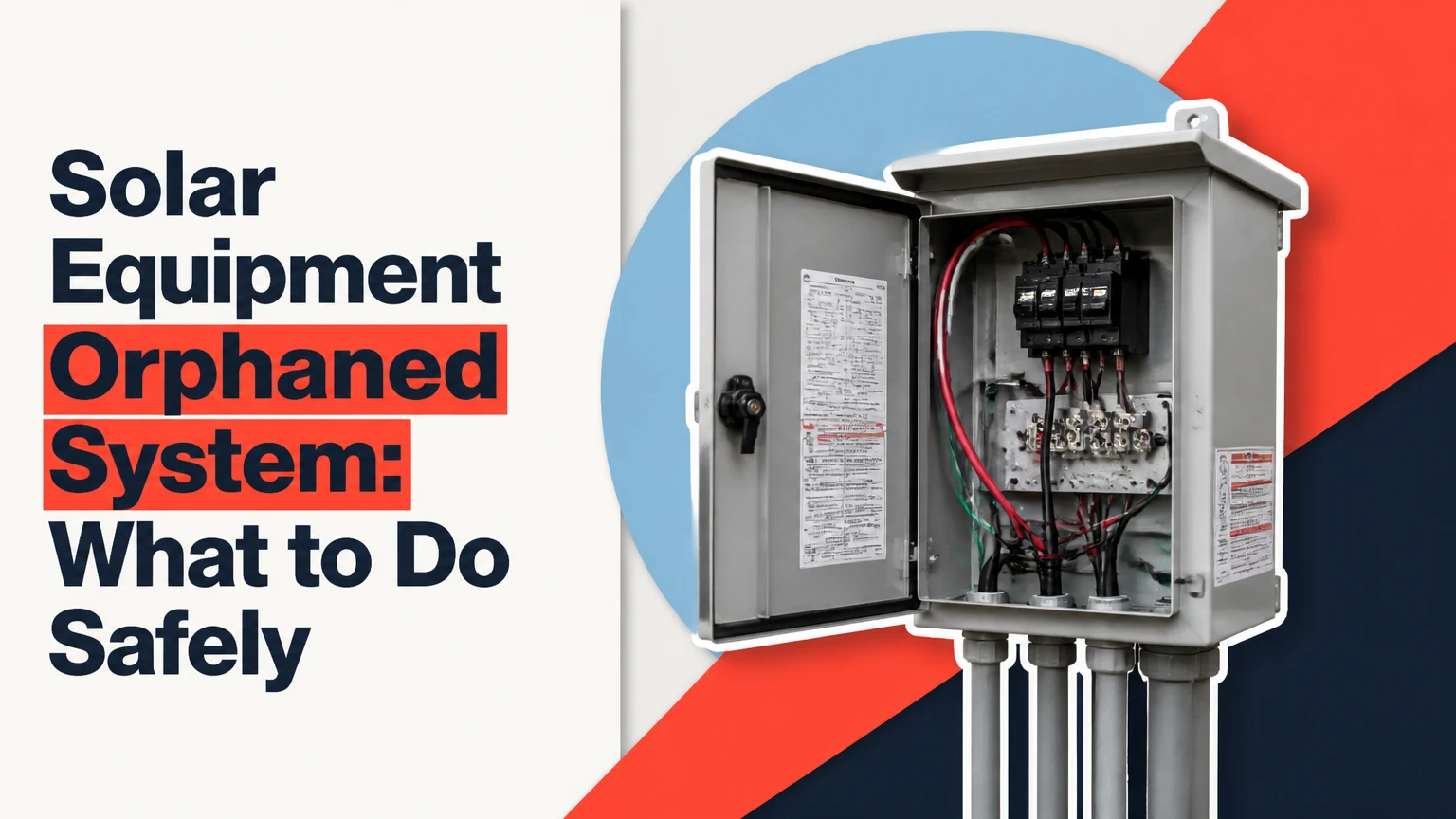
A solar equipment orphaned system is a solar installation whose installer no longer provides support because the company closed, entered bankruptcy, or abandoned the project. First confirm ownership, electrical safety, permits, monitoring, and equipment warranties, then hire a qualified solar service provider to inspect and restore the system without assuming the hardware is worthless.
Key Facts at a Glance
- A failed installer does not automatically cancel a solar panel, inverter, or battery manufacturer warranty.
- A leased or PPA system is normally maintained by the system owner named in the agreement, not by the homeowner.
- An independent inspection typically costs $150-$350 and takes 2-4 hours.
- A grid-tied system must have utility approval and required inspections before operation.
- Solar arrays can produce hazardous DC voltage when the building disconnect is off.
- Inverter age, replacement availability, roof condition, and warranty labor terms determine whether repair or repowering is economical.
What Counts as an Orphaned Solar System?
An orphaned solar system is an installed solar asset without a functioning installation company responsible for service, monitoring, warranty administration, or unfinished work. The condition can affect a completed operating array, an inactive system, or a project abandoned before inspection and permission to operate.
The term describes a support and accountability problem, not a particular equipment failure. A system can produce electricity normally while lacking a service contact, or it can have a failed inverter, missing documentation, unresolved permit, and inaccessible monitoring account.
A closed installer is not the same as a manufacturer failure. Qcells, REC, LONGi, Enphase, SolarEdge, Tesla, and other equipment manufacturers may still exist and may honor their own product terms. The difficult part is proving the model, serial number, installation date, ownership, and claim eligibility.
Which situation do you have?
| Situation | Legal equipment owner | First contact | Main risk |
|---|---|---|---|
| Paid-in-full installation | Homeowner | Independent solar O&M provider | Missing service records |
| Solar loan | Homeowner, subject to loan terms | Lender and service provider | Payment continues during outage |
| Lease | Leasing company | Billing or asset-owner company | Unauthorized repairs |
| Power purchase agreement | PPA provider | PPA provider | Contractual production obligations |
| Unfinished installation | Contract may control ownership | Building department and attorney | Unsafe, uninspected work |
Do not authorize major work until the contract establishes who owns the panels, inverter, battery, racking, and monitoring gateway. A homeowner can own the equipment while another company retains a lien, loan interest, or service obligation.
What Should You Do First?
The safest first response is to stop electrical work, preserve all records, and determine whether the system is operating legally. A homeowner should not open an inverter, combiner box, battery enclosure, or rooftop junction box to investigate an orphaned system.
Use binoculars for a ground-level visual check. Photograph the inverter display, warning lights, equipment labels, utility meter, visible conduit, and roof condition without touching energized components. Record the date, weather, utility-bill usage, and any error code exactly as displayed.
Step 1: Confirm the installer’s status
Search the installer’s legal name, trade name, state contractor license, corporate registry, and bankruptcy docket where applicable. A website outage alone does not prove dissolution, because an installer may have changed names or sold its service portfolio.
Save dated evidence, including bounced emails, disconnected phone numbers, registry results, invoices, and warranty correspondence. Those records support lender disputes, insurance claims, bankruptcy filings, and contract remedies.
Step 2: Secure the project and electrical status
For a completed system, avoid resetting equipment repeatedly because repeated fault clearing can erase useful diagnostic information. For an incomplete project, do not energize the array or connect unfinished conductors before a licensed professional verifies terminations, grounding, overcurrent protection, and labeling.
Call emergency services if you see smoke, arcing, melted insulation, battery swelling, unusual heat, or a burning odor. Keep people away from damaged equipment until the utility or qualified electrical responder makes the site safe.
Step 3: Contact the utility and building department
Ask the electric utility whether the address has an active interconnection agreement, approved net-metering arrangement, and permission to operate. Ask the building department whether electrical, structural, and battery permits were issued, inspected, and closed.
A utility bill showing export does not prove that every part of the installation was permitted. Conversely, a missing homeowner copy of the permit does not prove that the installer failed to obtain one.
Who Is Responsible for an Orphaned System?
Responsibility follows the contract and equipment ownership, not simply the presence of solar panels on a roof. A homeowner-owned system generally requires the homeowner to arrange service, while a lease or PPA usually places maintenance responsibility with the financing or energy company.
Review these documents in order
- Purchase agreement: Identify equipment, workmanship warranty, exclusions, and completion obligations.
- Loan agreement: Check lender servicing, installer-performance provisions, and required insurance.
- Lease or PPA: Find the asset owner, repair hotline, production guarantee, and transfer rules.
- Utility agreement: Confirm interconnection, meter configuration, and export authorization.
- Permit records: Match the permitted equipment to what is physically installed.
- Insurance policy: Check coverage for storm damage, fire, vandalism, and resulting property damage.
A loan servicer may provide a contractor referral, but the lender is not automatically the installer’s warranty replacement. A lease provider may own the system and control approved repair methods. Sending an independent technician to a leased array without written authorization can create a contract dispute.
Are Manufacturer Warranties Still Valid?
Manufacturer warranties often survive installer closure, but warranty validity does not guarantee free diagnosis, shipping, roof access, or replacement labor. Product warranties, performance warranties, workmanship warranties, and labor warranties are separate obligations with different claim procedures.
The Solar Energy Industries Association advises consumers to retain system documentation and understand warranty terms before installation. In practice, a manufacturer typically requests the product serial number, proof of purchase or installation, fault description, installer details, and evidence that an authorized technician performed the replacement.
| Covered item | Typical term | Usually covers | Common exclusion |
|---|---|---|---|
| Solar module product defect | 12-25 years | Manufacturing defects | Impact, unauthorized modification |
| Module power output | 25-30 years | Output below degradation curve | Shading or measurement error |
| String inverter | 5-12 years | Internal equipment defect | Labor and travel |
| Microinverter | 10-25 years | Device failure | Unapproved rewiring |
| Lithium battery | 10 years or throughput limit | Defect and capacity threshold | Improper temperature or installation |
These are typical ranges, not a promise for a specific brand or model. The actual certificate controls. Some manufacturers require an installer or authorized service partner to submit the claim, while others accept homeowner requests after ownership verification.
A workmanship warranty is not automatically void when an installer closes. The legal result depends on the contract, jurisdiction, bankruptcy status, warranty language, and whether another company assumed the obligation. That distinction matters because homeowners may still have a claim against a bond, insurer, state recovery fund, or bankruptcy estate.
How Should You Find a Replacement Solar Technician?
Hire a solar O&M contractor, photovoltaic electrical contractor, or manufacturer-authorized service provider with documented experience on the installed equipment. A general electrician may be excellent for AC wiring, but many lack PV string tracing, insulation-resistance testing, inverter commissioning, or battery-control experience.
Ask each candidate for:
- License number and jurisdiction.
- General liability and workers’ compensation certificates.
- Experience with the exact inverter and battery brands.
- A sample inspection report with private customer details removed.
- Diagnostic fee, travel charge, hourly rate, and minimum billing period.
- Written policy for leased equipment and warranty claims.
- Roof-access, fall-protection, and electrical-safety procedures.
Require a written scope before the visit. The scope should state whether the technician will inspect the roof, test DC strings, verify grounding and labeling, review permits, recover monitoring, and prepare manufacturer warranty paperwork.
What should an inspection report contain?
A useful system condition report identifies every major component by manufacturer, model, and serial number. It records inverter faults, array configuration, operating voltage, current readings, insulation results, racking condition, visible module damage, rapid-shutdown status, battery state, and monitoring communications.
The report should separate observed defects from suspected causes. “Inverter displays isolation fault” is an observation; “one damaged roof cable caused the fault” requires testing. This distinction prevents unnecessary inverter replacement.
How Do You Restore Solar Monitoring?
Monitoring recovery requires identifying the gateway, account owner, communications method, and installer-level permissions. A service technician can often transfer Enphase Enlighten, SolarEdge monitoring, Tesla, or another platform to the homeowner, but the manufacturer may require proof of ownership and a new commissioning process.
| Monitoring setup | Physical gateway | Typical recovery action | Typical time |
|---|---|---|---|
| Enphase microinverters | Enphase IQ Gateway | Transfer site, verify serials, reconnect Internet | 1-3 hours |
| SolarEdge optimizers | SolarEdge inverter | Change site ownership, use SetApp if authorized | 1-5 business days |
| Cellular inverter modem | Internal modem | Replace inactive modem or update SIM service | 2-10 business days |
| Wi-Fi inverter | Inverter communications card | Reconfigure router credentials | 30-90 minutes |
| Battery gateway | Dedicated storage controller | Authorized firmware and operating-profile review | 2-6 hours |
Monitoring data is useful evidence, but the application is not the power system. A disconnected app can coexist with normal generation, while a functioning app can report stale or incomplete data. Compare portal readings with inverter totals, utility interval data, and a weather-adjusted production estimate.
Do not install random communications hardware inside a live inverter. Some gateways require installer credentials, firmware compatibility, or utility-approved settings.
Which Solar Architecture Changes the Repair?
The inverter architecture determines whether one failed device can disable a string, a panel, or the whole array. String-inverter systems concentrate conversion in fewer devices, microinverter systems distribute conversion across modules, and hybrid systems add battery controls that require compatible firmware and operating parameters.
| Architecture | Conversion location | Typical failure impact | Repair priority |
|---|---|---|---|
| String inverter | One or more ground-level inverters | One inverter can disable 4-20 panels | Check inverter and DC strings |
| String inverter with optimizers | Module-level DC optimization, central AC conversion | Optimizer or inverter fault can reduce a string | Review optimizer map and codes |
| Microinverters | Behind each module | One device commonly affects one panel | Compare module-level data |
| Hybrid battery system | Hybrid inverter plus battery controller | Grid, solar, and battery functions can fail separately | Use certified storage technician |
A single dark panel in a microinverter system may indicate a failed microinverter, module, connector, or monitoring channel. A zero-production reading from a string inverter may result from an AC disconnect, utility outage, inverter fault, or unsafe DC isolation problem.
Battery systems require additional caution. A battery can retain hazardous energy after the solar array and main service disconnect are off, and firmware or state-of-charge settings should be changed only by a qualified technician familiar with the model.
How Much Does Orphaned-System Recovery Cost?
Typical recovery costs range from $150-$350 for an initial diagnostic visit and $1,500-$3,500 for an out-of-warranty residential inverter replacement. Labor remains payable even when a manufacturer supplies a replacement part, because warranty terms frequently exclude travel, diagnosis, removal, installation, and commissioning.
| Recovery task | Typical price | Typical duration | Main price variable |
|---|---|---|---|
| Document and remote review | $0-$200 | 30-90 minutes | Record quality |
| On-site health inspection | $150-$350 | 2-4 hours | Travel and roof access |
| Solar technician labor | $100-$175/hour | 1-8 hours | License and equipment |
| Warranty inverter replacement labor | $400-$900 | 3-8 hours | Roof, wiring, commissioning |
| Out-of-warranty inverter replacement | $1,500-$3,500 | 1-3 days | Inverter size and redesign |
| Monitoring gateway replacement | $250-$1,200 | 1-5 hours | Brand and communications |
| Single module replacement | $250-$700 | 2-6 hours | Module availability and roof access |
These figures are typical U.S. residential ranges, not published tariff schedules. Permit fees, engineered redesign, steep-roof access, battery labor, emergency dispatch, and travel can increase the invoice.
A manufacturer warranty claim may take 2-6 weeks for approval and shipping. A straightforward local repair may finish within 3-10 business days after parts arrive, while discontinued equipment can require a design review and utility amendment.
Should You Repair, Replace, or Repower?
Repair the system when the fault is isolated, compatible replacement parts remain available, and the array has acceptable roof, wiring, and production condition. Consider repowering when the inverter is obsolete, repeated failures occur, the system lacks required safety functions, or replacement parts require a costly redesign.
| Decision factor | Repair is favored at | Repowering is favored at | Verification method |
|---|---|---|---|
| Inverter age | Under 10 years | Over 12-15 years | Serial-number lookup |
| Repair estimate | Under $1,500 | Over $3,000 | Written proposal |
| Annual failure count | 0-1 event | 2 or more events | Service records |
| Roof remaining life | Over 10 years | Under 7 years | Roofing inspection |
| Product support | Parts available | Discontinued model | Manufacturer confirmation |
| Production health | Within 10-15% of estimate | Below 70% of expected output | Utility and monitoring data |
Repowering is not automatically more efficient. Replacing a functioning inverter can discard useful equipment, trigger new permitting, alter interconnection settings, and require compatibility checks for module voltage, rapid shutdown, battery control, and utility export limits.
An independent technician should calculate expected annual production, remaining warranty value, repair cost, repower cost, and roof-removal risk before recommending a complete replacement.
What If the Installer Abandoned the Project Mid-Installation?
An incomplete solar project must be treated as unfinished electrical construction, not as a repair. Stop work, prevent system energization, obtain the permit file, and have a licensed contractor inspect every installed conductor and mounting connection before completing the project.
Request these records from the municipality:
- Permit numbers and approved plans.
- Inspection results and correction notices.
- Structural calculations where required.
- Electrical one-line diagram.
- Interconnection application and utility correspondence.
- Battery and rapid-shutdown documentation.
Have the replacement contractor compare the physical installation with the approved design. Missing roof flashing, incorrect conductor sizing, absent labels, open conduit, unbonded racking, and incompatible equipment can remain hidden after an installer disappears.
Consult a construction attorney if the contract is incomplete, a lender has funded undelivered work, a mechanic’s lien is recorded, or another party claims ownership of the equipment. Do not sign a new completion contract until the unfinished work, payment history, warranties, and lien status are documented.
What Problems Are Common After Installer Closure?
The most common problems are inaccessible monitoring, unclear ownership, unsupported inverter models, missing permits, and unpaid labor required for manufacturer warranty repairs. These administrative failures can cost almost as much time as the physical defect.
| Symptom | Likely causes | Safe owner check | Technician test |
|---|---|---|---|
| Utility bill rises sharply | Inverter outage, shading, meter issue | Compare 3-12 months of usage | AC and DC production test |
| Inverter shows red fault | Grid fault, isolation fault, overheated unit | Photograph code and time | Fault-log and insulation testing |
| App shows no data | Wi-Fi, cellular, gateway, account loss | Check last update timestamp | Communications and gateway test |
| One panel underproduces | Module, optimizer, microinverter, shade | Ground-level visual check | Module-level electrical comparison |
| Battery will not discharge | Reserve setting, firmware, grid rule | Review user-visible settings | Certified battery diagnostics |
Expert rule: utility bills are not a complete production test
A higher bill confirms changed household economics, not necessarily a solar failure. Weather, heating loads, electric vehicles, occupancy, utility-rate changes, and net-metering credits can alter the bill even when the array performs normally.
Expert rule: the inverter is often the best first evidence source
Technicians should capture fault history before clearing errors or replacing parts. A current fault code identifies the operating symptom, while stored logs can reveal intermittent grid voltage, thermal events, communication loss, or repeated shutdowns.
Expert rule: panel warranties do not pay for every panel visit
A module manufacturer may provide a replacement panel while excluding labor, shipping, diagnostics, roof access, color mismatch, and disposal. Obtain the complete warranty certificate before treating “covered” as “free.”
What Mistakes Should You Avoid?
Avoid DIY electrical diagnosis, premature repowering, unapproved equipment substitution, and operation without confirmed utility authorization. Each mistake can create a safety problem, reduce warranty eligibility, or produce a second permit and engineering dispute.
- Opening energized equipment: Solar DC voltage can remain present in daylight. Use a qualified PV technician.
- Replacing only the inverter by model name: Voltage window, maximum current, string count, rapid shutdown, communications, and utility settings must match.
- Assuming the installer warranty disappeared: Check contract remedies, bonds, recovery funds, insurers, and successor companies.
- Ignoring roof age: A roof replacement soon after solar repair can duplicate removal and reinstallation costs.
- Hiring only on price: The lowest diagnostic fee may exclude roof inspection, warranty administration, or a written report.
- Resetting the system repeatedly: Reboots can conceal intermittent errors and remove useful timestamps from some equipment logs.
What Records Should You Keep for Repair or Sale?
Keep the purchase agreement, equipment invoices, serial-number photographs, permits, inspection approvals, utility PTO letter, monitoring history, repair reports, warranty certificates, and financing documents. A complete records package reduces service delays and gives a future buyer evidence that the system is legal and transferable.
Create a one-page equipment register with these fields:
| Record field | Example value | Why it matters |
|---|---|---|
| Inverter model | SolarEdge SE7600H | Determines replacement compatibility |
| Inverter serial | 7A123456789 | Opens warranty claim |
| Array size | 7.2 kW DC | Supports production review |
| Module model | Qcells Q.PEAK DUO 400 W | Identifies electrical specifications |
| PTO date | 2021-08-14 | Establishes warranty and interconnection history |
| Monitoring site ID | Enphase 1234567 | Enables account transfer |
For a home sale, disclose known defects and provide repair estimates rather than describing the system as fully operational without evidence. For insurance, photograph damage before removing equipment unless emergency mitigation is necessary.
Can an Orphaned System Still Be Worth Keeping?
An orphaned system is usually worth evaluating before removal because panels, racking, wiring, and inverters may retain useful service life. Removal becomes more reasonable when structural damage, obsolete equipment, repeated faults, unsafe installation, poor remaining roof life, or uneconomic repair combine into a high total cost.
Use this order of operations:
- Establish legal operation and ownership.
- Measure actual production and inspect safety.
- Verify warranty and replacement availability.
- Price repair, roof work, and future maintenance.
- Compare the result with a permitted repower or removal.
The correct financial comparison is not the original purchase price. Compare the next five years of repair, monitoring, roof access, insurance, and lost-generation costs against a new system’s installed cost and warranty.
Frequently Asked Questions
Can I sell a house with an orphaned solar system?
Yes, but disclose the installer’s closure, financing, lease, PPA, known faults, and permit status. A buyer’s lender may require a transferable loan, lease assumption, PTO evidence, or a professional inspection. Resolve ownership and lien records before listing because unresolved solar financing can delay closing.
Does turning off the main breaker shut down solar panels?
No. Solar modules can continue producing hazardous DC voltage in sunlight even when the building’s main breaker and inverter AC disconnect are off. Rapid-shutdown equipment may reduce array voltage when activated, but only qualified personnel should verify de-energization with rated test equipment.
Can a regular electrician repair orphaned solar equipment?
A regular electrician may handle some AC-side work, but PV diagnosis often requires solar-specific tools and training. Choose a licensed contractor experienced with DC strings, insulation testing, rapid shutdown, inverter commissioning, monitoring gateways, and battery systems when those components are involved.
What happens if my solar company went bankrupt but I still have a loan?
Continue following the loan agreement unless the lender provides written modification or legal advice. Notify the lender, document the installer’s failure, check whether the loan includes service referrals or performance remedies, and obtain an independent condition report before disputing payments or authorizing expensive work.
Can I claim compensation from the failed installer?
Potential sources include a bankruptcy claim, contractor bond, state recovery fund, insurer, lender remedy, or contract lawsuit, depending on jurisdiction and documentation. These routes do not guarantee payment. Preserve contracts, invoices, permit records, photographs, correspondence, and professional repair estimates.
The Bottom Line
When a solar equipment orphaned system what to do situation occurs, protect people first, then establish ownership, permit status, utility authorization, equipment identity, warranty rights, and actual production. Do not assume the array is worthless or that a manufacturer warranty covers labor. An independent PV inspection, followed by monitoring recovery and a repair-versus-repower calculation, provides the safest path to a supportable system.