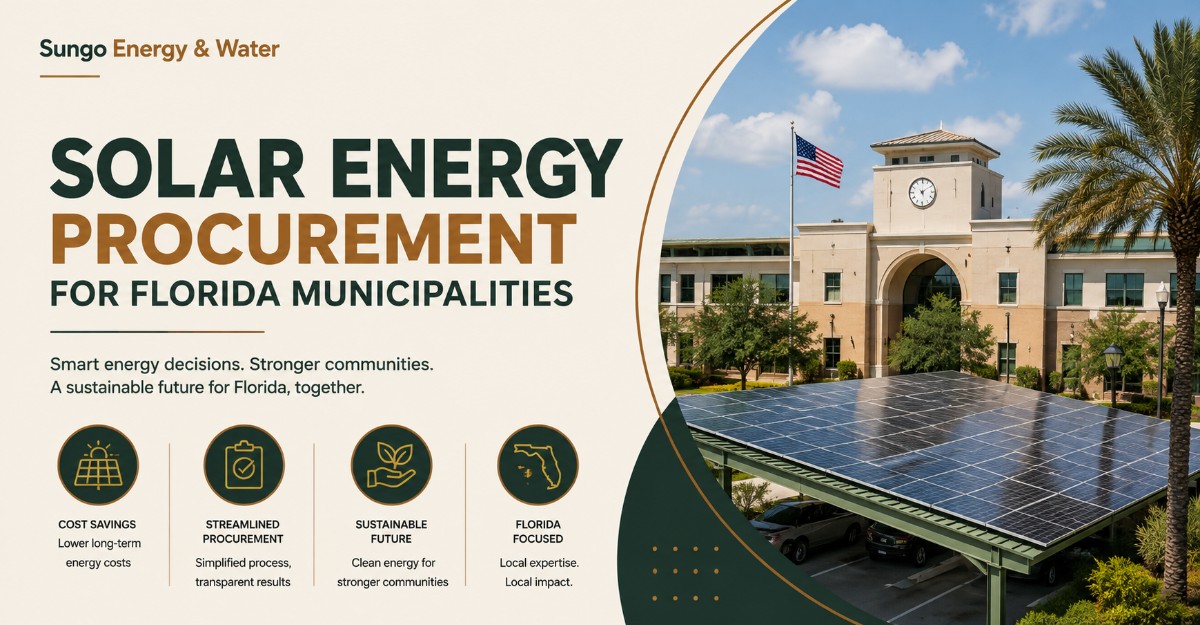
Solar energy procurement for Florida municipalities is the process through which a city, county, public authority, or municipal electric utility acquires solar electricity, solar infrastructure, or renewable-energy attributes. A municipality can own an on-site system, purchase wholesale generation, subscribe to utility solar, or contract for privately financed infrastructure, but the best structure depends on utility status, capital access, site conditions, tax-credit timing, and legal authority.
Key Facts at a Glance
- Florida municipalities may use elective pay to monetize eligible federal clean-energy tax credits.
- A municipal facility served by an investor-owned utility must follow that utility’s interconnection tariff and technical requirements.
- Florida’s standard net-metering framework separates Tier 2 systems above 10 kW through 100 kW from larger Tier 3 systems.
- A utility solar subscription does not give the municipality ownership of panels or control over emergency power.
- Renewable energy certificates must be assigned contractually before a municipality claims renewable electricity use.
- Solar construction timing became more important after federal legislation changed the termination rules for Sections 45Y and 48E.
What Is Solar Energy Procurement for Florida Municipalities?
Solar energy procurement for Florida municipalities combines public purchasing, energy planning, engineering, utility regulation, financing, construction, and long-term asset management. The object being procured may be a physical photovoltaic system, electricity from a remote solar farm, capacity under a wholesale contract, a utility subscription, or renewable energy certificates.
The first distinction is whether the municipality operates an electric utility. A municipal electric utility can participate in wholesale generation and joint-action projects. A city government that buys retail electricity from Florida Power & Light, Duke Energy Florida, Tampa Electric, a cooperative, or another provider normally acts as a retail customer and must work within that provider’s tariff.
Florida law defines customer-sited demand-side renewable energy as generation located on the customer’s premises, intended primarily to offset the customer’s electricity requirements, and limited to 2 MW for the statutory definition. Florida utilities must maintain standardized interconnection and net-metering programs for eligible customer-owned renewable generation.
How Does Municipal Solar Procurement Work?
Municipal solar procurement begins with energy data and ends with verified commercial operation. The municipality identifies the loads or renewable-energy claims it wants to serve, selects an ownership or purchasing structure, conducts a public procurement, completes utility and permitting reviews, and verifies that the delivered system or electricity satisfies the contract.
On-site photovoltaic modules generate direct-current electricity. Inverters convert that output into alternating current, which serves the facility before any eligible excess enters the distribution grid. Remote solar follows a different path: electricity enters the bulk or distribution system, while contractual allocations, wholesale settlements, bill credits, or renewable energy certificates connect the generation economically to the municipality.
Solar alone does not create outage resilience. Standard grid-connected inverters must stop exporting during a grid outage unless the facility has approved islanding equipment, storage, transfer controls, and a defined critical-load architecture.
Which Procurement Structures Can Florida Municipalities Use?
Florida municipalities generally choose among direct ownership, municipal-utility wholesale procurement, utility subscription programs, and carefully structured privately financed arrangements. The choice determines who supplies capital, owns tax attributes, performs maintenance, carries storm risk, and controls the renewable-energy certificates.
| Structure | Capital source | Typical term | Asset owner | Main municipal use |
|---|---|---|---|---|
| Direct ownership | Cash, bonds, loans or grants | 25-35 years | Municipality | Buildings, water plants, parking areas |
| Joint-action solar | Participating municipal utilities | 15-30 years | Developer or joint project entity | Wholesale power supply |
| Utility subscription | Monthly tariff charge | Program-specific | Investor-owned utility | Bill credits and renewable allocation |
| Site lease or service model | Private developer | 15-25 years | Developer | Sites where capital is constrained |
| REC purchase | Operating budget | 1-10 years | Generator retains physical asset | Environmental accounting only |
Direct Municipal Ownership
Direct ownership usually produces the greatest municipal control and can deliver strong lifecycle savings when the facility has a sound roof, stable daytime load, suitable interconnection capacity, and long-term public use. The municipality pays for design and construction, owns the equipment, receives the electricity, and assumes operations, insurance, replacement, and decommissioning duties.
Ownership also allows an eligible governmental entity to pursue elective pay. The IRS describes elective pay as a mechanism that lets governmental and other applicable entities treat an eligible clean-energy credit as a tax payment and receive the resulting overpayment as a refund. Pre-filing registration is mandatory, and the registration number must appear on the return.
Direct ownership is less attractive when a roof will need replacement soon, a site may be sold, the municipality lacks asset-management staff, or avoided electricity costs are too low to support the investment.
Joint-Action and Wholesale Solar
Joint-action procurement is usually the most scalable option for municipalities that operate electric utilities. Participating utilities aggregate demand, purchase utility-scale generation, and avoid installing separate arrays at every municipal facility.
FMPA reports that its Florida Municipal Solar Project currently includes four solar farms totaling about 300 MW. Harmony and Taylor Creek began operating in June 2020, Rice Creek followed in January 2025, and Whistling Duck followed in December 2025. The project supplies participating municipal utilities and is large enough to power approximately 60,000 Florida homes.
FMPA states that a large-scale project can produce solar power at approximately one-third the cost of a typical private rooftop system. That comparison reflects scale, standardized development, land economics, and wholesale delivery, but it does not mean every municipality can join. Eligibility depends on municipal-utility participation and project subscription availability.
Utility Solar Subscriptions
Utility subscription programs suit municipalities that want solar allocations without owning equipment or managing construction. The municipality pays a tariff-based subscription charge and receives credits tied to allocated capacity or solar production.
FPL SolarTogether provides monthly bill credits based on actual production and may place customers on a waitlist when program capacity is unavailable. Duke Energy Florida’s Clean Energy Connection similarly uses subscription fees and production-related bill credits, although Duke reported in August 2025 that the program was at capacity for large business and governmental customers.
These programs provide no on-site backup capability. Contract administrators must also determine whether the municipality receives and retires the associated renewable energy certificates, because bill participation and environmental ownership are separate questions.
Third-Party PPAs, Leases and Service Contracts
A conventional third-party PPA can present Florida regulatory risk when a private owner sells electricity at retail to a site host. Florida’s statutory definition of a public utility includes many private entities supplying electricity to or for the public, while municipalities and cooperatives receive specified exclusions. The legality of a proposed transaction depends on its exact facts, not its marketing label.
Municipal counsel should examine whether the agreement is a retail electricity sale, equipment lease, energy-service contract, site concession, public-private partnership, or another authorized arrangement. Florida’s public-private partnership statute permits responsible public entities to solicit or receive proposals for qualifying public projects, but it imposes procurement and agreement requirements that must be evaluated separately.
A developer’s statement that a structure is “PPA-like” is not a legal conclusion. Obtain a written opinion before publication of the solicitation.
Which Option Is Best for Each Municipality?
The best procurement structure is the one that matches the municipality’s legal status, balance sheet, operational capacity, load shape, and renewable-energy objective. No option wins every criterion.
| Municipal situation | Preferred starting point | Main reason | Primary limitation |
|---|---|---|---|
| City served by an investor-owned utility | Direct ownership or utility subscription | Uses retail load or tariff program | Utility interconnection and tariff limits |
| City with municipal electric utility | Joint-action wholesale procurement | Utility-scale economics | Participation and transmission commitments |
| Small town with limited staff | Subscription or pooled procurement | Minimal asset-management burden | Less control and no on-site resilience |
| County with stable public facilities | Portfolio of owned systems | Aggregates multiple viable sites | Higher procurement complexity |
| Critical facility seeking backup | Solar plus storage and controls | Supports selected loads during outages | Higher capital cost and engineering burden |
A small municipality should not automatically avoid ownership. A simple ground-mounted project at a wastewater facility may be easier to manage than multiple aging rooftops. Conversely, a large city should not assume every building deserves solar. Portfolio screening frequently eliminates leased buildings, shaded roofs, planned demolitions, low-load facilities, and sites with expensive interconnection upgrades.
How Should a Municipality Procure a Solar Project?
A defensible procurement usually requires seven stages. The municipality should preserve competition while giving bidders enough site and utility data to price the same scope.
Step 1: Establish the Procurement Objective
Define whether the project must reduce electricity expense, support climate goals, supply critical loads, hedge future rates, replace purchased RECs, or achieve several measurable outcomes. Avoid broad instructions such as “maximize solar.”
Create minimum thresholds. Examples include a 20-year positive net present value, a maximum simple payback, defined critical-load duration, annual production guarantees, or a target percentage of municipal electricity matched with retired RECs.
Step 2: Build the Energy and Site Data Room
Collect at least 12 months of bills, although 24-36 months captures weather, rate, and operational variation better. Obtain interval data, tariff schedules, demand charges, transformer information, site plans, roof reports, insurance requirements, planned capital projects, and prior environmental assessments.
A bidder cannot reliably model savings from annual kilowatt-hour totals alone. Municipal accounts with demand charges require hourly or sub-hourly analysis because a solar array can reduce energy purchases without materially reducing the facility’s monthly billing demand.
Step 3: Screen Interconnection Before Final Design
Submit pre-application or preliminary interconnection inquiries for larger sites before the RFP price is locked. Available feeder capacity, protection requirements, export limits, transformer changes, and distribution upgrades can alter project economics.
Florida’s statewide framework does not make every system from 10 kW through 2 MW a Tier 2 project. Utility filings implementing Rule 25-6.065 identify Tier 2 as greater than 10 kW through 100 kW. Larger eligible systems enter Tier 3 review, where engineering studies, protection equipment, fees, and insurance can be more demanding.
Step 4: Issue a Performance-Based RFP
The RFP should specify outcomes and minimum standards without forcing one vendor’s proprietary design. Require bidders to identify system size, first-year output, annual degradation, equipment models, structural assumptions, interconnection scope, construction exclusions, warranties, monitoring architecture, cybersecurity controls, REC ownership, and tax-credit assumptions.
| Evaluation category | Suggested weight | Required evidence |
|---|---|---|
| Evaluated lifecycle cost | 30% | Cash flows, NPV, escalation and degradation |
| Technical design | 20% | Drawings, equipment, structural and electrical narrative |
| Florida project experience | 15% | Completed systems, references and PTO dates |
| Delivery and interconnection plan | 15% | Utility milestones, permits and schedule |
| Financial and bonding capacity | 10% | Statements, surety letter and insurance |
| O&M and guarantees | 10% | Availability, response times and damages |
Require a completed price schedule. Separate base EPC price, roof work, trenching, switchgear, utility upgrades, storage, owner’s engineering, performance bond, maintenance, and optional equipment.
Step 5: Evaluate Cost on a Common Basis
Levelized cost of energy is useful, but municipal evaluation should also include net present value, annual budget impact, retained risk, residual value, and tax-credit timing. Standardize every bidder’s discount rate, utility escalation, module degradation, useful life, inverter replacement, insurance, and O&M assumptions.
A low bid can become the most expensive proposal when it excludes structural reinforcement, utility upgrades, prevailing-wage compliance, security fencing, stormwater work, or removal and reinstallation during roof replacement.
Step 6: Complete Contracting and Tax Planning
The contract should allocate design risk, permitting, interconnection, production, schedule, latent conditions, hurricanes, equipment substitutions, tariffs, tax-credit compliance, and change in law. Public-project payment and performance bonding requirements must also be reviewed under Florida law.
For eligible Section 48E projects, the IRS states that the base investment credit is 6%, increasing to as much as 30% when prevailing-wage and apprenticeship requirements are satisfied. Domestic content and energy-community qualifications can each add percentage points under applicable rules.
The former assumption that every future municipal solar project can obtain an uncomplicated 30% payment is no longer safe. Federal legislation enacted in 2025 generally applies an early termination rule to wind and solar facilities that begin construction after July 4, 2026, with restrictions for facilities placed in service after 2027. Procurement schedules must therefore be reviewed by tax counsel before the municipality prices elective pay into its budget.
Step 7: Verify Construction and Commercial Operation
Use an owner’s engineer or qualified independent representative to review submittals, inspect construction, witness testing, verify as-built documents, and confirm completion of punch-list items. Final acceptance should follow utility permission to operate, not merely mechanical completion.
The contract should require commissioning records, warranties, spare-parts lists, emergency shutdown instructions, monitoring credentials, equipment serial numbers, cybersecurity documentation, and training for municipal staff.
How Much Does Municipal Solar Procurement Cost?
Municipal solar budgets should be built from site-specific bids rather than a single statewide dollar-per-watt assumption. Roof condition, foundation design, carport steel, utility upgrades, insurance, bonding, labor rules, drainage, storage, and owner-side professional services can move the price materially.
The following ranges are planning allowances, not guaranteed market quotes:
| Cost component | Typical planning range | Main cost driver |
|---|---|---|
| Rooftop solar EPC | $1.80-$2.80 per W-DC | Roof access, structure and electrical scope |
| Ground-mounted solar EPC | $1.50-$2.50 per W-DC | Civil work, fencing and foundations |
| Solar carport | $2.50-$4.50 per W-DC | Structural steel, drainage and lighting |
| Owner’s engineering | 2%-6% of EPC | Number of sites and review depth |
| Annual O&M | $15-$30 per kW-year | Cleaning, inspection and response coverage |
| Development contingency | 5%-15% of EPC | Design maturity and latent conditions |
A municipality should model at least three price cases: base, downside, and delayed-incentive. The downside case should include lower production, slower utility-rate growth, inverter replacement, higher insurance, and interconnection upgrades.
How Long Does Procurement and Construction Take?
A straightforward municipal rooftop project often requires 9-15 months from authorization through permission to operate. A portfolio, carport, battery, land-use change, major feeder study, or complex public-private structure can require 15-30 months.
| Project phase | Typical duration | Completion evidence |
|---|---|---|
| Portfolio screening | 4-8 weeks | Ranked site list |
| Feasibility and interconnection inquiry | 6-12 weeks | Concept design and utility response |
| RFP and public selection | 8-16 weeks | Notice of award |
| Contract and financing | 4-12 weeks | Executed agreement |
| Design, permits and utility review | 8-24 weeks | Approved plans |
| Construction and commissioning | 8-32 weeks | PTO and acceptance |
The AI Overview’s claim that Florida universally requires local governments to review single-trade solar applications within five business days is too broad. Florida statutes contain several five-business-day requirements, including acknowledgement of certain development applications and response periods in private-provider permitting, but those provisions do not create one universal five-day approval deadline for every municipal solar project.
Should Municipal Solar Include Battery Storage?
Battery storage should be added when the municipality has a defined resilience, demand-management, or operational objective. Storage is not justified merely because batteries are available.
Police facilities, emergency operations centers, shelters, lift stations, communications sites, and water infrastructure may benefit from storage when engineers identify the critical loads, starting currents, required runtime, recharge strategy, and relationship with existing generators. A battery sized from total facility consumption rather than critical-load data will often be either unaffordable or operationally inadequate.
Municipalities should specify black-start capability, islanding controls, usable capacity, degradation, ambient-temperature limits, fire-code compliance, dispatch rights, and post-storm service response. Solar and storage should complement generators where long-duration outages exceed practical battery capacity.
What Contract Risks Require Special Attention?
The largest municipal solar losses often arise from contract gaps rather than panel performance. Price certainty, tax-credit allocation, renewable claims, hurricane obligations, and interconnection responsibility must be explicit.
- REC ambiguity: State who owns, registers, transfers, and retires each renewable energy certificate.
- Tax-credit shortfall: Define responsibility when elective pay is reduced by labor, domestic-content, timing, or prohibited foreign entity rules.
- Roof mismatch: Do not install a 25-year asset on a roof scheduled for replacement within several years.
- Unpriced utility work: Require disclosure of study fees, transformer work, switchgear, communications, export controls, and upgrade allowances.
- Storm restoration gap: Specify inspection deadlines, debris removal, temporary stabilization, replacement logistics, and insurance cooperation.
- Savings overstatement: Prevent bidders from using unsupported utility escalation or demand-charge reductions.
- Equipment substitutions: Require equivalent electrical, structural, warranty, domestic-content, cybersecurity, and bankability characteristics.
- Price reopening: Limit the events that permit repricing and require documentary support.
A production guarantee is not enough when the remedy is weak. Define the measurement source, weather adjustment, exclusions, annual threshold, cure period, and payment formula.
Common Municipal Solar Procurement Mistakes
The most common error is selecting a procurement structure before defining the municipality’s objective. A city seeking lower electricity costs may need a different project from a city seeking emergency power or auditable renewable-energy claims.
Another mistake is evaluating each building independently. Portfolio procurement can combine strong and weak sites, standardize equipment, reduce mobilization costs, and create one monitoring platform. However, portfolio pricing should not conceal site-specific profitability.
A third mistake is assuming that subscription solar, on-site net-metered solar, wholesale generation, RECs, and resilience are interchangeable. They solve different problems. Environmental claims require REC rights, outage power requires islanding and storage, and wholesale procurement usually requires municipal-utility authority.
Conclusion
Solar energy procurement for Florida municipalities succeeds when the municipality aligns legal authority, utility status, site engineering, public procurement, tax-credit timing, and long-term operational responsibility before requesting prices. Direct ownership provides control, joint-action procurement offers scale, utility subscriptions reduce administrative burden, and privately financed structures can preserve capital, but each transfers different costs and risks.
The strongest program begins with portfolio data, screens interconnection early, uses a performance-based RFP, evaluates lifecycle value rather than bid price, and writes renewable attributes, hurricane recovery, tax compliance, and utility obligations directly into the contract.
Frequently Asked Questions
Can a Florida municipality use net metering?
A Florida municipality can use an applicable utility’s net-metering program when it installs eligible customer-owned renewable generation behind a qualifying retail meter. System size, application fees, insurance, protection equipment, export rules, credit treatment, and review procedures depend on the serving utility’s tariff and the system’s interconnection tier.
Can a municipality claim elective pay before receiving PTO?
Elective pay is generally claimed through the applicable federal return after the eligible project satisfies the relevant placed-in-service and credit requirements. The municipality must complete IRS pre-filing registration and include the issued registration number on its return. Procurement staff should coordinate the filing calendar with tax counsel and the project’s commercial-operation documentation.
Does a solar subscription make a city 100% renewable?
A subscription supports a renewable allocation, but the city’s environmental claim depends on ownership and retirement of the associated renewable energy certificates. A municipality should not state that its electricity is renewable when another entity retains, sells, or retires the RECs linked to the same generation.
Can solar replace emergency generators at municipal facilities?
Solar alone cannot replace a generator because standard grid-connected solar shuts down during an outage. Solar combined with storage and islanding controls can serve selected critical loads, but runtime depends on load, battery capacity, solar conditions, recharge availability, equipment redundancy, and the duration of the outage.
Should the municipality hire an owner’s engineer?
An owner’s engineer is advisable for multi-site, high-value, structurally complex, storage-equipped, or performance-contracted projects. The engineer gives the municipality independent design review, bid normalization, construction inspection, commissioning support, and performance verification rather than relying solely on representations from the selected developer or EPC contractor.
What is the best first step for a small Florida town?
A small Florida town should begin with a portfolio-level energy and site screen, not a construction solicitation. The screen should compare direct ownership, utility subscription availability, nearby municipal-utility partnerships, simple ground-mount opportunities, roof conditions, interconnection constraints, staffing capacity, and the value of any renewable-energy claims.