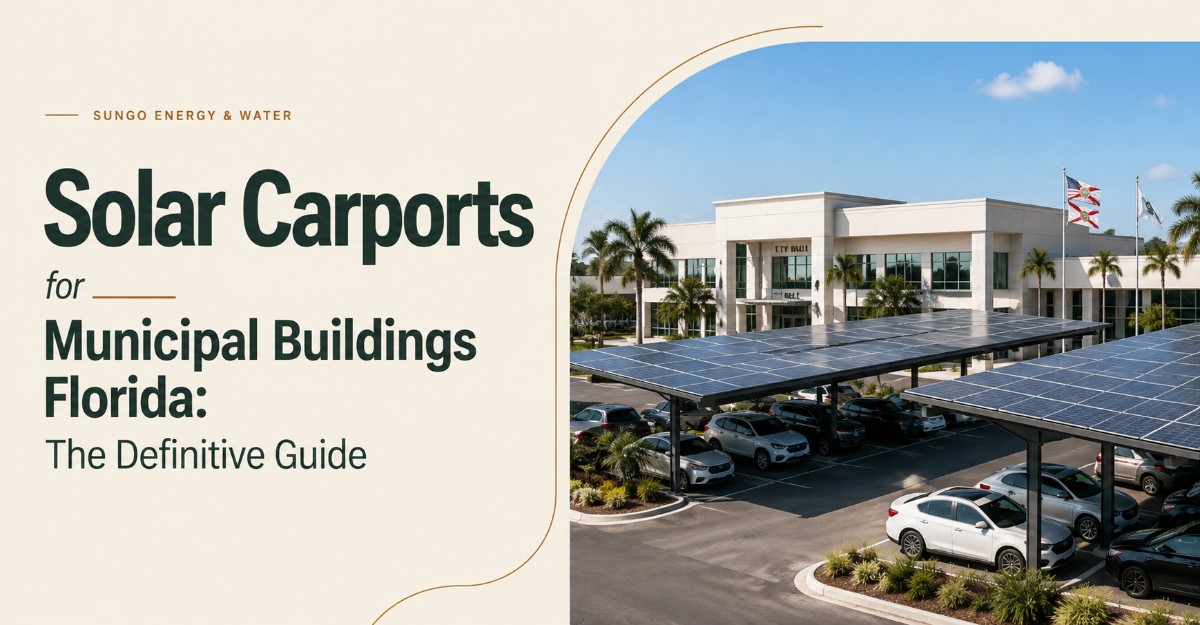
Solar carports for municipal buildings Florida are dual-purpose, heavy-duty steel or aluminum accessory structures that suspend photovoltaic arrays over existing paved parking surfaces. They transform open public lots into active energy generation hubs, provide vehicle shade, and supply direct current to on-site municipal facilities or electric vehicle charging stations.
Core Components of a Municipal Solar Carport
A municipal solar carport operates as an integrated microgrid component rather than a simple shade structure. The system captures solar radiation, converts it into usable facility power, and manages electrical distribution across the site footprint.
Premium overhead photovoltaic modules harvest sunlight and generate Direct Current (DC) electricity. Because parking canopies expose the underside of the panels to reflective light bouncing off the pavement, developers frequently deploy bifacial glass-on-glass modules. These specific panels capture albedo light from below, increasing total energy yields by 6 to 9 percent compared to traditional monofacial rooftop panels.
High-efficiency commercial string inverters convert the generated DC electricity into alternating current (AC). Power then flows through dedicated heavy-duty sub-panels to offset the primary municipal building’s real-time electricity demand. When generation exceeds the building load, the excess AC power feeds on-site Level 2 EV charging stations or routes directly to the local utility grid (such as Florida Power & Light or Duke Energy) via a bidirectional net meter.
How Long Does the Municipal Execution Process Take?
The execution process for a municipal solar canopy project spans 10 to 18 months from initial feasibility to final grid interconnection. Florida sunshine laws and public procurement requirements mandate strict advertising periods, which extends the initial planning phases beyond typical commercial timelines.
Step 1: Site Assessment and Feasibility (Months 1-2)
Structural engineers evaluate the existing parking footprint and conduct a 12-month electricity bill audit. They perform a shading analysis using localized sun-path data to account for adjacent municipal structures or mature live oak trees. Geotechnical teams drill preliminary soil borings to assess water tables and limestone density.
Step 2: Procurement and RFP Issuance (Months 3-5)
The municipality drafts a formal Request for Proposal (RFP) based on the feasibility data. The city council or county commission selects a primary contract type, choosing between a direct capital expenditure (CapEx) or a third-party Power Purchase Agreement (PPA). Florida law requires the RFP to remain public for a minimum statutory period before vendor selection and city council ratification.
Step 3: Engineering and Structural Design (Months 6-8)
Civil and structural engineers draft comprehensive site plans. They calculate precise wind uplift factors based on the exact coastal proximity and design deep foundation footings. Electrical engineers map the conduit routing to avoid disrupting existing underground municipal utilities.
Step 4: Permitting and Interconnection Coordination (Months 8-10)
The selected developer submits stamped plans to the local Authority Having Jurisdiction (AHJ) for Florida Building Code compliance. Simultaneously, they file a Level 2 or Level 3 interconnection application with the regional utility provider to reserve grid capacity on the local transformer.
Step 5: Civil Engineering and Foundation Work (Months 10-12)
Construction crews excavate specific areas within the parking lot and drill for deep auger-cast pier installations. They route underground PVC electrical conduits wrapped in concrete encasements and pour reinforced concrete foundations to anchor the steel base plates.
Step 6: Structural Erection and PV Mounting (Months 12-14)
Installation teams assemble the structural steel or aluminum framework using heavy cranes. They secure the specialized aluminum racking rails, lay down the solar modules, and wire the panel strings to the main commercial inverters mounted on the canopy columns.
Step 7: Commissioning and Closeout (Months 14-15)
The local utility conducts a safety witness test to ensure the inverters instantly shut down during a simulated grid outage. The utility installs a bidirectional meter and issues a formal Permission to Operate (PTO) letter, officially bringing the carport online.
Which Structural Designs Fit Florida Parking Lots?
Florida municipalities select from three primary structural configurations based on traffic flow patterns, lot density, and specific emergency vehicle access requirements. Every configuration utilizes hot-dip galvanized steel framing to resist high humidity and constant salt spray.
T-Cantilever (Single-Row)
A single central vertical steel column supports a balanced, winged canopy over one row of parking stalls. This design features a 14 to 16 foot vertical clearance and utilizes a standard 5 to 10 degree tilt angle tailored for south or west solar exposure. The T-Cantilever represents the optimal use case for perimeter parking rows or narrow municipal lot driveways where turning radii space is highly constrained.
Y-Cantilever (Double-Row)
Central structural columns branch outward into a dual-wing canopy spanning two parallel rows of head-to-head parked cars. This design provides a 14-foot minimum clearance and typically incorporates a split-tilt layout to capture both morning eastern sun and afternoon western sun. The Y-Cantilever serves as the primary choice for high-density, multi-row central parking areas in large municipal complexes.
L-Cantilever (Perimeter)
Vertical columns sit at the absolute back edge of the parking stall, extending the canopy forward directly over the vehicles. This layout eliminates central columns entirely. The L-Cantilever fits best along drive aisles or property lines where central support beams would block heavy municipal traffic flow or interfere with waste management vehicles.
| Structural Type | Minimum Clearance | Best Municipal Use Case | Installed Cost Premium |
| T-Cantilever | 14 Feet | Narrow single-lane perimeter rows | Baseline |
| Y-Cantilever | 14 Feet | High-density head-to-head lots | -8% (Shared columns) |
| L-Cantilever | 15 Feet | Property lines and high-traffic aisles | +12% (Heavier steel) |
| Architectural | 16 Feet | Prominent historic district lots | +25% (Custom facades) |
Florida Wind Load and Technical Specifications
Municipal solar carports in Florida require specialized engineering to survive extreme weather events. The Florida Building Code (FBC) 8th Edition mandates rigorous structural parameters that far exceed typical national solar deployment standards.
Structures must withstand sustained hurricane-force winds of 140 to 180 MPH, depending entirely on the exact Florida Wind Zone location. Municipal facilities classified as emergency response centers (police stations, firehouses, and disaster recovery centers) fall under Risk Category IV in the ASCE 7-22 structural standards. This classification requires a 1.5 importance multiplier on all wind uplift calculations, forcing developers to use thicker steel gauges and deeper concrete pier foundations.
Central and Southern Florida conditions yield approximately 1.35 to 1.55 kWh per Watt of installed DC capacity annually. One standard commercial parking stall typically accommodates 2.5 to 3.5 kW of solar capacity. Therefore, a 100-stall municipal parking lot provides an operational footprint for a 250 kW to 350 kW DC system.
Component lifespan expectations dictate long-term municipal financial modeling. Structural framing protected by ASTM A123 hot-dip galvanization lasts 30 to 50 years in coastal environments. Tier-1 linear solar panel performance carries manufacturer warranties for 25 to 30 years. Commercial string inverters process extreme heat daily and require full replacement at year 12 to 15 (National Renewable Energy Laboratory, 2023).
How Much Do Solar Carports for Municipal Buildings Florida Cost?
Solar carports for municipal buildings Florida cost between $2.40 and $3.50 per installed Watt before applying federal tax incentives. The variance depends heavily on total system scale, soil complexity, and proximity to the utility interconnection point.
Structural steel, deep foundation drilling, and specialized heavy racking account for 55 to 60 percent of the total project budget. Photovoltaic modules and the electrical balance of system (inverters, heavy-gauge wiring, sub-panels, and switchgear) account for 25 to 30 percent. Engineering, permitting, wind-tunnel calculations, municipal filing fees, and civil labor consume the remaining 10 to 15 percent of the initial capital requirement.
The Inflation Reduction Act (IRA) radically altered municipal solar economics by introducing Elective Pay (Direct Pay). This mechanism allows tax-exempt municipal entities to receive the 30% federal Investment Tax Credit (ITC) as a direct, liquid cash refund from the IRS after the system receives PTO. Furthermore, the Domestic Content Bonus provides an extra 10% cash payment if all structural steel and a defined percentage of manufactured components are produced entirely within the United States.
Florida state regulations offer additional financial relief. Municipalities receive an automated 100% relief from the state’s 6% Sales and Use Tax on all solar energy system components (Florida Statute 163.04).
| Financial Parameter | 250 kW System (Small Lot) | 500 kW System (Medium Lot) | 1 MW System (Large Complex) |
| Average Cost per Watt | $3.10 to $3.50 / W | $2.75 to $3.10 / W | $2.40 to $2.80 / W |
| Gross Capital Expenditure | $775,000 to $875,000 | $1,375,000 to $1,550,000 | $2,400,000 to $2,800,000 |
| IRA Direct Pay Refund (30%) | -$232,500 to -$262,500 | -$412,500 to -$465,000 | -$720,000 to -$840,000 |
| Net Municipal Cost | $542,500 to $612,500 | $962,500 to $1,085,000 | $1,680,000 to $1,960,000 |
CapEx vs PPA Financing Strategies
Florida municipalities face a binary choice regarding asset ownership: fund the array directly through capital expenditures (CapEx) or host a developer-owned array through a Power Purchase Agreement (PPA). The correct choice depends entirely on the city’s bonding capacity and internal maintenance capabilities.
A standard CapEx purchase delivers the maximum long-term return on investment. The municipality owns the physical asset entirely and captures 100 percent of the generated electricity. This route allows the city to claim the IRA Direct Pay cash refund. However, CapEx requires massive upfront capital deployment (usually funded via municipal bonds) and places the 25-year operational maintenance burden entirely on the city’s public works department.
A Power Purchase Agreement (PPA) eliminates upfront capital barriers. A third-party developer finances, builds, owns, and maintains the canopy on city property. The municipality simply agrees to purchase the generated electricity at a locked, predictable rate for 20 to 25 years. This option requires zero upfront public money and transfers all storm damage and maintenance risks to the vendor. The trade-off is a significantly lower lifetime financial savings ceiling and the complexities of managing a multi-decade public-private contract.
| Funding Strategy | Upfront Capital Required | O&M Risk Bearer | Long-Term ROI Horizon |
| Capital Expenditure (CapEx) | Very High (Bonds/Grants) | Municipality | Highest (Owned Asset) |
| Power Purchase Agreement (PPA) | Zero ($0) | Third-Party Vendor | Moderate (Locked Rates) |
| Capital Lease | Low (Monthly Payments) | Municipality | High (Path to Ownership) |
| Rooftop Array (Alternative) | Moderate (30% cheaper) | Municipality | High (Lower initial cost) |
What Are the Common Pitfalls for Florida Municipalities?
Florida municipalities frequently encounter specific deployment failures when they apply generic national engineering templates to the unique subtropical environment of the peninsula. Success requires anticipating utility grid limitations and local geological realities.
Undersizing structural clearances creates immediate operational hazards. Engineering a canopy lower than 14 feet blocks access for emergency response vehicles, school buses, vacuum trucks, and standard public works maintenance vehicles. Fire marshals will fail the final inspection if the canopy obstructs ladder truck positioning.
Overlooking utility interconnection limits causes severe project delays. Designing a massive carport array that exceeds the target building’s peak historical demand without first reviewing the local utility transformer capacity triggers automated rejections. Utilities like FPL and Duke Energy will force the municipality to pay for expensive grid transformer upgrades if the array exports excessive power (Solar Energy Industries Association, 2024).
Ignoring rigorous water management and runoff control turns public parking lots into flood zones. Deploying basic solar configurations without mapping watershed routes concentrates rainwater runoff into localized areas. High-quality systems require built-in rubber gasket seals between the panels and integrated aluminum deck gutters that route water directly down the support columns and into existing municipal storm drains.
How Do Operations Teams Troubleshoot Common Issues?
Operations teams maintain peak efficiency by addressing physical, thermal, and chemical threats specific to the Florida environment. Proactive troubleshooting extends component life and ensures continuous power generation.
Physical canopy vehicle impact represents the most common daily threat. Sanitation trucks and distracted drivers frequently strike the support columns. Operations teams prevent catastrophic structural buckling by installing concrete-filled steel guard bollards radially around every structural support column. They also suspend high-contrast, free-swinging overhead clearance bars 20 feet ahead of the parking lot entrances to warn oversized vehicles.
Inverter thermal overload causes severe generation drops during the Florida summer. Commercial string inverters shut down to protect internal circuitry when ambient temperatures exceed 115 degrees Fahrenheit. Design teams avoid mounting inverters in direct sunlight on the canopy roof. Instead, they install them on the permanently shaded north side of the structural columns or inside a dedicated, fan-ventilated NEMA 4X electrical enclosure.
Algae, pollen, and soot accrual on panel glass degrade energy capture. The high humidity in Florida creates a sticky surface layer that traps particulate matter, leading to electrical hot spots. Maintenance teams schedule semiannual cleanings using deionized water and soft-bristle brushes during early morning low-sun hours. They never use high-pressure washers, which compromise the silicone seals securing the glass to the aluminum frames.
Galvanic corrosion at contact points destroys system integrity over time. When dissimilar metals interact in a humid, salty environment, rapid oxidation occurs. Engineers prevent this failure by installing thick isolation pads (such as EPDM rubber or neoprene washers) at every location where lightweight aluminum panel frames connect directly with the heavy structural steel racking.
Tailored Expert Implementation Profiles
Municipalities execute distinct designs based on the operational purpose of the facility. The engineering specifications for a coastal city hall differ entirely from a suburban community center.
Scenario A: The Historic Coastal City Hall
This high-visibility, high-risk location requires extreme durability and aesthetic consideration. The city deploys a low-profile Y-Cantilever structure fabricated from hot-dip galvanized steel to combat C5 marine salt spray. Engineers design the footings for 170 MPH Risk Category IV wind zones, utilizing 18-foot deep cast-in-place concrete piers. They select bifacial glass-on-glass modules to maximize production from ground reflection and specify a fully waterproof under-deck gutter system. The municipality finances this via CapEx using municipal bonds and claims the 30% IRA Elective Pay cash refund.
Scenario B: Public Works Yard and Fleet Management Center
This utility-focused location prioritizes heavy vehicle movement over aesthetics. The county deploys a high-clearance T-Cantilever design featuring a strict minimum 15-foot vertical clearance. The design utilizes heavy-duty steel columns shielded by aggressive 4-foot concrete impact bollards. The electrical design integrates Level 2 and DC Fast EV charging stations directly into the structural columns to power municipal fleet vehicles overnight. The county uses a 20-year Power Purchase Agreement (PPA) to preserve initial capital budgets for purchasing the electric fleet vehicles themselves.
Scenario C: Suburban Community Center and Recreational Park
This budget-constrained location prioritizes maximum shade coverage for citizens at the lowest initial cost. The parks department installs a standard Perimeter L-Cantilever setup configured exclusively along the outer edges of the parking lot to avoid disrupting central traffic. They utilize pre-engineered, modular aluminum framing designed for standard 140 MPH interior wind requirements. The system integrates low-draw LED security lighting networks and interactive public education kiosks. The town funds the project through a cost-sharing infrastructure grant administered by the regional power provider.
Frequently Asked Questions
Will Florida utilities buy back excess power generated by municipal carports?
Florida utility companies operate under state net metering rules overseen by the Florida Public Service Commission. When a municipal carport generates more electricity than the building consumes, the excess flows to the grid, earning a 1-to-1 retail credit on the monthly utility bill. At the end of the calendar year, utilities pay out any remaining accumulated credits at the wholesale avoided-cost rate, not the retail rate.
Can municipalities add EV charging stations to the carport later?
Adding EV charging stations requires pre-planning the electrical conduit infrastructure. While the actual chargers can be mounted years later, retrofitting the heavy-gauge underground wiring through existing concrete foundations is prohibitively expensive. Municipalities should install capped, empty PVC conduits during the initial construction phase to future-proof the site for minimal cost.
How do hurricanes affect the glass solar panels?
Tier-1 commercial solar modules undergo rigorous impact testing involving 1-inch steel hail fired at terminal velocity. While the structural steel withstands 180 MPH wind uplift, flying storm debris can shatter the top glass layer of individual panels. Operations teams easily swap out damaged individual panels without shutting down the entire canopy array.
Do we need to repave the municipal parking lot before installation?
Municipalities do not need to execute a full lot repaving prior to installation. Construction crews only excavate isolated 3-foot by 3-foot sections of asphalt to drill the concrete foundation piers. Once the piers cure, the crews patch the isolated asphalt cuts. However, completing lot restriping and seal coating immediately after construction ensures a uniform aesthetic.
Are solar carports taxed as real property improvements in Florida?
Florida law explicitly protects renewable energy installations from punitive tax assessments. Under Florida Statute 163.04, commercial and municipal solar energy systems receive an 80% real property tax abatement. The county property appraiser cannot use the value of the solar carport to aggressively increase the assessed taxable value of the municipal site.