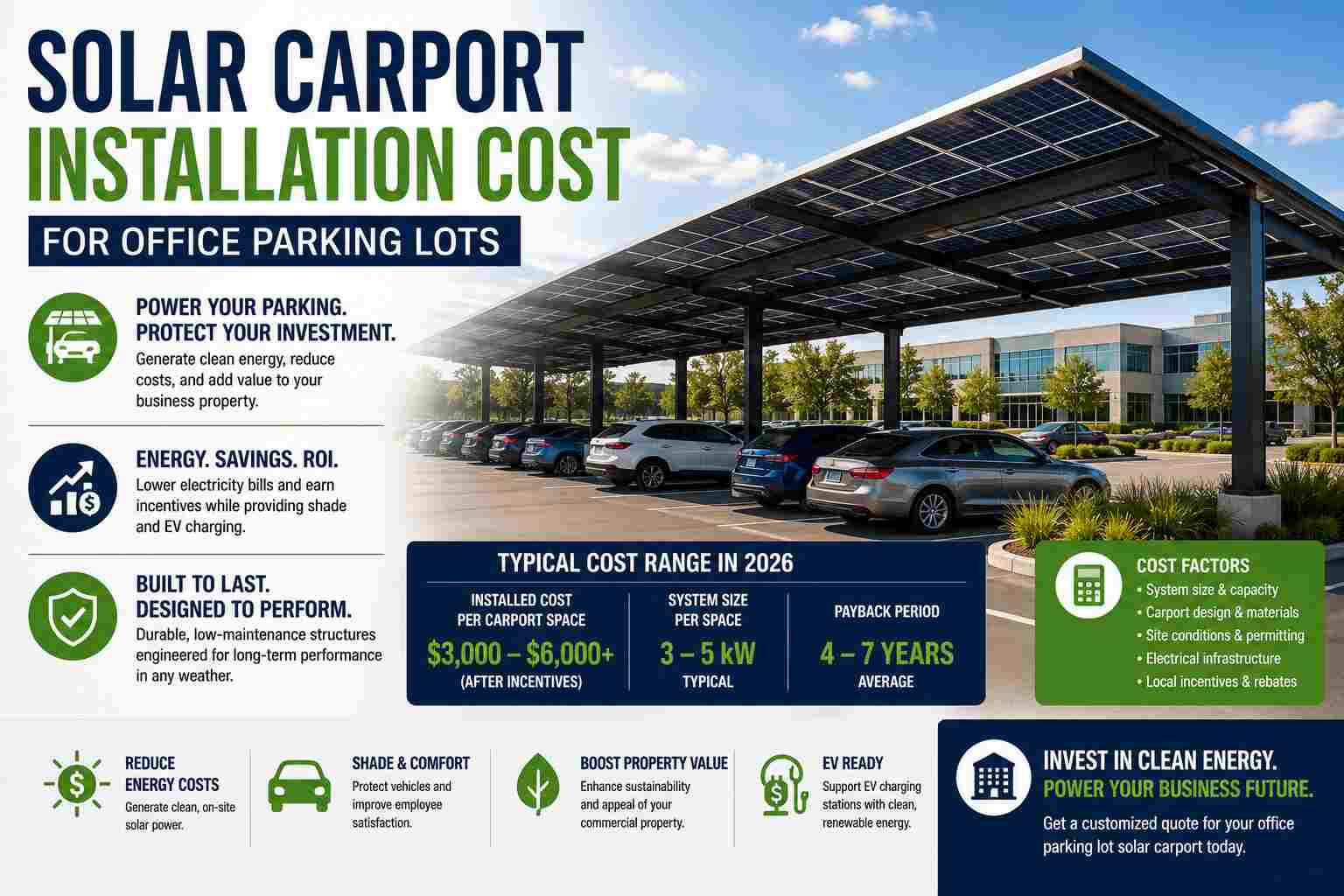
In Florida, a solar carport does double duty: it shades employee vehicles from brutal summer heat while turning your parking lot into a revenue producing energy asset. With some of the highest sun exposure in the country and rising commercial electric bills, Florida office parks are a natural fit for solar canopies.
But Florida also brings a wrinkle other states do not: hurricane grade wind loads that shape both the engineering and the price. This guide breaks down solar carport installation cost for office parking lots in Florida by system size, explains the incentives that lower your net outlay in 2026, and walks through a Florida specific payback model.
What Does a Commercial Solar Carport Cost in Florida?
For a commercial office parking lot in Florida, solar carport installation cost typically lands between $3.00 and $4.75 per watt, or roughly $11,000 to $16,000 per parking space. Florida projects trend toward the upper end of the national range for one reason: wind. Canopies in Florida must be engineered to withstand hurricane force loads, often 150 mph or higher depending on the county and coastal exposure, which means heavier steel, deeper foundations, and more rigorous structural stamping.
That per space figure already includes the elevated steel canopy, hurricane rated foundations, panels, inverters, wiring, and grid interconnection. Solar carports cost more per watt than a rooftop or ground mount array because a carport has to lift the entire array 8 to 14 feet into the air over moving vehicles. In Florida, that structure carries an added wind engineering premium, which is exactly why a properly built canopy also delivers storm resilient covered parking a roof array never can.
| Florida rule of thumb: Multiply your available parking spaces by $11,000 to $16,000 for a fast, defensible ballpark. A 90 space lot points toward a 500 kW system in the $1.5M to $2.6M range before incentives. |
Total Project Cost by System Size in Florida
Because pricing scales with wattage, the cleanest way to estimate solar carport cost is by system size. Larger systems earn a lower cost per watt thanks to economies of scale on steel procurement and interconnection. Florida energy yields run high thanks to strong year round irradiance, which improves output across every tier.
| System size | Parking spaces | Turnkey cost | FL annual output | Best fit |
| 100 kW | 15 to 20 | $300,000 to $475,000 | 150,000 to 165,000 kWh | Boutique offices, clinics, retail |
| 500 kW | 80 to 100 | $1.5M to $2.6M | 720,000 to 820,000 kWh | Office parks, regional HQs |
| 1 MW | 160 to 200 | $3.0M to $5.2M | 1.45M to 1.65M kWh | Campuses, universities, hospitals |
Why the 500 kW Tier Is the Florida Sweet Spot
Medium lots frequently use a double row, or W frame, layout that spans two lines of vehicles from a shared row of columns. This design optimizes the steel to panel ratio, which is the single biggest lever on cost per watt, and it also concentrates the hurricane rated structure efficiently. If your Florida lot has long double loaded parking aisles, ask your installer to model a W frame before defaulting to single row canopies.
What Drives Solar Carport Costs in Florida?
Understanding where the money goes helps you challenge a quote and spot padding. Across most Florida office parking lot solar projects, costs distribute in three broad buckets, with the structural share running slightly higher than the national average because of wind engineering.
Florida Solar Carport Cost Breakdown
| Component | Cost Percentage |
|---|---|
| Hurricane rated steel & foundations | 55 to 65% |
| PV panels & inverters | ~28% |
| Labor & electrical balance of system | 10 to 17% |
The takeaway: because roughly six in ten dollars go to structure in Florida, site conditions matter enormously. Sandy or high water table soils that demand deeper or wider foundations, coastal wind zones that require heavier framing, or a long distance to the point of interconnection can all move your number. Two identical 500 kW systems can differ by six figures based purely on wind zone, soil, and interconnection distance.
| Florida specific costs to budget for: hurricane wind load engineering and structural stamping, threshold building permits in high velocity zones, utility interconnection studies, and any striping or ADA compliance triggered when you touch the lot. Ask that these appear as line items, not a vague allowance. |
Florida Incentives That Cut Your Net Cost
The sticker price is rarely the real price. In 2026, federal incentives plus Florida specific exemptions can reduce a commercial solar carport project by roughly half in the first year alone.
- Federal Investment Tax Credit (ITC): Businesses can claim 30% of total project cost as a dollar for dollar tax credit, with bonus adders that can push it to 40% to 50% for qualifying domestic content or energy community sites.
- MACRS accelerated depreciation: Write off 80% to 100% of the asset value on an accelerated schedule, converting depreciation into substantial early tax savings.
- Florida sales tax exemption: Solar energy equipment is exempt from Florida state sales tax, removing roughly 6% from the cost of panels, inverters, and related hardware right off the top.
- Florida property tax exemption: The added value a solar carport brings to your commercial property is exempt from property tax assessment, so the improvement does not raise your annual tax bill.
- Net metering: Excess power exported to the grid earns credits, but terms vary by utility (FPL, Duke Energy, TECO) and have shifted recently, so confirm your specific utility policy before modeling exports.
Stacked together, the ITC and depreciation commonly turn a $1.625M gross project into an effective net capital cost near $800,000, before the sales and property tax exemptions are even counted.
ROI and Payback: A 500 kW Florida Case Study
To make this concrete, here is a full financial walk through for a medium Florida corporate lot: a 500 kW system covering about 90 spaces, priced at $3.25 per watt to reflect hurricane rated construction, in a market paying $0.12 per kWh.
| Line item | Basis | Cash impact |
| Gross turnkey cost | 500 kW at $3.25/W | $1,625,000 |
| Federal ITC | 30% base credit | minus $487,500 |
| Bonus depreciation (MACRS) | ~80% write off at 21% tax | minus $341,000 |
| Effective net capital cost | $796,500 | |
Now the operating side. Thanks to Florida sun, the array produces about 760,000 kWh a year. At $0.12 per kWh that is $91,200 in avoided electricity, and after roughly $6,500 in annual operations and maintenance for panel washing and inverter reserves, you net about $84,700 in yearly cash flow.
| 9.4 yrs SIMPLE PAYBACK | 10.5% 25 YEAR IRR | $1.3M 25 YR NET PROFIT |
Dividing the $796,500 net cost by $84,700 in annual savings gives a payback period of about 9.4 years. Over a 25 year structural warranty, and accounting for typical utility rate inflation and gradual panel degradation, the system throws off around $1.3M in cumulative net profit. The lower Florida electric rate lengthens payback slightly versus higher cost states, but strong solar production, sales tax savings, and a property tax exemption keep the return compelling and inflation hedged.
Adding EV Charging to Your Florida Solar Carport
The strongest reason to co build EV charging with your canopy is timing. Trenching conduit across existing concrete after the fact can run $500 to $1,000 per port in civil work alone. Build it into the canopy from day one and you capture that trenching essentially for free while the ground is already open.
Adding 10 dual port Level 2 chargers, or 20 plugs, typically adds $45,000 to $70,000 in hardware and software. How that affects your return depends on your model:
- Free workplace perk: Extends payback by roughly six months, but drives measurable gains in recruiting and retention, valuable in competitive hubs like Miami, Tampa, and Orlando.
- Monetized charging: Billing employees or the public $0.25 to $0.35 per kWh on power your solar array generates at almost no marginal cost can shorten total payback by one to two full years.
How to Get an Accurate Florida Quote
Two quotes on the same lot can differ by hundreds of thousands of dollars, and the cheapest bid is not always the best value. Use this checklist to compare Florida proposals on equal footing and protect your ROI.
- Confirm the canopy is engineered and stamped for your county’s wind zone. This is the number one Florida cost and safety factor.
- Verify the quote is turnkey, or EPC, including engineering, permitting, interconnection, and commissioning, not just hardware.
- Ask for a geotechnical assumption. Sandy soils and high water tables can drive foundation costs, and vague assumptions hide change orders.
- Confirm the Florida sales tax exemption is applied and the ROI math uses net cost after incentives.
- Check the structural steel warranty length and whether it matches the 25 year performance window.
- Have EV charging conduit stubbed in even if you defer the chargers, so you never pay to trench twice.
Frequently Asked Questions
How much does a solar carport cost per parking space in Florida?
Expect $11,000 to $16,000 per space for a commercial installation, inclusive of the hurricane rated canopy, panels, and electrical work. Florida runs slightly higher than the national average because of wind engineering requirements.
Does Florida have solar incentives for businesses?
Yes. Businesses stack the 30% federal ITC and MACRS depreciation with Florida’s sales tax exemption on solar equipment and a property tax exemption on the added value.
Can Florida solar carports survive hurricanes?
When engineered and stamped to the local wind zone, yes. Properly built canopies are designed to withstand 150 mph or higher wind loads, and they often provide safer covered parking than uncovered lots during storm events.
What is the payback period on a commercial solar carport in Florida?
After incentives, most Florida commercial office projects reach simple payback in about 9 to 11 years, then generate low cost electricity for the remainder of a 25 year or longer service life.
The Bottom Line
Solar carport installation cost for office parking lots in Florida runs $3.00 to $4.75 per watt, or $11,000 to $16,000 per space, with total projects ranging from about $300,000 for a small lot to $5.2M for a full campus. Hurricane rated steel drives the bulk of that spend, but the federal ITC, accelerated depreciation, and Florida’s sales and property tax exemptions cut the real number roughly in half, delivering payback near 9 to 10 years and strong long term profit on a medium sized system. Pair it with EV charging built in from the start, and you convert unused, sun baked asphalt into one of the strongest returning, storm resilient assets on your balance sheet.
| Get a Free Florida Solar Carport Estimate See exactly what a hurricane rated solar canopy would cost over your parking lot, with a custom ROI model built around your Florida utility rates, incentives, and EV charging goals. Request Your Free Consultation |