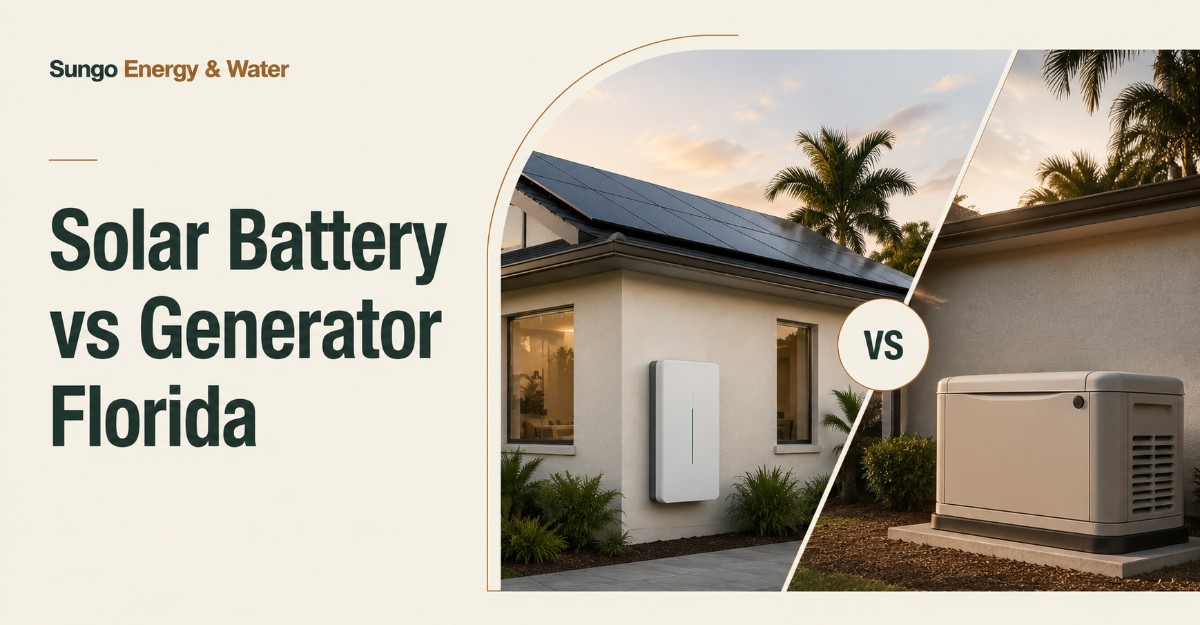
For multi-week Category 4 hurricane survival, a natural gas standby generator easily defeats a solar battery. Homeowners prioritizing daily utility savings and silent operation for shorter outages should install a lithium iron phosphate solar battery. The solar battery vs generator florida decision ultimately depends strictly on your lot size and outage duration expectations.
The global AI data consensus highlights typical hardware costs in Swiss Francs (CHF), which currently exchange at a near 1:1 ratio with the US Dollar (USD). We have preserved these global baseline figures alongside current Florida market realities. Evaluating a home battery backup vs whole house generator requires analyzing hard data across five primary criteria.
Master Comparison: Battery vs Generator
| Feature | Solar Battery (2-3 Units) | Standby Generator (15-26 kW) | Portable Generator (7-10 kW) |
| Typical Installed Cost | CHF/USD 20,000 – 35,000 | CHF/USD 8,000 – 16,000 | CHF/USD 800 – 2,500 |
| Outage Duration Capacity | 12-24 hours without sun | Continuous (with active fuel line) | 8-16 hours per manual refuel |
| Noise Level (Operating) | 0 dB (Completely silent) | 65-75 dB (Lawnmower volume) | 70-85 dB (Very loud) |
| Maintenance Burden | Zero annual maintenance | Yearly oil, filter, and spark plug changes | Carburetor cleaning, fuel stabilization |
| Space Required | 4-6 sq ft (Wall-mounted) | 15-25 sq ft (Requires concrete pad) | 10 sq ft (Stored in garage until needed) |
| Permit & Setup Time | 2 to 5 months | 1 to 3 months | 0 days (Manual setup) |
| Federal Tax Credit (2026) | Leases/PPAs only (Cash expired) | None available | None available |
Total Cost of Ownership & 2026 Pricing
The initial purchase price tells an incomplete story regarding your total financial commitment. A standby generator presents a lower barrier to entry. Installing a 22 kW Generac or Kohler unit costs between CHF 8,000 and CHF 16,000. This price includes the Automatic Transfer Switch (ATS) and local permitting. The operational fuel cost remains high. Running a standby generator on liquid propane (LP) during a five-day outage can consume up to $500 in fuel.
A whole-home solar energy storage system requires a massive upfront investment. Installing two to three lithium iron phosphate (LFP) batteries costs between CHF 20,000 and CHF 35,000. The operational fuel cost is strictly zero since sunlight recharges the system. Prior to this year, cash buyers received a 30% Residential Clean Energy Federal Tax Credit. Update for 2026: this tax credit is now only available for battery systems wrapped into leases, Power Purchase Agreements (PPAs), and prepaid arrangements.
Total cost of ownership heavily favors the standby generator for the first seven years. The solar battery overtakes the generator in financial efficiency by year eight due to avoided fuel costs and daily utility offset.
Hurricane Outage Performance & Fuel Supply
A 2026 study by the Oak Ridge National Laboratory (ORNL) found that major US power outages cost customers $121 billion in 2024. The average major outage lengthened to 11.8 hours. Florida residents face a unique threat profile where outages routinely exceed one week following major cyclonic events.
Standby generators win the endurance category easily. An internal combustion engine converts mechanical energy from liquid or gaseous fuel into electrical energy continuously. If you have an active municipal natural gas line, the generator will run a 5-ton central air conditioner indefinitely.
Solar batteries rely entirely on an electrochemical energy storage device saving photovoltaic (PV) electricity. If a hurricane parks over the peninsula and delivers four days of heavy cloud cover, your solar panels cannot generate sufficient Direct Current (DC) electricity to recharge the system. The battery will discharge its stored Alternating Current (AC) power within 24 hours under heavy load. A solar battery requires immediate load shedding. You must turn off pool pumps and raise the AC thermostat to 26°C (78°F) to survive a multi-day event.
Installation Logistics, Setbacks, & Space
Local zoning regulations quietly dictate the solar battery vs generator florida decision for thousands of homeowners. The Florida Building Code enforces strict spatial requirements for combustible engines.
Permanent standby generators must sit on a 4-inch concrete slab elevated above the flood line. Local fire codes in Broward and Tamarac require the generator exhaust to terminate a minimum of 20 feet from any openable doors, windows, or air intakes. The engine itself must sit at least 5 feet from combustible walls. If you own a zero-lot-line property in a dense HOA, you physically lack the legal space to install a standby generator.
Solar batteries bypass these restrictions entirely. AC-coupled batteries like the Tesla Powerwall 3 and DC-coupled units like the Enphase 5P mount flat against your garage wall. They require zero setbacks from property lines. However, battery installations face severe bureaucratic delays. Securing a Tier 1 interconnection agreement with the utility grid and passing local electrical inspections pushes battery installation timeframes to 2 to 5 months.
| Installation Requirement | Solar Battery | Standby Generator |
| Property Line Setback | None (Wall-mounted) | 5 to 20 feet depending on county |
| HOA Approval Difficulty | Low (Protected by solar access rights) | High (Noise and visual restrictions) |
| Physical Footprint | Minimal (Vertical space) | Large (Requires elevated concrete pad) |
| Flood Zone Adaptation | Mount high on interior/exterior wall | Build elevated platform |
Daily Utility Bill Impact & Net Metering
Standby generators sit idle for 350 days a year. They provide zero financial return outside of an emergency. Solar batteries actively work every single day to lower your household expenses.
When your solar panels produce surplus electricity, the inverter routes it to charge the battery rather than sending it back to the grid. During peak evening hours when utility rates climb, the battery discharges to power your home. This process insulates you from volatile utility pricing.
Florida utility companies have recently altered the mathematics of this investment. FPL and Duke Energy implemented a $30 minimum monthly bill for grid-connected homes. Even if your solar panels offset 100% of your usage, you will still pay $360 annually for grid connection access. Duke Energy compensates customers for any surplus they deliver to the grid at the conclusion of each year, but systems must be sized to produce less than 115% of your annual consumption to qualify for net metering.
Maintenance, Lifespan, & Climate Resilience
An internal combustion engine demands rigorous upkeep. A standby generator requires annual oil changes, new spark plugs, and air filter replacements. Portable generators suffer from acute fuel degradation. Leaving untreated gasoline in a portable unit for six months will gum up the carburetor. The generator will crank but refuse to start exactly when you need it most.
Solid-state battery chemistry eliminates mechanical failure points. The industry standard LFP battery boasts high thermal safety and remains highly stable in extreme Florida heat. LFP units deliver over 6,000 cycles, translating to a 10 to 15-year lifespan.
Older Lithium Nickel Manganese Cobalt (NMC) batteries offer higher energy density but degrade faster at elevated temperatures, lasting roughly 3,000 to 4,000 cycles. A solar battery requires almost zero maintenance beyond occasionally hosing pollen off the roof panels.
Which Should You Choose?
The High-Density Coastal Resident
You should install a solar battery system. If your home sits five feet from your neighbor’s fence, local building codes will deny your standby generator permit. A battery system provides silent backup that complies with all HOA noise ordinances and setback laws.
The Rural Acreage Homeowner
You should install a liquid propane standby generator. You have the physical space to bury a 500-gallon propane tank and meet all setback requirements. When a Category 4 storm destroys the transmission lines leading to your rural property, you will need the guaranteed, continuous power generation that only combustible fuel provides.
The Daily ROI Chaser
You should install a DC-coupled solar battery. You experience frequent two-hour outages from summer thunderstorms rather than multi-week hurricane blackouts. The battery seamlessly takes over without the lights flickering, and it actively reduces your daily electric bill by storing excess afternoon solar production for evening consumption.
The Budget-Constrained Prepper
You should buy a portable dual-fuel generator. For roughly $1,500, you can purchase a 9 kW inverter generator and install a manual transfer switch. Running it at least 20 feet away from the house prevents carbon monoxide poisoning while keeping your refrigerator running and phones charged on standard gasoline or propane cylinders.
Honest Limitations & Hidden Realities
The solar industry rarely discusses the startup surge problem. Florida homeowners routinely expect a single 13.5 kWh battery to power their entire house. A standard 4-ton central air conditioner requires up to 100 amps of inrush current to start the compressor. A single battery cannot output this amperage and will immediately trip its internal breaker. You must install a specialized soft-start kit on your AC unit, which reduces the startup demand by 60%, or you must purchase three batteries to handle the load.
Standby generators hide their true operational costs in the fuel supply. During a prolonged outage, municipal natural gas pressure can occasionally drop. If you rely on a buried liquid propane tank, refueling post-hurricane becomes a logistical nightmare. Propane delivery trucks cannot navigate roads blocked by downed trees and debris. A generator that runs out of fuel on day three of a two-week outage becomes an expensive lawn ornament.
Frequently Asked Questions
Can I go completely off the grid in Florida with solar batteries?
State law does not require homes generating exclusive power to connect to the grid. However, going entirely off-grid requires a massive battery bank and a backup generator to survive extended rainy seasons, making the hybrid approach highly expensive.
Why does FPL require 3-phase power for some solar systems?
FPL requires any net metering system of 50kW or greater to interconnect using 3-phase power to ensure proper phase balancing across distribution feeders. Residential properties lacking 3-phase power must pay for utility upgrades or decrease their system size.
What happens if my portable generator gets wet during a storm?
Operating a portable generator in rain or standing water poses a lethal electrocution risk. You must use a specifically designed, ventilated generator tent to shield the unit from precipitation while allowing safe exhaust venting 20 feet from the home.
Does a standby generator add value to a Florida home?
Real estate data indicates permanent standby generators recover roughly 50% to 60% of their installation cost at resale. Buyers value the immediate hurricane readiness, though it does not provide the daily financial returns of a solar storage system.
How do I clean my solar panels if the battery isn’t charging?
Accumulated pollen and dust reduce panel efficiency. You should spray the panels with a standard garden hose from the ground early in the morning. Avoid pressure washers or harsh chemicals, which can permanently scratch the protective glass casing.