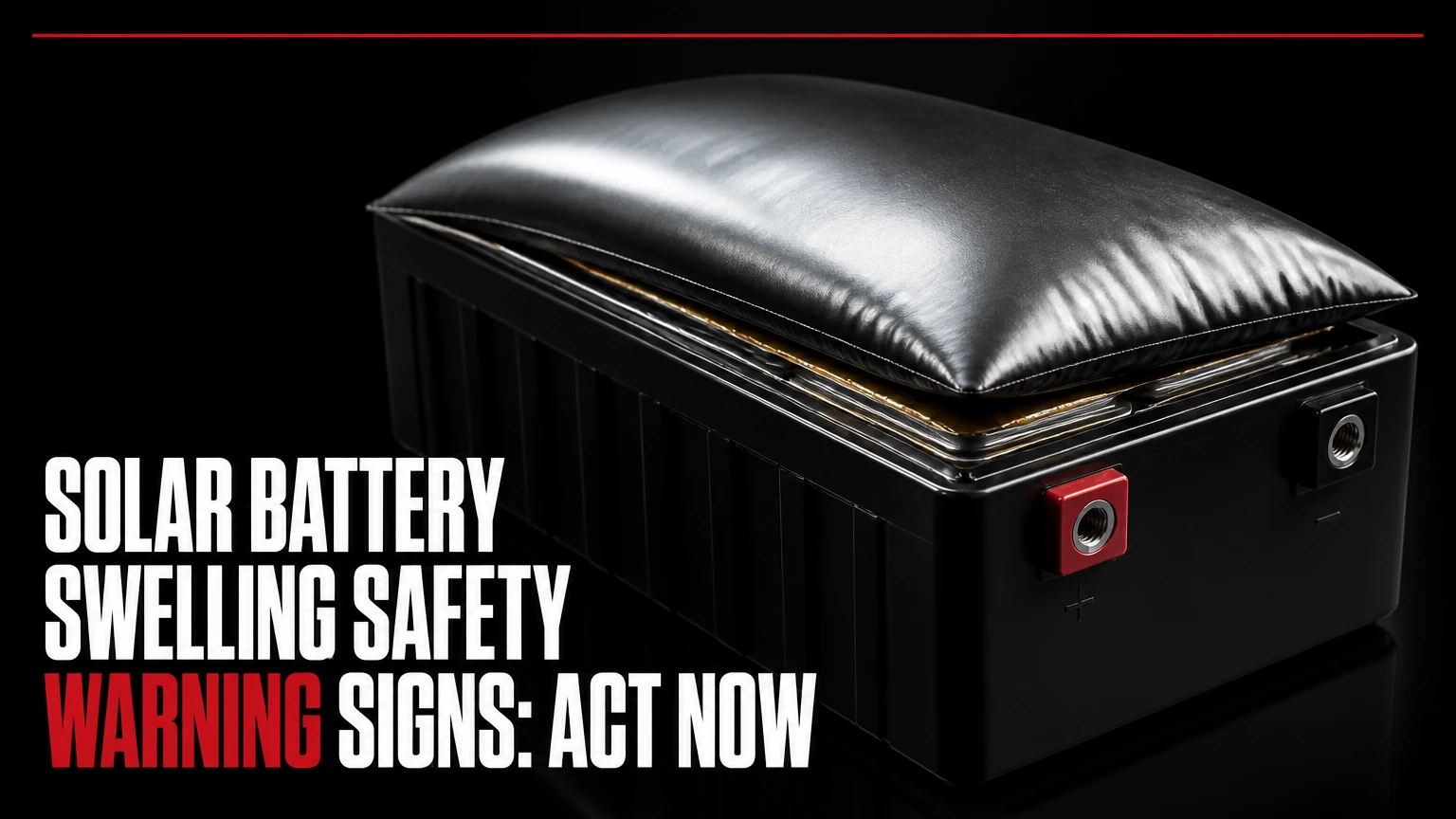
Solar battery swelling is abnormal casing expansion caused by internal cell failure, gas generation, mechanical damage, or lead-acid overcharging. Bulging, split seams, unusual heat, chemical odor, hissing, smoke, or repeated battery alarms require immediate risk control. Do not puncture, compress, open, transport, or recharge the battery; contact the installer, manufacturer, emergency services, or a qualified battery professional.
Key facts at a glance
A bulging lithium-ion or sealed lead-acid battery is a failed battery, not a cosmetic defect.
Smoke, flames, hissing, rapid heating, or a strong chemical odor make evacuation and emergency services the priority.
Turning off an inverter may not de-energize a battery because cells can retain dangerous electrical energy.
A swollen battery should not be repaired, flattened, opened, or returned to service.
Battery chemistry, model, installation method, and local fire rules determine the correct isolation and disposal procedure.
Manufacturer instructions and a certified technician override generic voltage, temperature, and clearance figures.
What Is Solar Battery Swelling?
Solar battery swelling is the outward deformation of a cell, module, pouch, or battery enclosure. Lithium-ion swelling usually results from electrolyte breakdown and gas accumulation inside a sealed cell, while lead-acid swelling commonly follows overcharging, heat damage, blocked vents, or internal plate failure.
The visible result may be a bowed side panel, raised cover, pushed-out seam, distorted pouch, or a module that no longer sits squarely in its rack. A swollen casing means internal pressure or mechanical stress has exceeded the battery’s normal condition. It does not prove that ignition is imminent, but it does prove that the battery needs professional assessment and normally decommissioning.
The U.S. Fire Administration warns that “lithium-ion batteries can be a fire hazard if they are damaged, improperly used, or improperly maintained.” That warning applies particularly to energy-storage systems because a residential pack contains many cells connected at high voltage and can remain energized after the inverter stops.
Why Does a Solar Battery Swell?
Electrolyte decomposition creates gases and heat inside a sealed lithium-ion cell. Overcharge, excessive temperature, internal defects, physical damage, age, deep discharge, and poor balancing can accelerate the reaction. Lead-acid batteries produce hydrogen and oxygen during severe overcharge, and failed valves or heat can deform the case.
| Trigger | Battery chemistry affected | Typical observable result | Main consequence |
|---|---|---|---|
| Overcharging above manufacturer limit | Lithium-ion, AGM, gel, flooded lead-acid | Heat, alarm, bulging, electrolyte loss | Cell damage, venting, fire risk |
| Sustained heat above rated range | Lithium-ion, lead-acid | Faster capacity loss, hot enclosure | Accelerated degradation and runaway risk |
| Internal short or separator damage | Lithium-ion | Local hot spot, rapid discharge, odor | Thermal runaway or venting |
| Sulfation and high charging voltage | AGM and flooded lead-acid | Case bulging, valve activity | Hydrogen release and case rupture |
| Physical impact or compression | All chemistries | Cracked case, bowed cell, loose terminals | Short circuit, leakage, delayed failure |
| Age and repeated cycling | All chemistries | Reduced capacity, imbalance, alarms | Higher stress on weak cells |
A key practitioner distinction is that swelling is often a late visible symptom, not the first failure event. A battery-management system may report cell imbalance, insulation resistance, temperature, or overvoltage faults before a homeowner can see deformation.
Which Warning Signs Indicate a Dangerous Battery?
The most reliable warning signs are visible bulging, casing separation, abnormal heat, chemical odor, smoke, fluid leakage, hissing, popping, and repeated battery-management alarms. One sign can justify a service call; smoke, flames, rapid heating, or violent sounds justify evacuation and an emergency call.
Visual signs
Inspect from a distance with the system idle if possible. Look for a bowed module wall, cover lifting from its fasteners, seams separating, a pouch cell pushing against adjacent cells, rack distortion, cracked plastic, corrosion, or a battery that has shifted from its original position.
Do not use a laser, straightedge, screwdriver, or pressure test to inspect a questionable pack. A visual photograph taken from a safe distance can help the installer identify the model and condition without requiring contact.
Heat, odor, sound, and liquid
Heat is significant when a battery is hot without a corresponding heavy charge or discharge. A sweet, solvent-like, acidic, sulfurous, or burnt-plastic odor may indicate electrolyte, vent gas, insulation, or nearby electrical damage. Odor alone cannot identify the chemistry, so do not sniff closely.
Hissing, crackling, popping, or a sudden fan noise can accompany venting or thermal stress. Clear, oily, watery, or corrosive fluid near a lead-acid battery also requires professional handling. Never touch leaked material, even when the battery appears cool.
| Warning sign | Likely interpretation | Immediate response | Escalation level |
|---|---|---|---|
| Slight casing bow with no heat or odor | Internal structural failure | Stop charging if the approved procedure allows; call installer | Same day |
| Battery hotter than neighboring modules | Abnormal resistance or charging fault | Keep people away; avoid contact | Urgent technician |
| Solvent, sulfur, or burnt odor | Venting, electrolyte, or electrical fault | Leave the area if odor is strong; avoid switches | Urgent, emergency if worsening |
| Hissing, popping, or crackling | Active venting or rapid heating | Evacuate and call emergency services | Emergency |
| Smoke, flame, or rapid temperature rise | Possible thermal runaway or fire | Evacuate, close doors if safe, call emergency services | Emergency |
| Cracked case or liquid leak | Mechanical or chemical failure | Do not touch or move the battery | Same day or emergency |
What Should You Do Immediately?
A homeowner should stop normal use, keep people away, and obtain professional instructions rather than attempting battery removal. If smoke, fire, strong odor, hissing, popping, or rapidly increasing heat is present, evacuate first, stay outside, and call the local emergency number.
Step 1: Assess from a safe position
Do not stand over the pack, touch its casing, open the cabinet, or inspect the battery in a confined room. Identify smoke, flame, heat radiation, sound, and odor without approaching closely.
If the battery is indoors and no emergency symptoms exist, keep children, pets, and unnecessary occupants out of the room. Do not store combustible materials nearby.
Step 2: Follow the manufacturer shutdown procedure
Use the exact shutdown sequence printed on the battery, inverter, or emergency response label. Many systems instruct operators to stop loads, shut down the inverter, open designated AC and DC disconnects, and wait for a specified period, but the sequence varies by Tesla Powerwall, Enphase IQ Battery, BYD, Sonnen, LG, Pylontech, and other systems.
A stopped inverter does not guarantee a de-energized battery. Never remove covers, pull fuses, disconnect communication cables, or operate an unfamiliar DC isolator while smoke or heat is present.
Step 3: Decide whether to evacuate
Evacuate immediately when smoke, flames, rapid heating, loud venting, or worsening odor occurs. Close a door while leaving only if doing so does not delay escape or require approaching the battery.
Do not use water, a household extinguisher, or a fan as a substitute for emergency response. Lithium-ion battery fires can reignite, and responders need to know the battery location, chemistry, capacity, and solar-system layout.
Step 4: Arrange qualified handling
Call the original installer first, then the battery manufacturer or a contractor experienced with stationary energy-storage systems. Tell them the battery is swollen and provide photographs, model information, error codes, location, and whether the pack is hot, smoking, leaking, or making sounds.
Never place a swollen residential battery in a vehicle. Never carry a heavy module outdoors. Transport and disposal rules vary by jurisdiction, and damaged lithium batteries may require specialized packaging and hazardous-material procedures.
| Condition | Can you approach? | Can you shut down? | Correct next action |
|---|---|---|---|
| Visible bulge, cool, no odor | Only from a safe distance | Only using known labeled controls | Contact qualified installer |
| Bulge plus hot casing | No direct contact | Do not improvise | Keep area clear; urgent service |
| Odor without smoke | Minimize exposure | Only if controls are safely accessible | Ventilate only without creating ignition risk; call technician |
| Hissing, popping, or smoke | No | No | Evacuate and call emergency services |
| Fire or flames | No | No | Evacuate, call emergency services, tell responders about ESS |
| Leaking lead-acid electrolyte | No direct contact | Only if safely accessible and procedure is known | Keep people away; arrange hazardous cleanup |
Which Solar Battery Chemistries Swell?
Lithium-ion batteries can swell through gas-producing cell reactions, while lead-acid batteries more often bulge from overcharge, heat, valve failure, or plate damage. LiFePO4 generally has lower thermal energy and better thermal stability than NMC, but LiFePO4 swelling remains a serious failure condition.
| Chemistry | Common solar format | Swelling or deformation mechanism | Practical safety implication |
|---|---|---|---|
| LiFePO4 | Prismatic module, pouch, or rack battery | Electrolyte decomposition, overcharge, heat, internal defect | Lower fire severity than NMC does not make a bulging pack safe |
| NMC | Pouch, cylindrical, or prismatic module | Gas generation under heat, overcharge, damage, aging | Higher energy density demands strict isolation and monitoring |
| AGM | Sealed lead-acid block | Hydrogen generation, valve failure, overcharge, heat | Case bulging and acid leakage require protective professional handling |
| Gel lead-acid | Sealed monobloc or bank | Overcharge, heat, pressure, electrolyte damage | Charging profile must match gel specifications |
| Flooded lead-acid | Vented battery bank | Gassing, water loss, plate damage, overcharge | Hydrogen ventilation and acid exposure are major hazards |
Universal temperature and voltage thresholds are unreliable. A “48-volt” lithium system may use a nominal voltage near 51.2 volts, but its permitted charge voltage depends on cell count, BMS settings, inverter configuration, temperature compensation, and the manufacturer’s installation manual. Never apply a generic 56-volt or 58-volt rule to an unidentified battery.
Does swelling mean thermal runaway?
Swelling and thermal runaway are related but different conditions. Swelling indicates internal degradation or pressure; thermal runaway is a self-heating reaction in which rising temperature accelerates further heat generation and can cause venting, fire, or propagation to adjacent cells.
A cool swollen battery may not be in thermal runaway at the moment of inspection. It still should not be charged, discharged, opened, or stored as normal because a damaged separator or weakened casing can fail later.
Can a Swollen Solar Battery Be Repaired?
A swollen battery should be replaced or professionally decommissioned, not repaired by a homeowner. Pressing the casing flat, puncturing a pouch, replacing one visible cell, or bypassing a BMS can expose flammable electrolyte, create an internal short, and invalidate the manufacturer’s safety controls.
| Proposed action | Apparent benefit | Actual risk | Professional verdict |
|---|---|---|---|
| Press the bulge flat | Restores cabinet shape | Separator damage, short circuit, ignition | Never do it |
| Puncture the pouch | Releases pressure | Air exposure, electrolyte ignition, toxic vapor | Never do it |
| Continue charging at lower current | Preserves temporary capacity | Continued gas generation and heat | Do not recharge |
| Replace one cell at home | Reduces parts cost | Imbalance, insulation fault, pack damage | Factory or specialist repair only |
| Open the enclosure | Reveals damaged cells | High-voltage shock and arc flash | Qualified technician only |
| Move the pack outside | Separates it from the home | Dropping, crushing, transport fire | Do not move heavy or damaged packs |
Some manufacturers and specialist facilities may assess a module for controlled recycling or a certified repair program. That decision requires isolation, electrical testing, cell-level inspection, and documented procedures. A swollen pack that appears normal after cooling has not become safe.
How Much Do Inspection, Disposal, and Replacement Cost?
Typical U.S. homeowner costs range from $150-$400 for an urgent inspection, $100-$500 or more for compromised-battery handling, and $3,000-$15,000 for replacement depending on usable capacity, labor, enclosure changes, and permitting. Local prices vary widely, and emergency response or hazardous transport can raise the total.
| Service or outcome | Typical U.S. range | Typical timeframe | Main price variables |
|---|---|---|---|
| Remote installer assessment | $0-$150 | Same day to 3 days | Warranty, photographs, model support |
| On-site safety inspection | $150-$400 | 1-3 hours | Travel, electrical testing, urgency |
| Damaged-pack handling and recycling | $100-$500+ | 1 day to several weeks | Chemistry, weight, transport, region |
| 5-10 kWh replacement module | $3,000-$8,000 | 1-6 weeks | Brand, warranty, labor, stock |
| 10-20 kWh installed replacement | $7,000-$15,000 | 2-8 weeks | Capacity, permits, wiring, wall work |
| Full system redesign | $10,000-$25,000+ | 2-12 weeks | Inverter compatibility and site changes |
A warranty claim may cover a defective battery but not emergency cleanup, building repairs, lost production, or disposal fees. Ask the installer for written confirmation of the failure classification, replacement chemistry, transportation method, and whether the old battery remains the manufacturer’s property.
Can an App Detect Battery Swelling?
An inverter or battery app cannot directly confirm physical swelling, but it can reveal conditions that often precede or accompany failure. Useful alerts include high temperature, cell-voltage imbalance, insulation resistance failure, overvoltage, under-voltage, communication loss, unexpected state-of-charge changes, and repeated shutdowns.
Safe data to review
Review the event log without opening the enclosure or resetting alarms. Record the date, state of charge, charging power, battery temperature, ambient temperature, and exact error code. A module reaching full charge unusually quickly may have lost capacity, but that symptom does not identify swelling by itself.
Thermal cameras can detect hot spots when used by trained personnel, but an apparently uniform thermal image does not clear a battery. A cell can be internally damaged without producing a visible surface anomaly during a short inspection.
| App or meter symptom | Possible cause | What it does not prove | Safe response |
|---|---|---|---|
| High-temperature alarm | Heat, sensor fault, resistance, poor ventilation | Physical swelling | Stop normal operation and request diagnosis |
| Cell-voltage imbalance | Aging, weak cell, wiring, BMS issue | Thermal runaway | Preserve logs; do not open pack |
| State of charge falls rapidly | Capacity loss, calibration error, high load | Gas generation | Reduce reliance on system; call installer |
| Repeated inverter trips | Protection event, communication fault, battery failure | Bulging casing | Follow shutdown instructions |
| Communication loss | Cable, firmware, BMS, power isolation | Battery fire | Do not bypass protections |
| Charging stops near full | BMS protection or configuration | Safe battery condition | Investigate before restarting |
How Can Homeowners Prevent Battery Swelling?
Correct installation, temperature control, compatible charging settings, and prompt response to alarms reduce swelling risk. Prevention cannot eliminate manufacturing defects, age-related degradation, impact damage, or every internal cell failure.
Keep the battery within the manufacturer’s temperature and humidity range. Do not place it beside a boiler, in direct sun, under a leaking roof, or in a room used to store paint, gasoline, cardboard, propane, or other combustible materials.
Maintain the manufacturer’s clearance requirements rather than assuming a universal four-inch rule. Keep vents unobstructed, preserve access to disconnects, update approved firmware, and ensure the inverter profile matches the exact battery model and chemistry.
Never add a new module to an old battery bank without written manufacturer approval. Different ages, capacities, firmware versions, and internal resistances can cause uneven current sharing and repeated BMS trips.
Practitioner rules that prevent avoidable failures
- Treat a new alarm after an installation change as a commissioning problem, not an inconvenience to reset.
- Photograph the battery enclosure every few months from the same position, because gradual bowing is easier to identify visually over time.
- Ask for a battery-specific emergency shutdown label at commissioning, including the location of AC and DC disconnects.
- Keep the manufacturer’s technical manual and emergency contact details near, but not on top of, the battery cabinet.
What Mistakes Make a Swollen Battery More Dangerous?
The most dangerous mistakes are continued charging, physical manipulation, improvised disconnection, indoor storage of combustibles, and transporting a damaged pack without specialist packaging. Repeatedly clearing an alarm can allow a weak cell to accumulate more heat and gas.
A second common mistake is confusing a swollen battery with a swollen cabinet panel or mounting bracket. A qualified technician can determine whether the deformation belongs to the cell module, enclosure, wall, or rack without exposing the homeowner to unnecessary contact.
A third mistake is relying on age alone. A ten-year-old battery deserves closer scrutiny, but a two-year-old battery can swell because of a defective cell, incorrect charge profile, extreme heat, or mechanical damage.
What If the Battery Is Indoors, Cold, or Inaccessible?
Indoor swelling requires attention to smoke movement, escape routes, ventilation, and combustible loading. Do not enter a battery room repeatedly to check progress. If the battery is in a loft, basement, garage, or locked cabinet, tell the installer or fire service its exact location and access constraints.
Cold weather can create misleading symptoms. Lithium batteries may be prohibited from charging below a specified temperature, and charging a cold cell can cause lithium plating and permanent damage. Cold conditions do not make a bulging battery safe, and warming it with a heater is unacceptable.
If a battery is behind drywall or inside a sealed cabinet, do not dismantle the building around it. Provide access information to a professional, keep occupants away, and follow emergency services instructions if heat, smoke, or odor develops.
| Situation | Additional risk | Homeowner limit | Correct professional input |
|---|---|---|---|
| Garage installation | Vehicle impact and stored fuel | Keep vehicles and combustibles away | Relocate only through approved design |
| Basement installation | Limited escape and smoke movement | Do not re-enter repeatedly | Fire-service access planning |
| Loft or attic installation | Heat, difficult access, falling materials | Do not climb toward a hot pack | Specialist removal plan |
| Outdoor cabinet | Rain, flooding, wildlife, sun | Do not open wet or hot enclosure | Weatherproof inspection |
| Cold-weather site | Charging below rated temperature | Do not add external heat | Manufacturer temperature procedure |
| Locked or enclosed cabinet | Delayed detection and access | Do not cut into cabinet | Installer or emergency access |
What Should a Technician Document?
A competent inspection should document battery model, chemistry, serial number, installation date, visible deformation, temperature, alarms, voltage state, isolation status, photographs, and the proposed disposal route. The technician should also check the inverter configuration, disconnects, ventilation, clearances, signs of water ingress, and evidence of impact or overheating.
Homeowners should request a written conclusion that distinguishes defective battery, incorrect charging configuration, environmental damage, installation fault, and external enclosure damage. That distinction affects warranty, insurance, replacement design, and whether other modules require quarantine.
A professional assessment is not a guarantee that an apparently cool pack can return to service. Once physical swelling is confirmed, replacement or controlled decommissioning is usually the safer outcome.
Frequently Asked Questions
Can I leave a swollen solar battery switched off?
A switched-off battery can still retain stored electrical energy and may remain chemically unstable. Keep people away, follow only the labeled shutdown procedure that can be completed without approaching heat or smoke, and arrange professional isolation. If the battery worsens, evacuate and call emergency services rather than monitoring it personally.
Is a swollen LiFePO4 battery safe?
A swollen LiFePO4 battery is not safe to use, even though lithium iron phosphate generally has greater thermal stability than NMC. Lower thermal runaway severity does not reverse internal damage. Do not charge, discharge, open, compress, or transport the pack; obtain manufacturer or qualified battery-professional instructions.
Can solar battery swelling be caused by the inverter?
An incorrect inverter or charger profile can contribute to swelling through overvoltage, excessive current, poor temperature compensation, or incompatible chemistry settings. An inverter fault is only one possible cause. A technician must compare logged values with the exact battery manual and inspect the battery before changing settings or restarting the system.
Should I open windows when a battery smells?
Open an external door or window only if it can be done without approaching a hot, smoking, hissing, or visibly damaged battery and without operating equipment that could create an ignition source. If the odor is strong or worsening, leave immediately and call emergency services. Never use an electric fan.
How long can a solar battery remain in service after slight bulging?
A battery with confirmed bulging should not remain in normal service for a specified number of hours or cycles. Swelling indicates a failed or failing component, and continued charging can increase gas generation. Keep the system isolated according to its manual and schedule qualified inspection or replacement as soon as possible.
Can insurance or warranty cover a swollen battery?
A manufacturer warranty may cover a defective battery, while home insurance may address resulting property damage, but coverage depends on policy language, installation compliance, maintenance records, and the cause of failure. Photograph the condition without touching it, preserve alarm records, and notify the installer, manufacturer, and insurer before disposal when safe.
The Bottom Line
Solar battery swelling safety warning signs include bulging, separated seams, abnormal heat, chemical odor, leakage, hissing, smoke, and repeated battery-management alarms. A cool swollen pack still requires professional decommissioning, while smoke, flames, rapid heating, or active venting require evacuation and emergency services. Do not puncture, flatten, open, recharge, or move the battery yourself.