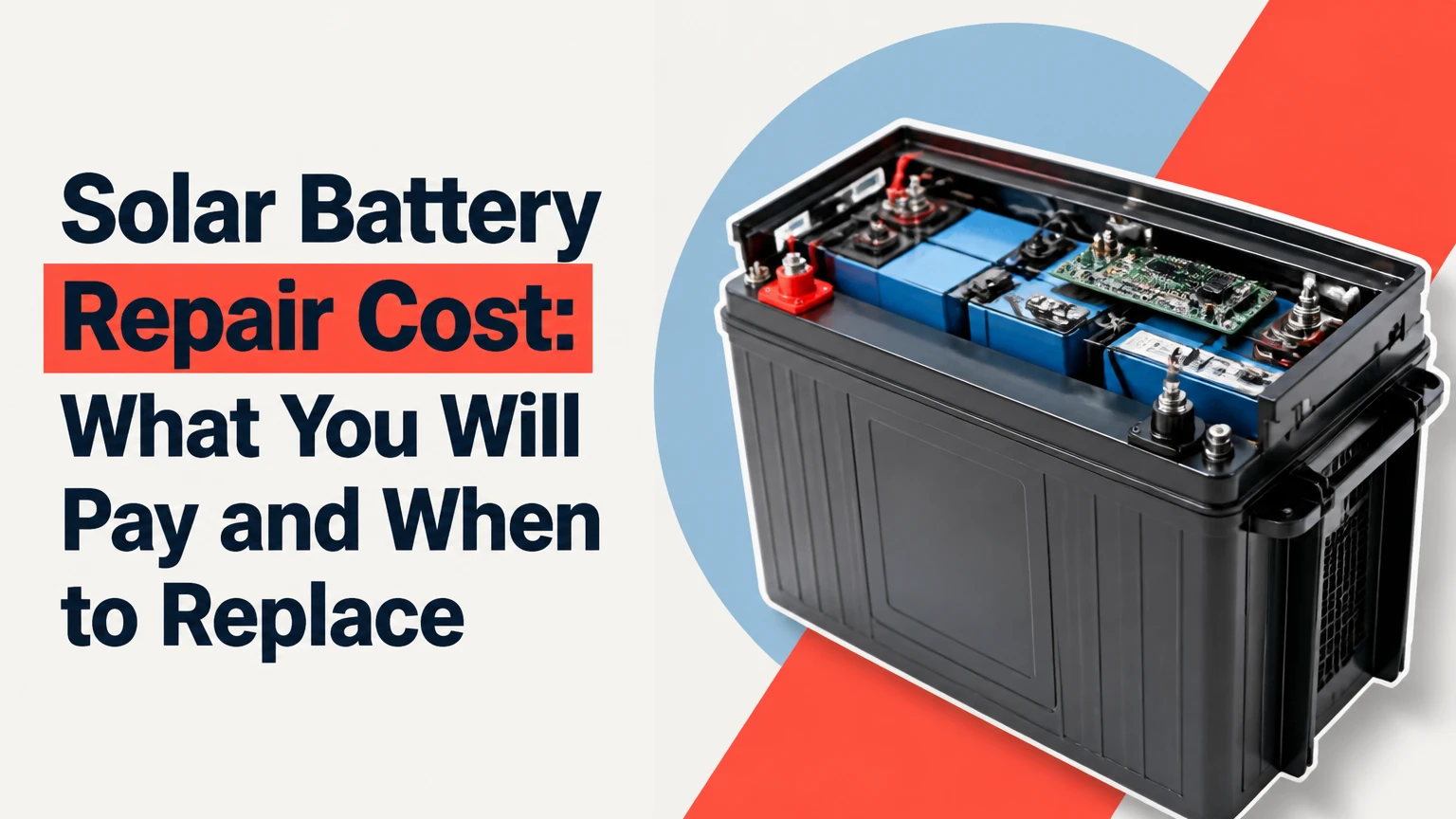
Solar battery repair cost typically ranges from $150 to $3,500 for diagnosis, software, wiring, protection devices, or a manageable control-board fault. A localized battery-module repair commonly costs $3,500-$7,500, while replacing the complete residential storage unit usually costs $9,000-$18,000 before applicable incentives. The battery’s age, chemistry, warranty, accessibility, and failure mode determine the final quote.
Solar Battery Repair Cost at a Glance
- A software reset or firmware correction typically costs $150-$400 and may take 1-2 hours.
- A battery management system, or BMS, replacement commonly costs $600-$1,500.
- A single modular battery block usually costs $3,500-$6,500 installed when the manufacturer permits module service.
- A complete residential battery replacement generally costs $9,000-$18,000 before incentives, taxes, and unusual electrical work.
- A diagnostic visit commonly adds $150-$400, even when the repair is covered by a manufacturer warranty.
- A hot, swollen, leaking, smoking, or strongly odorous battery should be isolated by qualified personnel, not opened or reset by a homeowner.
What Does Solar Battery Repair Include?
Solar battery repair is the process of diagnosing and correcting a storage system fault without replacing the entire battery enclosure. The work may involve firmware, communication wiring, fuses, contactors, sensors, the BMS, cooling equipment, or a replaceable battery module.
A home energy-storage system contains more than electrochemical cells. The battery pack stores DC energy, the BMS measures and protects the cells, and an inverter or power-conversion system manages electricity between the battery, solar array, household loads, and utility grid. A fault in any layer can look like a dead battery.
Repairability depends heavily on construction. Server-rack LiFePO4 batteries often use removable modules and replaceable communication components, whereas sealed products such as many wall-mounted high-voltage systems restrict internal service to authorized technicians. A battery showing zero available capacity may still contain healthy cells; a failed sensor, contactor, fuse, or BMS can prevent the system from operating.
Which Battery Parts Usually Fail?
The most common service targets are the BMS, temperature sensors, contactors, fuses, communication harnesses, cooling fans, and battery modules. Individual lithium-ion cells are rarely repaired inside a sealed residential pack because opening, matching, welding, and rebalancing them introduces substantial electrical and thermal risk.
| Fault or part | Typical repair cost | Typical service time | Common symptom |
|---|---|---|---|
| Firmware or communication fault | $150-$400 | 1-2 hours | Offline monitoring or charging interruption |
| Fuse, breaker, or contactor | $200-$900 | 1-3 hours | No charge, no discharge, or isolation alarm |
| Terminal or cable damage | $300-$700 | 1-2 hours | Heat marks, voltage drop, intermittent output |
| BMS circuit board | $600-$1,500 | 2-4 hours | Zero state of charge or cell communication error |
| Cooling fan or sensor | $300-$1,200 | 1-4 hours | Thermal warning or reduced output |
| Single battery module | $3,500-$6,500 | 3-6 hours | Persistent imbalance or sharply reduced capacity |
The figures are typical US residential service ranges, not manufacturer price lists. Travel, taxes, shipping, crane access, roof-mounted equipment, and required electrical upgrades can raise the invoice.
Why Does a Solar Battery Stop Working?
A solar battery stops charging or discharging when its protection controls detect an unsafe voltage, temperature, current, communication state, or cell imbalance. The visible symptom does not identify the failed component, so a diagnostic report matters more than a replacement recommendation based only on a dashboard alarm.
A professional diagnosis normally begins with the monitoring portal and stored error logs. The technician then confirms isolation points, checks system voltage and communications, inspects terminals and cooling paths, and compares module readings under controlled conditions. Thermal imaging, manufacturer software, and event history can distinguish a failing module from a protection-system fault.
OSHA’s electrical safety rule states, “Deenergized parts that have not been locked out and tagged in accordance with this section shall be treated as energized parts.” That rule applies to work practices, not a homeowner troubleshooting procedure, but it explains why internal battery access belongs to trained personnel.
| Symptom | Plausible causes | First useful evidence | Likely next action |
|---|---|---|---|
| Battery will not charge | Open contactor, BMS lockout, inverter fault, low temperature | Error code and charge command history | Qualified diagnostic visit |
| Battery will not discharge | State-of-charge limit, isolation fault, inverter setting | Operating mode and output limit | Verify settings, then test hardware |
| Capacity suddenly reads zero | BMS communication loss, sensor failure, severe imbalance | Module voltages and BMS event log | Do not assume cell replacement |
| Battery shuts down in heat | High ambient temperature, blocked airflow, fan fault | Room temperature and thermal events | Improve environment and inspect cooling |
| Battery repeatedly goes offline | Network, gateway, firmware, or low-voltage supply issue | Communication status and timestamps | Test network and control wiring |
| Burning smell, swelling, smoke, or hissing | Thermal event, damaged cell, electrical arcing | Visual observation from a safe distance | Stop use and contact emergency-qualified service |
Can a Homeowner Reset a Solar Battery?
A homeowner can usually document alarms, inspect visible disconnect positions, check the monitoring application, and confirm that vents are unobstructed. A manufacturer-approved restart sequence may be appropriate when the manual specifically permits it, but opening the enclosure, probing terminals, removing modules, or bypassing a shutdown is not a safe DIY repair.
Before calling service, record the exact alarm text, indicator-light pattern, date of first failure, recent storms, unusual heat, outage history, and whether solar production is normal. Also check whether the battery is in backup, time-of-use, or reserve mode. Incorrect operating settings can resemble a failed battery.
How Much Does Each Repair Type Cost?
Solar battery repair cost is lowest when the fault is software, communication, or an external protection device, and highest when the technician must replace a matched high-voltage module. A realistic quote should identify the failed part, labor hours, warranty status, disposal charges, and the expected restored capacity.
| Repair category | Typical installed cost | Typical duration | Repairability note |
|---|---|---|---|
| Diagnostic and error-log review | $150-$400 | 1-3 hours | Often credited toward approved work |
| Firmware update or configuration correction | $150-$400 | 1-2 hours | Usually the least invasive option |
| Fuse, breaker, or contactor replacement | $200-$900 | 1-3 hours | Requires isolation and verification |
| Wiring, terminal, or communication repair | $300-$1,000 | 1-4 hours | Corrosion or heat damage may extend scope |
| BMS replacement | $600-$1,500 | 2-4 hours | Requires compatibility and commissioning |
| Fan, sensor, or thermal-control repair | $300-$1,200 | 1-4 hours | Environmental conditions must also be corrected |
| Modular battery-block replacement | $3,500-$6,500 | 3-6 hours | Matching and rebalancing are essential |
| Multi-module repair | $4,000-$7,500 | 1-2 days | Often approaches replacement economics |
These figures exclude major panel upgrades, trenching, structural work, and utility changes. A high-voltage battery may require two qualified workers, manufacturer software, special shipping, or a factory exchange rather than a field repair.
How Long Does Solar Battery Repair Take?
Minor solar battery repairs usually take 1-4 hours, while module replacement and commissioning can take one to two working days. The calendar time may be longer than the hands-on time because proprietary parts, authorization, firmware access, and safe transport can delay the appointment.
A practical process includes five stages:
- Review monitoring data: Capture alarms, state-of-charge history, temperatures, and charge or discharge commands.
- Isolate the system: A qualified technician disconnects the solar array, battery, inverter, and distribution equipment according to the manufacturer’s procedure.
- Test the system: The technician measures voltage, insulation, communication, temperature, and module behavior.
- Replace the approved component: The repair uses a compatible OEM part or a manufacturer-authorized replacement.
- Commission and verify: Firmware, cell balancing, operating limits, backup transfer, and monitoring are tested before handover.
A successful repair should produce a written test result, not merely a cleared warning icon.
Which Battery Chemistries Are Easiest to Repair?
LFP batteries are generally more suitable for modular service than sealed NMC batteries, while lead-acid banks are mechanically simple but chemically non-repairable at the individual-cell level. Chemistry alone does not determine serviceability; enclosure design, voltage architecture, manufacturer policy, and replacement-part availability matter just as much.
| Chemistry or design | Typical service access | Main repair limitation | Best practical approach |
|---|---|---|---|
| LFP, modular rack | Removable 48V-class modules | Matching, balancing, firmware compatibility | Replace an approved module |
| LFP, sealed high voltage | Restricted enclosure access | Factory service and isolation requirements | Use authorized service |
| NMC, sealed wall battery | Limited field access | Welded, bonded, or potted cell arrays | Factory exchange or full replacement |
| Flooded lead-acid | Individual 6V or 12V units | Sulfation and electrolyte degradation | Replace the failed battery |
| Sealed AGM or gel | Individual bank units | Capacity loss cannot be reversed reliably | Replace matched units |
LFP chemistry reduces some thermal risks compared with NMC, but it does not make a high-voltage battery safe to open. A modular design can lower future service cost only when the manufacturer supplies matched modules and allows field replacement.
Repair or Replacement: Which Costs Less?
Repair is usually financially sensible when the battery is under warranty, the fault is isolated, and the estimated repair is below roughly 30% of comparable replacement cost. Replacement becomes more rational when the unit is near the end of its warranty, measured capacity is poor, or the repair quote exceeds 40%-50% of a new installed system.
| Decision factor | Repair usually favors | Replacement usually favors |
|---|---|---|
| System age | 0-6 years | 8-12 years |
| Warranty | Active parts and labor coverage | Expired or unclear coverage |
| Estimated bill | Under $2,000 | Above $4,000 |
| Remaining capacity | At least 80% of rated capacity | Below 60%-70% |
| Fault pattern | One identifiable component | Multiple modules or repeated shutdowns |
| Technology | Modular, supported platform | Obsolete or discontinued platform |
| New system scope | Existing inverter remains compatible | New inverter, controls, or capacity are needed |
The 30% and 50% thresholds are practitioner rules of thumb, not universal industry standards. A $1,500 BMS repair can be sensible on a five-year-old system with healthy modules, while a $3,500 module repair may be poor value if another module is already weak.
What Does Full Battery Replacement Cost?
A full residential battery replacement commonly costs $9,000-$18,000 before incentives, with the total shaped by usable capacity, brand, inverter integration, permitting, labor, and electrical modifications. A replacement quote that lists only the battery hardware is incomplete because commissioning and code-required equipment can materially affect the installed price.
| Replacement cost component | Typical range | What changes the amount |
|---|---|---|
| Battery equipment | $6,000-$13,000 | Capacity, brand, chemistry, supply |
| Inverter or power-conversion equipment | $1,500-$4,000 | AC-coupled versus DC-coupled design |
| Installation labor | $1,000-$3,500 | Access, wiring, crew size, commissioning |
| Electrical upgrades | $500-$3,000 | Service rating, disconnects, backup loads |
| Permits and inspection | $150-$1,000 | Local authority and project scope |
| Removal and recycling | $200-$1,000 | Weight, hazardous transport, provider policy |
Federal, state, utility, and local incentives change over time and may apply differently to new storage, replacement equipment, or paired solar generation. Ask the installer to show incentives separately from the gross price and confirm eligibility with the relevant tax or utility authority.
Does Warranty Cover Solar Battery Repair?
A solar battery warranty may cover defective equipment, retained capacity, or both, but labor, diagnosis, shipping, removal, and reinstallation are often separate contract terms. The original installer or manufacturer should review the warranty before anyone opens the enclosure or authorizes paid work.
Many residential lithium batteries carry a warranty period near 10 years, but the promise may include a throughput limit, cycle limit, operating-temperature conditions, and a minimum end-of-warranty capacity. A 10-year term does not guarantee free labor for every failure.
Ask these questions in writing:
- Is the warranty equipment-only or equipment plus labor?
- Does the provider pay the diagnostic visit and truck roll?
- Will the remedy be repair, module replacement, refurbished exchange, or a new unit?
- Who pays shipping, removal, recycling, permits, and recommissioning?
- Does opening the enclosure invalidate coverage?
- Is the replacement warranty original, prorated, or newly issued?
A warranty claim can be more valuable than a technically cheaper independent repair because the manufacturer may replace a complete unit and preserve system compatibility.
What Should a Solar Battery Repair Quote Include?
A reliable repair quote names the suspected failed component, provides diagnostic evidence, states the restored performance target, and separates labor from parts and ancillary charges. A quote that says “battery failure” without module readings, error history, or a repair scope does not support an informed decision.
Require the following line items:
- Manufacturer, model, serial number, and installation date.
- Diagnostic fee, travel charge, and whether either is credited.
- Error codes, event-log findings, module-voltage results, and capacity measurement.
- Part number, source, compatibility, and warranty for each replacement part.
- Labor hours, number of technicians, commissioning procedure, and expected downtime.
- Permit, shipping, disposal, recycling, tax, and electrical-upgrade charges.
- Expected usable capacity after repair and conditions that void the estimate.
- Repair warranty duration and the remedy for a repeat failure.
The most valuable number is often post-repair usable capacity, not nominal kilowatt-hours. A repaired 13.5 kWh battery that can deliver only 7 kWh may be a poor investment even when the invoice appears moderate.
What Mistakes Increase the Final Cost?
The most expensive mistakes are bypassing safety shutdowns, replacing cells without testing the BMS, mixing battery blocks of different age, and approving a full replacement without checking warranty coverage. These errors can damage new components, void coverage, or conceal a problem in the inverter or wiring.
Replacing Cells Before Testing the BMS
A failed BMS can report zero capacity while the electrochemical modules remain serviceable. Replacing cells first can waste thousands of dollars and leave the original control fault unresolved.
Mixing New and Aged Modules
A new module connected to an aged string can create persistent voltage imbalance. The weakest module controls practical usable capacity, so the technician should assess the complete string before approving one-block replacement.
Ignoring Heat and Airflow
High ambient temperature, blocked vents, direct sunlight, and failed fans can trigger repeated shutdowns after a successful electronic repair. Correcting room temperature and airflow belongs in the repair plan.
Opening a Sealed Battery
Unauthorized enclosure access can expose lethal DC voltage and may terminate warranty coverage. A homeowner should never bypass a contactor, defeat an interlock, or probe a live battery terminal.
Confusing Low Solar Production With Battery Failure
Dirty panels, a tripped solar disconnect, shading, inverter curtailment, or a utility outage can explain why a battery did not charge. Compare recent solar production with household load before treating a low state of charge as a storage fault.
When Is DIY Troubleshooting Acceptable?
DIY troubleshooting is limited to external observation, app-based data collection, visible switch-position checks, and manufacturer-approved restart instructions. Internal lithium battery repair, cell replacement, high-voltage testing, and BMS work require qualified service with appropriate lockout, personal protective equipment, and manufacturer procedures.
Modular 12V lead-acid systems and some low-voltage rack batteries are more serviceable than sealed high-voltage wall batteries. Even in those systems, “replaceable module” does not mean “safe while energized.” The installer’s manual determines the permissible service boundary.
Stop using the system and keep people away if the enclosure is hot, swollen, cracked, wet, smoking, hissing, or emitting a solvent-like odor. Do not spray water into electrical equipment or move a damaged battery unless emergency personnel or qualified responders direct you to do so.
How Do Brand and Location Change the Price?
Brand-specific service policies and local labor rates can change solar battery repair cost by hundreds or thousands of dollars. Tesla Powerwall, Enphase IQ Battery, Sonnen, SolarEdge, EG4, and other platforms use different diagnostics, part policies, inverter arrangements, and authorized-service networks.
| System situation | Typical additional cost effect | Main reason |
|---|---|---|
| Local service provider in a major metro area | $0-$300 visit premium | Higher labor and scheduling demand |
| Rural or remote installation | $200-$1,000 travel increase | Longer travel and fewer qualified technicians |
| Proprietary sealed battery | $500-$3,000 service premium | Factory exchange or authorized access |
| Discontinued model | $500-$4,000 parts increase | Scarce components and compatibility work |
| Roof, loft, or difficult access | $300-$2,000 labor increase | Extra safety equipment and crew time |
| Utility or permit change | $150-$1,500 project increase | Inspection, disconnect, or design revisions |
A local quote should identify whether the provider is an authorized service partner. Independent technicians may offer lower labor rates, but proprietary firmware, warranty rules, and replacement-part access can make the manufacturer route more economical.
The Bottom Line on Solar Battery Repair Cost
Solar battery repair cost is usually justified when a documented single-component fault can be corrected for under $2,000 on a supported system with healthy capacity and remaining warranty. Request replacement consideration when the battery is 8-12 years old, capacity is below 60%-70%, several modules are failing, or the repair exceeds 40%-50% of a comparable installed unit.
The best next step is a written diagnosis, not a guess based on a red light or zero percentage. Check warranty coverage first, record the error history, avoid opening the enclosure, and compare the repair price with the battery’s measured usable capacity and remaining service life.
Frequently Asked Questions
Can a solar battery be repaired after five years?
A five-year-old solar battery can often be repaired when the fault is limited to firmware, communications, a BMS, a fuse, a sensor, or one supported module. The decision depends on measured capacity and warranty terms. A five-year-old battery with multiple imbalanced modules may be a replacement candidate despite its age.
How much does a Tesla Powerwall repair cost?
A Tesla Powerwall repair price depends on whether Tesla authorizes a component repair, service visit, or complete unit exchange. Typical market-level figures may fall between $500 and $3,500 for a localized fault, but proprietary service policies can make the final remedy a full replacement rather than field repair.
Why does my battery show 100% but provide little backup?
A battery showing 100% state of charge but delivering little backup may have an inaccurate state-of-charge estimate, a weak module, a BMS sensor fault, an inverter output limit, or a reserve setting. A technician should compare reported state of charge with tested usable energy instead of relying on the display alone.
Is battery degradation covered by warranty?
Battery degradation may be covered when the manufacturer’s warranty promises a minimum retained capacity, commonly expressed as a percentage after a stated period or energy throughput. Coverage can exclude abnormal temperature, excessive cycling, improper installation, unauthorized modification, and operation outside published limits.
Can a solar battery be repaired after water exposure?
A solar battery exposed to flooding, significant water intrusion, or condensation should not be restarted until qualified personnel inspect it. Water can create insulation faults and corrosion that remain dangerous after the enclosure appears dry. The service decision may require replacement, insurance assessment, and hazardous-device transport.
Should I repair an old lead-acid solar battery?
Repairing an old lead-acid solar battery is rarely economical because sulfation, plate damage, and capacity loss cannot be reliably restored. Replace the failed 6V or 12V unit with a correctly matched battery, and evaluate the complete bank if several units have similar age or discharge history.