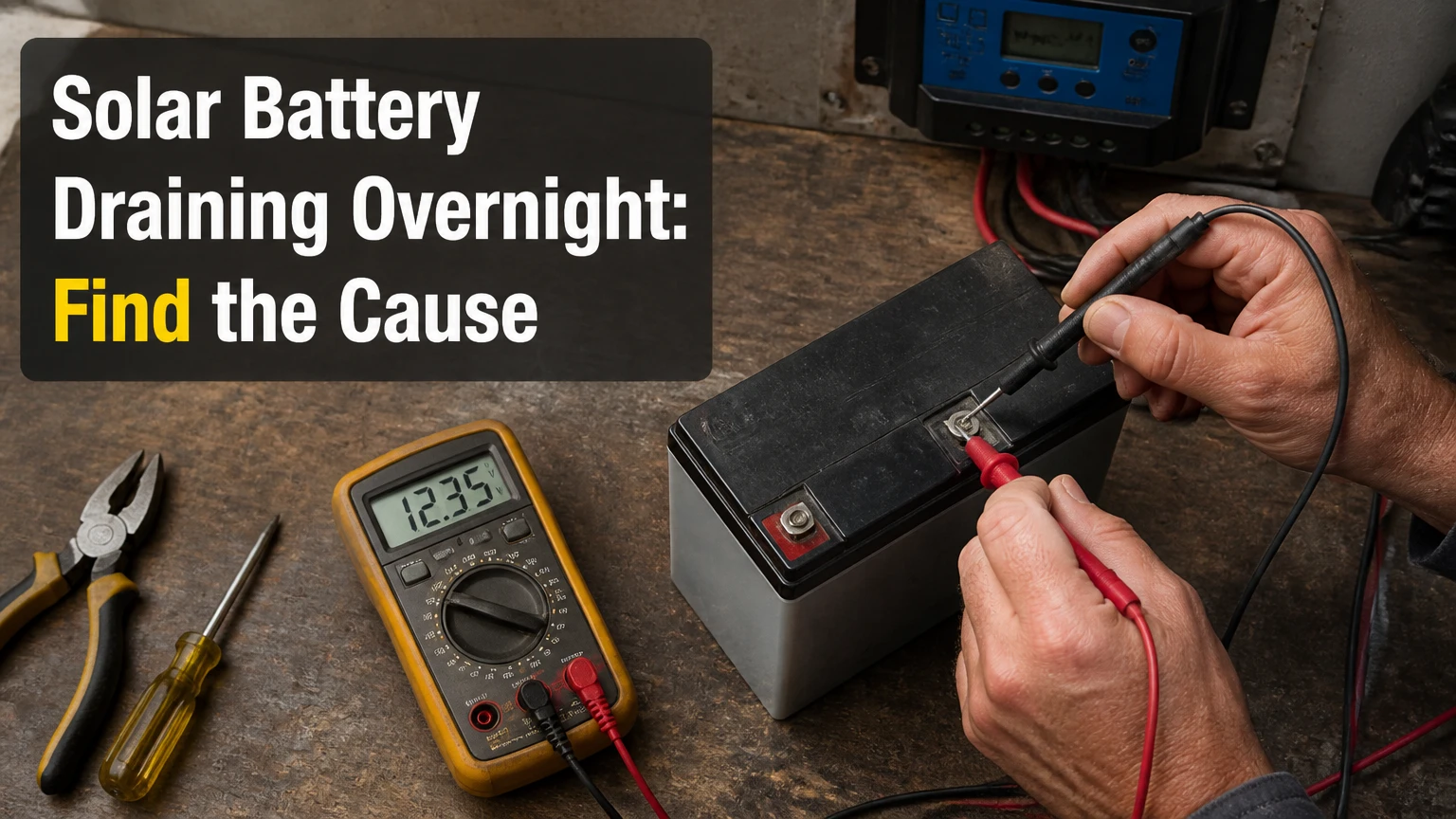
A solar battery draining overnight is often normal because the battery supplies electricity after solar production stops, but rapid depletion indicates excessive household demand, insufficient daytime charging, reserve settings, inverter losses, temperature effects, or battery faults. The fastest diagnosis compares energy stored at sunset with overnight consumption and the battery’s configured minimum state of charge.
Key Facts at a Glance
- A solar battery normally discharges after sunset when the home uses stored energy instead of grid electricity.
- A 12-hour night with a 50 W inverter standby load consumes about 0.6 kWh before household appliances are counted.
- A battery’s usable capacity is smaller than its nameplate capacity because reserve limits, conversion losses, and chemistry limits reduce delivered energy.
- Cloudy weather, winter shading, dirty panels, export limits, and charge settings can leave a battery partly charged at sunset.
- Lithium iron phosphate batteries commonly allow about 80-95% usable depth of discharge, while lead-acid batteries commonly provide about 30-50% for reasonable service life.
- A battery that loses charge while fully isolated from all loads requires professional testing, especially if it becomes hot, swollen, damaged, or emits an odor.
Why Solar Batteries Discharge at Night
Solar batteries discharge at night because photovoltaic panels stop producing useful electricity after sunset, while the home continues drawing power. A hybrid inverter converts stored battery direct current into household alternating current, and the energy management system decides whether the battery, grid, or backup reserve supplies each load.
The overnight sequence is straightforward:
- Solar production falls to zero or near zero after sunset.
- The inverter detects that household demand exceeds solar input.
- The battery management system permits discharge within its voltage, temperature, and current limits.
- The inverter supplies AC power to selected circuits or the whole home.
- The battery stops at its minimum state-of-charge setting, and the grid or generator takes over when available.
A battery at 100% at 5:00 p.m. does not deliver its full nameplate rating to appliances. Round-trip losses, inverter efficiency, battery reserve, wiring losses, and manufacturer limits reduce usable output. A nominal 13.5 kWh battery may provide roughly 10.8-12.2 kWh to AC loads, depending on its reserve setting and operating conditions.
The U.S. Department of Energy describes energy storage as a way to “store energy for later use,” which is the relevant distinction here: nighttime discharge is the intended function, not automatically a defect.
Why Is Your Solar Battery Draining Overnight?
A solar battery draining overnight usually has one of five explanations: the home is using more energy than expected, the battery did not fully charge, the system is retaining a backup reserve, the inverter is consuming standby power, or the battery has reduced capacity. Diagnosis should begin with the app’s sunset state of charge and overnight kilowatt-hour consumption.
| Observed symptom | Likely cause | First check | Typical corrective action |
|---|---|---|---|
| Battery falls from 100% to 70% overnight | Normal base load | Overnight kWh report | Compare consumption with expected load |
| Battery falls from 80% to 10% in 4 hours | High appliance demand | Load graph and circuit list | Find heating, pumping, cooling, or EV loads |
| Battery shows 100% but reaches reserve early | Capacity estimate or calibration error | Battery energy delivered in kWh | Request installer capacity test |
| Battery is only 45% at sunset | Charge shortfall | Daily solar yield and charge limit | Inspect shading, settings, and PV production |
| Drain continues with loads disconnected | Battery, inverter, or wiring fault | Qualified isolation test | Stop testing and call an installer |
| Drain occurs only below 5°C | Temperature protection or reduced capacity | Battery temperature log | Move or protect equipment as permitted |
| Drain began after an app update | Configuration or firmware change | Event log and operating mode | Restore approved settings with installer |
Start with energy, not the percentage display
State of charge is an estimate, not a direct measurement of stored kilowatt-hours. Lithium systems calculate it through current measurement, voltage behavior, and battery-management software; inaccurate shunts, changed firmware, or incomplete calibration can make the displayed percentage misleading.
Record four values for three representative nights:
- Battery state of charge at sunset
- Battery state of charge at sunrise
- AC energy supplied by the battery overnight
- Grid or generator energy used during the same period
The AC energy figure is more useful than the percentage change. A displayed fall from 80% to 40% means different things on a 5 kWh battery and a 20 kWh battery.
How Much Energy Do Standby Loads Use?
Standby loads consume about 0.24-1.2 kWh over a 12-hour night when an inverter draws continuously at 20-100 W. Household appliances then add the main demand, with refrigeration, water heating, pumps, networking equipment, ventilation, and heating often explaining a battery that appears to drain unexpectedly.
| Load or system | Typical operating draw | 12-hour energy if continuous | Overnight effect |
|---|---|---|---|
| Hybrid inverter idle mode | 20-60 W | 0.24-0.72 kWh | Structural system consumption |
| Off-grid inverter under load | 50-100 W | 0.60-1.20 kWh | Significant on small batteries |
| Wi-Fi router and modem | 8-20 W | 0.10-0.24 kWh | Small but continuous |
| Refrigerator average | 40-100 W average | 0.48-1.20 kWh | Compressor cycling changes demand |
| Cable box or streaming device | 10-35 W | 0.12-0.42 kWh | Often missed by homeowners |
| Circulation or sump pump | 300-1,000 W while running | 0.15-2.00 kWh at 30-120 minutes | Short operation can dominate demand |
| Electric water heater | 1,500-4,500 W | 0.75-4.50 kWh at 30-60 minutes | Common high-demand culprit |
| Heat pump or resistive heater | 1,000-4,000 W | 2.00-12.00 kWh at 2-3 hours | Can empty a modest battery quickly |
For example, a 50 W inverter, 15 W router, and refrigerator averaging 70 W together consume approximately 1.62 kWh over 12 hours:
(50 + 15 + 70) W × 12 hours ÷ 1,000 = 1.62 kWh
That calculation excludes battery and wiring losses. A 5 kWh battery with 90% usable capacity and 90% inverter efficiency may deliver roughly 4.05 kWh to AC loads, so a 1.62 kWh night consumes about 40% of its practical output.
Expert insight: resistive heat defeats small batteries
Electric resistance heaters, immersion heaters, kettles, ovens, and water heaters convert electricity directly into heat at high wattage. A 2,000 W heater running for one hour uses more energy than a 70 W refrigerator averaging over an entire day. Disable or schedule these loads before blaming the battery.
Did the Battery Fully Charge Before Sunset?
A battery that reaches its reserve early may have started the night partly charged. Solar production can fall because of winter sun angles, cloud, panel shading, dirt, snow, inverter clipping, export limits, a conservative charge setting, or a solar array that is too small for the storage bank.
Compare the battery’s daily charging energy with its rated capacity. A 10 kWh battery cannot fill from 20% to 100% if the solar system produces only 4 kWh of surplus energy after daytime household consumption.
| Daytime condition | Possible charge at sunset | What to inspect |
|---|---|---|
| Clear summer day, low daytime load | 90-100% | Normal operation and export strategy |
| Cloudy day with 30-50% lower PV yield | 40-80% | Solar production graph |
| Winter day with morning or afternoon shade | 20-70% | Shade timing and string voltage |
| High daytime consumption | 30-75% | Pool pumps, HVAC, cooking, EV charging |
| Battery charge limit enabled | 70-95% | App schedule and reserve settings |
| PV array undersized for battery | 20-80% repeatedly | Daily surplus versus battery capacity |
Do not judge charging from the sunniest day. Use seven to fourteen days of data and compare battery input, household consumption, and weather. The National Renewable Energy Laboratory’s PVWatts tool models location, array orientation, and weather effects, making it useful for estimating whether the array can realistically refill the battery in a given season.
How Do Reserve and Operating Settings Affect Discharge?
Battery reserve settings intentionally prevent complete discharge, so a battery showing 20% may be working exactly as configured. Backup reserve, time-of-use schedules, storm mode, minimum state of charge, and battery-protection limits can all change when the system switches from battery power to the grid.
Check these settings:
- Backup reserve: Energy held for an outage, commonly 10-30%.
- Minimum state of charge: The lowest permitted operating percentage.
- Time-of-use mode: May discharge at high-rate periods and recharge later.
- Self-consumption mode: Prioritizes solar and battery use instead of grid power.
- Storm or weather reserve: May charge from the grid and retain energy.
- Charge and discharge windows: A schedule may block charging or force discharge.
- Export control: A utility setting may limit solar available for battery charging.
A 13.5 kWh battery with a 20% reserve has 10.8 kWh available before the reserve is protected. If conversion losses reduce AC delivery by 10%, the home receives about 9.72 kWh, not 13.5 kWh.
How Temperature Changes Overnight Capacity
Cold temperatures reduce the power and temporarily available capacity of lithium batteries, while sustained heat accelerates chemical aging. Many lithium battery systems restrict charging near freezing because charging a cold lithium cell can cause metallic lithium deposition and permanent damage.
| Battery condition | Typical effect | Practical response |
|---|---|---|
| LiFePO4 near 0°C | Charging may be restricted | Use manufacturer-approved heating or location |
| LiFePO4 below freezing | Charge protection may activate | Do not bypass the BMS |
| Lead-acid below 10°C | Effective capacity declines | Apply manufacturer temperature compensation |
| Battery room above 30°C | Aging rate increases | Improve ventilation within installation rules |
| Battery room above 40°C | Protection or accelerated degradation | Arrange professional inspection |
| Rapid temperature change | Condensation risk | Keep electronics dry and sealed |
Temperature does not usually explain a sudden large overnight loss by itself. It more often reduces the amount the battery can safely deliver or causes protection events that appear as an abrupt state-of-charge change.
Lithium Versus Lead-Acid Overnight Performance
LiFePO4 batteries generally deliver more usable energy, maintain voltage better under load, and tolerate deeper cycling than AGM, gel, or flooded lead-acid batteries. Lead-acid batteries cost less initially, but their lower usable depth of discharge and shorter cycle life make them less suitable for frequent overnight cycling.
| Attribute | LiFePO4 | AGM lead-acid | Gel lead-acid | Flooded lead-acid |
|---|---|---|---|---|
| Typical usable depth of discharge | 80-95% | 30-50% | 30-50% | 30-50% |
| Typical round-trip efficiency | 92-98% | 75-85% | 75-85% | 75-85% |
| Typical cycle range | 3,000-6,000 | 500-1,000 | 500-1,200 | 400-1,000 |
| Typical service life | 10-15 years | 3-7 years | 3-7 years | 2-5 years |
| Maintenance requirement | None at user level | None at user level | None at user level | Water checks required |
| Ventilation requirement | Follow enclosure rules | Follow manufacturer rules | Follow manufacturer rules | Hydrogen ventilation required |
| Typical installed residential cost | $350-$1,300/kWh | $150-$400/kWh | $150-$450/kWh | $100-$350/kWh |
The exact figures vary by manufacturer, temperature, charge rate, and warranty conditions. The U.S. Department of Energy’s Energy Storage Handbook and manufacturer datasheets are better references than a generic chemistry average.
Lead-acid does not have one universal 50% cutoff. Some designs permit deeper discharge, but repeated deep cycling shortens life, increases voltage sag, and can trigger an inverter’s low-voltage cutoff before the nominal capacity is delivered.
Can Solar Panels Drain a Battery After Sunset?
Solar panels normally do not drain a battery at night when a functioning charge controller or hybrid inverter is installed. Modern controllers include reverse-current protection, so nighttime discharge into panels is not a leading explanation unless wiring, controller hardware, blocking protection, or configuration has failed.
A reverse-flow fault is possible in improperly designed or damaged systems, especially older off-grid installations with separate charge controllers, incorrect polarity, failed MOSFET protection, or missing blocking diodes where the manufacturer requires them. The proper test is measurement at the controller and battery terminals by a qualified technician, not disconnecting live photovoltaic wiring casually.
Never assume a dark panel is the cause because the battery percentage falls after sunset. Household loads and inverter consumption are far more common explanations.
How to Diagnose the Drain Safely
Diagnose an overnight drain by separating three energy paths: solar energy entering during the day, household energy leaving at night, and battery energy lost inside the storage and conversion equipment. A useful investigation takes one to three nights with app data, a plug-in meter, or an electrician’s clamp meter.
Step 1: Record the sunset baseline
Write down the time, battery state of charge, battery temperature, operating mode, and cumulative energy reading at sunset. Repeat the record at sunrise. Take screenshots because some apps overwrite historical data.
Success checkpoint: You have both a percentage and an overnight kWh figure.
Common mistake: Comparing percentages from different battery sizes or firmware versions.
Step 2: Identify large overnight circuits
Use the inverter app’s circuit monitoring, smart meter data, or a plug-in energy meter on individual appliances. Check water heaters, pool pumps, heat pumps, HVAC, refrigerators, freezers, aquarium equipment, server racks, and outdoor lighting.
Success checkpoint: Each major load has an estimated wattage and runtime.
Common mistake: Measuring only plug-in electronics while ignoring hardwired heating or pumping equipment.
Step 3: Compare battery output with household demand
If the battery reports 6 kWh discharged but monitored household circuits account for 4.5 kWh, the remaining 1.5 kWh may represent inverter losses, unmonitored loads, battery charging of another device, or metering error. Repeat the comparison over several nights.
Success checkpoint: The energy totals are within a reasonable measurement margin.
Common mistake: Treating the percentage display as an energy meter.
Step 4: Check reserve, schedule, and chemistry profile
Confirm the selected battery model, charge voltage, maximum current, minimum state of charge, time-of-use schedule, and communication status. A lithium battery configured with an unsuitable lead-acid profile may charge incompletely or produce inaccurate state-of-charge estimates.
Success checkpoint: Settings match the battery manufacturer’s installation documentation.
Common mistake: Changing voltage limits from internet advice without the battery datasheet.
Step 5: Inspect temperature and event logs
Look for low-temperature charging protection, high-temperature warnings, inverter overloads, BMS communication errors, and repeated low-voltage events. Record the timestamp of each event and compare it with the discharge graph.
Success checkpoint: No unexplained protection event coincides with the sudden drop.
Common mistake: Disabling a safety cutoff instead of resolving its cause.
Step 6: Arrange an isolated capacity test
Only a qualified installer should isolate a permanently wired battery system. The technician can fully charge the battery according to the manufacturer’s procedure, disconnect approved loads, and conduct a controlled discharge test with calibrated equipment.
A voltage reading alone cannot establish lithium battery health. Lithium batteries hold a relatively flat voltage curve across much of their usable range, and a BMS can disconnect a weak cell abruptly. For lead-acid batteries, resting voltage becomes meaningful only after surface charge dissipates and loads are removed.
What Is Normal Self-Discharge?
A healthy battery loses relatively little energy through internal self-discharge compared with a home’s overnight loads. Lithium batteries often have monthly self-discharge rates of a few percent under storage conditions, while lead-acid batteries commonly lose several percent per month, but inverter standby consumption can exceed internal loss in a single night.
Do not use a universal “0.1 V lithium” or “0.05 V AGM” overnight threshold as a diagnosis. Voltage depends on temperature, rest time, current, cell balance, measurement location, and battery chemistry. A battery that drops voltage under load may be normal, while a battery that collapses at light load may have a weak cell or high internal resistance.
A controlled capacity test, BMS diagnostic report, and manufacturer-specific voltage chart provide stronger evidence than a two-point voltage comparison.
How to Size Storage for Night Loads
Size a solar battery from measured overnight energy, desired reserve, and seasonal charging ability rather than from daily solar panel capacity alone. A practical first estimate divides required AC energy by usable depth of discharge and inverter efficiency, then adds a margin for cold weather and unusually high demand.
Example:
- Measured overnight AC use: 6 kWh
- Desired operating margin: 20%
- LiFePO4 usable depth of discharge: 90%
- Inverter efficiency: 92%
6 kWh × 1.20 ÷ (0.90 × 0.92) = 8.7 kWh nominal storage
An 8.7 kWh result points toward a 10 kWh nominal battery, provided the battery can supply the required peak power. A 10 kWh battery cannot run a 5 kW heater for two hours if its inverter or battery output limit is lower, even when the energy arithmetic appears sufficient.
| Night load profile | Measured AC use | Suggested nominal LiFePO4 range | Suitable application |
|---|---|---|---|
| Router, lighting, refrigerator | 1-3 kWh | 3-5 kWh | Essential-load backup |
| Refrigerator, lights, electronics | 3-6 kWh | 5-10 kWh | Small household |
| Whole home without electric heating | 6-12 kWh | 10-16 kWh | Average home with load control |
| Whole home with heat pump | 12-25 kWh | 16-30 kWh | Large or cold-climate home |
| Off-grid high-demand operation | 20-40 kWh | 25-50 kWh | Multiple battery modules |
When Grid Power, Load Shifting, or a Generator Makes Sense
A larger battery is not always the best fix for overnight depletion. Reduce or reschedule demand first when one appliance causes most consumption, expand solar when the battery repeatedly reaches sunset undercharged, and use grid or generator support when seasonal production cannot meet essential loads.
| Problem pattern | Better solution | Reason |
|---|---|---|
| Water heater uses 3 kWh overnight | Heat water during solar hours | Removes a high-wattage night load |
| Battery undercharged in winter | Add PV or reduce reserve | More storage cannot help if it remains empty |
| Outages last several days | Generator plus battery | Battery alone may be uneconomic for long autonomy |
| Time-of-use rates are high overnight | Shift charging and discharge schedule | Uses tariff differences without oversizing |
| Essential loads total 2 kWh | Critical-load subpanel | Avoids backing up unnecessary circuits |
| Battery is degraded | Capacity test and replacement | Load reduction cannot restore lost cells |
A battery system is not a good substitute for electrical repairs, insulation improvements, or efficient heating. Oversizing storage to compensate for a failed thermostat or leaking hot-water system increases cost without fixing the underlying demand.
Common Mistakes That Make the Problem Worse
- Discharging lead-acid below its design limit repeatedly: This causes sulfation and capacity loss, even when the inverter continues operating.
- Charging lithium batteries below the approved temperature range: The BMS may prevent charging, and bypassing that protection can damage cells.
- Turning off the inverter without understanding backup circuits: Some systems require a controlled shutdown, and improvised isolation can expose live DC conductors.
- Replacing a battery before checking loads: A new battery can appear to fail when an electric heater, pump, or faulty appliance consumes the same excessive energy.
- Changing charge voltages from a generic chart: Battery models differ in cell count, communications, balancing behavior, and approved voltage limits.
- Using a clamp meter incorrectly: A DC clamp meter must be rated for the conductor and current direction; AC-only meters produce misleading results on battery cables.
Stop testing and contact a qualified solar electrician if the battery is swollen, leaking, unusually hot, damaged, sparking, producing an odor, or repeatedly disconnecting. Do not open sealed battery modules or probe high-voltage packs.
FAQ
Should a solar battery be empty every morning?
A solar battery may reach its configured minimum state of charge every morning if the system is designed for daily cycling and household demand matches available capacity. Reaching zero earlier than expected, losing charge with loads disconnected, or showing a large change without corresponding kWh use indicates a sizing, measurement, configuration, temperature, or equipment problem.
Why does my battery drain overnight when the house is empty?
An empty house can still consume energy through refrigerators, freezers, routers, security systems, ventilation, pumps, hot-water controls, and inverter standby operation. Check the overnight kWh graph and turn off only safe, identified loads for one controlled test night. Hardwired circuits require an electrician.
Why does my battery show 100% but drain quickly?
A 100% display can represent the battery’s charge estimate rather than tested usable capacity. Incorrect state-of-charge calibration, a weak cell, low-temperature protection, an unsuitable charging profile, or a battery that reached voltage before absorbing sufficient charge can create this symptom. Review BMS events and request a controlled capacity test.
Do solar batteries charge from the grid at night?
Solar batteries can charge from the grid at night when the inverter permits grid charging, a time-of-use schedule requires it, storm reserve is active, or backup software predicts an outage. Grid charging is not evidence of a fault. Check the operating mode, tariff schedule, reserve setting, and grid-charge permissions.
How long should a solar battery last overnight?
Runtime equals usable AC capacity divided by average household demand. A battery delivering 9 kWh to AC loads lasts about 9 hours at a 1 kW average load, or about 4.5 hours at 2 kW. Startup surges, inverter losses, temperature, and minimum reserve reduce the practical result.
Is a generator better than a larger solar battery?
A generator is usually better for multi-day outages or winter periods with inadequate solar production, while a larger battery is quieter and more efficient for routine overnight use. Many resilient systems combine both: the battery handles short interruptions and peak rates, while the generator provides extended backup.
The Bottom Line
A solar battery draining overnight is normal when it supplies household electricity after sunset. The battery is likely undersized, undercharged, misconfigured, temperature-limited, or degraded when it reaches its reserve much earlier than the measured load and usable capacity predict. Start with sunset and sunrise kWh data, audit high-demand circuits, verify reserve and chemistry settings, and use a qualified technician for isolation or capacity testing. Include the exact keyword, solar battery draining overnight, in your troubleshooting notes only as a label; the measured energy flows determine the real cause.