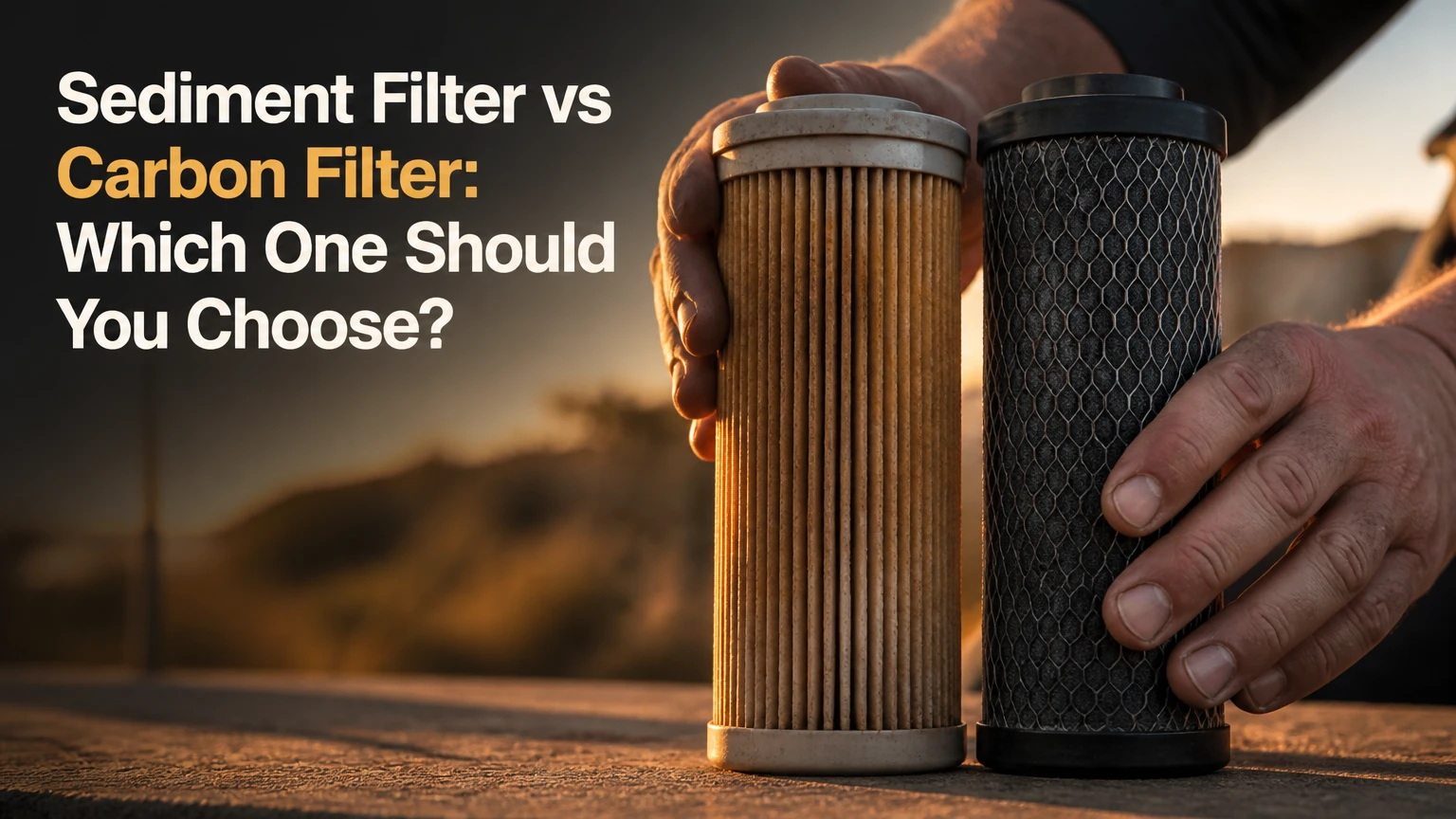
A sediment filter removes suspended particles such as sand, rust, and silt by mechanical filtration, while a carbon filter adsorbs chlorine, many organic chemicals, and taste- and odor-causing compounds. Neither cartridge handles every contaminant. For most home systems, the correct sequence is sediment filtration first, followed by activated carbon, with the water source and laboratory test determining the final design.
Key Facts at a Glance
- Sediment filters capture physical particles; they do not reduce dissolved chlorine, nitrate, hardness, or TDS.
- Carbon filters reduce selected chemicals through adsorption; ordinary carbon does not reliably remove pathogens, nitrate, fluoride, or every heavy metal.
- A sediment cartridge normally precedes carbon because particles occupy carbon pores and increase pressure loss.
- A 5-micron rating describes particle-size performance, but nominal and absolute ratings are not interchangeable.
- Free chlorine and chloramine require different carbon media and verified contact time.
- Filter replacement depends on contaminant load, water volume, flow rate, and the manufacturer’s tested capacity, not a universal calendar interval.
What Is a Sediment Filter?
A sediment filter is a porous mechanical barrier that removes suspended solids from water. Water passes through a mesh, fiber matrix, or pleated sheet, while particles larger than the available pathways are retained at the surface or within the filter depth.
Sediment media target visible or particulate contamination. Common examples include sand, clay, silt, pipe scale, rust flakes, and drilling debris. A sediment cartridge does not chemically react with chlorine and cannot lower dissolved salts or total dissolved solids.
The filter’s job is often protective rather than cosmetic. A sediment stage keeps particulate matter away from carbon beds, reverse-osmosis membranes, ultraviolet sleeves, faucet aerators, ice makers, and solenoid valves. That protection can reduce premature clogging even when the sediment cartridge does not change water taste.
How Does Mechanical Filtration Work?
Mechanical filtration uses size exclusion. Larger particles become trapped at the outer surface, while smaller particles move deeper into the fiber structure until a pore or tortuous pathway retains them.
Depth cartridges, including melt-blown polypropylene and string-wound designs, use a progressively tighter structure. Pleated cartridges provide a large surface area and often maintain flow longer in water with a moderate particle load. Spin-down separators use a washable screen and a purge valve for coarse material, but they are not a substitute for fine cartridge filtration.
A new cartridge may create a pressure drop of roughly 1-5 psi in a residential system, depending on cartridge size, flow, micron rating, and water temperature. Pressure loss rises as retained solids fill the media.
What Is a Carbon Filter?
A carbon filter contains activated carbon, a highly porous material that adsorbs certain dissolved compounds onto internal surfaces. Activated carbon commonly reduces free chlorine, selected volatile organic compounds, fuel-related compounds, pesticides, and taste- and odor-causing organic molecules.
Adsorption is different from absorption. Adsorption holds a contaminant on a surface; the carbon does not function like a sponge that uniformly draws chemicals into its bulk. Performance depends on carbon type, contaminant chemistry, bed volume, water temperature, pH, flow rate, and empty-bed contact time.
Carbon filters also have limits. Standard activated carbon does not reliably reduce TDS, nitrate, fluoride, microbiological contamination, hardness, or every dissolved metal. A manufacturer’s performance sheet must identify the specific contaminant and capacity.
The U.S. Environmental Protection Agency states, “There is no single treatment process that will remove all contaminants from drinking water.” That principle applies directly here: cartridge selection must follow a water test and a contaminant claim, not a general label such as “purifier.”
Which Carbon Media Should You Use?
| Carbon type | Typical construction | Main strength | Main limitation |
|---|---|---|---|
| GAC | Loose granules | 1-5 gpm chlorine polishing | Channeling risk at high flow |
| Carbon block | Compressed carbon powder | 0.5-10 micron particulate and chemical reduction | Higher pressure drop |
| Radial-flow carbon | Carbon wall around a flow path | 5-15 gpm whole-house capacity | Requires correct cartridge sizing |
| Catalytic carbon | Modified carbon surface | Chloramine and hydrogen sulfide treatment | Higher media cost and capacity dependence |
Granular activated carbon usually permits greater flow through a smaller pressure drop, but water can form preferential channels through loose granules. Carbon block creates more uniform contact and may provide limited particulate capture, although it should not replace a dedicated sediment prefilter where turbidity is high.
Catalytic carbon is a specific choice for chloramine or hydrogen sulfide. A standard carbon cartridge rated for free chlorine should not be assumed to treat chloramine at the same flow rate.
Sediment Filter vs Carbon Filter: What Is the Difference?
Sediment filters remove particles by physical retention, whereas carbon filters reduce selected dissolved chemicals through adsorption. A sediment filter is the better match for cloudy water, sand, and rust; a carbon filter is the better match for chlorine taste, chemical odor, and certain organic contaminants.
| Decision factor | Sediment filter | Carbon filter |
|---|---|---|
| Primary mechanism | Mechanical retention | Adsorption or catalytic reduction |
| Typical targets | Sand, rust, silt, scale | Chlorine, VOCs, odor compounds |
| Typical rating | 1-100 microns | 0.5-10 microns for many blocks |
| Normal position | First stage | Second stage or polishing stage |
| TDS reduction | 0% | Usually 0% |
| Chlorine reduction | 0% | Up to the certified claim |
| Heavy-metal reduction | 0% | Selective, model-specific |
| Typical cartridge cost | $5-$25 | $10-$60 |
| Typical replacement interval | 1-6 months | 3-12 months |
| Main failure symptom | Falling water pressure | Returning taste or odor |
The comparison has a practical conclusion: these filters are usually complementary, not competing. A sediment filter protects the carbon cartridge, and the carbon cartridge addresses contaminants that mechanical filtration cannot touch.
Which Filter Removes Which Contaminant?
No cartridge should be selected from a symptom alone when the contaminant could affect health. Cloudiness may indicate harmless sediment, while odor may indicate chlorine, sulfur compounds, organic contamination, or a plumbing problem.
| Contaminant or symptom | Sediment cartridge | Standard carbon cartridge | More appropriate treatment |
|---|---|---|---|
| Sand and visible grit | Effective at selected rating | Limited, early clogging | Spin-down plus sediment stages |
| Rust particles | Effective at selected rating | Limited | Sediment filter and iron testing |
| Free chlorine | No reduction | Often effective | Carbon block with certified capacity |
| Chloramine | No reduction | Variable | Catalytic carbon with tested flow |
| Hydrogen sulfide odor | No reduction | Variable | Catalytic carbon or oxidation treatment |
| Lead or copper | No reduction | Model-specific | Certified adsorption or RO |
| Nitrate | No reduction | No reliable reduction | Anion exchange or reverse osmosis |
| Fluoride | No reduction | No reliable reduction | Reverse osmosis or specialty media |
| Bacteria and viruses | No reliable reduction | No reliable reduction | Disinfection, such as UV or chlorination |
| Hardness and scale ions | No reduction | No reduction | Water softener or antiscalant |
| TDS | No reduction | No reduction | Reverse osmosis or deionization |
A carbon block can reduce some metals, but the claim must name the metal, cartridge model, capacity, and test protocol. “Carbon filter” alone is not sufficient evidence for lead, PFAS, or other regulated contaminants.
How Do Micron Ratings Work?
A micron rating indicates the approximate particle size a filter is designed to retain, but the number alone does not reveal whether the rating is nominal or absolute. A nominal 5-micron filter may remove a percentage of particles at or above 5 microns, while an absolute rating indicates a tighter maximum-pore performance under a defined test.
A lower rating generally captures smaller particles, but it also increases pressure loss and can shorten cartridge life. Installing a 1-micron cartridge immediately on a sandy well can produce rapid blockage without improving the treatment of dissolved contaminants.
| Rating or design | Typical use | Flow consequence | Practical choice |
|---|---|---|---|
| 50-100 micron screen | Large sand and grit | Low pressure loss | Spin-down prefilter |
| 20-30 micron depth | Coarse well sediment | Moderate loading capacity | First cartridge stage |
| 5-10 micron depth | General household particles | Balanced flow and capture | Common second sediment stage |
| 1-5 micron absolute | Fine particles and membrane protection | Higher pressure loss | RO or sensitive equipment prefilter |
Use staged reduction when the source carries heavy sediment. A 50-micron separator followed by a 20-micron depth cartridge and then a 5-micron cartridge usually lasts longer than one very fine cartridge exposed to the full particle load.
Which Filter Goes First?
The sediment filter goes first in a conventional two-stage system because suspended solids can block carbon pores and restrict water passages. The standard order is raw water, spin-down or coarse sediment stage, fine sediment cartridge, carbon filter, then any membrane or disinfection stage.
An exception can occur when a manufacturer designs a combined cartridge or a specialty carbon system with an integrated prefilter. The installation manual controls in that case. Whole-house systems also require attention to rated flow because a cartridge sized for one bathroom may starve a larger household.
How Should You Install and Flush the Filters?
Install cartridges according to the housing arrow, gasket position, and manufacturer’s flow direction. Close the supply, release pressure, remove the old cartridge, clean the sump, inspect the O-ring, install the new media, and reopen the supply slowly.
Flush a new carbon cartridge until the water runs clear and the manufacturer’s stated volume has passed. Five to ten minutes is a common practical starting point for small cartridges, but a larger whole-house carbon bed can require substantially more water. Carbon fines are usually harmless black particles, yet they can clog aerators and discolor water temporarily.
Check for leaks at the sump, cap, fittings, and bypass valve. Measure pressure before and after the system at the expected flow rate, because a static pressure reading can hide a cartridge that restricts water only during use.
Which Filter Type Fits Each Application?
| Application | Source condition | Recommended sequence | Typical replacement trigger |
|---|---|---|---|
| Municipal kitchen faucet | Chlorine and low turbidity | 5-micron sediment, carbon block | Taste return or certified gallon limit |
| Municipal whole house | Chlorine or chloramine | 20-micron prefilter, carbon or catalytic carbon | Pressure loss or capacity limit |
| Private well | Sand, silt, iron particles | Spin-down, 20-micron, 5-micron, carbon if tested | Pressure loss and seasonal turbidity |
| Reverse osmosis system | Fine sediment and chlorine | 5-micron sediment, carbon block, RO membrane | Pressure loss, chlorine breakthrough, schedule |
| Refrigerator dispenser | Low sediment, chlorine taste | Manufacturer-approved carbon cartridge | Rated gallons or six-month schedule |
| Rural rental property | Unknown source | Water test before treatment | Test result and filter capacity |
A well-water owner should test for coliform bacteria, nitrate, pH, hardness, iron, manganese, and turbidity before choosing carbon. Carbon can improve odor while leaving a microbiological hazard untreated.
How Much Do Sediment and Carbon Filters Cost?
Typical residential replacement costs range from $5-$25 for sediment cartridges and $10-$60 for carbon cartridges. Housing, plumbing size, cartridge capacity, certification, and whole-house flow can move system costs from approximately $40 for a basic two-stage point-of-use setup to more than $1,000 for a high-flow well-water installation.
| System scale | Sediment cost | Carbon cost | Typical replacement period |
|---|---|---|---|
| Under-sink single cartridge | $8-$20 | $15-$60 | 3-12 months |
| Standard 10-inch dual housing | $5-$15 | $10-$35 | 1-9 months |
| Big Blue whole-house housing | $15-$40 | $25-$100 | 2-12 months |
| Backwashing carbon tank | $300-$900 media system | $600-$2,000 installed | 2-5 years for media |
Replacement intervals are estimates, not guarantees. A household using 300 gallons per month can keep a low-sediment cartridge longer than a household using 2,000 gallons, while a single muddy well event can exhaust a cartridge in days.
How Do You Verify a Filter’s Performance?
Verify performance through the exact contaminant claim, rated capacity, flow rate, and certification. NSF/ANSI 42 commonly relates to aesthetic effects such as chlorine, taste, and odor, while NSF/ANSI 53 addresses specific health-effect claims when the product is certified for that contaminant.
Certification does not mean a cartridge removes every chemical. Read the performance data sheet and confirm the model number, contaminant, gallons, replacement interval, and operating conditions. A filter advertised as “tested to NSF standards” is not necessarily certified by NSF.
What Should a Water Test Include?
For municipal water, start with the supplier’s annual water-quality report, then test at the tap if plumbing contamination or unusual taste is suspected. For private wells, use a laboratory accredited by the relevant state or provincial authority.
Test results should guide treatment selection. A chlorine result supports carbon selection, while nitrate requires a different process, and high turbidity requires upstream particle control before carbon or membrane treatment.
What Can Go Wrong?
The most common failure is choosing a cartridge from a symptom without identifying the contaminant. A carbon cartridge may remove chlorine odor but leave nitrate unchanged, and a fine sediment cartridge may clear visible particles while leaving dissolved iron that later stains fixtures.
- Sudden low pressure: Replace or inspect the sediment cartridge first, then check the inlet screen and pressure regulator.
- Black specks after replacement: Flush the carbon cartridge until clear and clean faucet aerators.
- Taste returns early: Check rated gallons, flow rate, carbon type, and possible channeling in GAC media.
- Rotten-egg odor remains: Test for hydrogen sulfide and verify catalytic-carbon suitability.
- Carbon clogs rapidly: Add a sediment prefilter or reduce the particle load with a spin-down separator.
- Water remains cloudy: Confirm whether the cloudiness is air, fine sediment, microbial growth, or dissolved minerals.
Do not send hot water through a cartridge rated only for cold water. Heat can alter adsorption behavior, damage housings, and release retained compounds under unsuitable operating conditions.
Which Should You Choose?
Choose Sediment Filtration for Particles
Choose a sediment filter when the problem is sand, rust flakes, silt, or visible debris. Select a 20-50 micron stage for coarse well material and a 1-10 micron stage for finer protection, while checking pressure loss at the household’s actual flow.
Choose Carbon Filtration for Taste and Chlorine
Choose a carbon block when municipal water tastes or smells of free chlorine and the source has relatively low turbidity. Select catalytic carbon when chloramine or hydrogen sulfide is documented and the product has a matching performance claim.
Choose Both for Most Household Systems
Choose both when water contains particles and dissolved compounds, which is common in private wells and older plumbing. Use sediment first, carbon second, and add RO, softening, ion exchange, or disinfection only when testing identifies a contaminant those technologies address.
Choose Neither Without Testing for Health Risks
Do not rely on either cartridge as the sole treatment for bacteria, viruses, nitrate, fluoride, hardness, or unknown well contamination. Boiling, ultraviolet treatment, reverse osmosis, ion exchange, or professionally designed oxidation may be required, depending on the test result.
Expert Rules That Prevent Expensive Mistakes
First, size the system by peak flow rather than average daily volume. A carbon cartridge that treats one gallon per minute can provide acceptable taste at a kitchen tap but allow chlorine breakthrough when two showers and a washing machine operate together.
Second, use pressure gauges before and after a whole-house filter when possible. A rising differential pressure gives a more reliable replacement signal than a calendar reminder, especially for wells with seasonal sediment changes.
Third, treat carbon capacity as contaminant-specific. A cartridge may have a large chlorine capacity but a much smaller capacity for a solvent, pesticide, chloramine, or sulfur compound, so one successful claim cannot be generalized to another chemical.
FAQ
Can a Carbon Filter Replace a Sediment Filter?
A carbon block may capture some fine particles, but it should not replace a dedicated sediment stage when water contains sand, rust, or silt. Particles consume carbon capacity and increase pressure loss. A separate sediment cartridge usually costs less to replace and protects the more expensive carbon media.
Is a Sediment Filter Better for Well Water?
A sediment filter is better for the particulate portion of well water, not for every well-water problem. Private wells can contain bacteria, nitrate, dissolved iron, manganese, sulfur compounds, or hardness. Test the well first, then combine sediment filtration with the treatment matched to each confirmed contaminant.
Does Carbon Filtration Lower TDS?
Standard activated carbon does not meaningfully lower total dissolved solids. TDS measures dissolved ions and salts, while carbon primarily adsorbs selected organic compounds and chlorine. Reverse osmosis or deionization is generally required when reducing TDS is the treatment objective.
Should You Use a Carbon Filter on Hot Water?
Use carbon cartridges only within the temperature range specified by the manufacturer, which is commonly intended for cold water. Hot water can damage housing components, change adsorption performance, and increase contaminant release. Install point-of-use carbon filtration on the cold-water line.
Why Does Filtered Water Still Smell Bad?
Filtered water can retain odor when the carbon type is mismatched, the cartridge is exhausted, the flow is too high, or the odor source is not adsorbable. Hydrogen sulfide, chloramine, bacterial growth, and drain gases require different diagnoses. Test the source and inspect the cartridge and plumbing.
The Bottom Line
Sediment filter vs carbon filter is not usually a choice between interchangeable products. Sediment filtration removes suspended particles and protects downstream equipment, while activated carbon targets chlorine, selected organic chemicals, and taste or odor. For a typical household system, install sediment first and carbon second, then verify the water test, flow rate, certification, and replacement capacity before selecting the cartridge.