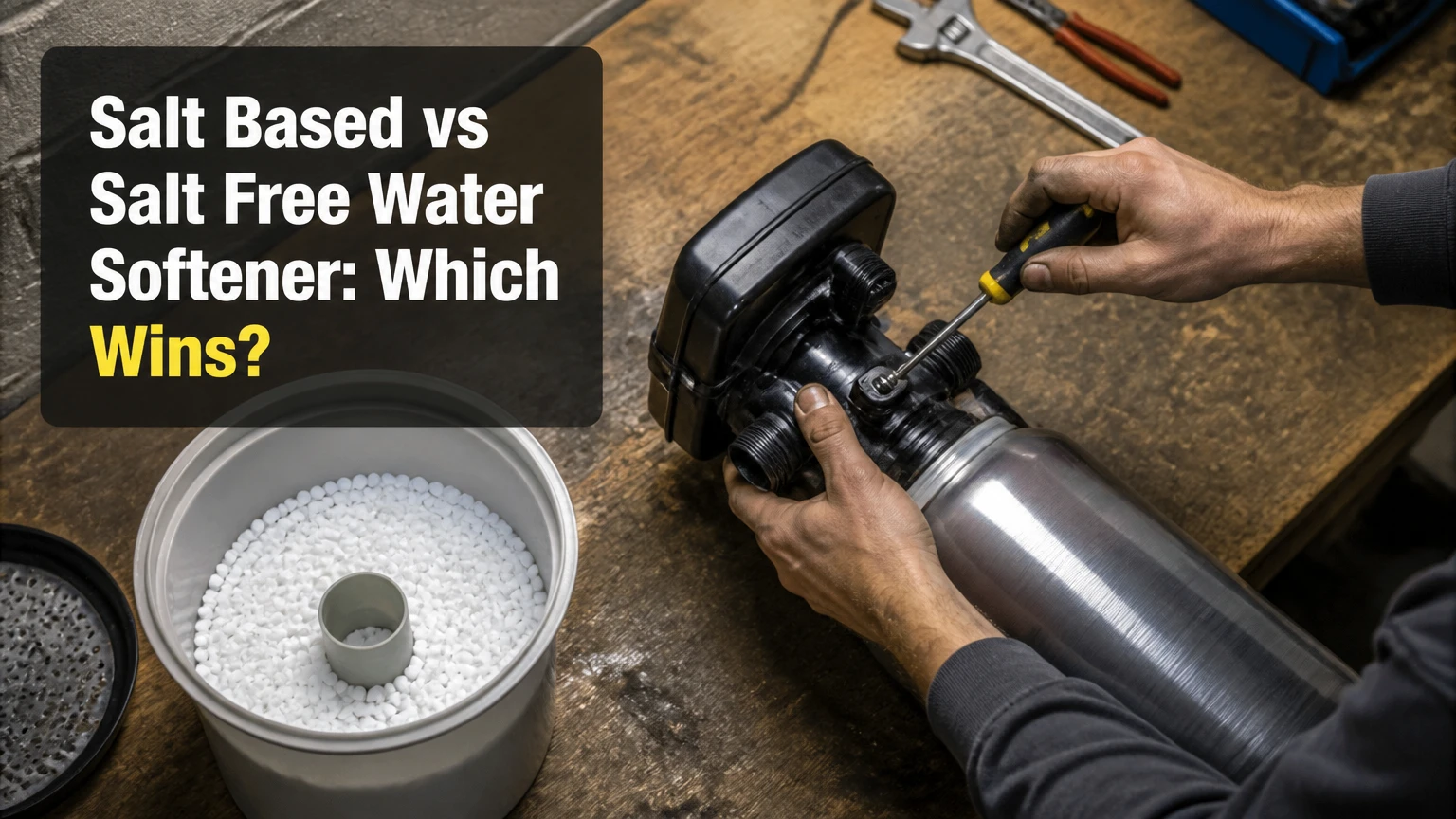
A salt-based water softener is the better choice when you need calcium and magnesium removed, softer-feeling water, easier soap lather, and fewer mineral spots. A salt-free water conditioner is better when scale reduction, zero brine discharge, low maintenance, and mineral retention matter more than chemically soft water.
Key Facts
Salt-based softeners remove hardness through ion exchange; salt-free conditioners leave calcium and magnesium in the water.
Salt-free TAC systems control scale attachment, but they do not lower a hardness test result.
A typical salt-based installation requires a drain, power outlet, brine tank, and periodic salt replenishment.
A typical whole-house TAC installation produces no regeneration wastewater and needs media replacement rather than salt.
Well water with iron, manganese, sediment, or sulfur usually needs testing and pretreatment before either system.
Local wastewater rules can restrict brine discharge, so homeowners should verify requirements with the municipality.
Salt Based vs Salt Free Water Softener: The Core Difference
The core difference is mineral removal. A salt-based softener exchanges calcium and magnesium for sodium or potassium ions, while a salt-free conditioner changes how some minerals crystallize so they attach less readily to plumbing and fixtures.
That distinction determines nearly every household result. Ion exchange lowers hardness, reduces scale-forming minerals, improves soap performance, and changes the water’s measurable chemistry. Template-assisted crystallization, commonly called TAC, targets scale control without substantially changing hardness, alkalinity, or total dissolved solids.
The U.S. Geological Survey describes hard water as “not a health hazard, but a nuisance.” That nuisance can include deposits on faucets, reduced heating efficiency, cloudy glassware, dry-feeling skin, and increased detergent use. A conditioner may address deposits inside a water heater, but it cannot deliver every benefit associated with mineral removal.
How Does Each System Work?
A salt-based softener uses resin beads, brine, and a control valve; a salt-free TAC conditioner uses catalytic media and does not regenerate with salt. The systems therefore have different plumbing, operating costs, test results, and failure modes.
How ion exchange removes hardness
A salt-based unit sends hard water through resin beads carrying exchangeable sodium or potassium ions. Calcium and magnesium have a stronger attraction to the resin than sodium, so the hardness ions attach to the beads and release sodium or potassium into the treated water.
A metered control valve eventually starts regeneration according to the gallons used and the programmed hardness. The usual sequence is:
- Backwash: Water flows through the resin in reverse to remove sediment and expand the bed.
- Brine draw: Concentrated salt solution passes through the resin and displaces calcium and magnesium.
- Slow rinse: The displaced hardness and brine move toward the drain.
- Fast rinse: Fresh water compacts and cleans the resin bed.
- Brine refill: The brine tank receives a measured volume of water.
A typical residential regeneration uses roughly 20-60 gallons of water, although efficient metered and counter-current designs can use less. Twin alternating tanks can provide softened water while one tank regenerates, which matters in large households or properties with continuous demand.
What does a salt-free conditioner change?
A TAC conditioner exposes water to a media surface that encourages dissolved hardness minerals to form microscopic crystals. The crystals remain in the water, but they have less tendency to nucleate onto heated surfaces and pipe walls.
TAC is therefore a scale-control process, not a softening process. A hardness test can still report the original calcium and magnesium concentration, and evaporation can leave minerals on a glass, shower door, or faucet. Performance also depends on correct flow rate, media capacity, pH, chlorine exposure, iron concentration, and the manufacturer’s water-quality limits.
Which System Fits Your Water and Household?
The correct choice depends on the result you want, not the product label. Salt-based treatment fits mineral removal; salt-free treatment fits scale control where preserving minerals and avoiding brine are higher priorities.
| Decision criterion | Salt-based softener | Salt-free TAC conditioner | Practical consequence |
|---|---|---|---|
| Hardness removal | Yes, often 90% or more | No meaningful reduction | Only ion exchange changes a hardness test |
| Scale control | Very high after correct sizing | High when water meets media limits | TAC does not prevent every evaporative spot |
| Soap lather | Improves substantially | Usually unchanged | Salt-based treatment suits bathing and laundry goals |
| Regeneration wastewater | Typical 20-60 gallons per cycle | 0 gallons | TAC avoids a drain connection |
| Salt or media replacement | Salt often every 4-8 weeks | Media commonly every 3-6 years | Usage depends on water chemistry and household demand |
| Electrical requirement | Usually 120-volt control valve | Often none | TAC works where power is unavailable |
| Drain requirement | Required for regeneration | Usually none | Installation is simpler for TAC |
| Drinking-water minerals | Calcium and magnesium reduced | Minerals retained | Choose based on taste, diet, and treatment goals |
Hardness levels change the decision
Water hardness is commonly expressed in grains per gallon, or GPG, and milligrams per liter as calcium carbonate. One GPG equals approximately 17.1 milligrams per liter.
| Hardness classification | GPG | Approximate mg/L as CaCO3 | Typical household concern |
|---|---|---|---|
| Soft | 0-1 | 0-17 | Little scale from hardness |
| Slightly hard | 1-3.5 | 17-60 | Occasional spots or film |
| Moderately hard | 3.5-7 | 60-120 | Noticeable soap and fixture deposits |
| Hard | 7-10.5 | 120-180 | Frequent scale and higher detergent use |
| Very hard | Above 10.5 | Above 180 | Strong case for ion exchange if regulations permit |
These categories are screening tools, not universal treatment rules. A household with a tankless heater may value scale control at 6 GPG, while a renter with no drain may accept hard-water symptoms at 15 GPG. Test the supply before buying equipment.
What Does Each Option Cost to Own?
Typical installed prices overlap, so the cheapest purchase price does not identify the lower-cost system. Salt, water, electricity, cartridges, pretreatment, drain work, and replacement media determine long-term expense.
| Cost element | Salt-based typical range | Salt-free TAC typical range | Main cost driver |
|---|---|---|---|
| Equipment | $500-$2,500 | $600-$2,000 | Capacity, valve, tank, and certification |
| Installation | $500-$1,500 | $300-$800 | Drain, outlet, bypass, and pipe changes |
| Annual consumables | $100-$250 | $100-$300 | Salt use or replacement cartridges |
| Regeneration water | 20-60 gallons per cycle | 0 gallons | Hardness, household demand, programming |
| Typical service life | 10-15 years | 5-10 years | Resin or media condition and pretreatment |
| Added electrical work | $0-$300 | $0-$100 | Existing outlet and control-valve location |
| Point-of-use RO add-on | $300-$1,000 | $300-$1,000 | Sodium reduction or drinking-water polishing |
Salt-based operating cost is often predictable when the valve meters actual consumption. A four-person household using 12,000 gallons per month in 15 GPG water has a hardness load of about 180,000 grains per month before efficiency adjustments. That figure determines resin capacity and salt demand more accurately than household size alone.
Salt-free systems avoid brine and often reduce installation complexity, but TAC media is not permanent. Chlorine, iron, sediment, excessive flow, and high hardness can shorten its useful life, creating an early replacement cost.
Does Salt-Free Mean Maintenance-Free?
Salt-free treatment reduces routine labor but does not eliminate maintenance. A TAC system commonly needs an upstream sediment filter, periodic inspection, and media replacement on a schedule determined by gallons, water chemistry, and the manufacturer.
| Maintenance task | Salt-based frequency | Salt-free frequency | Failure if neglected |
|---|---|---|---|
| Check salt or media | Monthly | Every 3-6 months | Interrupted treatment |
| Replace consumable | Salt every 4-8 weeks | Media every 3-6 years | Hardness or scale returns |
| Clean prefilter | Every 1-3 months | Every 1-3 months | Pressure loss and media fouling |
| Test hardness or scale | Every 6-12 months | Every 6-12 months | Incorrect settings remain hidden |
| Inspect bypass and leaks | Every 6-12 months | Every 6-12 months | Untreated water or water damage |
| Service control valve | Every 3-5 years | Usually not applicable | Failed regeneration or leakage |
A common practitioner error is treating a salt-free unit as a universal filter. TAC media does not reliably remove iron, manganese, sediment, chlorine, bacteria, nitrate, or dissolved salts. Pretreatment must address those contaminants separately.
Which System Works Better for Specific Goals?
Salt-based softeners win when the goal involves the water’s chemistry. Salt-free conditioners win when the goal is scale management with minimal discharge and no salt handling.
| Household goal | Recommended system | Reason | Important limitation |
|---|---|---|---|
| Spot-free dishes | Salt-based | Removes calcium and magnesium | Rinse aid and proper detergent still matter |
| Softer bathwater feel | Salt-based | Reduces hardness minerals | Skin symptoms can have other causes |
| Tankless heater scale control | Salt-based or TAC | Both can reduce scale under correct conditions | TAC requires compliant inlet chemistry |
| No drain connection | Salt-free TAC | No regeneration discharge | Hardness remains in the water |
| Low-sodium drinking water | Salt-free or RO plus softener | Avoids or removes added sodium | TAC does not purify microbiologically |
| High-iron well water | Salt-based with pretreatment | Ion exchange can handle some iron after testing | Iron may foul resin without oxidation or filtration |
| Rental property | Salt-free TAC | Easier installation and removal | Tenant still sees hard-water deposits |
| Very hard water | Usually salt-based | Consistent mineral reduction | Confirm brine-discharge rules first |
When is salt-based treatment the better choice?
Choose ion exchange when you want measurable soft water throughout the home. The strongest use cases are water above approximately 7 GPG, persistent soap scum, severe faucet deposits, cloudy laundry, high hardness entering a water heater, or well water that has been professionally tested.
Salt-based systems do add sodium or potassium, but the amount varies with hardness and programmed efficiency. A reverse-osmosis drinking system at the kitchen sink can reduce sodium while the whole-house softener protects fixtures and appliances. People on medically restricted sodium diets should ask a clinician about their total intake rather than estimate from taste.
When is salt-free treatment the better choice?
Choose TAC when the priority is reducing scale with no brine discharge, no salt bags, and minimal installation work. TAC can suit municipal water with moderate hardness, a homeowner who wants to protect a water heater, or a property without a floor drain.
TAC is not a good substitute for softening when the household expects better lather, less soap use, reduced hardness readings, or consistently spotless surfaces. A conditioner can reduce scale on heating elements while leaving visible mineral residue after water evaporates. That limitation is often missed during sales demonstrations.
What About Magnetic, Electronic, and Citric Systems?
Magnetic and electronic descalers have less consistent independent support than ion exchange or properly specified TAC media. Citric-acid systems bind some minerals temporarily, but cartridge consumption and water chemistry determine performance.
| Alternative | Primary mechanism | Typical maintenance | Best-supported limitation |
|---|---|---|---|
| Magnetic device | Applied magnetic field | Inspect device annually | Results vary with water and plumbing conditions |
| Electronic descaler | Electrical signal or field | Check power supply monthly | Does not remove hardness |
| Citric-acid cartridge | Chelation | Replace cartridge every 3-6 months | Treatment capacity depends on flow and dose |
| Reverse osmosis | Membrane separation | Replace filters every 6-24 months | Point-of-use flow, wastewater, and no whole-house softening |
| Polyphosphate feeder | Sequestration | Refill media every 3-12 months | Controls deposits without lowering hardness |
A magnetic device should not be selected solely because it has no cartridge or drain. Claims about scale reduction can be difficult to compare because test conditions, pipe material, temperature, flow, and observation time differ. For expensive equipment, use a treatment with a defined performance test and published operating limits.
How Should You Size and Install a Salt-Based Unit?
Size a salt-based softener by hardness load and peak flow, then verify that the resin capacity matches household demand. The basic estimate is daily gallons multiplied by hardness in GPG, multiplied by days between regenerations, with reserve capacity added.
For example, 300 gallons per day at 12 GPG creates 3,600 grains per day. A seven-day interval requires 25,200 grains, before reserve capacity and iron correction. A professional may choose a nominal 32,000-grain or larger unit after considering peak flow, actual usable capacity, and manufacturer salt settings.
Installation normally includes a whole-house bypass, a drain air gap where required, a nearby outlet, brine-tank space, and a prefilter if sediment or chlorine threatens the resin. Keep the drain line secure. A loose line can flood the room during regeneration.
What Water Testing Should Happen First?
Test hardness, iron, manganese, pH, total dissolved solids, chlorine, and sulfur indicators before selecting media. Municipal customers can start with a utility report, but a certified laboratory test is more dependable for well water or unexplained staining.
| Test | Typical concern | Salt-based implication | TAC implication |
|---|---|---|---|
| Hardness | Above 7 GPG | Determines resin capacity | May exceed practical media limits |
| Iron | Above 0.3 mg/L | Can foul resin | Can coat catalytic media |
| Manganese | Above 0.05 mg/L | May require oxidation or filtration | Usually needs pretreatment |
| Chlorine | Above 1-2 mg/L | Can degrade resin over time | Can shorten media life |
| pH | Below 7 or above 8.5 | May require correction | Can reduce conditioning consistency |
| Sediment | Visible particles or turbidity | Requires sediment filtration | Requires sediment filtration |
| Hydrogen sulfide | Rotten-egg odor | Needs separate oxidation treatment | Not solved by TAC |
The pretreatment rule is simple: remove the contaminant that damages the treatment media before asking the media to control hardness or scale. A softener is not a substitute for an iron filter, carbon filter, sediment filter, or disinfection system.
What Problems Do These Systems Commonly Develop?
Salt-based units commonly fail through salt bridging, resin fouling, incorrect programming, blocked injectors, or valve leakage. Salt-free units commonly lose pressure through clogged prefilters or lose scale-control performance when media capacity is exhausted or inlet chemistry falls outside specifications.
| Symptom | Likely cause | Immediate check | Corrective action |
|---|---|---|---|
| Hard water after softener | Bypass open or resin exhausted | Check valve position and hardness | Close bypass or regenerate and test |
| Salt tank appears full | Salt bridge or wet salt | Probe carefully with a broom handle | Break bridge and correct refill level |
| Continuous drain flow | Stuck valve or debris | Observe drain during non-regeneration | Service valve and inspect seals |
| Rust-colored water | Iron breakthrough | Test iron before and after unit | Add iron pretreatment or resin cleaner |
| TAC pressure loss | Clogged sediment filter | Compare inlet and outlet pressure | Replace or flush prefilter |
| Scale returns suddenly | Exhausted or fouled media | Check media age and chlorine | Replace media and correct pretreatment |
Do not pour random chemicals into a brine tank or media vessel. Resin cleaners, disinfectants, and acid products require label compatibility with the specific equipment and drinking-water application.
Which Should You Choose?
Choose salt-based for mineral removal
Select a metered salt-based softener if your priorities are softer-feeling water, improved lather, fewer mineral spots, and lower hardness entering appliances. Choose a twin-tank configuration when uninterrupted softened water matters, and choose efficient counter-current regeneration when salt and water consumption are high priorities.
Choose salt-free TAC for scale control
Select a TAC conditioner if you accept that the water remains hard but want to reduce scale on heating surfaces without salt, regeneration wastewater, or a drain. Confirm hardness, iron, chlorine, pH, and flow limits before installation.
Choose a combination system for mixed objectives
A practical combination can include sediment filtration, carbon treatment, ion exchange, and reverse osmosis at the kitchen sink. That arrangement separates jobs: filtration removes particles or chlorine, softening removes hardness, and reverse osmosis polishes drinking water.
FAQ
Will a salt-free conditioner remove existing scale?
No. A salt-free conditioner can reduce new scale attachment when its media suits the water, but it does not dissolve deposits already coating faucets, showerheads, heat exchangers, or pipe walls. Existing mineral buildup requires manual descaling or a compatible cleaning procedure before conditioning results can be evaluated.
Is softened water safe to drink?
Softened water is generally usable for many households, but sodium or potassium is added during ion exchange. The amount depends on hardness and softener settings. Households managing sodium-restricted diets should ask a healthcare professional and can install reverse osmosis at the kitchen faucet for lower-sodium drinking water.
Can a salt-free system improve dry skin?
A salt-free conditioner may reduce some scale residue, but it does not remove hardness minerals from bathwater. Salt-based softening can change the washing experience because soap reacts less with calcium and magnesium. Persistent irritation can also involve water temperature, fragrance, eczema, chlorine, or other personal factors.
Does a water softener protect a tankless water heater?
Both ion exchange and compliant TAC systems can reduce scale risk in a tankless heater, but neither works correctly with unsuitable inlet water. Ion exchange provides the more direct hardness reduction. TAC can be a reasonable alternative where brine discharge is restricted, provided flow, temperature, chlorine, iron, and hardness remain within specifications.
Are salt-based softeners banned?
Some municipalities restrict or discourage salt-based equipment because regeneration brine can increase chloride loading in wastewater. Rules differ by state, utility, and discharge method. Check the local water authority, wastewater agency, or building department before installation rather than relying on a nationwide claim.
What is the best choice for well water?
A salt-based softener is often more adaptable for well water, but only after testing and pretreatment design. Iron, manganese, sediment, sulfur, acidity, and bacteria can damage equipment or require separate treatment. A laboratory water analysis should determine whether oxidation, filtration, pH correction, or disinfection comes before softening.
The Bottom Line
Salt based vs salt free water softener is ultimately a choice between mineral removal and scale control. Choose a salt-based softener when you need genuinely soft water and lower hardness; choose a salt-free TAC conditioner when zero brine, mineral retention, and simpler maintenance matter more. Test the water first, verify local discharge rules, and size the system from measured hardness and flow rather than household size alone.