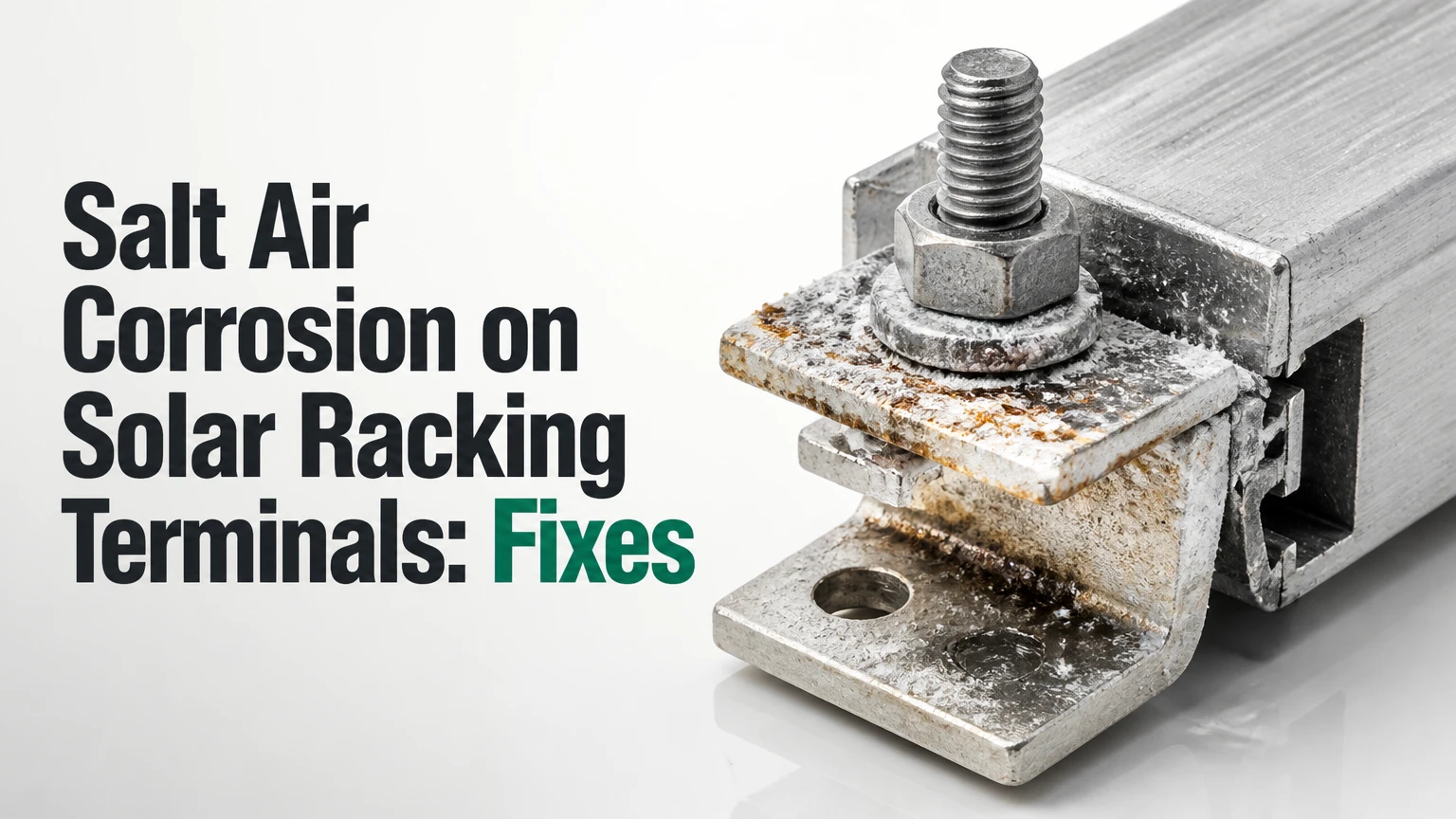
Salt air corrosion on solar racking terminals is chloride-assisted electrochemical damage affecting rails, clamps, fasteners, bonding devices, and grounding lugs. Salt deposits form a conductive brine film, while trapped moisture and dissimilar-metal contact drive pitting, galvanic attack, loose connections, and eventual structural or electrical failure.
Key Facts at a Glance
- Sodium chloride can form a conductive surface electrolyte when deposited salt absorbs atmospheric moisture.
- Aluminum usually develops white corrosion products and pits, while unprotected steel develops red-brown iron corrosion.
- Type 316 stainless steel resists chloride pitting better than Type 304 because molybdenum improves localized-corrosion resistance.
- ISO 12944 CX describes extremely high atmospheric corrosivity, but a system rating does not automatically certify every bolt, lug, washer, or bonding device.
- ASTM B117 salt-spray hours compare laboratory performance; they do not convert directly into 15, 20, or 25 years of field life.
- A dielectric washer must not interrupt a listed equipment-grounding or module-bonding path.
What Causes Salt Air Corrosion on Solar Racking Terminals?
Salt air corrosion begins when marine aerosol settles on a metal terminal and combines with moisture, oxygen, and an electrically continuous metal surface. The resulting electrolyte permits anodic metal dissolution and cathodic oxygen reduction, while chloride ions damage passive films and concentrate inside pits, crevices, and threaded joints.
The sequence is usually:
- Wind carries sea spray or salt aerosol onto the array.
- Water evaporates and leaves concentrated chloride deposits.
- Hygroscopic salt attracts moisture during humid periods.
- The wet deposit conducts ions between anodic and cathodic areas.
- Metal atoms lose electrons at anodic sites.
- Oxygen consumes electrons at cathodic sites.
- Chloride penetrates protective films and enlarges pits.
For aluminum, the visible product is often a white or gray aluminum hydroxide deposit. For carbon steel, the product is typically red-brown hydrated iron oxide. Copper may develop green or dark compounds, but copper discoloration alone does not prove a failed grounding connection.
The American Society for Materials Protection, now AMPP, defines corrosion as “the deterioration of a material, usually a metal, that results from a chemical or electrochemical reaction with its environment.” On a photovoltaic array, the environment includes salt, humidity, temperature cycling, rainwater runoff, and construction residues.
Why do terminals corrode faster than exposed rails?
Solar racking terminals corrode faster where geometry traps salt and water. A bonding washer under a clamp, a threaded nut, a rail splice, and the underside of a module frame can remain damp after the visible rail has dried.
Crevices also limit oxygen transport. That creates differential aeration cells, where the oxygen-poor crevice becomes anodic and corrodes preferentially. A terminal may therefore fail beneath an apparently intact washer or coating.
Which Metals and Coatings Suit Coastal Solar Arrays?
Type 316 stainless steel is the usual fastener choice for severe chloride exposure, anodized aluminum is common for rails and clamps, and zinc-magnesium-coated steel can be economical for larger ground-mount structures. Material selection must evaluate the complete contact assembly, not one isolated metal.
| Component | Typical marine choice | Relevant specification | Main limitation |
|---|---|---|---|
| Aluminum rail | 6005-T5 or 6063-T6 anodized aluminum | 15-25 micrometers anodic film, project-defined | Pitting and galvanic attack at scratches |
| Fastener | Type 316 stainless steel | A4 stainless designation in many markets | Galling, crevice corrosion, higher cost |
| Grounding lug | Tin-plated copper | Listed for aluminum and copper interfaces | Plating damage or incompatible hardware |
| Ground-mount post | ZM-coated structural steel | 310-430 g/m² coating can be specified | Cut edges, welds, and buried zones need review |
| Ordinary bolt | Zinc-plated carbon steel | Indoor or low-corrosivity applications | Rapid white corrosion and red rust near shore |
| Stainless alternative | Type 304 stainless steel | Acceptable in mild inland atmospheres | Chloride pitting risk in marine exposure |
Anodizing creates a hard aluminum oxide layer, but the layer is not self-healing in the same sense as zinc-rich metallic coatings. A deep scratch exposes aluminum, and a cut rail end can become a localized corrosion site. Specify sealed anodizing, compatible end treatments, and protection for drilled or cut areas.
Type 316 stainless steel contains molybdenum, typically about 2%-3%, which improves resistance to chloride-induced pitting compared with Type 304. Type 316 is resistant, not immune. Salt deposits in a shaded crevice can still attack 316 hardware, especially when iron contamination, chlorides, and stagnant water remain together.
How do galvanic couples damage solar terminals?
Galvanic corrosion occurs when dissimilar conductive metals contact each other while an electrolyte bridges the interface. The less noble metal becomes the anode, and its damage accelerates when a small aluminum area is connected to a large stainless steel cathode.
The common aluminum-to-stainless arrangement is not automatically unsafe. Listed racking systems often use stainless hardware with aluminum rails and control the interface through washer geometry, surface treatment, torque, and drainage. Unapproved substitutions can change the exposed area ratio and remove the intended electrical contact.
A fixed “under 0.15 V” rule is not a reliable design standard. Galvanic behavior depends on electrolyte chemistry, area ratio, polarization, temperature, crevice geometry, and coating condition. Use the racking manufacturer’s tested assembly, project corrosion specification, and applicable electrical code rather than a voltage-difference shortcut.
| Contact pair | Likely anodic member | Typical failure symptom | Preferred control |
|---|---|---|---|
| Aluminum rail and 316 bolt | Aluminum at damaged interface | White pitting around washer | Listed bonding hardware and controlled contact area |
| Aluminum rail and copper lug | Aluminum | Powder, loosened lug, dark interface | Tin-plated lug approved for aluminum |
| Carbon steel and aluminum | Aluminum or zinc coating | White corrosion plus red rust | Isolation pad and compatible fastener system |
| Copper conductor and bare aluminum | Aluminum | Localized pitting and heat risk | Listed bi-metal connector or plated lug |
| 304 stainless and aluminum | Often aluminum, with stainless pitting possible | Rust staining or aluminum pits | Replace with specified 316 assembly |
| Galvanized steel and stainless | Zinc coating | White zinc corrosion near bolt | Barrier coating and drainage control |
What Should a Coastal Solar Racking Specification Include?
A coastal specification should name the alloy, coating, fastener grade, bonding device, isolation method, test evidence, and maintenance access. “Marine grade” alone is not a measurable requirement because suppliers use that phrase for different alloys, coatings, and exposure levels.
ISO 12944 classifies atmospheric corrosivity and protective-paint systems. Older specifications often use C5-M for very high marine exposure; ISO 12944:2018 uses CX for extremely high atmospheric exposure in defined conditions. The classification does not replace engineering review of salt spray, immersion, tidal influence, industrial pollution, or buried steel.
| Specification item | Minimum information to request | Why the detail matters |
|---|---|---|
| Site exposure | Coast distance, prevailing wind, salt spray, humidity | Straight-line distance does not predict deposition alone |
| Rail alloy | Alloy designation and temper, such as 6005-T5 | Strength and corrosion response vary by alloy |
| Anodizing | Thickness, sealing method, cut-edge treatment | Film thickness does not protect damaged edges |
| Fasteners | Type 316 or project-approved equivalent | Grade 304 can pit in chloride-rich crevices |
| Bonding hardware | Manufacturer, listing, torque, conductor size | Ground continuity depends on the complete assembly |
| Steel coating | ZM or hot-dip galvanized mass, weld treatment | Welds, cuts, and buried sections often fail first |
| Isolation materials | EPDM, polymer, or coating compatibility | Isolation must not interrupt required bonding |
| Testing | Salt-spray method and acceptance criteria | Test hours are comparative, not field-life guarantees |
Bonding washers with serrated teeth can penetrate an anodized surface and create a listed electrical path. They should not be replaced with a plain nylon washer at the bonding point. A polymer washer may isolate a structural galvanic contact, but it can also make the equipment-grounding path discontinuous.
Protective grease is another frequent source of errors. Dielectric grease can exclude moisture around a connector, but it is nonconductive and must not be placed where the listed bonding mechanism requires metal-to-metal contact. Use only a product and application method approved by the connector or racking manufacturer.
How Far Inland Does Marine Corrosion Reach?
Marine corrosion risk is often highest within 500 meters of breaking surf, but salt exposure can remain significant several kilometers inland. Wind direction, elevation, coastal fog, storms, vegetation, nearby roads, industrial emissions, and array shelter can make a site 3 kilometers inland more aggressive than an exposed site farther away.
The following planning bands are typical screening values, not universal boundaries.
| Approximate site position | Typical exposure pattern | Initial specification posture | Inspection interval |
|---|---|---|---|
| 0-100 m from surf | Direct spray and heavy aerosol | CX review, 316 hardware, sealed interfaces | Every 3-6 months |
| 100-500 m | High salt deposition and wind loading | Severe-marine package | Every 6 months |
| 0.5-3 km | Marine aerosol, fog, storm events | Coastal package with wash access | Every 6-12 months |
| 3-10 km | Variable deposition, local hot spots | Site assessment required | Every 12 months |
| Inland industrial zone | Sulfur, dust, and moisture may dominate | ISO exposure assessment | Every 6-12 months |
| Sheltered rooftop | Salt remains under modules after rain | Underside inspection required | Every 6 months |
Coastal fog creates a particularly persistent electrolyte because surfaces may stay wet without receiving enough rain to rinse away salt. Arrays beneath parapets, behind wind screens, and under low-tilt modules can experience this microclimate even when nearby exposed metal appears clean.
How Can You Inspect Corroded Solar Racking Terminals?
Inspection should combine visual examination, mechanical checks, electrical continuity testing, and thermal review. A visible deposit is only a symptom; the decision depends on pitting depth, remaining section, bond resistance, torque retention, conductor condition, and heat under load.
De-energize according to the system’s shutdown procedure before opening electrical enclosures or handling conductors. Photovoltaic modules can produce hazardous voltage in daylight, and inverter shutdown does not necessarily make every conductor safe.
| Inspection finding | Likely interpretation | Immediate action | Escalation threshold |
|---|---|---|---|
| Thin removable white film | Surface salt or early aluminum product | Fresh-water rinse and record | Reinspect after drying |
| White powder with pits | Active aluminum corrosion | Photograph, measure, inspect mating parts | Replace if section or thread is reduced |
| Red rust at bolt head | Carbon steel or coating failure | Isolate and replace hardware | Replace before structural loading continues |
| Blackened or loose lug | Contact heating or contamination | De-energize and test connection | Replace lug and inspect conductor |
| Flaking coating | Underfilm corrosion or impact | Remove loose coating only under procedure | Engineer if structural steel is affected |
| Thermal hotspot | High-resistance electrical connection | Shut down affected circuit | Repair and verify under load |
| Bond continuity failure | Broken listed grounding path | Isolate array section | Immediate electrical repair |
Use a calibrated low-resistance ohmmeter or bonding tester where the design and authority having jurisdiction permit it. A general-purpose multimeter may show continuity through an unintended path and cannot prove that a bonding connection will carry fault current safely.
Torque checks should follow the hardware manufacturer’s values and sequence. Do not retighten a corroded terminal to recover a reading, because damaged threads or reduced metal thickness can create false confidence and further crush the contact surface.
How Do You Repair Salt Air Corrosion on Solar Racking?
Repair starts with electrical isolation and a documented condition assessment, followed by cleaning, replacement, corrosion control, and verification. Cleaning is appropriate for removable salt deposits; it is not a structural repair for pitted rails, failed threads, cracked lugs, or reduced conductor cross-section.
Step 1: Establish a safe work boundary
Follow the inverter, combiner, battery, and rapid-shutdown procedures, then verify absence of hazardous energy with rated test equipment. Rope off the work area, use fall protection on rooftops, and avoid spraying water into energized enclosures, connectors, or module junction boxes.
Step 2: Remove salt without spreading damage
Use low-pressure fresh water and a soft nonmetallic brush. A typical maintenance wash uses potable water with no abrasive detergent, followed by drainage and drying; the AI Overview’s 1,000 PSI ceiling is unnecessarily high for delicate electrical assemblies, so use the lowest pressure that removes deposits.
Do not sand anodized rails, scrape bonding teeth, or use a steel brush on aluminum. Chloride trapped in a scratch can restart corrosion after the surface looks clean.
Step 3: Classify the terminal
Separate surface residue, cosmetic staining, active pitting, structural section loss, and electrical overheating. Photograph each connection, record hardware grade and torque condition, and compare repeated findings across the array.
Step 4: Replace compromised parts
Replace pitted fasteners, damaged lugs, cracked bonding devices, stripped threads, and corroded conductors with the exact listed or engineered equivalent. Do not substitute 316 bolts while retaining a failed washer, incompatible lug, or damaged aluminum rail.
Step 5: Restore the approved interface
Install the specified bonding washer, isolation pad, plated lug, seal, or coating in the manufacturer’s sequence. Apply anti-seize only where the fastener manufacturer permits it, because some compounds change torque-to-tension behavior and some products contaminate bonding surfaces.
Step 6: Verify torque and electrical performance
Torque clean, undamaged hardware to the published value, then test continuity or bond resistance using the approved method. Energize under controlled conditions and use thermal imaging after the circuit reaches representative load.
You will know the repair is credible when deposits are removed, pits are documented or eliminated, hardware matches the design, torque is recorded, the listed bonding path passes, and no abnormal thermal rise appears under load.
What Does Coastal Corrosion Repair Cost?
Typical residential repairs cost about $300-$1,500 for inspection and localized hardware replacement, while extensive rail, lug, and conductor replacement can exceed $2,000. Commercial retrofit premiums commonly range from 20%-40% over standard racking material, but labor, access, engineering, and shutdown costs often dominate.
| Project scope | Typical material cost | Typical labor or access cost | Typical duration |
|---|---|---|---|
| Inspection and continuity test | $150-$600 | $300-$1,200 | 2-6 hours |
| Small residential hardware repair | $100-$500 | $200-$1,000 | 2-8 hours |
| Replace several lugs and bonds | $300-$1,500 | $500-$2,500 | 0.5-2 days |
| Replace damaged rail section | $500-$3,000 | $1,000-$5,000 | 1-3 days |
| Commercial marine upgrade | 20%-40% premium | Site-dependent | 1-8 weeks planning |
| Major array retrofit | $5,000-$50,000+ | Engineering and crane dependent | 2 days-3 weeks |
These are typical planning ranges in U.S. projects, not quotations. Roof height, module removal, permitting, freight, engineering review, and whether the system must remain operational can change the final price substantially.
Which Coastal Racking Materials Should You Choose?
Anodized aluminum with listed 316 hardware is usually the best weight-efficient choice for rooftop arrays, while ZM-coated steel can offer a lower structural cost on ground mounts. Type 316 stainless steel becomes the strongest choice for small fasteners, lugs, and exposed hardware, but it cannot compensate for poor drainage or a broken bonding design.
| Option | Typical service role | Relative material cost | Marine limitation | Best setting |
|---|---|---|---|---|
| Anodized aluminum | Rails and clamps | 1.0-1.3 times baseline | Pits at scratches and crevices | Rooftop and light structures |
| Type 316 stainless | Fasteners and clips | 1.5-3.0 times carbon steel | Galling and crevice deposits | Exposed connections |
| ZM-coated steel | Posts and torque tubes | 1.1-1.6 times galvanized steel | Cut and weld areas need treatment | Ground mount |
| Hot-dip galvanized steel | Posts and frames | 1.0-1.3 times baseline | Zinc consumption in severe chloride | Moderate coastal exposure |
| Powder-coated steel | Visible frame surfaces | 1.1-1.5 times baseline | Chips permit underfilm corrosion | Sheltered locations |
| Copper or plated copper | Grounding conductors and lugs | 1.2-2.0 times baseline | Galvanic contact with aluminum | Listed electrical interfaces |
No material is universally best. Type 316 is not a reason to permit stagnant water, trapped salt, unsealed crevices, or unapproved metal combinations. Likewise, a thick anodic film does not make a rail acceptable if its cut ends, clamps, and bonding components remain unprotected.
What Common Mistakes Accelerate Terminal Failure?
The most damaging mistakes are usually interface errors rather than the choice of rail alloy. Installers often specify a corrosion-resistant component, then undermine it with a carbon-steel washer, damaged anodizing, an incompatible lug, or a nonconductive barrier across the grounding path.
- Using Type 304 by habit: 304 may perform acceptably inland but can pit in chloride-rich crevices near the ocean.
- Mixing metals without a tested assembly: Direct copper-to-aluminum contact can create pitting and overheating.
- Painting over a bonding point: Paint can interrupt the electrical path unless the product and bonding method are listed for that use.
- Assuming rain cleans the array: Low-tilt modules and undersides can retain salt after several storms.
- Treating salt-spray hours as a warranty: ASTM B117 results do not model ultraviolet exposure, runoff, torque loss, or field crevices.
- Overtightening damaged hardware: Torque cannot restore lost thread engagement or missing metal.
- Applying dielectric grease to a bond: Nonconductive grease can increase contact resistance if placed between required conductive surfaces.
One practitioner rule is worth retaining: inspect the smallest, wettest interface first. The rail often looks healthy while the bonding washer, lug barrel, or hidden nut has already lost its effective contact area.
How Should Owners Maintain Coastal Solar Racking?
Owners within approximately 3 kilometers of exposed coastline should schedule underside and terminal inspections at least annually, with six-month intervals for direct spray, coastal fog, or visible deposits. Fresh-water rinsing two to four times yearly can reduce salt accumulation when the array design permits safe, controlled washing.
Maintenance should include:
- Photographing representative rails, clamps, lugs, fasteners, and underside surfaces.
- Recording corrosion location, deposit type, pitting diameter, and affected component.
- Checking drainage paths after cleaning.
- Testing a representative sample of bonding points.
- Reviewing inverter alarms and thermal images for high-resistance connections.
- Confirming that replacement parts retain the original listing and torque values.
- Escalating section loss, cracked rails, loose module clamps, and failed bonds to a qualified professional.
Drone thermal imaging can locate electrical hotspots, but it cannot reliably identify early galvanic pitting or prove structural capacity. Ground-level inspection and electrical testing remain necessary.
FAQ
Can salt air damage solar panels themselves?
Salt air usually attacks metal frames, racking, fasteners, connectors, and junction hardware before damaging the photovoltaic cells. Salt deposits can also reduce glass transmission and combine with moisture to corrode the module frame. Cleaning must follow the module manufacturer’s instructions and must not force water into connectors or junction boxes.
Does stainless steel prevent all coastal corrosion?
Stainless steel reduces corrosion risk but does not prevent every failure. Type 316 can pit in stagnant chloride deposits, especially inside threads, under washers, or where carbon-steel contamination remains. Proper drainage, cleaning, compatible torque, and a listed assembly still matter after upgrading from Type 304.
Is white powder on an aluminum rail dangerous?
White powder may be removable salt residue, aluminum hydroxide, or evidence of active pitting. The color alone cannot determine severity. Clean a safe test area, inspect for cavities and section loss, and examine the mating clamp or fastener. Replace or engineer-review parts when threads, bolt seats, rail walls, or clamp contact surfaces are reduced.
Can I spray marine grease on a grounding terminal?
Only when the connector or racking manufacturer approves that product and placement. Dielectric grease is nonconductive, so it must not separate the conductive surfaces required by a bonding device. A protective product around a sealed connection is different from grease placed between a bonding washer and rail.
How often should coastal solar racking be washed?
A typical exposed coastal array benefits from fresh-water rinsing two to four times per year, with more frequent cleaning when salt deposits remain visible. Washing frequency depends on rainfall, wind, tilt, access, and coastal fog. The procedure must avoid high-pressure spray and comply with electrical and rooftop safety requirements.
Should corroded solar racking be replaced or cleaned?
Clean surface salt and light staining, but replace components with deep pitting, section loss, stripped threads, cracked lugs, failed coatings, or failed bonding tests. Cleaning cannot restore lost metal or electrical contact area. A qualified engineer should assess corrosion that affects rail capacity, module retention, posts, or torque tubes.
Conclusion
Salt air corrosion on solar racking terminals is controlled through compatible materials, drainage, listed bonding assemblies, safe cleaning, and measured inspection. Specify anodized aluminum or ZM steel for the structural context, Type 316 hardware where chloride exposure warrants it, tin-plated copper interfaces for approved aluminum connections, and a documented maintenance plan rather than relying on a generic marine-grade label.