If you live in Orlando, you have likely noticed stubborn white spots on your glassware, chalky scale building up on showerheads, or soap that simply refuses to lather. These everyday annoyances are not a sign of poor water quality or bad plumbing. They are the direct result of mineral hardness in the municipal water supplied by the Orlando Utilities Commission (OUC).
The average water hardness across the OUC service network is approximately 129 parts per million (ppm), which converts to roughly 7 grains per gallon (gpg). On standard water quality scales, this puts Orlando tap water squarely in the moderately hard to hard range.
Understanding what these numbers mean, how your neighborhood compare across the metro region, and how hard water impacts your home allows you to protect your plumbing, extend appliance lifespans, and make informed choices about water filtration.
Source: Water eStore
Understanding Water Hardness: What Are ppm and gpg?
When water treatment professionals and municipal utilities measure water hardness, they are evaluating the concentration of dissolved minerals, primarily calcium and magnesium. These minerals are measured using two common units of measurement: parts per million (ppm) and grains per gallon (gpg).
What Is Parts Per Million (ppm)?
Parts per million measures mass concentration. One ppm means there is one milligram of dissolved calcium carbonate dissolved in one liter of water (also expressed as mg/L).
- 1 ppm = 1 mg/L of dissolved minerals
Municipal utility reports, including OUC Consumer Confidence Reports, almost always publish water test results in ppm or mg/L because it is the scientific standard for water chemistry.
What Is Grains Per Gallon (gpg)?
Grains per gallon is an imperial measurement unit historically used by the water conditioning industry and appliance manufacturers. One grain equals 1/7000th of a pound, representing the dry weight of calcium carbonate present in a single US gallon of water.
- 1 gpg = 17.1 ppm (or mg/L)
When you purchase a new dishwasher, washing machine, or whole-home water softener, the installation manual will almost always ask you to enter the water hardness setting in gpg.
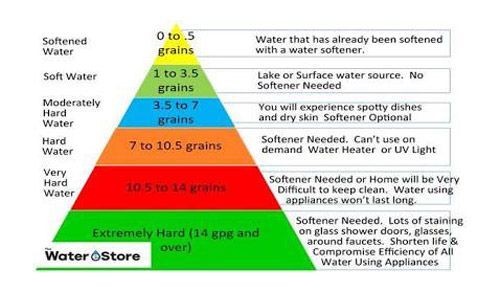
Water Hardness Classification Scale
To put the numbers into context, the Water Quality Association (WQA) and the United States Geological Survey (USGS) categorize water hardness into standard brackets:
| Hardness Level | Parts Per Million (ppm / mg/L) | Grains Per Gallon (gpg) | Practical Impact on Household |
|---|---|---|---|
| Soft | 0 to 17.1 ppm | 0 to 1 gpg | Soap lathers easily, no scale buildup on fixtures |
| Slightly Hard | 17.1 to 60 ppm | 1 to 3.5 gpg | Minimal scale formation over extended periods |
| Moderately Hard | 60 to 120 ppm | 3.5 to 7 gpg | Noticeable spots on glassware, mild soap scum |
| Hard | 120 to 180 ppm | 7 to 10.5 gpg | Limescale on heating elements, dry skin, reduced soap efficiency |
| Very Hard | 180 ppm and above | 10.5+ gpg | Heavy scale, shortened appliance lifespan, frequent pipe flushing needed |
At an average of 129 ppm (7 gpg), OUC tap water straddles the upper boundary of moderately hard and the beginning of hard water.
OUC Water Hardness Data: Neighborhood Variations
While 129 ppm represents the citywide baseline average, your actual water hardness can vary depending on where you reside in the Orlando metropolitan area. OUC operates multiple water treatment plants and subterranean wells across its service territory, drawing groundwater from localized points within the region.
Downtown Orlando Area
Residential and commercial accounts near Downtown Orlando generally record hardness levels near 133 ppm (approximately 7.8 gpg). This places downtown water firmly in the hard category. Homeowners in these older neighborhoods frequently report visible scale on shower doors and chrome fixtures over time.
Southeast Orlando and Lake Nona Area
In faster-growing areas such as Southeast Orlando, Lake Nona, and surrounding communities near Orlando International Airport, mineral levels trend higher. Well samples in this district frequently reach up to 179 ppm (roughly 10.5 gpg). Water in this zone touches the upper limit of the hard classification, meaning residents experience faster scale accumulation in water heaters and dishwashers.
Why Is OUC Water Hard? The Geology of Florida’s Groundwater
To understand why Orlando water contains elevated levels of calcium and magnesium, you have to look deep underground at Central Florida’s hydrogeology.
Dolomite (Magnesium Carbonate)
OUC pumps 100 percent of its drinking water from the Lower Floridan Aquifer, a massive subterranean reservoir beneath Florida. The aquifer is bounded by thick layers of rock, sedimentary soil, and ancient limestone formations.
- Natural Rainland Recharge: Rainwater falls across Central Florida and slowly percolates down through soil and clay layers.
- Contact with Limestone Formations: As water moves through the porous subterranean layers, it comes into direct contact with limestone (calcium carbonate) and dolomite (magnesium carbonate).
- Mineral Dissolution: Naturally acidic rainwater dissolves microscopic particles of calcium and magnesium from the rock strata, binding them directly into the water supply.
- Pumping and Purity: OUC extracts this water from deep wells reaching 1,000 to 1,400 feet below ground. The raw water is treated, aerated to remove hydrogen sulfide gases, disinfected, and fluoridated.
Because municipal water treatment plants focus on pathogen removal, safety, and taste standards mandated by the EPA, they do not remove beneficial minerals like calcium and magnesium. Consequently, hard minerals remain intact when the water enters municipal supply pipes.
Is OUC Water Safe to Drink?
Yes, OUC water is completely safe and healthy to drink. The minerals that cause hard water are essential nutrients that your body requires daily. Calcium supports bone density and vascular health, while magnesium supports nerve function and energy production.
Neither the Environmental Protection Agency (EPA) nor the Florida Department of Environmental Protection (FDEP) set health-based regulatory limits for water hardness because dissolved calcium and magnesium pose zero health risk to humans or pets. Hardness is classified purely as an aesthetic or secondary water quality characteristic.
However, what is beneficial for human consumption can be tough on home plumbing and modern household appliances.
How OUC Hard Water Affects Your Home
Though harmless to ingest, hard water causes measurable friction in your daily household routine. Understanding where hard water inflicts damage helps you stop problems before they turn into costly plumbing repairs.
| Affected Area | Common Symptoms & Long-Term Impacts |
|---|---|
| Water Heaters | Scale coats heating elements, reducing efficiency by 15–22%. |
| Plumbing & Pipes | Limescale restricts flow, reduces pressure, and clogs valves. |
| Dishwashers | White film forms on glassware, cutlery, and interior walls. |
| Soap & Cleaning | Minerals bind with soap, creating sticky soap scum residue. |
| Skin & Hair | Soap residue clogs pores, causing dry skin and brittle hair. |
1. Water Heater Efficiency and Lifespan
Your water heater bears the brunt of hard water damage. When hard water is heated inside a tank or tankless heat exchanger, dissolved calcium carbonate precipitates out of solution and turns back into solid mineral scale (limescale).
- Tank Water Heaters: Scale settles at the bottom of the tank, forming a thermal barrier between the burner element and the water. This forces the heater to run longer, raising energy costs and causing popping or rumbling noises during heating cycles.
- Tankless Water Heaters: Narrow heating passages in tankless units clog quickly with scale, triggering automatic thermal shutdowns and requiring annual descaling flushes.
2. Plumbing Fixtures and Water Pressure
Limescale collects around faucet aerators, showerheads, and internal valve cartridges. Over time, these crusty white deposits restrict water flow, lower water pressure, and degrade rubber seals, leading to pinhole leaks.
3. Kitchen Dishes and Glassware
If your clear drinking glasses come out of the dishwasher looking cloudy, foggy, or covered in white spots, hard water is the culprit. When water droplets evaporate during the heated drying cycle, they leave behind concentrated calcium spots that ordinary washing cannot wipe away.
4. Soap Scum, Skin, and Hair Problems
Hard minerals react chemically with natural fats in soaps and detergents, neutralizing their foaming ability and creating an insoluble curd known as soap scum.
- Cleaning Challenges: You need up to 50 percent more laundry detergent, dish soap, and shampoo to achieve a rich lather in hard water.
- Dermatological Effects: Soap scum does not rinse off cleanly from human skin. It leaves a micro-thin film behind, stripping away natural oils, clogging pores, and worsening skin conditions like eczema.
- Hair Texture: Mineral buildup on hair shafts makes hair feel brittle, dull, and difficult to style.
Practical Solutions for Managing OUC Water Hardness
Whether you want to clear up localized scale or protect your entire home, several proven remedies exist to manage OUC water hardness effectively.
Solution 1: Vinegar and Citric Acid Rinses (Localized Fix)
For surface-level limescale buildup on chrome faucets, showerheads, or glass shower doors, mild natural acids provide a quick cleaning fix.
- Faucet Aerators: Unscrew the aerator tip and submerge it in a bowl of warm distilled white vinegar for 30 to 60 minutes. Scrub with a soft brush to remove loosened calcium deposits.
- Showerheads: Fill a small plastic bag with white vinegar, wrap it around the showerhead, and secure it with a rubber band overnight. Flush with hot water in the morning.
- Coffee Makers & Dishwashers: Run a monthly cleaning cycle using two cups of white vinegar or commercial citric acid descaling powder to keep internal heating coils clean.
Solution 2: Correcting Appliance Hardness Settings
Modern home appliances feature built-in water softeners or intelligent wash cycle adjustments based on incoming water hardness.
When configuring a new dishwasher, laundry machine, or steam oven in the Orlando area:
- Set the hardness value to 7 gpg (or 130 ppm) if you live in Downtown or Central Orlando.
- Set the value to 10 gpg (or 175 ppm) if you reside in Lake Nona, Southeast Orlando, or Osceola county border zones.
Correct settings ensure your appliance dispenses the ideal amount of rinse aid and water conditioner, preventing film on dishes while avoiding detergent waste.
Solution 3: Whole-Home Ion-Exchange Water Softeners (Permanent Fix)
For comprehensive protection against hard water throughout your home, an ion-exchange water softener is the most effective solution available.
Source: VectorMine / Getty Images
How Ion-Exchange Water Softeners Work
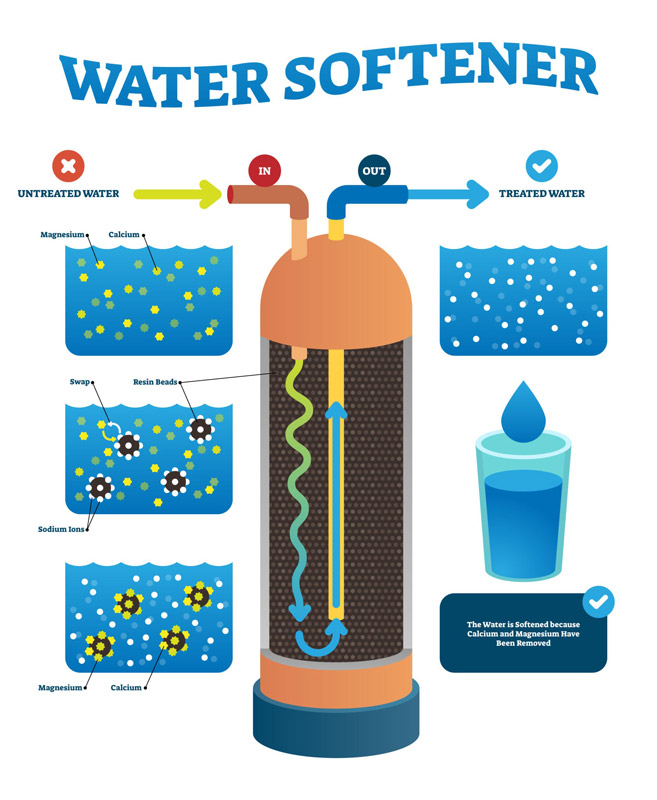
An ion-exchange system connects directly to your home’s main water supply line. Inside the unit’s mineral tank are millions of microscopic resin beads charged with sodium or potassium ions.
- Mineral Capture: As hard municipal water flows through the resin bed, the positively charged calcium and magnesium ions swap places with the sodium ions on the resin.
- Soft Water Delivery: The hard minerals remain trapped inside the resin bed, while fully softened water flows out to your faucets, showerheads, and water heater.
- Regeneration Cycle: Every few days, the system flushes the resin bed with a concentrated salt brine solution from an adjacent brine tank, stripping away accumulated calcium and resetting the system.
Salt-Free Conditioners vs. Salt-Based Softeners
- Ion-Exchange Softeners (Salt-Based): Actively remove calcium and magnesium ions from the water. This eliminates soap scum, prevents scale completely, and leaves skin feeling smooth.
- Tac / Salt-Free Media Conditioners: Do not remove hard minerals. Instead, they alter the crystalline structure of calcium so it cannot adhere easily to pipe walls. While helpful for basic scale prevention, they do not create true soft water, reduce soap requirements, or prevent water spots on glass.
How to Size a Water Softener for Your Orlando Home
Installing a water softener that is too small leads to frequent regeneration cycles, wasted salt, and premature equipment failure. Installing one that is too large can waste water during backwashing cycles.
To size a whole-home system correctly for OUC water, follow this simple calculation methodology:
Step 1: Calculate Daily Water Consumption
Multiply the total number of residents in your household by 75 gallons per day (the national average for daily indoor water consumption per person).
$$\text{Daily Gallons} = \text{Number of People} \times 75$$
Example: A household of 4 people uses approximately 300 gallons per day ($4 \times 75 = 300$).
Step 2: Determine Daily Mineral Grain Load
Multiply your daily gallon usage by your local OUC water hardness in grains per gallon (gpg). Use 8 gpg for general Orlando or 10 gpg for Lake Nona / Southeast Orlando.
$$\text{Daily Grains} = \text{Daily Gallons} \times \text{Hardness (gpg)}$$
Example: $300 \text{ gallons} \times 8 \text{ gpg} = 2,400 \text{ grains of hardness per day}$.
Step 3: Size for a 7-Day Regeneration Cycle
Most high-efficiency softeners should regenerate once every 6 to 7 days to keep resin beds clean and prevent bacteria growth. Multiply your daily grain load by 7 days.
$$\text{Target Capacity} = \text{Daily Grains} \times 7$$
Example: $2,400 \text{ grains/day} \times 7 \text{ days} = 16,800 \text{ grains per week}$.
To account for peak usage, guest visits, and optimal system efficiency, round up to the nearest standard softener capacity size:
| Household Size | Average Daily Usage | OUC Hardness (8 gpg) | Recommended Softener Size |
|---|---|---|---|
| 1 to 2 People | 150 Gallons | 1,200 Grains/Day | 24,000 Grain System |
| 3 to 4 People | 300 Gallons | 2,400 Grains/Day | 32,000 Grain System |
| 5 to 6 People | 450 Gallons | 3,600 Grains/Day | 48,000 Grain System |
| 7+ People | 600+ Gallons | 4,800 Grains/Day | 64,000 Grain System |
Frequently Asked Questions About OUC Water Hardness
Does OUC supply soft water anywhere in Orlando?
No. OUC relies entirely on groundwater drawn from the Floridan Aquifer. Because the aquifer consists of limestone bedrock across Central Florida, all municipal tap water delivered by OUC is naturally hard to moderately hard.
Will boiling OUC water remove the hardness?
Boiling water only removes temporary hardness (bicarbonates). The hardness in Central Florida water is permanent hardness caused by calcium sulfates and chlorides. Boiling water will actually increase mineral concentration as water turns to steam, leaving behind more concentrated calcium deposits at the bottom of your kettle.
How often should I descaling my water heater in Orlando?
Due to OUC’s average hardness level of 129 ppm, flush tank water heaters at least once per year. Tankless water heaters in Orlando should be flushed with a vinegar descaling pump every 12 months to maintain heating efficiency and protect manufacturer warranty coverage.
Does a reverse osmosis filter remove water hardness?
Yes, reverse osmosis (RO) systems remove calcium and magnesium alongside fluoride, chlorine, and heavy metals. However, because hard minerals can clog delicate RO membranes quickly, point-of-use RO systems are typically installed under the kitchen sink for drinking and cooking, rather than treated for the whole house.
Summary and Takeaways
- Average Hardness: OUC water averages 129 ppm or approximately 7 gpg, classifying it as moderately hard to hard.
- Geographic Variances: Downtown Orlando averages around 133 ppm, while Southeast Orlando and Lake Nona can reach up to 179 ppm (10.5 gpg).
- Geological Origin: Minerals dissolve naturally as groundwater flows through subterranean limestone formations within the Floridan Aquifer.
- Safety vs. Utility: The water is completely safe and healthy to drink, but mineral buildup can lower water heater efficiency, leave spots on glassware, and dry out skin and hair.
- Solutions: Use white vinegar for minor surface cleaning, set smart appliances to 7 to 10 gpg, and consider a properly sized ion-exchange water softener for whole-home mineral protection.