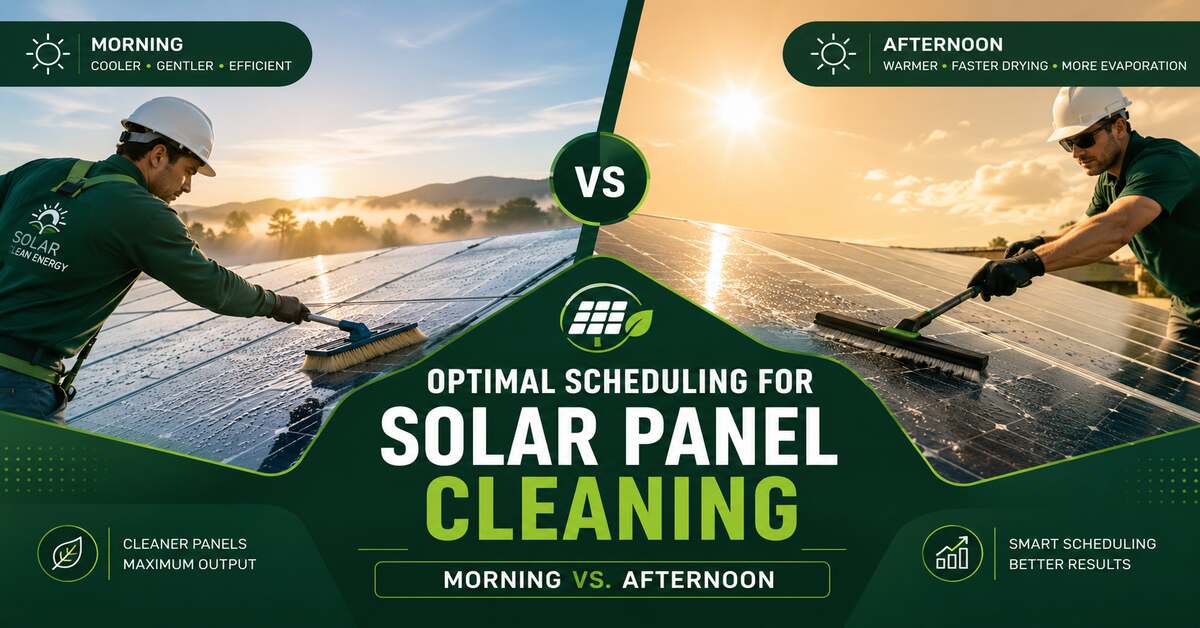
For optimal scheduling for solar panel cleaning: morning vs. afternoon, early morning before 8:00 AM is the superior choice for overall system performance and thermal safety. Early morning cleaning utilizes overnight cooling to prevent panel glass thermal shock while exploiting natural dew to loosen baked-on dust before peak solar generation hours begin.
Quick Verdict: Optimal Time by User Profile
- For DIY Residential Rooftop Cleaners: Late Afternoon (After 5:00 PM) — Dry roof tiles prevent dangerous slip hazards while panel temperatures drop to safe levels.
- For Desert & Extreme Heat Locations: Early Morning (Before 7:30 AM) — Mandatory to avoid thermal shock when ambient temperatures exceed $38^\circ\text{C}$ ($100^\circ\text{F}$).
- For Commercial & Industrial Fleets: Early Morning (5:00 AM – 8:00 AM) — Eliminates production downtime during high-value peak tariff hours.
- For Ground-Fed Pure-Water Operators: Early Morning (6:00 AM – 8:30 AM) — Dew pre-softens debris, cutting pure-water consumption by up to 40%.
Head-to-Head Comparison: Morning vs. Afternoon
To evaluate scheduling choices, solar operations and maintenance (O&M) teams track temperature differentials, fluid dynamics, and grid generation revenue. The table below outlines performance metrics across both cleaning windows.
| Operational Metric | Early Morning (Before 8:00 AM) | Late Afternoon (After 5:00 PM) | Evaluation Scale / Unit |
| Panel Surface Temperature Range | $15^\circ\text{C} – 25^\circ\text{C}$ ($59^\circ\text{F} – 77^\circ\text{F}$) | $35^\circ\text{C} – 50^\circ\text{C}$ ($95^\circ\text{F} – 122^\circ\text{F}$) | Degrees Celsius / Fahrenheit |
| Water Differential ($\Delta T$) | $0^\circ\text{C} – 10^\circ\text{C}$ ($0^\circ\text{F} – 18^\circ\text{F}$) | $15^\circ\text{C} – 35^\circ\text{C}$ ($27^\circ\text{F} – 63^\circ\text{F}$) | $\Delta T = T_{\text{panel}} – T_{\text{water}}$ |
| Thermal Shock Microcrack Risk | Very Low (1/5) | Moderate to High (3/5) | 1 (Safe) to 5 (Critical Risk) |
| Dew Softening Advantage | High (Reduces scrubbing time 40%) | None (100% manual wetting required) | Measured pre-soak benefit |
| Generation Losses During Cleaning | $0.00\text{ kWh/panel}$ | $0.05 – 0.15\text{ kWh/panel}$ | Lost generation per string |
| Water Dwell Time Before Evaporation | $>180\text{ seconds}$ | $<45\text{ seconds}$ | Seconds until dry film forms |
| Mineral Spotting Susceptibility | Low (Score: 1/5) | High (Score: 4/5) | 1 (Minimal) to 5 (Severe scale) |
| Roof Surface Friction ($\mu$) | $\mu < 0.3$ (Wet / Slippery) | $\mu > 0.6$ (Dry / High Traction) | Dynamic Friction Coefficient |
Thermal Shock Risk and Module Safety
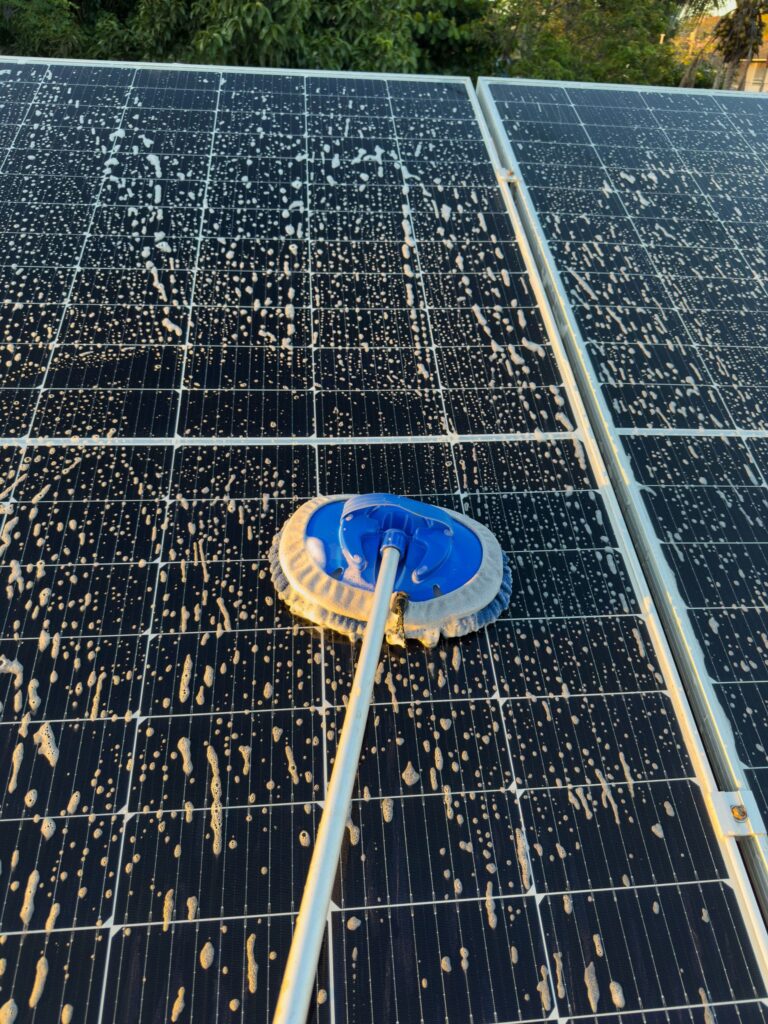
Thermal shock occurs when cool fluid contacts an expanded, hot photovoltaic module. During peak sunlight, solar panel surface temperatures reach $45^\circ\text{C}$ to $65^\circ\text{C}$ ($113^\circ\text{F}$ to $150^\circ\text{F}$). Applying hose water at $15^\circ\text{C}$ ($59^\circ\text{F}$) generates a steep thermal gradient:
When $\Delta T$ exceeds $30^\circ\text{C}$ ($54^\circ\text{F}$), differential thermal contraction occurs between the low-iron tempered glass, the Ethylene-Vinyl Acetate (EVA) encapsulant layer, and the aluminum frame. This contraction creates tensile stress exceeding the $90\text{ MPa}$ breaking threshold of standard solar glass, leading to microcracking in silicon cells, frame seal delamination, and voided warranties from major manufacturers like SunPower, Qcells, Canadian Solar, and LONGi.
Early morning cleaning ensures panel surface temperatures remain near ambient night levels ($15^\circ\text{C}$ to $25^\circ\text{C}$), maintaining $\Delta T$ safely below $10^\circ\text{C}$. Late afternoon panels retain substantial internal thermal mass within their backsheets, keeping $\Delta T$ elevated between $15^\circ\text{C}$ and $35^\circ\text{C}$ until well after sunset.
Winner for Thermal Shock Protection: Early Morning.
Soiling Removal Efficiency and Dew Advantage
Atmospheric soiling consists of cementitious dust, pollen, bird droppings, and particulate matter. Overnight, relative humidity rises, causing ambient moisture to condense on the cool panel glass.
This natural dew layer acts as a zero-cost pre-soak agent. It hydrates dried organic matter and softens caked-on dust over several hours. As a result, early morning cleaning requires $30\%$ to $50\%$ less fluid volume and significantly less mechanical scrubbing force, preserving anti-reflective glass coatings.
Conversely, late afternoon panels have experienced full-day solar radiation, baking dust onto the glass. Afternoon cleaning requires artificial pre-soaking and greater mechanical friction, increasing the risk of micro-scratches from abrasive silica particles.
Winner for Soiling Removal Efficiency: Early Morning.
Solar Generation Loss and Grid Shutdown Costs
Solar panels generate their highest energy yields during peak solar irradiance hours between 10:00 AM and 3:00 PM. Cleaning under direct sunlight requires isolating string inverters to eliminate high DC shock risks (often exceeding $600\text{V}–1000\text{V}\text{ DC}$).
Shutting down a standard $10\text{ kW}$ residential solar array during peak midday production loses $6$ to $8\text{ kWh}$ of generation per hour. Over a two-hour mid-day cleaning session, this equates to $12\text{–}16\text{ kWh}$ of forfeited energy yield.
Early morning cleaning completed before 8:00 AM occurs before the array’s morning generation ramp, resulting in zero production loss. Late afternoon cleaning after 5:00 PM incurs minimal loss, as solar irradiance drops rapidly toward dusk.
Winner for Minimizing Production Loss: Early Morning.
Water Evaporation Rate and Mineral Spotting
Water quality plays a major role in solar panel cleaning. Tap water containing dissolved calcium, magnesium, and silica (Total Dissolved Solids or TDS $>50\text{ ppm}$) leaves white mineral scale if it evaporates on the glass. These mineral deposits create permanent micro-shading patches that lower cell efficiency.
High Surface Heat + Rapid Water Evaporation = Mineral Calcification (Hard Spots)
Cool Surface Temp + Slow Water Evaporation  = Complete Pure-Water Sheeting (Streak-Free)
In the early morning, low surface temperatures keep fluid in a liquid state for over $180\text{ seconds}$. This extended dwell time gives operators ample margin to pass a squeegee or allow pure Deionized (DI) water to sheet off cleanly. In the late afternoon, residual heat evaporates water in under $45\text{ seconds}$, drying mineral residues onto the glass faster than squeegee passes can clear them.
Winner for Mineral Spotting Prevention: Early Morning.
Worksite Safety and Operational Ergonomics
Operational safety differs significantly depending on whether work is conducted from ground level or on a pitched roof. Early morning dew creates a major occupational hazard on sloped rooftops. Moisture on asphalt shingles or metal seam panels lowers the dynamic coefficient of friction below $\mu = 0.3$, creating severe slip-and-fall risks for technicians.
Late afternoon roof surfaces are completely dry, providing high traction ($\mu > 0.6$). However, late afternoon operators face ambient thermal fatigue and rushing against fading daylight. For operators using ground-fed telescopic poles, morning roof slipperiness is non-factor, making morning ergonomics superior due to cooler working ambient air.
Winner for Roof Footing and Worksite Safety: Late Afternoon.
Optimal Scheduling for Solar Panel Cleaning: Morning vs. Afternoon Guidelines
When resolving the choice between morning and afternoon cleaning, match your specific site conditions to the optimized recommendations below.
DIY Residential Rooftop Owners
If walking a sloped roof with basic hose equipment, choose Late Afternoon (After 5:00 PM). Morning dew creates dangerous rooftop slip hazards. By 5:00 PM, roof shingles are completely dry for secure footing, while panel glass has cooled below critical thermal shock thresholds. Ensure you isolate the AC main breaker before starting.
Desert and High-Heat System Owners
In high-irradiance regions like Arizona, Nevada, or Central Australia where summer temperatures exceed $38^\circ\text{C}$ ($100^\circ\text{F}$), choose Early Morning (Before 7:30 AM). Desert panels retain heat far into the evening, keeping surface temperatures above $50^\circ\text{C}$ ($122^\circ\text{F}$) well past 6:00 PM. Early morning is the only reliable window where $\Delta T$ stays safely under $15^\circ\text{C}$.
Commercial and Industrial O&M Fleets
For flat-roof or ground-mounted commercial arrays, select Early Morning (5:00 AM – 8:00 AM). Early morning work eliminates peak-hour array shutoff penalties, protecting commercial power purchase agreement (PPA) revenues. Flat-roof commercial layouts also allow safe walking along dedicated slip-resistant paths despite morning dew.
Ground-Fed Pure-Water Cleaners
If operating telescopic water-fed poles from ground level, choose Early Morning (6:00 AM – 8:30 AM). Ground operations avoid roof slip risks entirely while maximizing the benefits of morning dew. Natural moisture softens dirt, enabling faster single-pass cleaning with Reverse Osmosis / Deionization (RO/DI) pure water carts.
Limitations, Trade-Offs, and Hidden Realities
While early morning is the overall winner, it presents trade-offs that installers and sales reps rarely mention:
- The Dew-Slip Hazard: Morning dew makes pitched roofs hazardous for DIYers. Falling from a two-story roof presents a far higher risk than minor generation losses.
- Freezing Winter Limits: In winter, early morning cleaning with water causes black ice formation on panel glass and roof surfaces if ambient temperatures drop below $2^\circ\text{C}$ ($35^\circ\text{F}$). Winter cleaning should be delayed until midday under mild, overcast conditions.
- Water Quality Requirements: Neither morning nor afternoon timing will prevent mineral spotting if tap water TDS exceeds $50\text{ ppm}$. Unfiltered municipal water evaporates into permanent calcium carbonate deposits.
- Pressure Washer Damage: Pressure washers should never be used on solar arrays. Pressures exceeding $0.5\text{ bar}$ ($7\text{ PSI}$) force water past IP65/IP67 seals into junction boxes, inducing irreversible Potential Induced Degradation (PID) and severe electrical short circuits.
Standardized Step-by-Step Solar Cleaning Protocol
To protect solar modules and ensure worker safety, follow this technical standard:
- Electrical Isolation: Open the main AC solar breaker and switch the DC isolator to “OFF”. Wait 10 minutes to allow inverter internal capacitors to discharge fully.
- Thermal Surface Verification: Touch the aluminum module frame gently with the back of a gloved hand to verify the array is cool to the touch.
- Dry Debris Pre-Sweep: Gently clear loose organic debris, twigs, and leaves using a soft, non-abrasive dry brush.
- Pure-Water Wet Wash: Apply pure RO/DI water (TDS $<50\text{ ppm}$) at low pressure ($<0.5\text{ bar}$) paired with a soft microfiber solar brush. Use pH-neutral (6.5–7.5) soap only for stubborn organic soiling.
- Squeegee & Frame Wipe: Pass a soft rubber squeegee top-to-bottom to clear water drops before they dry.
- Re-Powering Verification: Ensure junction boxes and frame edges are fully dry before turning DC isolators and AC breakers back ON.
Frequently Asked Questions
Can I clean solar panels on a cloudy afternoon?
Yes, cleaning during overcast afternoon conditions is safe because low Global Horizontal Irradiance (GHI $<200\text{ W/m}^2$) prevents panel surface temperatures from surging above $25^\circ\text{C}$ ($77^\circ\text{F}$). Under cloudy skies, thermal shock risks are eliminated, allowing for a thorough rinse without rapid water evaporation or glass stress.
What is the maximum water temperature differential solar panels can handle?
Solar panel manufacturers like SunPower and Canadian Solar specify a maximum temperature differential ($\Delta T$) of $15^\circ\text{C}$ to $20^\circ\text{C}$ ($27^\circ\text{F}$ to $36^\circ\text{F}$) between cleaning water and tempered glass. Exceeding a $\Delta T$ of $40^\circ\text{C}$ ($72^\circ\text{F}$) induces severe microcracking, frame seal delamination, and immediate voiding of module warranties.
Why is pressure washing banned by solar panel manufacturers?
Pressure washers exceeding $0.5\text{ bar}$ ($7\text{ PSI}$) force water past IP65/IP67 weatherproofing seals around panel junction boxes and aluminum frames. This high-pressure fluid intrusion causes internal cell corrosion, Potential Induced Degradation (PID), short circuits, and severe electrical shock hazards when string voltages exceed 350V DC.
Do self-cleaning nano-coatings eliminate manual washing?
Hydrophobic nano-coatings reduce soiling accumulation by 20% to 40% but do not completely eliminate the need for periodic manual washing. Sticky bird droppings, tree sap, and agricultural haze still adhere to coated glass over time, requiring scheduled soft-brush pure-water washes during cool morning windows.
How does hard tap water permanently degrade photovoltaic output?
Using tap water with Total Dissolved Solids (TDS) above 50 ppm leaves behind calcium and magnesium carbonate scale as water evaporates. These white mineral deposits act like permanent shade patches on photovoltaic cells, scattering incoming sunlight and permanently reducing individual panel energy conversion efficiency by 5% to 15%.