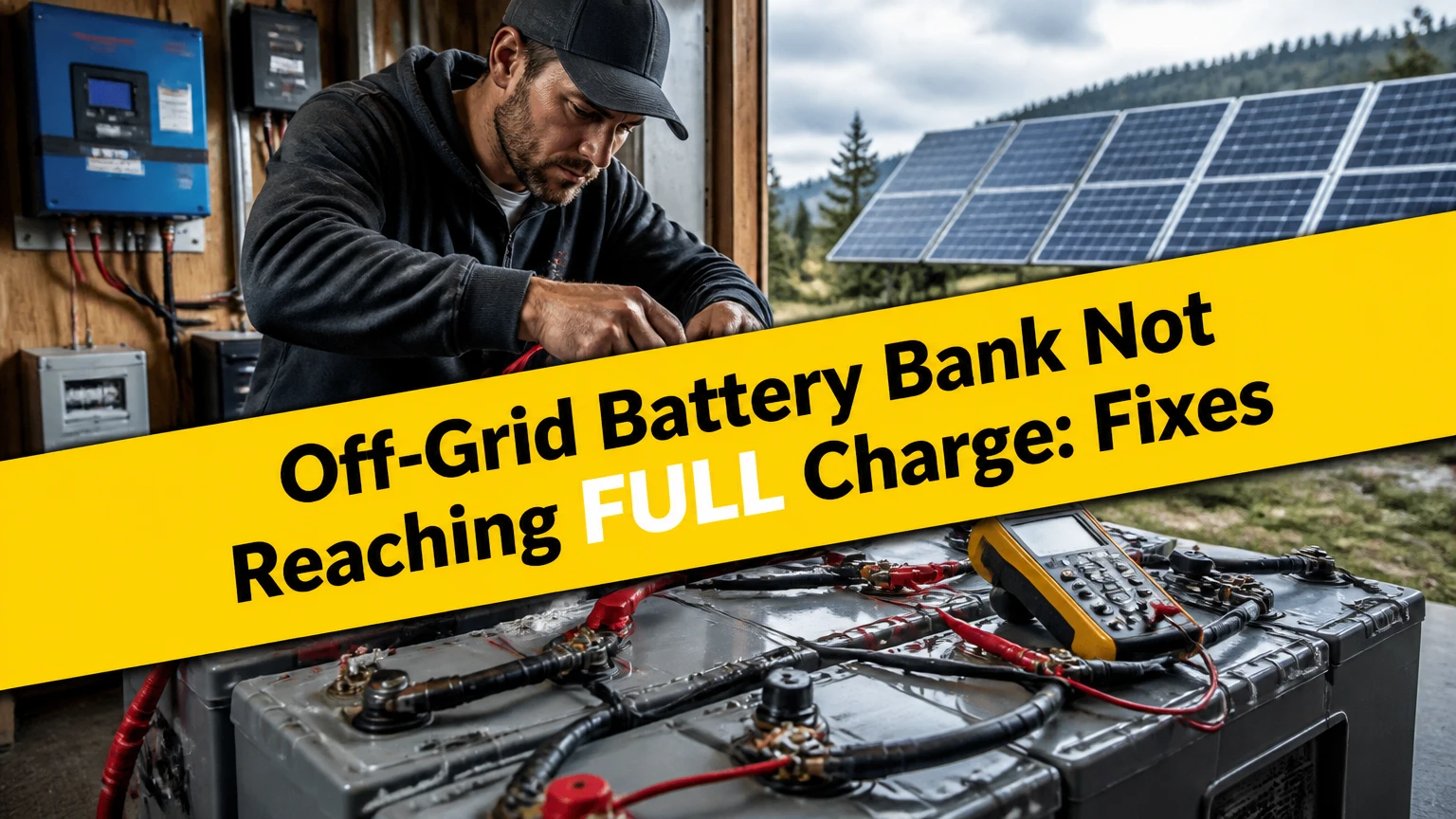
An off-grid battery bank not reaching full charge usually has insufficient charging energy, excessive voltage drop, incorrect charge-controller settings, a temperature-related limit, or a weak battery or cell. Confirm the battery chemistry, measure voltage at the controller and battery terminals, and compare charging current with daily energy consumption before replacing components.
Key Facts at a Glance
- Lead-acid batteries normally need a completed absorption stage, not merely a high charging voltage, to reach true full charge.
- LiFePO4 batteries can show nearly unchanged voltage across much of their usable range, so voltage alone is a poor state-of-charge gauge.
- A controller reading absorption voltage while the battery posts read substantially less indicates wiring, fuse, lug, or connection resistance.
- A flooded lead-acid battery requires a hydrometer and manufacturer procedure for reliable state-of-charge confirmation.
- LiFePO4 batteries should not be charged below the battery manufacturer’s permitted temperature, commonly 0°C or 32°F.
- Equalization is for compatible flooded batteries only. It can damage AGM, gel, and lithium batteries.
What Does the Symptom Actually Mean?
An off-grid battery bank is not “full” simply because its voltage briefly rises. Full charge means the battery has accepted the required charging profile and reached a verified end condition, such as stable absorption current, a manufacturer-defined lithium charge termination, or correct flooded-cell specific gravity.
A battery bank can stop at several different points. The solar array may lack enough power to finish bulk charging, the charge controller may leave absorption after an unsuitable timer, or a battery may reach an apparent voltage limit before its cells are balanced. Loads operating during daylight can also consume the final charging energy as quickly as the array produces it.
The first distinction is between not reaching the controller’s target voltage and reaching target voltage without becoming fully charged. The first points toward input power, wiring, settings, or a heavily loaded bank. The second points toward absorption duration, battery health, cell imbalance, temperature, or inaccurate state-of-charge reporting.
How Should an Off-Grid Battery Bank Charge?
An off-grid battery bank normally moves through bulk, absorption, and float, although lithium systems may use a shorter absorption period or no conventional float stage. During bulk, the charger supplies available current until battery voltage reaches the programmed limit. During absorption, voltage is held while current tapers. Float maintains a charged lead-acid battery at a lower voltage.
Typical charging behavior varies by manufacturer and temperature. A 12V lead-acid battery may use approximately 14.4-14.8V during absorption and 13.2-13.8V during float, while a 12V LiFePO4 battery commonly uses approximately 14.0-14.6V for charging and may use a reduced or disabled float setting. A 24V or 48V bank requires the corresponding setpoint multiplied by two or four.
| Charging stage | Lead-acid function | LiFePO4 function | Diagnostic clue |
|---|---|---|---|
| Bulk | Constant-current recovery to about 80-85% state of charge | High-current recovery until charge-voltage limit | Voltage never reaches target |
| Absorption | Constant-voltage saturation, often 1-4 hours | Short balancing or termination period, manufacturer-specific | Voltage is correct but current does not taper as expected |
| Float | Maintenance near 13.2-13.8V on a 12V bank | Often 13.4-13.6V or disabled | Controller drops to float too soon |
| Equalization | Controlled overcharge for compatible flooded batteries | Prohibited by most lithium manufacturers | Excessive voltage, heat, or gassing |
Which Charging Settings Fit Each Chemistry?
The correct charge profile depends on battery chemistry, nominal voltage, temperature, and the battery manufacturer’s manual. Generic setpoints are useful for diagnosis, but they are not permission to apply a flooded-lead-acid profile to AGM or LiFePO4 equipment.
| Battery type | Typical 12V absorption range | Typical 12V float range | Reliable full-charge check | Main warning |
|---|---|---|---|---|
| Flooded lead-acid | 14.4-14.8V | 13.2-13.5V | Specific gravity after rest | Ventilation and water level required |
| AGM lead-acid | 14.4-14.7V | 13.5-13.8V | Rested voltage plus charge history | No routine equalization unless approved |
| Gel lead-acid | 14.0-14.4V | 13.5-13.8V | Manufacturer voltage and rested test | Overvoltage can dry or damage cells |
| LiFePO4 | 14.0-14.6V | 13.4-13.6V or off | BMS data and coulomb counter | Charging below 0°C may be blocked |
LiFePO4 diagnosis
LiFePO4 voltage remains relatively flat, often near 13.2-13.4V for a large part of a 12V battery’s discharge. A reading of 13.3V does not prove 90% state of charge, and a rapid rise toward 14.4V does not prove every cell is balanced.
A battery-management system may stop charging because one cell reaches its high-voltage limit before the remaining cells. Check the BMS app or display for cell spread, high-voltage protection, low-temperature protection, charge-current limits, and cumulative fault events. A 50mV cell difference is a useful investigation trigger, but the battery maker’s balancing threshold takes priority.
AGM and flooded lead-acid diagnosis
Lead-acid batteries need enough time at absorption voltage for current to taper and the plates to become charged. A permanently undercharged battery can sulfate, losing capacity and increasing internal resistance, so the bank appears to reach voltage quickly while accepting little useful energy.
Flooded batteries add two diagnostic tools: electrolyte level and specific gravity. A hydrometer measurement taken from each cell, corrected for temperature and compared with the manufacturer’s full-charge specification, can reveal one weak cell even when total bank voltage looks normal. Never use a hydrometer on AGM, gel, or lithium batteries.
Is Generation Exceeding Daily Consumption?
A battery bank cannot reach full charge when daily consumption exceeds recoverable charging energy. Compare watt-hours consumed with watt-hours delivered, rather than comparing the solar array’s nameplate watts with inverter size.
For example, a 400W solar array may produce 1.2-2.0kWh per day in a favorable season after temperature, angle, controller, and wiring losses. A 1,500W inverter drawing 25W while idle uses about 600Wh per day, before refrigerators, pumps, lighting, or electronics run. A winter load profile can therefore consume the bank’s recovery margin without any component being defective.
Use the controller’s daily harvested watt-hours and the inverter’s logged consumption when available. If no monitoring exists, measure DC current with a shunt or estimate each load as watts multiplied by operating hours.
| Example system | Daily load | Typical available charge energy | Likely result |
|---|---|---|---|
| 400W solar, summer cabin | 1.0kWh | 1.2-2.0kWh | Full charge possible |
| 400W solar, winter cabin | 1.0kWh | 0.5-1.2kWh | Frequent partial charging |
| 800W solar, 24V bank | 2.0kWh | 2.0-3.8kWh | Recovery depends on weather |
| 5kW generator charger | 3.0kWh load | 4.0-6.0kWh delivered | Full charge possible if charger settings fit |
Calculate required charging current
A practical planning estimate for lead-acid charging is approximately 0.1C to 0.2C, where C is the bank’s amp-hour rating. A 400Ah, 12V lead-acid bank therefore commonly benefits from roughly 40-80A of charging capability, subject to battery specifications and available energy.
LiFePO4 batteries often accept higher charging rates, but the battery’s BMS, cables, fuses, and charger must support that current. A 280Ah lithium bank receiving only 8A may still charge eventually, but a simultaneous 10A load prevents net recovery.
How Can You Find Charging Voltage Drop?
Measure voltage at the charge-controller output and directly across the battery posts while charging at a known current. The difference is the charging-path voltage drop, and it includes cable, fuse, breaker, lug, disconnect, and terminal resistance.
For a 12V system, a 0.1-0.2V drop can materially alter charge termination. A controller reading 14.6V while the battery posts receive 14.1V may leave a lead-acid bank undercharged because the controller believes absorption voltage has already been reached.
- Record controller output voltage and current.
- Measure directly across the positive and negative battery posts.
- Repeat on both sides of each fuse, breaker, disconnect, and major lug.
- Inspect warm components after 10-15 minutes at high current.
- Clean, tighten, or replace defective connections only after isolating power safely.
| Measured difference at charging current | Interpretation | Typical response |
|---|---|---|
| 0.00-0.05V | Very low resistance | Keep existing conductors |
| 0.06-0.15V | Usually acceptable on short 12V runs | Inspect terminals and fuse holders |
| 0.16-0.30V | Material charging error | Improve lugs, cable size, or routing |
| More than 0.30V | Serious loss or connection fault | Stop and repair before normal use |
The National Electrical Code and local regulations govern overcurrent protection and conductor installation. Do not replace a fuse with a larger one merely to stop nuisance opening. A loose high-current connection can generate heat even when its voltage drop seems modest at low load.
Why Does the Controller Leave Absorption Early?
A charge controller leaves absorption early when its timer, tail-current threshold, battery-voltage reading, or temperature compensation tells it that saturation has completed. Incorrect battery type, an over-high sensed voltage, or a controller configured for a different bank voltage can trigger premature float.
Lead-acid batteries often need a time-based absorption period, commonly 1-4 hours depending on depth of discharge and manufacturer guidance. A deeply discharged or aged bank may require longer, but extending absorption cannot restore lost plate capacity. Lithium systems usually need a voltage and current termination strategy rather than a long lead-acid absorption timer.
Check these settings:
- Battery chemistry and nominal voltage.
- Absorption voltage and maximum absorption duration.
- Float voltage and re-bulk voltage.
- Tail-current or end-amps threshold.
- Temperature-compensation setting.
- Remote temperature sensor location.
- Maximum charge current.
- Battery monitor synchronization and state-of-charge reset.
A temperature sensor on the controller is not enough when batteries are in a colder shed. Lead-acid charging voltage generally needs temperature compensation, while LiFePO4 batteries require a low-temperature charge cutoff or battery heater rather than indiscriminate voltage increases.
How Do You Find a Weak Battery or Cell?
A weak series battery can prevent a bank from completing charge because the series string is limited by the battery that reaches its voltage ceiling first. A weak parallel battery can draw current unevenly, causing one string to remain undercharged while the overall bank voltage looks acceptable.
Turn off charging and loads, isolate batteries according to the manufacturer’s safe procedure, and allow them to rest for at least three hours. Measure each battery with the same calibrated multimeter, then test under a controlled load or with a battery analyzer rated for that chemistry.
| Rested 12V battery reading | Lead-acid interpretation | Required follow-up |
|---|---|---|
| 12.6-12.8V | Potentially full | Confirm with specific gravity or load test |
| 12.4-12.5V | Partial charge | Recharge and retest after rest |
| 12.0-12.2V | Low state of charge | Check capacity and sulfation |
| 10.5-11.8V | Possible shorted cell or severe failure | Isolate and test professionally |
Voltage alone cannot prove lithium state of charge. Use the BMS cell-voltage screen, a correctly installed shunt, and a controlled charge test. In a 16-cell 48V LiFePO4 bank, a single cell reaching the high-voltage cutoff can stop charging while the other 15 cells remain below their balancing region.
Do not mix a new battery with older batteries in the same series or parallel bank unless the manufacturer explicitly permits it and the electrical characteristics match. Different internal resistance causes unequal current sharing and accelerates the weaker unit’s decline.
When Is Equalization Appropriate?
Equalization is appropriate only for flooded lead-acid batteries whose manufacturer specifies it. Equalization deliberately raises voltage, often into the 15.0-16.0V range for a 12V bank, to correct sulfation or electrolyte stratification under controlled conditions. It is not a universal cure for a battery that never reaches full charge.
Before equalizing, verify electrolyte level, ventilation, temperature, charger compatibility, and manufacturer voltage limits. Disconnect sensitive DC electronics if the procedure requires it. Stop if temperature rises abnormally or a cell behaves differently from its neighbors.
AGM, gel, and LiFePO4 batteries generally must not receive a flooded-battery equalization cycle. Trojan Battery’s technical guidance identifies specific gravity testing as the most accurate way to determine the state of charge of flooded batteries, which is why voltage-only diagnosis is insufficient for open-cell banks.
Equalization cannot reverse a shorted cell, severe grid corrosion, physical plate shedding, or capacity loss. If specific gravity remains low or one cell differs materially after a correct charge and equalization procedure, replacement is usually more sensible than repeated overcharging.
How Do Temperature and Season Change the Diagnosis?
Cold weather reduces available solar energy, increases lead-acid charging-voltage requirements, and can block LiFePO4 charging through the BMS. Hot weather increases lead-acid overcharge risk and can shorten battery life, especially in poorly ventilated enclosures.
Winter diagnosis should include solar production, snow or shading, battery temperature, generator runtime, and the controller’s temperature sensor. A cold lead-acid bank may reach an uncompensated controller’s nominal voltage before accepting a complete charge. A cold lithium battery may show normal voltage while its BMS rejects all incoming current.
Seasonal operating changes can resemble hardware failure:
- Short winter days reduce harvest hours.
- Low sun angles increase shading from trees and structures.
- Snow can cover modules and create zero production.
- Cold panels may produce high voltage but little daily energy.
- Heating loads can consume more energy than expected.
- Generator auto-start settings may stop before absorption completes.
Which Fix Provides the Best Value?
Repair the measurement path first, then correct settings and energy balance, and replace batteries only after testing confirms capacity loss. Upgrading from PWM to MPPT helps when array voltage is materially higher than battery voltage, but it cannot compensate for a badly undersized array or failed battery.
| Remediation | Typical cost, USD | Typical time | Best use | Limitation |
|---|---|---|---|---|
| Clean terminals and replace lugs | $20-$120 | 1-3 hours | Measured connection resistance | Does not fix undersized conductors |
| Install shunt monitor | $60-$250 | 1-4 hours | Inaccurate state-of-charge readings | Requires correct programming |
| Increase cable size | $80-$500 | 2-8 hours | Verified voltage drop | Must retain correct overcurrent protection |
| Replace charge controller | $150-$700 | 2-6 hours | Wrong profile or insufficient current | Needs array and battery compatibility |
| Add generator charging | $400-$2,500 | 1-8 hours | Winter or high-load recovery | Fuel, noise, and maintenance costs |
| Replace one failed battery | $150-$1,500 | 1-4 hours | Confirmed battery failure | Mismatched age can reduce bank life |
An MPPT controller can often harvest more energy than PWM when panel voltage substantially exceeds battery voltage, especially in cool conditions. The gain is not a guaranteed 30 percent, and it disappears when panels are wired near battery voltage, the array is shaded, or battery charging is already limited by a BMS.
What is the safest troubleshooting order?
Use this order because it prevents expensive parts replacement:
- Confirm chemistry, bank voltage, and manufacturer settings.
- Check controller error logs and actual daily charging watt-hours.
- Turn off nonessential loads and observe whether charging progresses.
- Measure controller-to-battery voltage drop at charging current.
- Check battery and ambient temperatures.
- Test individual batteries, parallel strings, or lithium cell data.
- Perform chemistry-approved recovery procedures.
- Replace the failed component only after measurement identifies it.
Stop immediately for swelling, leaking electrolyte, hot terminals, smoke, a rotten-egg odor, cracked cases, or repeated fuse failure. Lead-acid batteries can release explosive hydrogen, and lithium battery faults can escalate into thermal runaway. Use eye protection, insulated tools, ventilation, and a qualified electrician for high-current or high-voltage banks.
How Long Should Recovery Take?
A healthy bank may reach full charge in one sunny day if charging energy exceeds the deficit and the charger completes absorption. A deeply discharged lead-acid bank commonly needs one to three days of adequate charging, while a generator may require several hours because the final absorption stage accepts progressively less current.
Recovery time depends on missing amp-hours, charging current, conversion losses, concurrent loads, and battery condition. A 400Ah, 12V bank at 50 percent state of charge requires roughly 2.4kWh nominally, and lead-acid charging losses may raise the required input toward 3.0kWh or more.
A lithium bank can accept high current near the end of charge, but its BMS may terminate abruptly when one cell reaches its limit. Repeated high-voltage cutoff events call for cell-balance diagnosis, not simply a larger charger.
When Is Battery Replacement the Correct Fix?
Replace a battery when a controlled full charge, rest period, and chemistry-appropriate capacity test show substantially reduced capacity, persistent cell imbalance, leakage, swelling, or a shorted cell. Repeatedly increasing charge voltage is unsafe and cannot restore active material lost from damaged plates.
For lead-acid, compare each flooded cell’s specific gravity and use a rated load test. For AGM, use a conductance or capacity tester because the case cannot be opened. For LiFePO4, review BMS logs, cell spread under charge and load, and delivered amp-hours measured by a shunt.
A bank with one failed battery presents a replacement decision. Replacing only one unit may preserve a series string temporarily, but a new battery paired with several aged units can become unbalanced. When the remaining batteries have similar age and documented capacity loss, replacing the complete matched bank is often the more reliable option.
Expert Rules That Prevent Repeat Failures
A high voltage is not the same as high state of charge. Surface charge can make a lead-acid battery look full for minutes or hours, while a LiFePO4 battery can show a normal voltage over most of its discharge. Use specific gravity, a shunt, BMS data, and rested measurements together.
The last 10-20 percent is an energy-budget problem. Many systems can complete bulk charging but cannot sustain absorption while refrigerator, inverter, pump, and communications loads continue operating. Testing with loads removed separates a production deficit from a battery fault.
Measure under real current. A cable can show nearly zero voltage drop with the charger idle and lose 0.4V at 60A. Voltage-drop testing at the operating current reveals resistance that an open-circuit inspection misses.
Do not use equalization as a diagnostic shortcut. Equalization may help a compatible flooded battery with stratification, but it can destroy sealed lead-acid and lithium equipment. The chemistry label must precede the charging action.
Frequently Asked Questions
Can cloudy weather alone stop a battery bank from reaching full charge?
Yes. Cloudy weather can reduce solar harvest below the energy used by inverter standby loads and appliances. Compare controller-recorded daily watt-hours with consumption over several days, then use a generator or reduce loads long enough to complete the absorption stage. A single cloudy day does not prove a battery failure.
Should a generator run until the battery voltage reaches 100 percent?
No. Generator runtime should continue through the required absorption or lithium termination condition, not stop at a voltage reading alone. For lead-acid, confirm tapering current and the manufacturer’s absorption duration; for lithium, follow BMS and battery-manufacturer limits.
Can a parallel battery bank charge unevenly?
Yes. Unequal cable lengths, different connection points, mismatched battery age, and varying internal resistance can make one parallel string receive more current. Use balanced busbar connections, matching conductors, individual fusing, and a current measurement for each string.
Why does the battery voltage fall immediately after charging stops?
A small drop can be normal surface-charge loss, especially in lead-acid batteries. A large or rapid drop under a modest load indicates low state of charge, sulfation, a weak cell, excessive load, or inaccurate monitoring. Allow a rest period, record the voltage, and perform a capacity-oriented test.
Is a battery monitor more reliable than voltage?
A correctly installed and programmed shunt monitor is generally more useful than voltage for tracking amp-hours in a lithium system or mixed-load off-grid installation. The monitor still needs an accurate battery capacity, charge efficiency, and synchronization point, and it cannot detect every failed cell by itself.
How often should an off-grid battery bank be replaced?
Replacement timing depends on chemistry, temperature, depth of discharge, charge completeness, and cycling. Flooded and AGM banks often last roughly 3-8 years in demanding service, while LiFePO4 banks may last 8-15 years when operated within manufacturer limits. Capacity testing matters more than calendar age.
The Bottom Line
An off-grid battery bank not reaching full charge should be diagnosed as an energy, measurement, configuration, temperature, or battery-health problem in that order. Confirm that generation exceeds loads, compare controller and battery-terminal voltage, verify chemistry-specific settings, inspect absorption behavior, and test individual batteries or lithium cells. Replace components only after those measurements identify the failure.