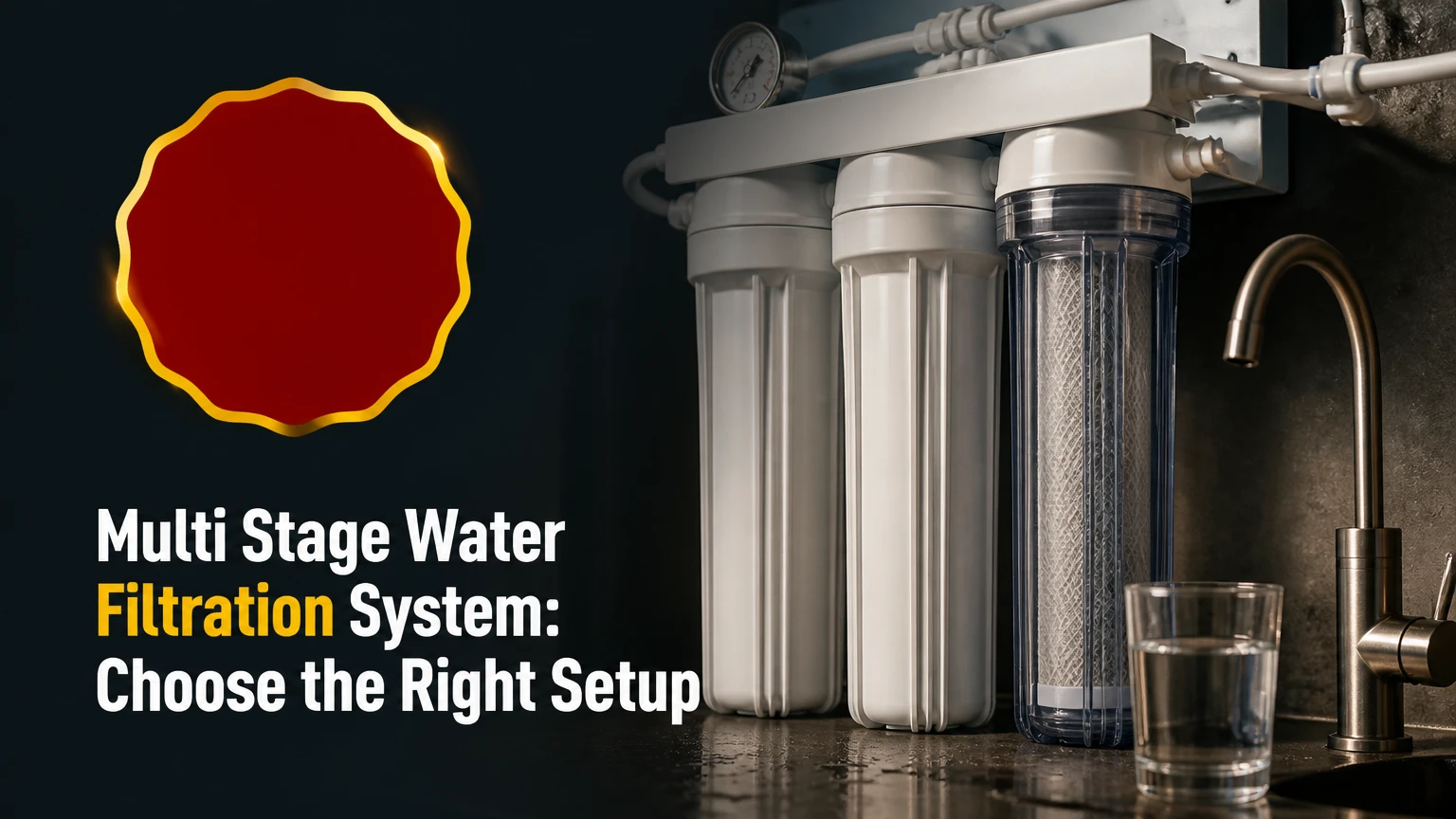
A multi stage water filtration system sends water through two or more treatment barriers, such as sediment filtration, activated carbon, reverse osmosis, ultrafiltration, ultraviolet disinfection, or remineralization. The correct combination depends on the contaminants in the source water, because no single system removes sediment, dissolved chemicals, microorganisms, and hardness equally well.
Key Facts at a Glance
- A multi stage water filtration system combines different treatment mechanisms in sequence, rather than repeating identical filters.
- Sediment filters capture particles; activated carbon adsorbs chlorine and many organic chemicals; membranes reduce selected dissolved contaminants.
- Reverse osmosis commonly reduces dissolved solids, fluoride, nitrate, lead, and arsenic, but performance depends on membrane condition and feed-water chemistry.
- Ultrafiltration retains minerals and produces no concentrate stream, but it generally does not remove dissolved salts, fluoride, nitrate, or most PFAS.
- Whole-house systems treat water at the main entry point, while under-sink and countertop systems usually target drinking and cooking water.
- A contaminant-specific water test and a certified performance claim are more useful than stage count alone.
What Is a Multi Stage Water Filtration System?
A multi stage water filtration system is a treatment assembly with at least two distinct barriers arranged in a defined flow path. A three-stage unit might use a sediment cartridge, granular activated carbon, and carbon block, while a five-stage reverse osmosis unit might add a membrane, storage tank, and post-carbon filter.
“Stage” describes a treatment step, not a universal performance level. Two carbon cartridges may improve taste and chlorine reduction, but they do not automatically remove nitrate or hardness. The Water Quality Association and NSF explain that contaminant reduction claims must be tied to a specific tested product, contaminant, and operating condition.
The U.S. Environmental Protection Agency states, “The presence of a contaminant does not necessarily mean that the water poses a health risk.” Water testing determines whether a treatment target is necessary. A filter selected only because it has seven stages can waste money or create maintenance problems.
Filtration, Adsorption, and Disinfection Are Different
Mechanical filtration physically retains particles. Activated carbon uses adsorption, meaning compounds attach to the carbon surface rather than dissolve into it. Reverse osmosis separates water from many dissolved substances through a pressure-driven membrane.
Ultraviolet treatment does not remove particles or chemicals. UV energy inactivates susceptible microorganisms after the water has been clarified, and it requires electricity, adequate dose, and a clean sleeve. Remineralization adds minerals after treatment; it does not make contaminated source water safe by itself.
How Does a Multi-Stage Filter Work?
A typical drinking-water system moves water from coarse protection to chemical treatment, membrane separation, and final conditioning. Correct order reduces clogging, protects the membrane, and prevents a post-treatment cartridge from becoming the first barrier against heavy sediment.
Stage 1: Sediment Filtration
A sediment cartridge captures sand, rust, silt, clay, and pipe debris through a pleated or depth-filtering structure. Typical residential ratings range from 1 to 20 microns, although the rating may be nominal or absolute, and those terms are not interchangeable.
Sediment filtration protects carbon pores and membrane surfaces. A cartridge that turns brown quickly indicates a source-water or plumbing issue, not necessarily a defective filter. Well owners may need a larger backwashing filter when sediment loads exceed cartridge capacity.
Stage 2: Granular Activated Carbon
Granular activated carbon reduces chlorine, taste, odor, and some volatile organic compounds through adsorption. Carbon effectiveness depends on contact time, carbon quality, flow rate, temperature, and the chemical being treated.
Chloramine is more persistent than free chlorine and often requires catalytic carbon or a larger carbon bed. A small carbon cartridge can improve taste without reliably reducing every regulated chemical. Product certification should identify the exact claim.
Stage 3: Carbon Block
A carbon block combines adsorption with physical filtration. The block can provide finer particle reduction than many granular cartridges and protects a reverse osmosis membrane from oxidants that can damage thin-film composite membranes.
Carbon blocks do not generally reduce hardness, nitrate, fluoride, or total dissolved solids. They also become a flow restriction when saturated. Many under-sink systems place sediment before granular carbon, then carbon block, although compact cartridges may combine several functions internally.
Stage 4: Reverse Osmosis or Ultrafiltration
Reverse osmosis applies pressure to force water through a semipermeable membrane. The membrane typically rejects a high percentage of many dissolved ions and molecules, while a concentrate stream carries rejected material to a drain.
Ultrafiltration uses a larger-pore membrane that removes suspended particles, bacteria, and many cysts while allowing dissolved minerals and salts to pass. UF does not provide the same dissolved-contaminant reduction as RO.
Stage 5: Post-Carbon Polishing
A post-carbon cartridge improves taste after water passes through a storage tank or internal tubing. It is a polishing stage, not a substitute for a failed membrane or exhausted prefilter.
Storage tanks create a practical trade-off. They provide reserve water but hold treated water for hours, so sanitation and scheduled replacement matter. Tankless RO systems avoid the tank but need a pump or favorable pressure to deliver useful flow.
Stage 6: UV or Remineralization
UV treatment inactivates bacteria, viruses, and other susceptible organisms without adding chemicals. UV cannot disinfect cloudy water reliably when particles shield microorganisms, so sediment reduction must occur first.
A remineralization cartridge typically adds calcium or magnesium salts and changes taste and alkalinity. It does not restore every mineral removed by RO, and pH claims vary with cartridge media, contact time, and source-water chemistry.
Which System Type Fits Your Water?
The best configuration depends on treatment location, contaminant profile, flow demand, and tolerance for wastewater. Point-of-use systems usually provide stronger drinking-water treatment for less money, while point-of-entry systems protect every fixture but require higher flow and larger media capacity.
| System type | Typical stages | Typical flow or output | Main targets | Main limitation |
|---|---|---|---|---|
| Under-sink carbon | 2-3 | 0.5-2 gallons per minute | Chlorine, taste, odor, some VOCs | Limited dissolved-contaminant reduction |
| Under-sink UF | 2-4 | 0.5-1.5 gallons per minute | Sediment, bacteria, cysts | Preserves fluoride, nitrate, and TDS |
| Under-sink RO | 4-7 | 20-100 gallons per day | TDS, lead, fluoride, nitrate, arsenic | Drain water and slower delivery |
| Countertop RO | 3-6 | 0.3-1 gallon per minute | Dissolved solids and selected chemicals | Reservoir and electricity required |
| Whole-house carbon | 2-3 | 5-15 gallons per minute | Chlorine, taste, odor, some VOCs | Does not equal drinking-water purification |
| Whole-house sediment and specialty media | 2-4 | 5-12 gallons per minute | Sediment, iron, manganese, sulfur | Requires media matched to water chemistry |
Under-Sink Reverse Osmosis
Under-sink RO is usually the strongest residential choice for high TDS, fluoride, nitrate, lead risk, or arsenic when the product carries an applicable certified claim. Typical systems include sediment, carbon, membrane, storage, and post-carbon stages.
RO does not solve every water problem. Hardness can scale the membrane, bacteria can grow in neglected plumbing, and poor pressure can increase waste and reduce production. A typical system performs best near 60 psi, although the manufacturer’s operating range controls.
Under-Sink Ultrafiltration
UF suits treated municipal water where the main concerns are chlorine, particles, bacteria, and cysts, while preserving calcium and magnesium. UF does not reduce TDS because dissolved ions pass through its membrane.
UF is also useful when drain access is unavailable. A UF unit may deliver faster flow than an unpressurized RO system, but it cannot compensate for nitrate, fluoride, salt, or many dissolved-metal problems.
Whole-House Filtration
Whole-house filtration treats water at the main entry point before it reaches showers, appliances, and faucets. It can reduce sediment, chlorine, iron, manganese, or sulfur when the media and capacity match the measured concentration.
A whole-house carbon tank is not automatically a microbiological barrier. Homes with private wells should test for coliform bacteria and nitrates at least annually, and after flooding, repairs, or changes in taste and odor. Drinking-water RO or UV may still be needed at the kitchen faucet.
Countertop and Tankless Systems
Countertop systems suit renters and households that cannot modify plumbing. Tankless units save cabinet space, but pump noise, reservoir cleaning, replacement-cartridge cost, and electrical dependence affect ownership.
Electronic TDS displays show conductivity-related dissolved solids, not a complete safety analysis. A low displayed TDS does not prove removal of bacteria, PFAS, or every regulated contaminant.
RO, UF, Carbon, and Whole-House Systems Compared
Reverse osmosis is the better choice for dissolved contaminants, UF is better when mineral retention and zero wastewater matter, carbon is efficient for chlorine and taste, and whole-house treatment is better for high flow and fixture protection. No category wins across every water source.
| Decision factor | Carbon | UF | RO | Whole-house specialty media |
|---|---|---|---|---|
| Typical installation | Faucet or under sink | Under sink | Under sink or countertop | Main water line |
| TDS reduction | 0-10% typical | 0% typical | 80-99% typical | 0-30%, media-dependent |
| Wastewater | None | None | Typical 1-4 gallons per gallon produced | None for cartridge systems |
| Mineral retention | High | High | Low | Usually high |
| Electricity | No | No | Usually no, pump optional | No, UV requires power |
| Best target | Chlorine and taste | Particles and microbes | Dissolved contaminants | Sediment, iron, chlorine, scale |
| Typical initial cost | $50-$250 | $150-$500 | $200-$800 | $400-$2,500 |
Does a Higher Stage Count Mean Better Water?
A higher stage count does not guarantee better water. Stage count becomes meaningful only when each cartridge has a defined role, adequate capacity, and a verified contaminant-reduction claim.
A duplicated carbon cartridge may extend contact time in a high-chlorine supply. Conversely, unnecessary stages increase pressure loss, replacement cost, and the number of places where leaks can develop. Compare media volume, rated capacity, flow, certification, and replacement price before counting cartridges.
Can a Whole-House Filter Replace an RO System?
A whole-house filter cannot replace an RO system when the drinking-water problem involves high TDS, fluoride, nitrate, arsenic, or another dissolved contaminant that the whole-house media does not specifically reduce. Whole-house filtration and point-of-use RO often work together.
The practical combination is source-specific pretreatment at the entry point, followed by a certified drinking-water cartridge or RO membrane at the kitchen faucet. Treating every gallon with RO can cost more and create unnecessary concentrate discharge.
What Does a Multi-Stage System Cost to Own?
Residential equipment commonly costs $50-$250 for carbon filtration, $150-$800 for under-sink RO, $200-$1,000 for countertop RO, and $400-$2,500 for whole-house treatment. Installation, specialty media, water testing, replacement cartridges, and plumbing modifications can materially change the total.
| Component | Typical replacement interval | Typical replacement cost | Replacement trigger |
|---|---|---|---|
| Sediment cartridge | 3-12 months | $10-$40 | Pressure drop or visible loading |
| GAC cartridge | 6-12 months | $20-$80 | Capacity reached or chlorine breakthrough |
| Carbon block | 6-12 months | $25-$100 | Capacity reached or reduced flow |
| RO membrane | 2-5 years | $40-$150 | Rejection decline or output loss |
| Post-carbon cartridge | 6-12 months | $15-$60 | Taste change or scheduled service |
| UV lamp and sleeve service | 12 months | $60-$200 | Annual lamp replacement |
| Specialty iron media | 3-8 years | $200-$1,000 | Media exhaustion or tested breakthrough |
Typical annual maintenance ranges from $60-$150 for a simple carbon system, $100-$300 for RO, and $150-$600 for whole-house systems with specialty media. A water test may cost $30-$200 for a basic panel and more for PFAS, arsenic, or broad private-well analysis.
How Should You Choose and Install One?
Choose treatment from a current water report or laboratory test, then verify that the selected product addresses the measured contaminant at your household flow and pressure. Installation normally takes 30-120 minutes for an under-sink unit and several hours for a whole-house assembly.
- Test the source water. Use the municipal Consumer Confidence Report as a starting point, but test private wells for coliform bacteria, nitrate, pH, hardness, iron, manganese, and total dissolved solids.
- Measure pressure and temperature. Residential RO commonly needs about 40-80 psi for practical operation. Connect filtration only to cold water; hot water can damage housings, seals, carbon, and membranes.
- Order stages by function. Place sediment before carbon, carbon before an RO membrane, and UV after particle reduction. Follow the manufacturer’s flow arrows.
- Flush new cartridges. Run the specified volume to remove carbon fines and preservatives. RO tanks commonly require several full discard-and-fill cycles, according to the manual.
- Check for leaks under pressure. Open the feed valve slowly, inspect every fitting, and leave dry tissue beneath connections for 15 minutes.
- Record baseline performance. Note pressure, production rate, taste, and feed-versus-product TDS when relevant. A baseline makes later diagnosis possible.
A common practitioner rule is to size whole-house cartridges for peak simultaneous flow, not average daily use. Undersized housings may cause pressure loss during a shower and shorten media life.
How Do You Maintain Filter Performance?
Replace cartridges by capacity or time, whichever comes first, and act sooner when pressure falls, taste changes, or source-water conditions worsen. Old carbon can lose adsorption capacity, while neglected housings and tanks can develop microbial growth.
| Maintenance task | Typical frequency | Measurement or action | Consequence of neglect |
|---|---|---|---|
| Replace sediment filter | 3-12 months | Check pressure drop | Carbon and membrane clogging |
| Replace carbon stages | 6-12 months | Follow gallon rating | Chlorine or taste breakthrough |
| Sanitize RO housing and tank | 12 months | Use approved procedure | Biofilm and off-taste risk |
| Inspect tubing and fittings | Every 3-6 months | Check dampness and cracks | Cabinet or floor water damage |
| Test private well | At least annually | Certified laboratory panel | Undetected bacterial or chemical exposure |
| Replace UV lamp | 12 months | Follow lamp-hour limit | Reduced disinfection dose |
A filter’s stated gallon capacity assumes particular water quality and flow. Sediment, hardness, high chlorine, and seasonal turbidity can reduce real service life substantially.
What Problems Occur Most Often?
Low flow usually comes from a clogged prefilter, low RO tank air charge, low feed pressure, a kinked tube, or a restricted faucet aerator. Strange taste often indicates an exhausted carbon cartridge, inadequate flushing, contaminated storage, or a membrane with declining rejection.
| Symptom | Likely cause | First diagnostic | Corrective action |
|---|---|---|---|
| Low faucet flow | Clogged cartridge or empty tank | Measure pressure and inspect filters | Replace cartridge or service tank |
| RO tank fills slowly | Feed pressure below specification | Read pressure under flow | Correct restriction or add booster pump |
| High product TDS | Membrane failure or poor seal | Compare feed and product TDS | Replace membrane or inspect seals |
| Constant drain flow | ASO valve, check valve, or pressure issue | Close product faucet and observe drain | Service valve and verify pressure |
| Chlorine taste returns | Carbon exhaustion or channeling | Use a chlorine test strip | Replace carbon and check flow rate |
| Water leaks | Loose fitting, damaged O-ring, cracked housing | Dry tissue inspection | Reseat, lubricate, or replace part |
RO rejection is calculated as: (feed TDS minus product TDS) divided by feed TDS, multiplied by 100. For example, 300 ppm feed and 30 ppm product equals 90% rejection, but TDS alone cannot verify lead, PFAS, bacteria, or nitrate performance.
What Happens When Pressure Is Too Low?
Low pressure reduces RO production and can increase the ratio of concentrate water to treated water. Check household pressure, clogged filters, shutoff valves, tubing restrictions, and the empty tank air charge before replacing the membrane.
A booster pump may help when supply pressure remains below the manufacturer’s minimum. Pumps add electrical demand, noise, cost, and another failure point, so they should follow diagnosis rather than replace it.
Can UV Make Unsafe Well Water Safe?
UV can inactivate microorganisms when dose, flow, clarity, and lamp condition are correct, but UV does not remove arsenic, nitrate, pesticides, sediment, or dissolved metals. A private-well system needs testing, pretreatment, and periodic microbiological verification.
UV units should include a flow restrictor or alarm where appropriate. If water bypasses the rated flow, exposure time falls and the claimed dose may no longer apply.
Which Setup Fits Common Household Situations?
Municipal households with chlorine and taste complaints often need carbon, while households with tested fluoride, nitrate, arsenic, or high TDS usually need certified RO. Private-well owners commonly need entry-point treatment plus a separate drinking-water barrier, but the exact combination must follow laboratory results.
- Renter with chlorine taste: Choose a countertop or under-sink carbon system with a certified chlorine claim. Avoid paying for RO when dissolved contaminants are not a concern.
- Municipal home with lead risk: Use a certified point-of-use filter for lead reduction and address plumbing sources. A general carbon cartridge without a lead claim is insufficient.
- High-TDS household: Choose RO with adequate pressure, membrane pretreatment, and a drain connection. Consider remineralization only for taste.
- Private well with bacteria risk: Test first, then use sediment treatment and UV or another validated disinfection method. Add RO when dissolved contaminants require it.
- Home with iron and manganese: Use oxidation or specialty media sized to concentration and pH. Carbon alone may load rapidly or fail to reduce the metals.
- Mineral-preserving user: Choose carbon or UF when tests show no dissolved-contaminant need. UF cannot solve a nitrate or fluoride problem.
FAQ
Does a multi-stage filter remove bacteria?
A multi-stage filter can remove or inactivate bacteria only when it includes a properly rated membrane, UV reactor, or other validated disinfection barrier. Carbon and sediment cartridges alone are not reliable microbiological treatment. Private-well users should test for coliform bacteria and follow local health-department guidance.
Does reverse osmosis remove beneficial minerals?
Reverse osmosis removes many dissolved minerals along with unwanted dissolved substances, although the health significance of minerals in drinking water varies by diet and source. A remineralization cartridge can alter taste and alkalinity, but it does not recreate the original mineral profile precisely.
How much water does an RO system waste?
Residential RO systems commonly discharge about 1-4 gallons for each gallon of product water, although efficiency varies by pressure, temperature, membrane design, and storage conditions. Reject water can sometimes be collected for suitable non-drinking uses, provided local plumbing rules and contamination concerns are considered.
Are expensive replacement filters better?
Expensive replacement filters are not automatically better. Compare certified contaminant claims, media quantity, rated capacity, pressure loss, fit, and laboratory or manufacturer documentation. An inexpensive cartridge with the correct certified claim can outperform a premium cartridge marketed only by stage count.
Can filtered water be stored indefinitely?
Filtered water should not be stored indefinitely because tanks, pitchers, and bottles can support microbial growth after treatment. Keep storage containers clean, protect them from heat and light, and follow the system manufacturer’s sanitation and replacement schedule.
Should you buy a five-stage or seven-stage system?
Buy the system that matches tested contaminants, not the system with the most stages. A five-stage RO unit may provide all necessary pretreatment and polishing, while a seven-stage unit may add redundant carbon or unnecessary remineralization. Verify flow, waste ratio, certification, and annual cartridge cost.
Conclusion
A multi stage water filtration system works when each barrier has a defined purpose and matches the source water. Test first, then choose carbon, UF, RO, whole-house media, UV, or a combination based on contaminants, pressure, flow, maintenance capacity, and verified performance claims rather than stage count alone.