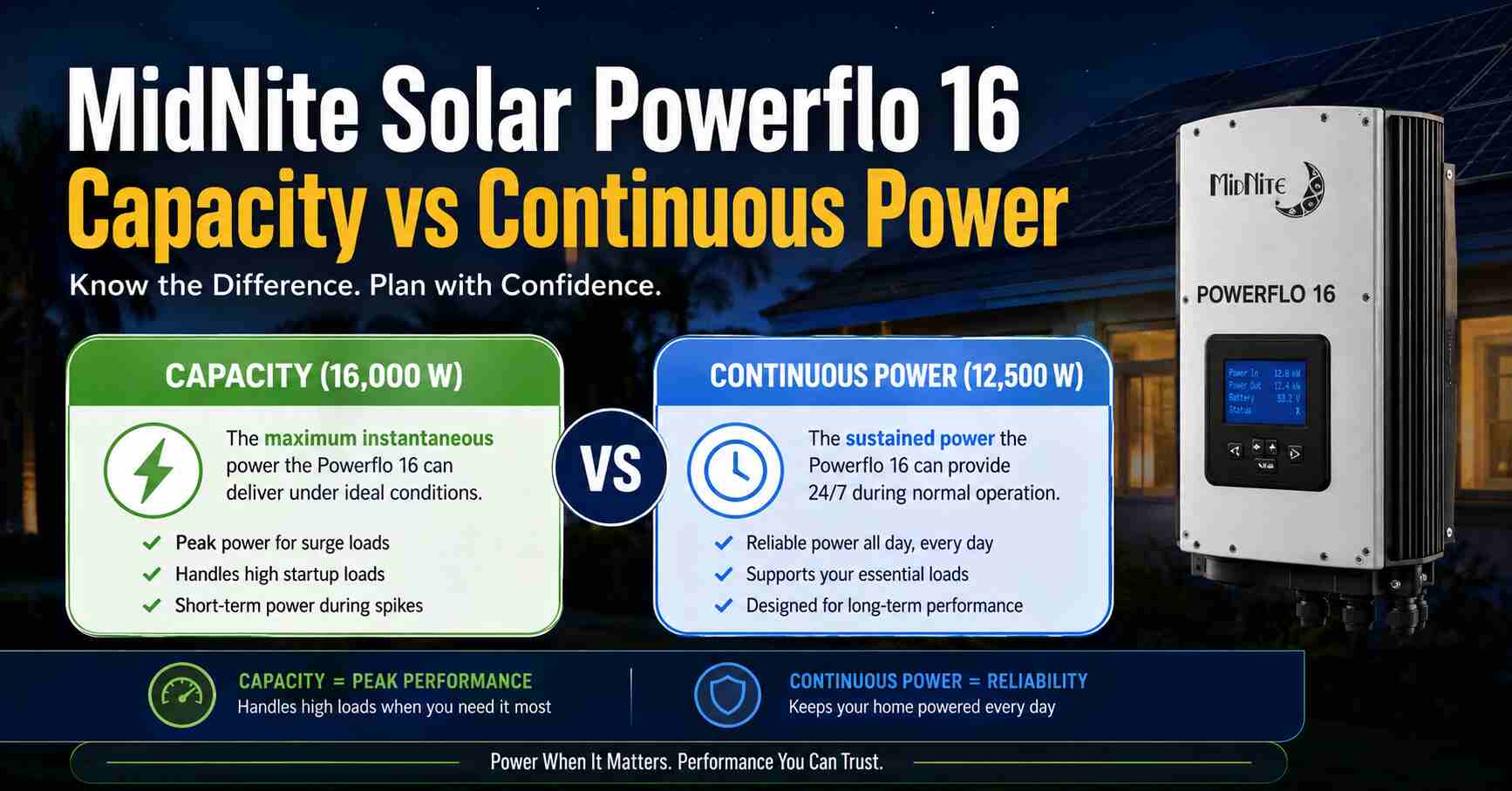
One number tells you how much energy the battery holds. A completely different number tells you how fast you can pull that energy out. Confusing the two is the most common mistake in energy storage sizing. Here is exactly how the MNPowerflo16 splits the difference.
| The Quick Answer The MidNite Solar MNPowerflo16 has a total energy capacity of 16 kWh (16,076 Wh) and a continuous power rating of roughly 8.1 kW, based on its 160A nominal current at 51.2V nominal voltage. For brief startup surges it can reach a peak of about 10.7 kW at its 210A maximum discharge rating. |
If you are shopping for a low voltage lithium battery for a home, cabin, or off grid property, the phrase capacity vs continuous power comes up constantly, and it trips up even experienced installers. Datasheets list a kilowatt hour number and an amp number side by side as if they measure the same thing. They do not. This guide breaks down the MNPowerflo16 numbers in plain language, shows you the real world runtime math, and explains how MidNite designed the pack so that neither figure becomes a bottleneck.
Capacity vs Continuous Power: The Core Difference
The single most useful thing to understand is that these two ratings answer two separate questions.
- Capacity (16 kWh) answers how much. It is the size of the fuel tank. A 16 kWh battery can deliver 1,000 watts for 16 hours, or 16,000 watts for one hour, at 100 percent depth of discharge.
- Continuous power (8.1 kW) answers how fast. It is the width of the fuel line. It describes how many watts you can safely pull at any given instant during normal everyday operation without overheating the cells or tripping a safety shutoff.
A tank can be enormous and still feed only a narrow pipe. Likewise, a battery can hold plenty of energy yet refuse to power a large motor if the demand exceeds its power rating. Both numbers have to fit your loads. On the MNPowerflo16, MidNite deliberately paired a generous 16 kWh tank with a wide 8.1 kW pipe so that a single unit can support a substantial critical loads panel.
MNPowerflo16 capacity vs power ratings at a glance
| Rating | Value | What it tells you |
| Energy Capacity | 16 kWh (16,076 Wh) | Total energy stored. 314Ah at 51.2V nominal. |
| Continuous Power | ~8.1 kW | 160A nominal charge and discharge rate, sustained. |
| Peak / Surge Power | ~10.7 kW | 210A maximum short term discharge for startup surges. |
| Nominal Voltage | 51.2V | Operating range 46.4V to 57.6V. |
The Continuous Power Rating Explained (160A at 51.2V)
Power in a DC battery is simply volts multiplied by amps. The MNPowerflo16 carries a nominal continuous current of 160A for both charging and discharging. Multiply that by the 51.2V nominal voltage and you get 8,192 watts, which rounds to about 8.1 kW of steady state output.
That 8.1 kW figure is what one battery can supply hour after hour without complaint. In practical terms it is enough to run a refrigerator, lighting, a well pump, entertainment gear, a microwave, and convenience outlets at the same time, which covers the loads most people actually care about during an outage. When paired with a MidNite MN15-12KW-AIO inverter, the inverter draws from the battery within this continuous window while the battery management system keeps the cells inside their safe operating band.
Power ratings: continuous vs peak surge
| Mode | Current / Voltage | Power output |
| Continuous (sustained) | 160A at 51.2V | ~8.1 kW |
| Peak surge (short term) | 210A at 51.2V | ~10.7 kW |
Why Peak Power Matters for Motors and Compressors
Steady state is only half the story. Deep well pumps, air conditioners, and refrigeration compressors demand two to three times their running wattage for a fraction of a second when they first switch on. If a battery cannot supply that inrush, the inverter never transfers to backup mode and none of your loads receive power. The MNPowerflo16 answers this with a 210A maximum discharge, giving roughly 10.7 kW of headroom to swallow those startup surges. MidNite has emphasized for years that surge capability is arguably more important than continuous ratings, because it is the difference between a system that starts your pump and one that simply shuts off.
Real Runtime: Putting Capacity to Work
Capacity only becomes meaningful once you divide it by your load. The math is straightforward: runtime in hours equals stored kilowatt hours divided by load in kilowatts. Because the MNPowerflo16 uses lithium iron phosphate cells, you can draw the full listed capacity without the depth of discharge penalties that plague lead acid banks.
How long does 16 kWh last at different loads?
| Steady load | Approx. runtime | Load category |
| 500 W | ~32 hours | Light critical loads |
| 1,000 W | ~16 hours | Typical household |
| 2,000 W | ~8 hours | Typical household |
| 4,000 W | ~4 hours | Heavy draw |
| 8,000 W | ~2 hours | Near maximum |
Notice how the runtime collapses as the load climbs. This is exactly why designers separate critical circuits from major appliances. Running lights, a fridge, and electronics stretches a single 16 kWh pack across most of a night. Add an electric range or an EV charger and the same tank empties in an hour or two. The lesson is not that the battery is small; it is that continuous power and capacity must both be matched to a realistic load list rather than a whole home wish list.
Charge Power and Cold Weather Behavior
The 160A rating applies to charging as well as discharging, so a single MNPowerflo16 accepts up to about 8.1 kW of charge current under normal conditions. MidNite notes that a firmware update can raise the ceiling toward 280A, after which the internal thermal sensors throttle the current to whatever the battery management system deems safe. In other words, the pack will never blindly accept more power than its cells can absorb without overheating.
Cold climates get special attention. The MNPowerflo16 includes integrated self heating pads. When the ambient temperature drops below 32 degrees Fahrenheit, the heaters engage so the cells reach a safe charging window before current flows. This keeps the usable capacity and charge power intact in winter conditions where an unheated lithium pack would refuse to charge at all.
| Key insight: Both the capacity and the continuous power numbers assume the cells sit within their operating temperature and voltage band. Outside that band the BMS reduces current on purpose. That protective throttling is not a flaw; it is the mechanism behind the pack’s 8,000 cycle life and 20 year design target. |
Scaling Beyond One Battery
Both ratings scale linearly as you add units. Because the MNPowerflo16 supports up to 16 units in parallel, capacity and continuous power grow together.
Capacity and continuous power scale together
| Units | Total Capacity | Continuous Power | Peak Power |
| 1 battery | 16 kWh | ~8.1 kW | ~10.7 kW |
| 2 batteries | 32 kWh | ~16.3 kW | ~21.5 kW |
| 4 batteries | 64 kWh | ~32.7 kW | ~43 kW |
| 16 batteries | ~257 kWh | ~131 kW | ~172 kW |
Paralleling is genuinely plug and play. Each battery automatically assigns its own address over a standard RJ45 daisy chain, so there are no DIP switches to set. The pack also identifies the inverter protocol and holds a closed loop connection with MidNite AIO inverters, and it speaks the widely used Pylontech protocol for compatibility with other 48V inverters that support lithium iron phosphate. That means when you double the capacity, you also double the continuous power without any manual reconfiguration.
Matching Batteries to the MN15-12KW-AIO Inverter
MidNite pairs the MNPowerflo16 with its flagship MN15-12KW-AIO hybrid inverter, sometimes called The One. A single inverter cleanly backs up a 100A critical loads panel, and two units in parallel can support a full 200A service. Because the inverter carries its own programmable load shedding circuits, you avoid the expensive external load shed box that competing systems require. The practical takeaway is that the battery’s 8.1 kW continuous rating and the inverter’s output are engineered to work as a matched pair, so neither side becomes the weak link.
Capacity vs Continuous Power: Which One Should Drive Your Decision?
Ask two questions in order. First, what is the largest combination of loads that could run at the same instant? That number sets your continuous power requirement, and it decides how many units and inverters you need. Second, how long do those loads need to run before the sun returns or the grid comes back? That number sets your capacity requirement, and it decides how many kilowatt hours you stack. A system sized only on capacity may hold plenty of energy yet stall on a pump start. A system sized only on power may start everything yet die by midnight. The MNPowerflo16 is competitive on both axes, which is why a single unit suits so many residential critical loads plans while the parallel path stays open for larger builds.
| Ready to Size Your MidNite System? Turn these numbers into a build that fits your exact loads and runtime goals. Get a personalized capacity and continuous power plan for the MNPowerflo16 and the MN15-12KW-AIO before you buy. Request a Free System Consultation |
Specifications reflect the MNPowerflo16 datasheet version v1.1.3 and user manual. Nominal voltage 51.2V, 314Ah, 16,076 Wh, 160A nominal charge and discharge, 210A maximum discharge, IP65, LFP chemistry, 8,000 cycles at 77 degrees Fahrenheit, 15 year limited warranty. Always confirm final figures against current MidNite Solar documentation and consult a licensed installer.