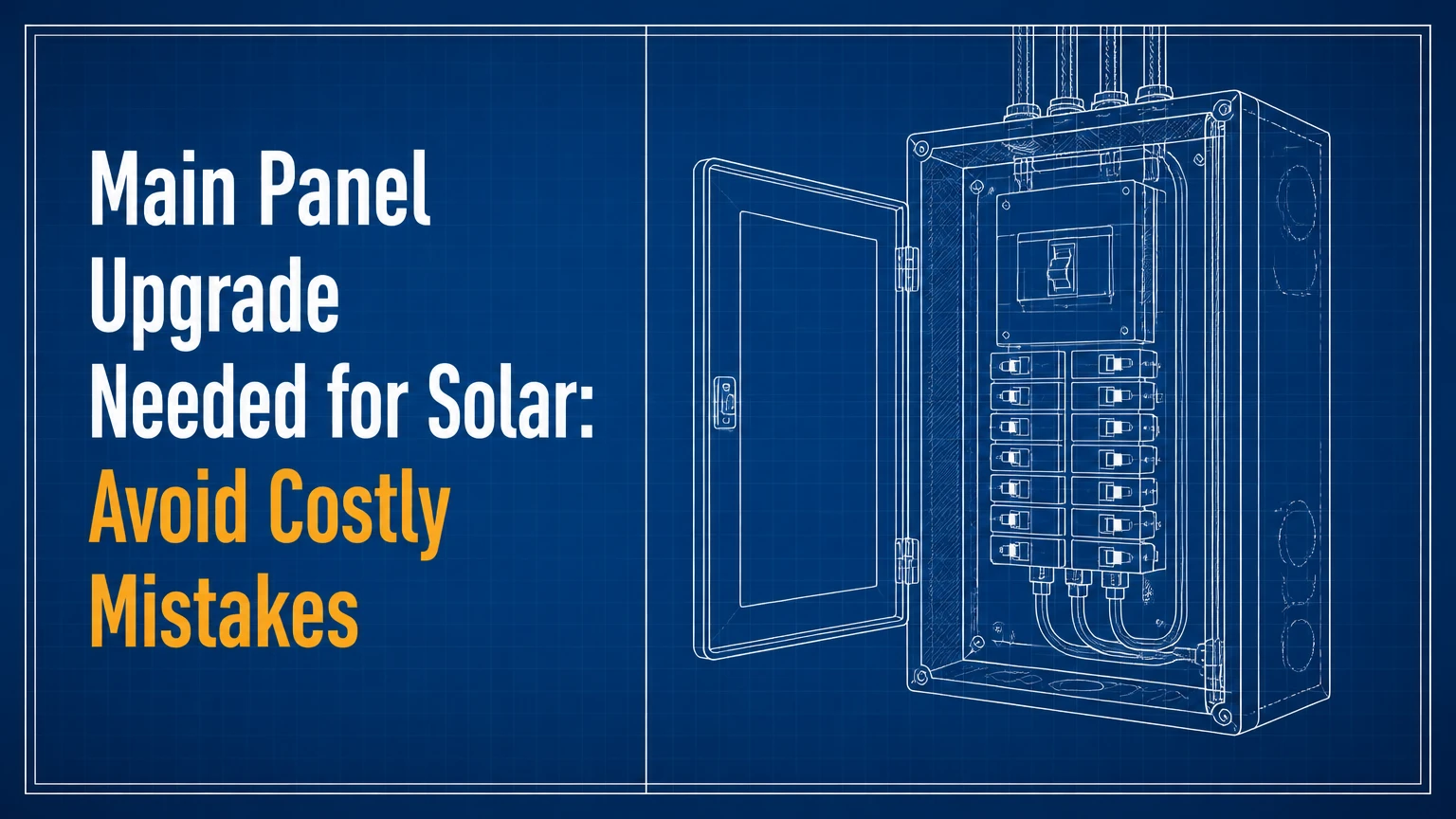
A main panel upgrade is needed for solar when the existing busbar, service rating, wiring, or utility connection cannot safely accommodate the solar backfeed and household loads. Many 200-amp panels pass inspection without replacement, while some 100-amp panels work with smaller systems. The deciding factors are electrical calculations, equipment ratings, and local approval.
Key Facts at a Glance
- The NEC 120% calculation limits the combined main-breaker and solar-breaker ratings relative to the panel busbar rating.
- A 200-amp panel with a 200-amp busbar commonly permits a maximum 40-amp solar breaker under the standard busbar calculation.
- A 200-amp main breaker on a 225-amp busbar can permit a 70-amp solar breaker, subject to listing, installation, and local code approval.
- A typical standard 200-amp panel upgrade costs approximately $2,500-$4,500, excluding major trenching or utility construction.
- Physical replacement often takes 4-8 hours, but permits, utility scheduling, and inspection can extend the complete process to 3-6 weeks.
- A panel upgrade is not automatically required for every solar installation; the approved design determines whether existing equipment is adequate.
Does Solar Always Require a Main Panel Upgrade?
Solar does not always require a main panel upgrade. An existing electrical panel can remain when its busbar, breakers, service conductors, load calculation, interconnection method, and physical condition support the proposed photovoltaic system.
The solar inverter sends alternating-current output into a dedicated breaker or an approved supply-side connection. That current can flow toward household circuits, the utility meter, or both. Because current can enter the panel from two directions, the panel must be evaluated for conductor and busbar heating rather than judged only by the number printed on the main breaker.
A panel upgrade becomes more likely when the home has a 100-amp service, a crowded or obsolete fuse box, damaged busbar connections, aluminum branch-circuit concerns, electric resistance heat, a heat pump, multiple EV chargers, or a large battery inverter. A small 3 kW solar array may fit where a 12 kW array does not.
The panel rating is only one part of the decision. The service rating, busbar rating, breaker position, inverter output, and local utility rules all matter.
What Is a Main Panel Upgrade?
A main panel upgrade replaces or materially modifies the service equipment that distributes utility power to the home. Contractors may call the work a service-panel replacement, electrical service upgrade, or “heavy-up,” although those terms do not always describe identical work.
A panelboard contains the busbar, overcurrent devices, neutral bar, grounding connections, and enclosure. A full service upgrade may also require larger service conductors, a new meter socket, a new disconnect, grounding electrode work, weatherhead changes, or utility-side construction.
| Equipment term | Primary function | Typical rating | Solar relevance |
|---|---|---|---|
| Main breaker | Limits service current entering the panel | 100A, 150A, 200A | Forms part of the busbar calculation |
| Busbar | Carries current to branch breakers | 125A, 200A, 225A | Determines allowable backfeed under standard rules |
| Service conductors | Carry utility current to the service equipment | 100A-400A | May limit a larger service upgrade |
| Solar breaker | Connects inverter output to the panel | 20A-70A typical | Adds a second source of current |
| Meter socket | Connects the utility meter to service conductors | Utility-specific | May need relocation or replacement |
| Disconnect | Allows service or equipment isolation | 100A-400A | Required configuration varies by code and utility |
A breaker upgrade alone is not a safe service upgrade. Increasing a 100-amp main breaker to 200 amps without replacing conductors and compatible service equipment can create a severe overcurrent hazard.
How the 120% Rule Determines Solar Capacity
The standard NEC busbar method generally limits the main-breaker rating plus the solar backfeed breaker rating to 120% of the panel busbar rating. The relevant rule appears in NEC 705.12(B), but the exact installation must follow the edition adopted by the authority having jurisdiction and the equipment manufacturer’s instructions.
The basic calculation is:
Main breaker rating + solar breaker rating ≤ 120% × busbar rating
The solar breaker rating is not always identical to the inverter’s nameplate output. Inverter output is continuous, so the design must apply the applicable continuous-load factor, commonly 125%, before selecting the overcurrent device. NEC 705.12 also includes placement and equipment conditions, so a simple arithmetic result does not guarantee approval.
| Busbar rating | Main breaker | 120% busbar limit | Approximate maximum solar breaker |
|---|---|---|---|
| 125A | 100A | 150A | 50A |
| 200A | 150A | 240A | 90A |
| 200A | 200A | 240A | 40A |
| 225A | 200A | 270A | 70A |
| 400A | 400A | 480A | 80A |
The 200-amp panel with a 200-amp busbar illustrates the common misconception. The calculation leaves 40 amps, not enough for every 10 kW solar design. At 240 volts, a 40-amp breaker represents 9.6 kVA of breaker capacity, but the allowed inverter output and equipment configuration still require engineering review.
The National Electrical Code expresses the core restriction as equipment that “shall not exceed 120 percent of the busbar rating.” Installers must also verify breaker compatibility, busbar position, conductor ampacity, temperature ratings, and manufacturer listing.
What Solar Size Fits a 200-Amp Panel?
A 200-amp panel may support approximately 7.6 kW to 9.6 kW of inverter output under common configurations, but no universal solar size applies to every 200-amp panel. A 200-amp busbar and a 200-amp main breaker often produce a 40-amp solar-breaker limit, while a 225-amp busbar can allow more.
For example, a 7.6 kW inverter operating at 240 volts draws about 31.7 amps before applying design rules. A 9.6 kW inverter draws 40 amps. A 12 kW inverter draws 50 amps, which exceeds the typical 40-amp allowance on a 200-amp busbar with a 200-amp main.
A larger array may still use a smaller inverter because photovoltaic module capacity and inverter output are different values. The permit drawing must identify the inverter’s continuous output, breaker size, and interconnection method.
When Is a 100-Amp Panel Adequate?
A 100-amp panel can support solar when the inverter is small, the panel is in good condition, the load calculation passes, and the utility accepts the interconnection. A 100-amp panel is less flexible for future electrification because electric heating, an induction range, an EV charger, and battery equipment consume substantial capacity.
Under a simple 120% calculation, a 100-amp main breaker on a 100-amp busbar leaves 20 amps for a solar breaker. At 240 volts, that is approximately 4.8 kVA of breaker capacity. A 100-amp panel with a 125-amp busbar leaves 50 amps under the same arithmetic, but equipment listing and breaker placement remain controlling requirements.
| Home condition | Likely panel outcome | Main reason |
|---|---|---|
| 100A service, 3 kW inverter, gas appliances | Existing panel may remain | Low inverter output and modest loads |
| 100A service, 8 kW inverter, electric range | Upgrade or redesign likely | Backfeed and demand compete for capacity |
| 100A service, 5 kW inverter, one EV charger | Load calculation required | Future EV demand can change the result |
| 100A fuse box, damaged enclosure | Replacement usually justified | Condition and code limitations |
| 100A panel, battery with limited backup loads | Existing panel may remain | Backup loads can be isolated |
| 100A panel, whole-home battery backup | Upgrade or smart load control likely | Battery and home loads require coordinated control |
An electrician should inspect heat damage, loose terminations, corrosion, recalled equipment, tandem-breaker use, and available breaker spaces before approving an existing panel. A panel that passes a mathematical calculation may still be unsuitable because of physical condition.
Which Panel Option Fits Your System?
A standard 200-amp replacement is usually the lowest-cost choice when the home needs more capacity and the solar system has ordinary interconnection requirements. A solar-ready panel with a larger busbar can solve a backfeed limitation without increasing the utility service conductors, while a smart panel adds monitoring and automated load management.
| Option | Typical equipment cost | Common solar use | Main limitation |
|---|---|---|---|
| Standard 200A panel | $2,500-$4,500 installed | Conventional PV system | May leave only a 40A breaker on a 200A bus |
| 225A-busbar solar-ready panel | $3,000-$5,500 installed | Larger inverter on 200A service | Availability and listing vary |
| 400A service upgrade | $5,000-$9,000+ | Large homes and heavy electrification | Utility conductors and trenching can dominate cost |
| Smart electrical panel | $4,500-$8,500 installed | Batteries, EVs, managed loads | Software and equipment cost more |
| Line-side connection | $1,500-$4,000 incremental | Suitable utility-approved designs | Utility and code restrictions are significant |
Solar-Ready Busbars and 225A Designs
A 225-amp busbar paired with a 200-amp main breaker can create more solar interconnection capacity than a conventional 200-amp busbar. The calculation is 225 × 1.20 = 270 amps; 270 minus 200 leaves a theoretical 70-amp solar breaker allowance.
That result does not mean every 16.8 kW inverter is automatically acceptable. A 70-amp breaker at 240 volts represents 16.8 kVA, but the inverter output, conductor sizing, breaker location, panel labeling, and manufacturer instructions must align. Some jurisdictions also impose requirements beyond the base NEC method.
Smart Panels for Solar and Batteries
A smart panel uses monitored relays, communications, and load controls to manage selected circuits. Products such as SPAN panels can coordinate batteries, backup loads, EV charging, and circuit prioritization, but product availability, software support, and installer experience affect the practical outcome.
Smart panels are useful when a homeowner wants whole-home backup without feeding every large load continuously. They are less attractive when the goal is only to add a modest solar array to a sound existing panel. A smart panel does not erase the need for service-conductor sizing or utility approval.
What Happens During the Upgrade?
A main panel upgrade normally follows seven stages: assessment, design, permitting, utility scheduling, electrical replacement, inspection, and reconnection. The electrician’s work may take 4-8 hours, while the total approval process commonly takes 3-6 weeks.
| Stage | Typical duration | Responsible party | Completion checkpoint |
|---|---|---|---|
| Site inspection and load calculation | 1-3 hours | Electrician or solar designer | Equipment and loads documented |
| Plan preparation | 1-5 business days | Contractor | One-line diagram completed |
| Permit and utility submission | 1-3 weeks | Contractor, AHJ, utility | Approval or correction notice issued |
| Utility disconnect scheduling | 1-4 weeks | Utility company | Outage appointment confirmed |
| Panel and service work | 4-8 hours | Licensed electrician | New equipment energized for inspection |
| Municipal inspection | 1-5 business days | Building inspector | Work passes inspection |
| Utility reconnection and meter work | 1-10 business days | Utility company | Service restored and interconnection advanced |
Step 1: Complete the Load Calculation
The electrician documents existing breakers, service conductors, appliance ratings, heating systems, EV charging, and planned solar or storage equipment. The calculation should account for future loads that will be installed soon, not only appliances operating on inspection day.
You will know this step is complete when the design identifies the service rating, busbar rating, main breaker, inverter output, solar breaker, and future-load assumptions. A common mistake is sizing the panel around solar alone and omitting a planned heat pump or second EV charger.
Step 2: Confirm the Interconnection Method
The designer chooses a load-side breaker connection, a supply-side or line-side tap, a service-rated transfer arrangement, or a managed-load architecture. The choice depends on equipment listing, available spaces, conductor routing, and utility rules.
A line-side tap can bypass the panel busbar calculation in some approved designs because the solar conductors connect ahead of the main breaker. Utilities often require specific disconnects, labeling, meter equipment, and inspection conditions. A line-side tap is not a universal shortcut.
Step 3: Submit Permits and Utility Documents
The contractor submits the electrical drawings, equipment specifications, site plan, load calculation, and utility application. The authority having jurisdiction reviews code compliance, while the utility reviews service and grid-interconnection effects.
You will know the submission is ready when the plans show conductor sizes, overcurrent devices, grounding, disconnects, equipment locations, and the single-line diagram. Missing inverter certification or unclear breaker calculations commonly create correction cycles.
Step 4: Schedule the Power Shutdown
The utility disconnects service before the electrician removes service equipment. The home usually loses power for several hours, and sensitive electronics should be disconnected before the outage.
The work is on schedule when the utility appointment, inspection requirements, electrician arrival, and equipment delivery are coordinated. Do not assume a contractor can restore utility power independently, because unauthorized reconnection can violate utility procedures.
Step 5: Install the New Service Equipment
The electrician removes the existing panel, installs the new enclosure, connects service conductors, installs breakers, upgrades grounding or bonding where required, and labels the solar disconnect. Meter relocation, conduit changes, or weatherproofing can extend the work.
You will know the installation is ready for inspection when terminations are torqued to manufacturer specifications, unused openings are closed, circuit labels are accurate, and the photovoltaic breaker matches the approved plan. An oversized main breaker on undersized conductors is an unacceptable shortcut.
Step 6: Pass Inspection and Correct Deficiencies
The inspector checks conductor sizing, grounding, bonding, overcurrent protection, working clearances, labeling, and equipment installation. The inspector may also verify that the solar equipment complies with the approved plans.
A passed inspection produces the documentation the utility needs for reconnection or permission to operate. Failed inspections commonly involve missing labels, incorrect breaker positions, unapproved equipment substitutions, or grounding details that differ from the plans.
Step 7: Restore Service and Obtain Permission to Operate
The utility restores power, replaces or reconfigures the meter when necessary, and completes its interconnection process. Solar should not be energized merely because the panel has power; the utility’s permission-to-operate requirements control grid-connected operation.
How Much Does a Solar Panel Upgrade Cost?
A typical standard 200-amp main panel upgrade costs $2,500-$4,500 installed, while a 400-amp service upgrade commonly costs $5,000-$9,000 or more. Meter relocation, underground service work, structural repairs, utility transformer changes, and trenching can add thousands of dollars.
| Cost item | Typical range | Cost driver | Usually included |
|---|---|---|---|
| Standard 200A panel replacement | $2,500-$4,500 | Panel access and circuit count | New panel, breakers, labor |
| 225A-busbar equipment | $3,000-$5,500 | Listed equipment availability | Panel and compatible breakers |
| Smart panel installation | $4,500-$8,500 | Product and commissioning | Smart panel, controls, labor |
| 400A service upgrade | $5,000-$9,000+ | Utility conductors and service route | Larger service equipment |
| Meter relocation | $1,000-$4,000+ | Exterior wall and utility standard | Socket relocation and conduit |
| Underground trenching | $2,000-$10,000+ | Distance and surface restoration | Excavation varies by contract |
| Utility transformer or line work | Utility-specific | Local grid capacity | Often separate from contractor quote |
A quote should identify whether the price includes permits, utility fees, inspection corrections, grounding, meter work, drywall repair, stucco repair, and solar commissioning. The cheapest proposal often excludes the exact items that cause change orders.
The federal tax treatment requires care. Internal Revenue Code Section 25C may provide a credit for qualifying electrical panel or wiring improvements that enable qualified energy property, subject to technical requirements, annual limits, and tax liability. Section 25D may apply to qualifying solar electric property and related installation costs. The Internal Revenue Service, not the contractor, determines eligibility, so homeowners should retain itemized invoices and consult a tax professional.
What Alternatives Can Avoid a Main Panel Replacement?
A main panel replacement may be avoidable through a smaller inverter, a line-side connection, a solar-ready busbar, a dedicated generation panel, or managed load controls. Each alternative changes the electrical design and must be accepted by the authority having jurisdiction and utility.
A subpanel does not automatically solve a main-panel capacity problem. A subpanel adds circuit spaces, but the feeder supplying it still draws through the main service equipment. A subpanel helps with organization and circuit placement, not with an overloaded service or busbar.
| Alternative | Best-fit scenario | Typical added cost | Key restriction |
|---|---|---|---|
| Smaller inverter | Solar production can be capped | $0-$2,000 design effect | Lower peak AC output |
| Line-side tap | Busbar capacity is limiting | $1,500-$4,000 | Utility-approved service connection |
| 225A busbar panel | 200A service has larger PV output | $500-$1,500 over standard | Equipment listing required |
| Generation subpanel | Multiple PV or battery circuits | $1,000-$3,000 | Main service calculation remains |
| Load-management system | EV and battery loads are controllable | $1,500-$5,000 | Requires compatible controls |
| Critical-load backup panel | Battery backs up selected circuits | $1,000-$3,500 | Not whole-home backup |
A smaller inverter can be economically sensible when annual energy production remains acceptable and the roof has more module capacity than the service can handle. Clipping during peak sunlight may cost less than a major utility service reconstruction.
Which Situations Create the Most Risk?
The highest-risk designs combine limited service capacity with future electric loads, battery backup, and difficult utility infrastructure. Homes with 100-amp services, electric heat, two EV chargers, and whole-home backup need a coordinated load-management design rather than a panel swap chosen from a catalog.
Batteries and Whole-Home Backup
A battery system adds another source of current and introduces transfer equipment, backup-load limits, and islanding controls. A battery may require a larger panel, but a critical-load panel can reduce the backed-up demand enough to preserve existing service equipment.
A whole-home backup system must address large loads such as heat pumps, electric water heaters, ranges, and EV chargers. Smart load shedding can disconnect those circuits during an outage, but the system must be designed so automatic controls operate safely and predictably.
Utility Transformer and Service Limits
A utility may deny or delay a service upgrade because the transformer, secondary conductors, or neighborhood infrastructure cannot support the requested capacity. A 225-amp busbar does not increase the utility transformer’s available capacity.
Ask the contractor whether the proposal includes a formal utility feasibility review. If the utility requires transformer work, the schedule can exceed the typical 3-6 week range and the cost may not be fully known until the utility responds.
Meter Location and Exterior Work
Moving a panel can trigger current utility requirements for meter height, working clearance, disconnect location, conduit, and weatherproofing. Exterior relocation may require stucco, siding, masonry, landscaping, or trench repairs.
A practitioner rule is to photograph the existing meter, service drop, panel interior, grounding electrode, and conductor route before requesting bids. Those images reveal many hidden-cost conditions before a contractor prices the job.
Obsolete or Damaged Panels
Federal Pacific Electric Stab-Lok, Zinsco, recalled breakers, corrosion, water intrusion, overheating, and loose terminations can justify replacement independently of solar. A solar installer should not reuse visibly compromised service equipment merely because the breaker calculation appears to pass.
An honest limitation matters here: a new panel does not correct undersized utility conductors, poor grounding, unsafe branch-circuit wiring, or an overloaded transformer. The upgrade improves one part of the electrical system, not every upstream or downstream condition.
Common Mistakes and How to Prevent Them
- Using the main-breaker rating as the busbar rating: A 200-amp main breaker may sit on a 225-amp or 200-amp busbar. Require the equipment label and manufacturer data.
- Sizing only for today’s solar array: Add planned EV charging, heat pumps, electric water heating, and induction cooking to the design.
- Treating a subpanel as a capacity upgrade: A subpanel creates breaker space but does not increase service capacity.
- Ignoring continuous inverter output: Confirm the inverter’s AC output and the applicable 125% continuous-load calculation.
- Accepting a quote without utility exclusions: Identify meter relocation, transformer work, trenching, utility fees, and wall repairs in writing.
- Assuming a battery is automatically an upgrade: Critical-load backup may fit an existing service, while whole-home backup may require load shedding or larger equipment.
- Energizing before permission to operate: Grid-connected photovoltaic equipment must follow the utility’s interconnection authorization process.
How Should You Decide Whether to Upgrade?
Choose a standard 200-amp upgrade when the existing service is 100 amps, the home needs additional capacity, and the solar design is conventional. Choose a solar-ready busbar when the utility service is adequate but the standard busbar calculation restricts inverter size.
Choose a smart panel when battery backup, EV charging, and automatic load prioritization justify software-controlled circuits. Choose a line-side connection only when the electrician, utility, equipment manufacturer, and inspector approve that method in writing.
Before signing, request these six items:
- Existing panel busbar and main-breaker ratings.
- Solar inverter AC output and proposed breaker size.
- NEC calculation and interconnection method.
- Load calculation including planned future equipment.
- Itemized upgrade price with utility and repair exclusions.
- Permit, inspection, meter, and permission-to-operate responsibilities.
Frequently Asked Questions
Can I install solar before upgrading my electrical panel?
Solar should not be installed before the approved electrical design resolves panel capacity and utility interconnection. A contractor may install modules before service work in some project schedules, but the inverter cannot operate legally on the grid until the electrical work passes inspection and the utility authorizes operation.
Does a new solar system need a 200-amp service?
A new solar system does not inherently need a 200-amp service. A smaller inverter may work with a 100-amp panel when the busbar, load calculation, equipment condition, and utility rules all support it. A 200-amp service becomes more valuable when the home also has EV charging, electric heating, or battery backup.
Can solar panels work with a fuse box?
Solar may technically connect to some fuse-based service equipment, but obsolete fuse boxes often lack the breaker spaces, ratings, labeling, disconnects, or equipment compatibility required for modern photovoltaic interconnection. An electrician must evaluate the specific equipment rather than assume replacement or approval.
Will a panel upgrade increase my electric bill?
A panel upgrade does not increase electricity consumption by itself. The upgrade changes service capacity and distribution equipment. Utility billing can change if the project alters the meter, rate schedule, demand structure, or solar export arrangement, but those effects come from the utility tariff and energy use.
Is a 400-amp upgrade necessary for multiple EV chargers?
A 400-amp upgrade is not automatically necessary for multiple EV chargers. Load management can stagger charging, reduce simultaneous demand, or prioritize solar and battery power. A service upgrade becomes more likely when chargers operate simultaneously with electric heat, electric water heating, cooking, and other large loads.
How much headroom should a solar panel design leave?
A design should account for known future equipment rather than rely on an arbitrary percentage of unused capacity. Many contractors discuss 20% planning headroom, but the correct margin depends on the adopted code, calculated demand, equipment ratings, and whether controllable loads can be shed.
The Bottom Line
A main panel upgrade needed for solar is determined by the busbar calculation, inverter output, service conductors, equipment condition, household load, and utility approval. A 200-amp panel may support solar without replacement, while a 100-amp service may work for a small inverter but limit future electrification. Obtain the load calculation, 120% calculation, interconnection method, and itemized utility scope before approving the project.