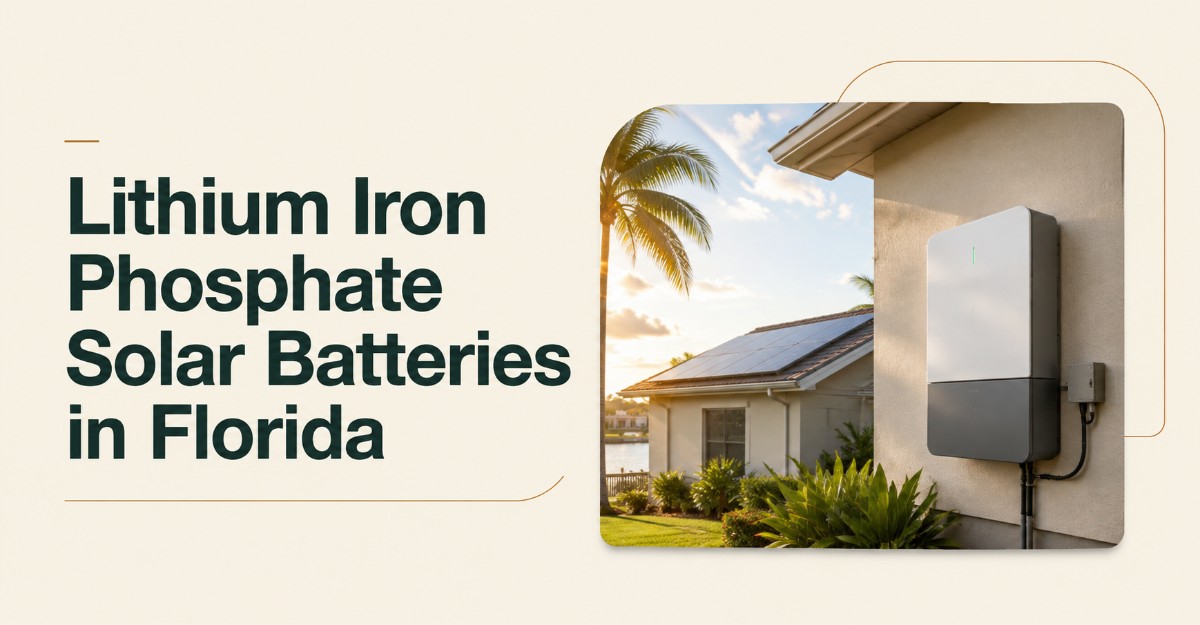
Lithium iron phosphate (LiFePO4 or LFP) solar batteries are the dominant home storage chemistry in Florida because their olivine cathode resists thermal runaway, tolerate garage heat approaching 45°C, and deliver 4,000 to 6,000 charge cycles. That safety and heat resilience makes LFP the default choice for hurricane backup and daily solar cycling across the state.
Key Facts at a Glance
- LFP cells hold a flat nominal voltage of 3.2V and reach thermal breakdown near 250°C, roughly 100°C higher than NMC chemistry.
- A quality LFP battery runs 10 to 15 calendar years and 4,000 to 6,000 cycles at 90 to 100% usable depth of discharge.
- Installed residential LFP storage in Florida typically costs $900 to $1,300 per usable kWh turnkey in 2026.
- Florida exempts residential solar and battery equipment from state sales tax and from added property tax under Florida Statutes 212.08 and 196.175.
- The 30% federal Residential Clean Energy Credit (IRS Section 25D) was scheduled to end for systems placed in service after December 31, 2025, so verify current eligibility.
- For a whole-home outage, most Florida homes need 10 to 20 kWh plus enough surge output to start a central AC compressor.
What Is a Lithium Iron Phosphate Solar Battery?
A lithium iron phosphate solar battery is a lithium-ion cell that uses LiFePO4 as the cathode and graphite as the anode, storing solar or grid energy for later use. Its defining trait is the olivine crystal structure, where strong phosphorus-oxygen covalent bonds lock oxygen into the lattice. That chemistry does not shed oxygen when heated, so LFP virtually eliminates the thermal-runaway pathway that older nickel manganese cobalt (NMC) batteries rely on venting to trigger.
LFP is completely cobalt-free, which removes the ethical sourcing and toxicity concerns tied to cobalt mining. In practice, that safety margin is why LFP packs earn UL 1973 cell listings and UL 9540A fire-propagation test data, and why they are the batteries most commonly approved for garage and indoor installation under NEC Article 706. For a Florida homeowner mounting storage in a hot garage next to living space, the chemistry is the whole argument.
How Does an LFP Battery Actually Store Energy?
An LFP battery stores energy through intercalation, moving lithium ions back and forth between the graphite anode and the LiFePO4 cathode like an atomic rocking chair. When your Florida home draws power overnight or during an outage, lithium ions travel from the anode to the cathode while electrons flow through your inverter to run appliances. When your panels produce a surplus, the process reverses and ions return to the anode for storage.
The practical payoff is the flat voltage curve. A single LFP cell holds close to 3.2V until it is nearly empty, so your inverter and MPPT charge controller operate near peak efficiency across the entire discharge instead of chasing a sagging voltage. That flat profile is a real efficiency advantage that pushes usable round-trip efficiency into the 90 to 95% range at the system level.
← charge ←
Which LFP Battery Formats Fit Florida Homes?
Three architectures cover nearly every Florida installation: low-voltage server-rack modules, wall-mounted all-in-one packs, and high-voltage stackable towers. The right one depends on whether you want DIY flexibility, a clean grid-tied backup, or a premium plug-and-play system. Voltage class matters too, because higher-voltage stacks push less current and allow thinner wiring with lower losses.
Server-rack systems (Fortress eFlex, EG4, SOK, BigBattery) suit DIY and off-grid builders pairing modules with hybrid inverters like the Sol-Ark 15K or Victron units. Wall-mount packs prioritize a clean footprint for grid-tied backup. Stackable high-voltage systems such as the Tesla Powerwall 3 (13.5 kWh, LFP) and Enphase IQ Battery 5P (5 kWh, LFP) offer the simplest install and tightest software integration, at the highest cost per kWh.
What Are the Real Technical Numbers?
LFP solar batteries deliver 4,000 to 6,000 full cycles before capacity fades to 80%, a 10 to 15 year calendar life, and 90 to 100% usable depth of discharge, roughly double the usable range of lead-acid. Round-trip efficiency runs 90 to 98% depending on inverter losses. One caveat the AI Overview omits: LFP should not charge below 0°C (32°F) without heaters, because lithium plating damages cells, a fringe concern during North Florida cold snaps but relevant for garages near freezing.
| Spec | Typical LFP value | Why it matters in Florida |
|---|---|---|
| Full cycles to 80% | 4,000 to 6,000+ | 12+ years of daily cycling |
| Calendar life | 10 to 15 years | Outlasts most inverter warranties |
| Usable DoD | 90 to 100% | More backup per kWh purchased |
| Round-trip efficiency | 90 to 98% | Less energy wasted as heat |
| Thermal breakdown onset | 250 to 270°C | Safe in hot garages |
| Charge temp floor | 0°C (32°F) | Watch North FL winter charging |
A practitioner rule of thumb: read the warranty as throughput (total MWh) and years, not just the cycle count. A 10 kWh pack rated at 6,000 cycles and 60 MWh throughput is guaranteeing about six full cycles per day for a decade, which no Florida home will ever reach.
Why Is LFP Better Suited to Florida’s Climate?
LFP handles Florida heat better than NMC or lead-acid, tolerating ambient temperatures into the low 40s°C where competing chemistries degrade or throttle sharply. That said, LFP is not immune to heat. Sustained garage temperatures above 45°C (113°F) push the battery management system (BMS) into thermal throttling, which caps charge and discharge rates and shortens life over years of exposure. Florida garages routinely hit 40 to 50°C in July.
The counterintuitive truth is that mounting location beats chemistry here. A pack on a shaded interior north wall will outlive an identical pack bolted to an unshaded west-facing exterior wall by years. In coastal and flood-zone properties, siting also means elevation: never mount storage below your base flood elevation, because a single storm surge event ends a battery and creates an electrical hazard.
How Much Do LFP Solar Batteries Cost in Florida?
Installed LFP storage in Florida typically runs $900 to $1,300 per usable kWh turnkey in 2026, with raw server-rack packs as low as $250 to $350 per kWh for DIY hardware. The single biggest variable in your final number is the federal tax credit, and its status recently changed.
| System size | Turnkey installed (FL) | DIY hardware only |
|---|---|---|
| 5 kWh | $5,500 to $7,500 | $1,500 to $2,200 |
| 10 kWh | $9,500 to $13,000 | $3,000 to $4,200 |
| 15 kWh | $14,000 to $19,000 | $4,500 to $6,000 |
| 20 kWh whole-home | $18,000 to $24,000 | $6,000 to $8,000 |
Here the AI Overview is outdated. It assumes a 30% Residential Clean Energy Credit applies, but the IRS Section 25D credit was scheduled to expire for systems placed in service after December 31, 2025 under 2025 federal legislation. Florida buyers installing in 2026 should confirm current eligibility with a tax professional rather than assuming a 30% reduction. Because tax law shifts, verify this against current IRS guidance.
Florida’s own incentives are more durable. The state exempts solar and battery equipment from sales tax (Florida Statutes 212.08) and shields the added home value from property tax (Florida Statutes 196.175). Florida also retained 1:1 retail net metering after Governor DeSantis vetoed HB 741 in April 2022, which preserves the arbitrage economics that make daily cycling worthwhile.
What Does Installation and Permitting Involve?
Permitting and utility interconnection in Florida run 2 to 6 weeks, and physical installation takes 1 to 2 days. Utilities including FPL, Duke Energy Florida, and TECO require stamped engineering diagrams and a signed interconnection agreement before energizing storage. Most of the install labor goes into the automatic transfer switch, a critical-loads subpanel, and BMS wiring, not the battery mounting itself.
Florida adds requirements other states skip. Exterior-mounted equipment must meet Florida Building Code wind-load standards, and in Miami-Dade and Broward’s High-Velocity Hurricane Zone (HVHZ), mounting hardware faces stricter approval. Combine that with flood-zone elevation rules and the message is clear: Florida installs are as much about surviving the storm as storing energy for it.
LFP vs NMC vs Lead-Acid: Which Wins?
For Florida residential storage, LFP wins on the criteria that matter most: safety, lifespan, and heat tolerance. NMC packs slightly more energy into less space but degrades faster in heat and carries higher fire risk. Lead-acid is cheap upfront and hopeless long-term in Florida’s climate. The table below anchors each claim to a value.
| Metric | LFP | NMC | Lead-Acid (AGM/Gel) |
|---|---|---|---|
| Safety | No active oxygen release | Oxygen-release fire risk | Hydrogen outgassing risk |
| Lifespan | 10 to 15 yrs, 4,000+ cycles | 5 to 8 yrs, 1,500 to 2,500 | 2 to 4 yrs, 500 to 1,200 |
| Usable DoD | 90 to 100% | 80 to 90% | 50% |
| Heat tolerance | Good to 45°C | Degrades above 35°C | Poor, heat kills it |
| Installed cost/kWh | $900 to $1,300 | $800 to $1,100 | $400 to $600 |
Verdict by persona: choose LFP for any grid-tied Florida home wanting decade-plus backup; consider NMC only where weight or space is the hard constraint; pick lead-acid only for a tiny, budget-capped, rarely cycled off-grid shed.
How Do You Size a Battery for Hurricane Backup?
Size a Florida backup system by critical loads and days of autonomy, not by a round number. Add the daily kWh of the appliances you must keep running, then multiply by the number of outage days you want covered. A refrigerator, lights, fans, internet, and phone charging draw roughly 3 to 5 kWh per day, so 10 to 13.5 kWh covers two to three days of essentials.
Running a central air conditioner changes the math twice. First, capacity: whole-home AC can add 20 to 40 kWh per day in a Florida summer, which is why AC backup demands 20 kWh or more plus solar recharge. Second, surge: a compressor draws a startup spike several times its running wattage, so your battery must deliver enough continuous and surge kW (often 5 to 9 kW) to avoid tripping the BMS. A soft-start kit on the AC flattens that spike and is the cheapest fix most installers overlook.
- Essentials only (fridge, lights, fans, devices): 10 to 13.5 kWh
- Essentials plus a window or mini-split AC zone: 13.5 to 20 kWh
- Whole-home including central AC: 20 to 40 kWh with a soft-start kit
What Installation Mistakes Cost Florida Owners the Most?
The most expensive Florida mistakes are thermal siting, surge undersizing, and mixing batteries. Mounting a pack on an unshaded south or west wall forces the BMS into constant thermal throttling and quietly shortens life. Sizing only for total kWh while ignoring surge kW causes the battery to fault the moment an AC compressor kicks on. Pairing new LFP modules with older or different-brand packs lets the weaker module’s internal resistance drag down the whole bank.
One practitioner rule prevents most of these: never parallel batteries of different age, brand, or state of health, because the BMS balances to the weakest member and you lose capacity you paid for.
Common Problems and How to Fix Them
Most LFP field issues in Florida trace to three causes: surge trips, cell imbalance, and over-discharge lockout. The fixes are specific and repeatable.
| Symptom | Cause | Fix |
|---|---|---|
| Inverter shuts off under high load | BMS over-current protection from AC or pool pump surge | Add a soft-start kit, program inverter peak-current limits, reset the module |
| Battery won’t reach 100% on sunny days | Cell imbalance and voltage drift | Force a top-balance: hold absorption voltage (about 56.8V on a 48V pack) for 4 to 6 hours |
| Battery reads 0V and rejects charge | Over-discharge below low-voltage cutoff, BMS disconnected cells | Use a BMS wake-up or LFP charger to jump baseline voltage, then charge normally |
What Is LFP Not Good For?
LFP is not the right pick for every scenario, and honest buyers should know its limits. It is heavier and bulkier per kWh than NMC, so weight-sensitive or cramped installs suffer. It should not be charged below freezing without an internal heater, a real edge case in North Florida garages. Its flat voltage curve, an efficiency asset, makes state-of-charge estimation harder, so cheap systems can misreport remaining capacity until a top-balance corrects them. And LFP does nothing to fix a poorly designed critical-loads panel: bad system design fails regardless of chemistry.
Which System Should You Choose?
The suburban grid-tied homeowner
Choose a closed-loop stackable system like the Tesla Powerwall 3 or Enphase IQ Battery 5P, sized at 10 to 13.5 kWh for multi-day essentials backup. This buyer values seamless automatic transfer and app control over cost per kWh, and gets a warranty-backed, code-simple install.
The off-grid rural homestead
Build a 48V server-rack bank (EG4, SOK, BigBattery) paired with a Sol-Ark 15K hybrid inverter, sized at 30 to 45 kWh for two to three cloudy-day autonomy. Open-BMS flexibility and low hardware cost per kWh outweigh the extra design work for this buyer.
The time-of-use arbitrageur
Choose a 5 to 10 kWh wall-mount or stackable system with smart scheduling, discharging during FPL or Duke peak evening rates and recharging off-peak. Florida’s retained net metering makes this economical where daily rate spreads exist.
FAQ
Are LFP solar batteries safe to install in a Florida garage? Yes. LFP does not release oxygen when heated and reaches thermal breakdown near 250°C, so it carries the lowest fire risk of home battery chemistries and is commonly listed to UL 1973 and UL 9540A for indoor and garage installation under NEC 706.
How long do LFP batteries last in Florida heat? A quality LFP pack lasts 10 to 15 years and 4,000 to 6,000 cycles when kept below about 45°C. Sustained garage heat above that throttles the BMS and shortens life, so shaded, ventilated mounting matters more than any spec sheet number.
Can an LFP battery run my central air conditioner during an outage? Only if it is sized for both capacity and surge. Central AC can draw 20 to 40 kWh daily plus a compressor startup spike, so plan for 20 kWh or more of storage, 5 to 9 kW of output, and a soft-start kit to prevent BMS trips.
Does Florida still offer net metering for solar batteries? Yes. Florida retained 1:1 retail net metering after Governor DeSantis vetoed HB 741 in April 2022, which preserves the bill-offset economics that make daily battery cycling worthwhile on FPL, Duke, and TECO territory.
Is the 30% federal tax credit still available in 2026? Verify it. The IRS Section 25D Residential Clean Energy Credit was scheduled to expire for systems placed in service after December 31, 2025 under 2025 federal legislation, so confirm current eligibility with a tax professional before counting on a 30% reduction.
What size lithium iron phosphate solar battery do I need in Florida? For essentials over a multi-day outage, 10 to 13.5 kWh is typical; for whole-home backup including central AC, plan on 20 to 40 kWh. Size by adding your critical daily kWh and multiplying by your target days of autonomy.
The Bottom Line
Lithium iron phosphate solar batteries earned their dominance in Florida on chemistry and climate: an oxygen-locking olivine cathode that resists fire, heat tolerance into the low 40s°C, and a decade-plus lifespan. Get the siting, surge sizing, and incentive timing right, and LFP is the clearest storage choice the state offers.