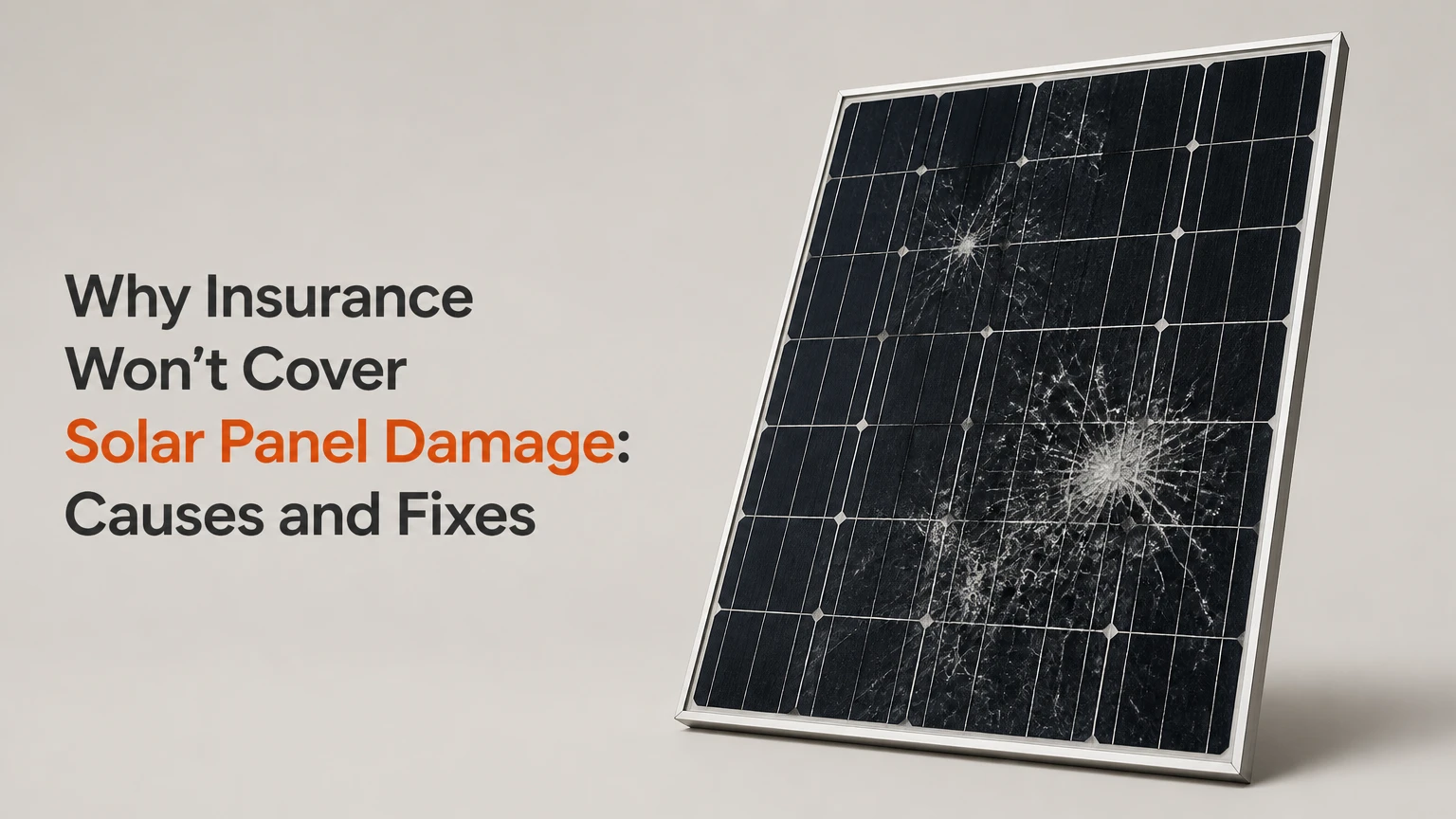
Homeowners insurance may cover solar panel damage when a covered, sudden peril damages an owned system, but exclusions, deductibles, installation defects, ownership contracts, and policy limits can defeat payment. The denial reason matters more than the panel itself: storm damage, inverter failure, roof leakage, and poor workmanship usually belong to different coverage sources.
Key Facts at a Glance
- Roof-mounted solar panels commonly fall under dwelling coverage when the homeowner owns them.
- Ground-mounted panels commonly fall under other structures coverage, which may have a lower limit.
- Homeowners insurance usually excludes wear, corrosion, mechanical breakdown, flood, and earthquake damage unless an endorsement or separate policy applies.
- A wind or hail deductible can equal 1%-5% of the insured dwelling limit, making a covered loss worth less than the deductible.
- Installer warranties generally address workmanship, while manufacturer warranties generally address defective equipment.
- A lease or power purchase agreement usually makes the solar company responsible for physical damage to the equipment, but the homeowner’s policy may still address the building, liability, or resulting damage.
Why Insurance Won’t Cover Solar Panel Damage
Insurance denies solar panel claims when the policy does not cover the triggering peril, the loss falls below the applicable deductible, or another party has contractual responsibility. A carrier may also deny damage caused by pre-existing roof deterioration, faulty installation, excluded maintenance conditions, or an ownership arrangement that places the equipment with a solar provider.
Which peril caused the damage?
The named cause of loss, called the peril, controls the initial coverage analysis. A falling tree during a covered windstorm is different from a panel that gradually cracks because of thermal cycling, and an inverter that stops working is different from lightning damage to the inverter.
| Damage cause | Typical policy result | Likely responsible source | Evidence needed |
|---|---|---|---|
| Hail impact | Covered subject to exclusions and deductible | Home insurer | Storm date, photos, adjuster report |
| Lightning surge | Often covered under a covered-peril policy | Home insurer or equipment warranty | Surge evidence, electrician report |
| Floodwater | Usually excluded | Flood policy or disaster program | Flood map, water-origin report |
| Earthquake movement | Usually excluded | Earthquake policy | Seismic event, engineering report |
| Corrosion | Usually excluded | Maintenance provider or warranty | Age, corrosion photographs |
| Inverter breakdown | Usually excluded by homeowners insurance | Manufacturer or installer warranty | Error code, service diagnosis |
| Squirrel-chewed wiring | Policy-specific, often excluded or limited | Pest control, installer, or insurer | Chew marks, wiring inspection |
| Falling tree from a covered event | Often covered, with possible debris limits | Home insurer | Tree and roof photographs |
Flood and earthquake exclusions are common but not universal across all policy forms. The Insurance Information Institute identifies flood and earthquake as risks that generally require separate coverage, while state endorsements and carrier forms can change the result.
Does hail damage qualify?
Hail damage can qualify under homeowners insurance, but a percentage wind or hail deductible may eliminate payment. Some policies also distinguish functional damage from cosmetic damage, so dents that do not reduce electrical production may be excluded even when broken glass or measurable output loss is covered.
A solar technician should test production and inspect the glass, cells, frame, junction boxes, and mounting hardware. Photographs alone may show impact marks but cannot establish whether the array still meets its rated output.
What counts as equipment failure?
Homeowners insurance usually does not pay for an inverter, optimizer, panel, or monitoring gateway that fails from internal malfunction. Manufacturer warranties commonly cover defective components, while installer workmanship warranties may cover labor, wiring, racking, and installation-related faults.
The distinction is important because a storm can damage equipment externally, while an identical-looking shutdown may result from a failed capacitor or software fault. Obtain a diagnostic report before describing the loss as storm damage.
How Are Solar Panels Classified Under a Home Policy?
Roof-mounted solar panels that are permanently attached to an owned residence are commonly treated as part of the dwelling, while ground-mounted arrays and some detached structures are commonly treated as other structures. The declarations page, endorsements, policy definitions, and coverage limits control the actual result.
| Solar asset location | Common coverage category | Typical limit concern | Verification question |
|---|---|---|---|
| Main roof | Dwelling coverage | Dwelling limit may omit upgrade cost | Does the dwelling limit include the array? |
| Detached garage roof | Other structures or detached building | Often a percentage of dwelling limit | Does the detached structure limit cover solar equipment? |
| Ground-mounted rack | Other structures | Lower sublimit or location exclusion | Is permanent ground equipment listed? |
| Carport canopy | Other structure or dwelling, policy-specific | Structural classification dispute | Is the canopy insured separately? |
| Home battery in garage | Dwelling contents or equipment endorsement | Fire and electrical exclusions | Is stationary storage scheduled? |
| Leased rooftop array | Provider-owned equipment | Contract controls physical damage | Who must repair or insure the system? |
A common policy structure assigns other structures coverage a percentage of dwelling coverage, such as 10%, but the percentage and treatment vary by insurer and jurisdiction. A $400,000 dwelling limit could therefore produce a $40,000 other-structures limit, subject to other losses and policy terms.
Do not assume that adding panels automatically increases the limit. Ask the insurer to confirm the replacement cost of the system, roof integration, labor, permits, taxes, code compliance, and temporary power.
Was the Damage Caused by the Roof or Installer?
Insurance may deny solar damage when a failing roof or defective installation caused the loss, because property insurance generally addresses fortuitous events rather than faulty construction or deferred maintenance. The insurer may still cover resulting damage from a covered peril, but the defective component itself can remain excluded.
Roof age often becomes decisive. If an inspection shows rotten decking existed before installation, a later leak may create a dispute over pre-existing damage, installation workmanship, and covered ensuing water damage.
| Problem discovered | Usually investigated by | Potential payer | Typical proof |
|---|---|---|---|
| Failed roof flashing | Roofing contractor and adjuster | Installer, roofer, or insurer | Moisture tracing, installation records |
| Loose racking bolts | Solar installer | Installer warranty or liability insurer | Torque records, photographs |
| Rotten roof decking | Roofer and engineer | Homeowner or roofer, depending on cause | Pre-install inspection |
| Cracked panel from hail | Solar technician and adjuster | Home insurer, subject to deductible | Cell testing and storm report |
| Incorrect wire termination | Solar installer | Workmanship warranty | Electrical inspection |
| Roof damage during removal | Solar installer or roofing contractor | Contractor liability policy | Work order and incident photos |
Installer workmanship warranties often last 10-25 years, but warranty terms differ on labor, roof penetrations, consequential damage, and transfer to a later homeowner. A warranty may require notice within a stated period and may exclude damage caused by another contractor.
Who pays for roof leaks beneath panels?
The payer depends on the leak’s cause. A covered windstorm may trigger roof and resulting interior damage, while failed flashing from poor installation usually points to the installer’s workmanship warranty or commercial general liability policy.
Insurance companies sometimes pay to repair covered roof damage but refuse to pay for defective flashing. Request a written explanation separating the covered resulting damage from the excluded workmanship.
Who Insures Leased Solar Panels?
The solar lessor or power purchase agreement provider generally owns and insures leased panels, but the contract determines repair duties, deductibles, access rights, and production guarantees. A homeowner should notify both the provider and personal insurer rather than assuming the homeowner’s policy has no role.
The AI Overview’s claim that a homeowner “cannot insure” leased panels is too absolute. A homeowner cannot insure property they do not own in the same way as owned property, yet a homeowners policy may coordinate liability, covered damage to the roof, interior water damage, or other property affected by the event.
| Ownership arrangement | Equipment owner | First notification | Typical homeowner responsibility |
|---|---|---|---|
| Cash purchase | Homeowner | Home insurer and installer | Deductible, maintenance, policy compliance |
| Solar loan | Usually homeowner | Home insurer and lender if required | Maintain insurance and loan collateral |
| Lease | Solar company | Lessor and home insurer | Permit access and report property damage |
| PPA | Solar company | PPA provider and home insurer | Preserve contract terms and report outages |
| Community solar subscription | Off-site project owner | Subscription provider | No physical rooftop equipment claim |
Read sections titled damage, casualty, insurance, indemnification, maintenance, removal, roof access, and production guarantee. A provider may repair equipment but not reimburse lost energy, a roof deductible, or interior repairs.
How Do Deductibles Change the Decision?
A covered solar loss produces no insurer payment when the repair cost does not exceed the applicable deductible. Wind and hail deductibles can be fixed amounts or percentages of the dwelling limit, and a percentage deductible can exceed the array’s entire replacement cost.
| Dwelling limit | Deductible rate | Deductible amount | $12,000 solar loss before payment |
|---|---|---|---|
| $250,000 | 1% | $2,500 | $9,500, before limits |
| $400,000 | 2% | $8,000 | $4,000, before limits |
| $500,000 | 2% | $10,000 | $2,000, before limits |
| $600,000 | 5% | $30,000 | $0, below deductible |
| $400,000 | $1,000 fixed | $1,000 | $11,000, before limits |
A $5,000 repair against an $8,000 hail deductible is not technically uncovered, but the claim produces no indemnity payment. Filing may still make sense when the same storm damaged the roof, siding, gutters, or interior.
Replacement cost coverage generally pays the cost to replace with comparable new property after deductible and claim conditions. Actual cash value subtracts depreciation, which can materially reduce payment for older equipment.
What Should You Do After Solar Damage?
A strong solar claim begins with evidence preservation, a qualified diagnosis, and a written comparison between damage cost and deductible. The practical sequence usually takes 1-3 weeks for initial inspection, although catastrophic storms and disputed roof leaks can take several months.
- Make the site safe. Shut down the system according to the manufacturer’s emergency instructions if wiring, glass, fire, or water creates a hazard. Do not climb onto a damaged roof.
- Document before disturbing evidence. Photograph wide views, serial numbers, broken glass, racking, roof penetrations, ceilings, electrical equipment, and visible debris. Record the date, weather event, outage, and monitoring data.
- Notify the solar provider. Request a written diagnostic report identifying storm impact, electrical failure, workmanship, or maintenance cause.
- Obtain an independent estimate. Ask for panel removal and reinstallation, permits, labor, roof repair, code upgrades, disposal, and temporary generation as separate line items.
- Compare the estimate with the deductible. Use the correct wind, hail, named-storm, or all-other-perils deductible, not the smallest deductible shown on the declarations page.
- Notify the insurer promptly. Provide the policy number, loss date, photographs, report, estimate, ownership contract, and roof inspection records.
- Prevent further damage. Use temporary tarping or electrical isolation through qualified contractors, keeping receipts and avoiding permanent repairs before inspection unless safety requires them.
- Preserve replaced components. Do not discard panels, inverters, connectors, or racking until the insurer and warranty provider have had a reasonable inspection opportunity.
The National Association of Insurance Commissioners advises policyholders to keep records of conversations, claim documents, and expenses. That administrative record often resolves disputes about notice, inspection access, and changing explanations.
How Do You Challenge a Denial?
Challenge a denied solar claim by requesting the denial letter, matching each reason to the policy language, and submitting technical evidence that addresses the insurer’s stated cause. An appeal is stronger when it asks for a specific coverage decision rather than arguing generally that solar panels should be covered.
Request these items in writing:
- The exact exclusion, condition, limit, or deductible applied.
- The adjuster’s photographs, engineer report, and recorded cause-of-loss findings.
- The coverage position for the panels, roof, interior damage, and removal labor.
- The deadline and procedure for reconsideration, appraisal, mediation, or suit.
- Any missing documentation the insurer says prevents payment.
| Denial wording | Useful response evidence | Escalation route |
|---|---|---|
| Wear and tear | Production history and sudden event data | Reinspection or appraisal |
| Improper installation | Installer report and workmanship contract | Installer warranty or liability claim |
| Below deductible | Itemized estimate including related damage | Supplement after full inspection |
| Cosmetic damage | Electrical output test and manufacturer criteria | Engineer review |
| Pre-existing damage | Pre-install roof inspection and timeline | Coverage counsel or regulator |
| Excluded flood or earthquake | Water-origin or seismic report | Separate policy claim |
A public adjuster can prepare and present a property claim, but fees commonly range from 5%-15% of the settlement and may be restricted by state law. An insurance attorney is more suitable for a substantial disputed loss, policy-rescission threat, bad-faith issue, or contractual deadline.
The state insurance department can review complaint handling and regulatory compliance, but it usually cannot rewrite a policy or guarantee payment. Keep pursuing contractual remedies while filing a regulator complaint if the carrier ignores evidence or fails to explain its position.
Which Coverage Source Should Pay?
The correct payer is determined by the ownership arrangement, physical cause, and contract terms, not by whether the damaged object is a solar panel. Home insurance addresses covered property perils, warranties address defects, and solar contracts allocate provider-owned equipment and service obligations.
| Loss type | Primary coverage candidate | Common exclusion | Immediate action |
|---|---|---|---|
| Hail-shattered owned panel | Homeowners policy | Hail deductible or cosmetic exclusion | File documented storm claim |
| Failed owned inverter | Manufacturer warranty | Mechanical breakdown | Obtain error diagnosis |
| Roof leak from bad flashing | Installer warranty | Poor workmanship | Preserve moisture evidence |
| Leased panel damaged by hail | Solar provider contract or policy | Contract deductible or exclusions | Notify provider and insurer |
| Fire damages panels and house | Homeowners policy | Limit or vacancy issue | Report entire property loss |
| Battery thermal event | Home policy endorsement or specialty policy | Battery-specific exclusion | Use emergency responders and notify carrier |
| Damage during panel removal | Contractor liability policy | Unclear scope of work | Send contract and incident report |
A solar endorsement may add accidental breakage, higher equipment limits, battery coverage, or a fixed deductible. It is not automatically better: a rider with a $10,000 deductible may provide less practical value than a standard policy with a $1,000 deductible for a modest array.
Specialty clean-energy policies can suit large off-grid systems, multiple structures, or income-producing installations. They are usually unnecessary for a small residential array unless the homeowners policy excludes the equipment or has inadequate limits.
Which Mistakes Commonly Cause Avoidable Losses?
The most preventable claim problems are failing to update coverage, repairing before inspection, confusing a warranty with insurance, and ignoring the deductible. Each mistake creates a different evidentiary or contractual disadvantage.
- No installation notice: Send the final contract, system cost, and interconnection approval to the insurer. Ask whether the dwelling limit and replacement-cost estimate changed.
- No roof records: Keep the pre-install inspection, permits, photographs, and installer completion certificate. These documents help separate old roof failure from new storm damage.
- Unqualified repairs: Use licensed solar and electrical contractors. Unauthorized repairs can create safety hazards and complicate warranty or subrogation claims.
- One vague estimate: Require separate prices for panels, racking, inverter, roof work, removal, reinstall, permits, and code upgrades.
- Discarded equipment: Preserve failed components and packaging when practical. A warranty provider may need serial numbers and physical inspection.
- Claiming a provider-owned asset incorrectly: Give the insurer the lease or PPA instead of asserting ownership that the contract contradicts.
A counterintuitive rule applies to small claims: do not compare only the panel repair with the deductible. A hail event that damages roofing, gutters, and panels may create one larger occurrence, depending on policy language and state law.
What Edge Cases Require Separate Treatment?
Solar batteries, roof replacement, cosmetic damage, and financed systems create separate coverage questions because the equipment, building, and contract may have different definitions. A denial for one component does not automatically decide coverage for the rest of the property.
Does insurance pay to remove panels for roof replacement?
Insurance may pay removal and reinstallation when a covered roof loss requires that work, but it may not pay removal for an old roof replacement caused by wear. The policy, roof endorsement, and causation analysis determine whether panel labor is part of the covered repair.
Obtain two estimates: one for roof work without solar interference and one showing the incremental removal and reinstall cost. Ask the adjuster for a written position before authorizing the solar contractor.
Are batteries covered like panels?
Batteries may be treated as dwelling equipment, personal property, or separately endorsed clean-energy equipment. Lithium-ion battery fire, smoke, installation, and code issues can trigger different exclusions, so a policy confirmation should name the battery model, location, and replacement value.
Does financing change coverage?
A solar loan commonly leaves the homeowner as equipment owner, so homeowners insurance generally remains relevant. The lender may require proof of insurance and may be listed as a loss payee, but the loan itself does not convert equipment failure into an insured peril.
Can an insurer cancel coverage after installation?
An insurer may re-underwrite a property after solar installation, especially where roof age, electrical work, wildfire exposure, or unsupported mounting creates underwriting concerns. Cancellation and nonrenewal rules vary by state, and the carrier must follow applicable notice requirements.
What Documents Strengthen a Solar Claim?
The strongest file connects the event, the damaged component, the repair cost, and the responsible payer. A homeowner should assemble policy documents, ownership records, system specifications, maintenance history, event evidence, and every inspection report before submitting an appeal.
| Document | What it proves | Best source | Useful timing |
|---|---|---|---|
| Declarations page | Limits and deductibles | Home insurer | Current policy term |
| Solar contract | Ownership and duties | Installer or provider | Before claim |
| Permit and inspection approval | Code-compliant installation | Local authority | Installation date |
| Production history | Sudden output change | Inverter portal | 30-90 days around loss |
| Roof inspection | Pre-loss condition | Independent roofer | Before or after installation |
| Diagnostic report | Technical cause | Qualified technician | Within 7-14 days |
| Repair estimate | Scope and price | Licensed contractor | After inspection |
| Weather report | Event confirmation | NOAA or local service | Loss date |
| Claim correspondence | Carrier reasoning | Insurer | Every interaction |
NOAA storm records can support the date and presence of hail, wind, lightning, or severe weather, but weather data does not prove that a specific panel failed because of that event. The technician’s physical findings and production test complete that causal link.
The Bottom Line
Insurance won’t cover solar panel damage when the loss is excluded, below the applicable deductible, caused by defective installation or deterioration, assigned to a solar provider under a lease, or limited by an inadequate policy endorsement. Confirm the peril, ownership, classification, deductible, and exact denial language, then coordinate the insurer, installer, manufacturer, and contract provider.
A storm-damaged owned array usually starts with the homeowners insurer. A failed inverter usually starts with the manufacturer. A roof leak from bad flashing usually starts with the installer. That division of responsibility is the fastest route to the correct remedy.
Frequently Asked Questions
Does homeowners insurance cover solar panels after a storm?
Homeowners insurance often covers owned solar panels after a covered storm such as hail, wind, or lightning, subject to exclusions, limits, and the applicable deductible. The insurer may deny cosmetic-only damage, mechanical failure, or losses caused by flood, earthquake, poor installation, or pre-existing roof deterioration.
Can I claim solar panel damage without a roof claim?
Yes, a panel-only claim can be submitted when the solar equipment is damaged by a covered peril. Compare the repair estimate with the wind, hail, or other applicable deductible first, because a covered panel loss can still produce no payment when the repair cost is lower than the deductible.
Does a solar warranty cover hail?
Manufacturer and installer warranties usually do not cover hail because hail is an external accidental event rather than a manufacturing or workmanship defect. Hail damage may instead fall under homeowners insurance or a solar endorsement, while the warranty may cover a component that failed independently of the storm.
Who pays if a leased solar panel breaks?
The lease or PPA provider usually handles physical repairs to provider-owned panels, but the contract controls deductibles, response times, production guarantees, and roof responsibilities. Notify the provider and homeowners insurer, especially when the same event damages the roof, interior, wiring, or detached structures.
Should I hire a lawyer for a denied solar claim?
Legal advice is more appropriate when the disputed loss is substantial, the insurer changes its reason for denial, the policy faces cancellation, or a suit deadline is approaching. For smaller claims, a written appeal, qualified engineering report, public adjuster review, or state insurance department complaint may be more proportionate.
Can I appeal a claim denied below the deductible?
You can appeal if the insurer omitted covered related damage, used the wrong deductible, or underestimated repair costs. Submit a complete estimate covering roof work, removal, reinstallation, wiring, permits, and interior damage, then request a written calculation showing how the carrier applied the deductible.