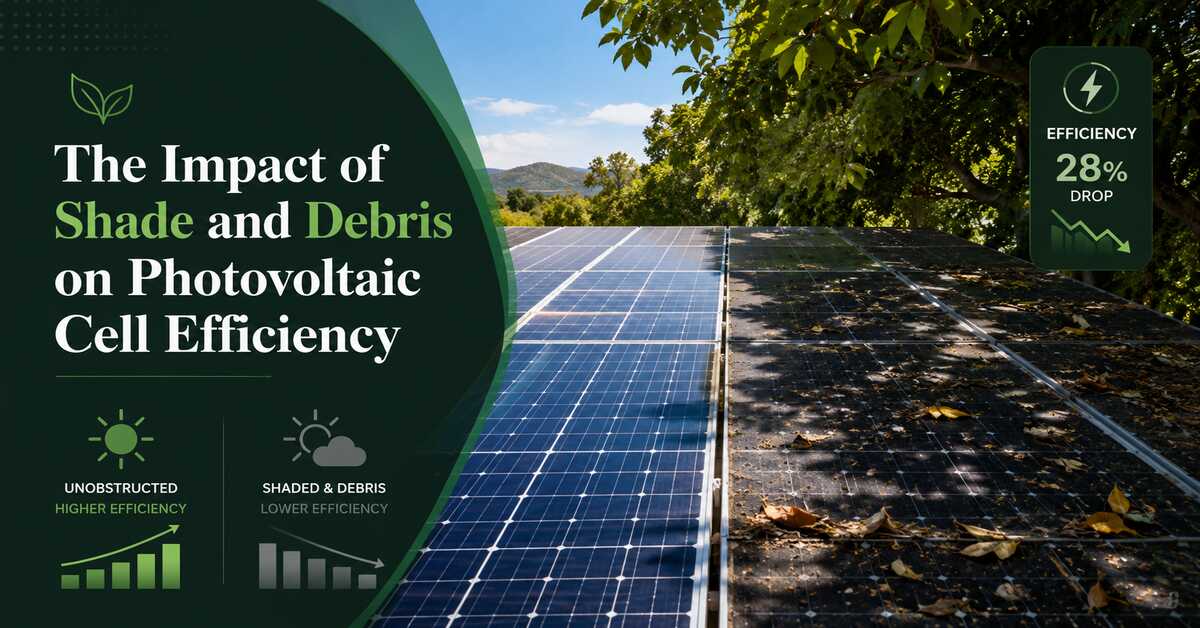
Shade and debris lower photovoltaic cell efficiency by blocking, scattering, or absorbing the sunlight a solar cell needs to free electrons in its silicon. Because cells are wired in series, one obstructed cell throttles the entire string’s current so shading 10% of a panel can cut far more than 10% of its power, and can trigger heat damage.
Key Facts at a Glance
- Photovoltaic (PV) efficiency is the percentage of incident sunlight a cell converts to electricity, measured at Standard Test Conditions (1,000 W/m², 25°C, AM1.5 spectrum); commercial silicon modules run 20–23%.
- In a series string, current is limited by the weakest cell so hard shade on a single cell can drop that cell’s whole sub-string, not just the shaded fraction.
- A shaded cell can reverse-bias and dissipate the string’s power as heat, forming hot spots that reach 100–150°C and permanently brown the encapsulant.
- Bypass diodes protect the panel by routing current around a blocked cell group, but each activation removes roughly one-third of a standard 60- or 72-cell panel’s voltage.
- Uniform soiling loss is roughly proportional to light blocked (5% film ≈ 5% loss); patchy soiling and hard shade cause disproportionate mismatch losses.
- Annual soiling losses run 1–5% in temperate, rainy climates and 15–40% in arid regions like the Middle East and US Southwest without cleaning.
What Is Photovoltaic Cell Efficiency?
Photovoltaic cell efficiency is the ratio of electrical power a cell produces to the solar power striking its surface, expressed as a percentage under Standard Test Conditions. Today’s mass-market monocrystalline silicon panels convert 20–23% of incident light; premium n-type and back-contact cells reach 22–24%, and lab tandem cells exceed 33%.
Efficiency is a property of the cell and its optical stack the anti-reflective coating, glass, and encapsulant that let photons reach the silicon. Anything that intercepts photons before the silicon absorbs them lowers effective efficiency, whether that “anything” is a cloud shadow, a dust film, or a bird dropping. Shade and debris are the two most common field losses because they act on that optical path directly and continuously.
How Do Shade and Debris Reduce Solar Panel Output?
Shade and debris reduce output by starving cells of photons and, more damagingly, by forcing a series circuit to run at the pace of its weakest cell. The optical loss is only the first-order effect; the electrical mismatch it creates is what turns a small obstruction into a large power loss.
Why does a small shadow cause a large power loss?
A small shadow causes a large loss because solar cells are wired in series, and series current is capped by the lowest-producing cell. If one cell in a 60-cell string is 50% shaded, it can only pass 50% of the current and every other healthy cell in that sub-string is dragged down to match. The panel doesn’t average the loss; it inherits the bottleneck.
This is the single most misunderstood fact about solar shading. Homeowners expect linear behavior “half a panel shaded, half the power” but the physics is nonlinear. Field measurements routinely show that hard-shading one cell (roughly 1.6% of a 60-cell panel’s area) can cut a string inverter’s output by a third or more before bypass diodes engage. The area shaded and the power lost are only loosely related; what matters is which cells and how the current path routes around them.
What happens inside a shaded cell?
Inside a shaded cell, current generation collapses and the cell flips from a power source into a power sink. The surrounding lit cells keep pushing current, forcing it backward through the shaded cell in reverse bias. The shaded cell now dissipates that current as heat instead of producing electricity the root cause of hot spots.
What is a hot spot and how hot does it get?
A hot spot is a localized region of intense heating on a cell that is reverse-biased by the string current forced through it. Hot spots commonly reach 100–150°C and, in severe cases with failed protection, higher. That heat browns the EVA encapsulant, cracks cell silicon, degrades the backsheet, and in extreme cases delaminates the module or poses a fire risk.
The IEC 61215 hot-spot endurance test exists precisely because this failure is so common: it stress-tests modules under partial shading to verify they survive reverse-bias heating. Bird droppings and leaf litter are the classic hot-spot triggers because they create sharp, fully opaque boundaries rather than a soft gradient.
How do bypass diodes protect the panel?
Bypass diodes protect the panel by giving current a detour around a blocked cell group before that group overheats. A standard 60- or 72-cell panel contains three bypass diodes, each spanning about 20–24 cells. When one diode activates, it sacrifices roughly one-third of the panel’s voltage to save the hardware protective, but a direct power loss.
Here is the practitioner’s rule of thumb worth internalizing: bypass diodes are damage control, not performance recovery. They stop your panel from cooking, but every time one fires you lose a third of that panel’s contribution. On a string inverter with panels in series, a single fired diode can pull the whole string’s operating point down.
Types of Shading and Their Behavior
Shading falls into five categories, each with a different temporal signature that dictates the right fix. Distinguishing them is the first diagnostic step, because a moving cloud and a fixed chimney demand completely different responses.
- Dynamic (transient) shade: Moving shadows from clouds, birds, or aircraft. Causes brief, fluctuating dips; rarely worth hardware mitigation on its own.
- Static (fixed) shade: Predictable obstruction from chimneys, dormers, vent stacks, neighboring buildings, or terrain. It recurs at the same clock time daily and is the prime candidate for module-level electronics.
- Vegetative shade: Tree branches and foliage. It grows across seasons and years, shifting from light dappling to dense blockage the most commonly underestimated shade source.
- Self-shading: Row-to-row shadowing when ground-mount or flat-roof rows are spaced too tightly. Worst at low winter sun angles, early and late in the day.
- Snow shading: Full or partial snow cover that behaves like opaque debris until it melts or slides. Steeper tilts (over ~30°) shed snow faster; the bottom cell row clears last.
Types of Debris (Soiling) and Their Adhesion
Soiling is any material deposited on the glass, and its removal difficulty depends entirely on what it is. Loose dust rinses off in rain; cemented organic and industrial films do not. The table below maps the common soiling types to their behavior and cleaning demands.
| Soiling type | Source | Behavior | Removal difficulty |
|---|---|---|---|
| Particulate dust / silt | Arid regions, dirt roads, construction | Uniform light-scattering film | Low, rain often clears it |
| Pollen | Seasonal vegetation | Sticky uniform coating | Low–moderate |
| Agricultural dust | Harvest, plowing, livestock | Organic, cements to glass | Moderate–high |
| Industrial / traffic soiling | Factories, highways, carbon and metals | Oily film resistant to rain | High, needs detergent |
| Bird droppings | Perching birds | Opaque, hard, localized | High, and a hot-spot risk |
| Biological growth | Moss, algae, lichen in humid climates | Pools along the bottom frame lip | High, mechanical removal |
Two field truths matter here. First, uniform dust and localized droppings are opposite problems: a thin even film costs a few percent linearly, while a single dropping can trigger a bypass diode and a hot spot far out of proportion to its size. Second, biological growth almost always starts at the lower frame edge, because a low tilt lets water and organic matter pool there which is why installation tilt angle is a soiling variable, not just an energy-yield one.
Key Numbers: How Much Do Shade and Debris Actually Cost?
The honest answer separates uniform soiling from mismatch losses, because they scale differently and this is where popular summaries get it wrong.
- Uniform soiling is roughly linear. A thin, even dust film that blocks 5% of light causes approximately a 5% output loss, not 20%. The widely repeated “5% coverage → 20% loss” figure conflates uniform soiling with patchy soiling: it holds only when that 5% is concentrated (a stripe of mud along one cell row) so it triggers series mismatch. State the mechanism, not the myth uniform films lose about what they block; concentrated deposits lose far more.
- Hard partial shading is steeply nonlinear. Shading ~10% of a single panel in a string-inverter system can cost 50–100% of that string’s output when bypass diodes are fully engaged or fail. The lost power can exceed the shaded area by 5–30×.
- Soiling loss by climate: 1–5% annually in temperate, rainy zones; 15–40% annually in arid deserts (Middle East, US Southwest, western India) with no cleaning.
- Thermal threshold: Hot spots exceeding 100–150°C cause irreversible encapsulant browning and cell cracking.
- Soiling rate: The industry tracks a soiling ratio (soiled output ÷ clean output) and a daily soiling rate, often 0.1–1% per day in dusty regions between rain or cleaning events. This rate not a single loss figure drives cleaning economics.
How Do You Detect Shade and Soiling Losses?
You detect these losses by comparing measured output to a clear-sky model and then localizing the fault with thermal and electrical imaging. Detection matters because uniform soiling and localized shade produce different signatures, and treating one as the other wastes money.
Four field methods, from cheapest to most precise: charting the daily power curve against a clear-sky expectation (a recurring afternoon dip points to fixed shade); infrared (IR) thermography, which lights up hot cells during peak sun; I-V curve tracing, where notches and steps in the curve reveal how many sub-strings are mismatched; and electroluminescence (EL) imaging, which shows cracked or inactive cells. Utility-scale sites add dedicated soiling-monitoring stations (a cleaned reference cell beside a soiled one) and report against the IEC 61724 performance-monitoring standard to quantify soiling loss objectively.
Which Mitigation Strategy Actually Recovers Lost Power?
The right fix depends on whether your loss is shading (an electrical mismatch problem) or soiling (a cleaning problem) — they are not interchangeable. Module-level electronics fix shading; nothing but cleaning fixes soiling. The comparison table below weighs the main hardware and maintenance options.
| Solution | Fixes | Typical cost (USD) | Best for | Honest limitation |
|---|---|---|---|---|
| Microinverters | Shading mismatch | $140–$220 / panel | Complex, multi-shade roofs | Highest cost; roof-level replacement labor |
| DC optimizers | Shading mismatch | $50–$80 / panel | Moderate shade, budget builds | Adds a roof failure point per panel |
| Half-cut cell panels | Reduces mismatch | $15–$30 / panel premium | Bottom-edge / snow shade | Cannot fix severe multi-row shade |
| Shingled cells | Reduces mismatch | Panel-dependent | Localized soft shade | Limited severe-shade benefit |
| Global MPPT firmware | Partial-shade tracking | Built into inverter | String systems, some shade | Software only; can’t undo hard mismatch |
| Manual cleaning | Soiling | $150–$350 / visit | All soiling | Recurring cost, safety risk, thermal-shock risk |
| Robotic cleaning | Soiling | $5,000–$50,000+ | Utility-scale arid sites | High capital; commercial scale only |
Do microinverters and optimizers really solve shading?
Microinverters and DC optimizers largely solve shading mismatch by decoupling each panel from its neighbors, so a shaded module can’t drag down the rest of the array. Microinverters convert DC to AC at each panel; optimizers keep the string running while tracking each panel’s maximum power point. Both recover the mismatch loss but neither recovers the light the shadow itself blocks. A fully shaded panel still produces near zero; the electronics just stop it from poisoning the string.
Are half-cut cells as good as claimed?
Half-cut cells help with edge shading but do not deliver the “top half stays at 100%” outcome sometimes claimed. Splitting cells in half and wiring the halves independently means a shadow across the bottom edge disables only the lower half’s sub-strings, so the panel keeps producing from its upper half roughly half its rated power, not full. That is a real, meaningful gain for snow and self-shading, but it is a mitigation, not immunity, and it does nothing for shade that crosses both halves.
When does cleaning actually pay for itself?
Cleaning pays off when the recovered energy value exceeds the cleaning cost a break-even that depends on your soiling rate, electricity price, and system size, not a fixed schedule. In a temperate climate losing 2–3% a year, one or two cleanings annually is plenty. In an arid site losing 0.5% per day, the recovered revenue can justify frequent robotic cleaning. The counterintuitive rule: over-cleaning wastes money and risks scratching the anti-reflective coating; the goal is to clean at the point where accumulated loss crosses your cost-per-clean, which soiling stations exist to pinpoint.
What Are the Costliest Maintenance Mistakes?
The most expensive mistakes cause permanent damage that no electronics can recover, and all four below are avoidable at the design or cleaning stage.
- Underestimating tree growth: Designing around today’s canopy height without modeling 5–10 years of growth. A tree that dapples now will densely shade later plan clearances for the mature canopy.
- Installing at too shallow a pitch: Tilts below ~10° prevent rain from self-cleaning and create a bottom-frame lip where mud, water, and biological growth pool. A minimum 10–12° tilt is a soiling defense, not just a yield choice.
- Abrasive cleaning: Stiff brushes, harsh detergents, and pressure washers strip the anti-reflective coating and micro-scratch the glass, permanently scattering light. Use soft brushes or squeegees and deionized or plain water.
- Thermal-shock cleaning: Hosing hot panels with cold water midday can fracture the tempered glass. Clean early morning or evening when panels are cool this is why utility sites schedule night cleaning in dusty seasons.
Troubleshooting: Symptom-to-Cause Diagnostic
Use this matrix to translate a performance symptom into a root cause and corrective action before spending on hardware.
| Symptom | Probable cause | Diagnostic step | Corrective action |
|---|---|---|---|
| Sudden ~33% drop in one string’s voltage | One bypass diode triggered by hard shade or debris | Inspect for droppings, leaves, or a fixed shadow | Remove the obstruction or trim the branch |
| Repeating midday or afternoon power dip | Fixed architectural or tree shade | Chart output against a clear-sky curve | Trim vegetation or add optimizers/microinverters |
| Gradual, uniform loss over weeks | Particulate soiling | Look for a dull matte film across the glass | Clean with low-pressure water and a soft squeegee |
| Localized brown spots or cracked glass | Long-term hot-spot degradation | IR-image the array during peak sun | Replace the damaged module to remove the fire risk |
Where These Fixes Fall Short (Honest Limitations)
No mitigation recovers blocked light only prevents mismatch. If a chimney casts a hard shadow across whole panels for hours a day, microinverters and optimizers will save the rest of the array but cannot conjure production from the shaded modules; the only real fix is relocating the panels or removing the obstruction.
Likewise, anti-soiling nano-coatings (hydrophobic and hydrophilic films) reduce adhesion and cleaning frequency but do not eliminate soiling, and they degrade over years. And bifacial modules add a rear-side soiling and shading variable that front-only models miss dirt or structure blocking the rear plane cuts the bifacial gain. Treat every fix as loss reduction, not loss elimination.
Frequently Asked Questions
Does shade permanently damage solar panels?
Transient shade does not, but sustained hard shading can. Moving cloud or bird shadows cause only temporary dips. Persistent partial shading that forces reverse bias creates hot spots reaching 100–150°C, which over time brown the encapsulant, crack cells, and degrade the backsheet — permanent damage that lowers output for the module’s life.
Does rain clean solar panels effectively?
Rain clears loose particulate dust reasonably well on tilts above 10°, but it does not remove cemented soiling. Oily industrial films, agricultural organics, bird droppings, and biological growth resist rain and can even streak as water dries. In dusty climates, rain slows soiling but rarely substitutes for scheduled cleaning.
How much power do bird droppings cost?
Far more than their size suggests. A single opaque dropping over one cell can fully block that cell, trigger a bypass diode, and remove up to a third of a standard panel’s voltage — while also creating a hot-spot risk. Their sharp, fully opaque boundary makes them one of the worst soiling types per unit area.
Can I clean my own solar panels safely?
Yes, with care. Clean when panels are cool early morning or evening using plain water and a soft brush or squeegee on an extension pole from the ground. Avoid pressure washers, stiff brushes, and cold water on hot glass. If roof access is unsafe, hire a professional rather than risk a fall.
What tilt angle reduces soiling best?
A tilt of at least 10–12° lets rain sheet off and self-clean the glass, and steeper angles above 30° shed snow faster. Flat or near-flat installs pool water and dust along the bottom frame, accelerating biological growth. Tilt is a soiling-control variable as much as an energy-yield one.
Do half-cut or shingled panels eliminate shading loss?
No. Half-cut and shingled architectures reduce mismatch loss from partial and edge shading by isolating smaller cell groups, which helps with snow and self-shading. But they still lose the light a shadow blocks and cannot fix severe multi-row shading. They are meaningful improvements, not a substitute for module-level electronics on complex roofs.
The Bottom Line
The impact of shade and debris on photovoltaic cell efficiency is dominated not by the light they block but by the electrical mismatch they create in series-wired strings which is why a small hard shadow can cost far more than its area and why hot spots can permanently damage hardware. Match the fix to the fault: module-level electronics and shade-tolerant cell layouts for shading, and disciplined, non-abrasive cleaning timed to your soiling rate for debris. Neither recovers blocked light, so the highest-value move remains designing the array to avoid obstruction in the first place.