Shopping for solar panels without understanding your utility bill is like buying a custom suit without taking your measurements. If you rely solely on a single month’s total dollar cost, you risk installing a system that is either underpowered for your needs or far too expensive for your budget.
Learning how to read electric bill before going solar is the single most effective step you can take to protect your investment. Utility bills contain specific data points that reveal how much energy you consume across different seasons, what time of day you use it, and which portion of your bill solar can actually eliminate.
By analyzing your bill beforehand, you gain total control over the quote comparison process. You will immediately spot when an installer is overestimating your production needs or underestimating your future utility charges.
Why Looking at the Dollar Amount Is a Mistake
The biggest trap homeowners fall into is focusing on their highest summer or winter bill and using that dollar figure as their baseline. Utility bills fluctuate dramatically throughout the year due to seasonal weather, fuel cost adjustments, and rate hikes. A $350 bill in July does not mean you need a system sized for a $350 monthly average year-round.
Solar arrays are sized based on volume, measured in kilowatt-hours (kWh), rather than dollars. A kilowatt-hour represents the amount of energy needed to run a 1,000-watt appliance continuously for one hour.
When you evaluate solar quotes, installers build their financial projections on how many kWh your panels will generate annually to offset your historical kWh consumption. If you only look at dollar amounts, you miss the underlying energy volume that dictates system size and long-term return on investment.
Step-by-Step: How to Read Electric Bill Before Going Solar
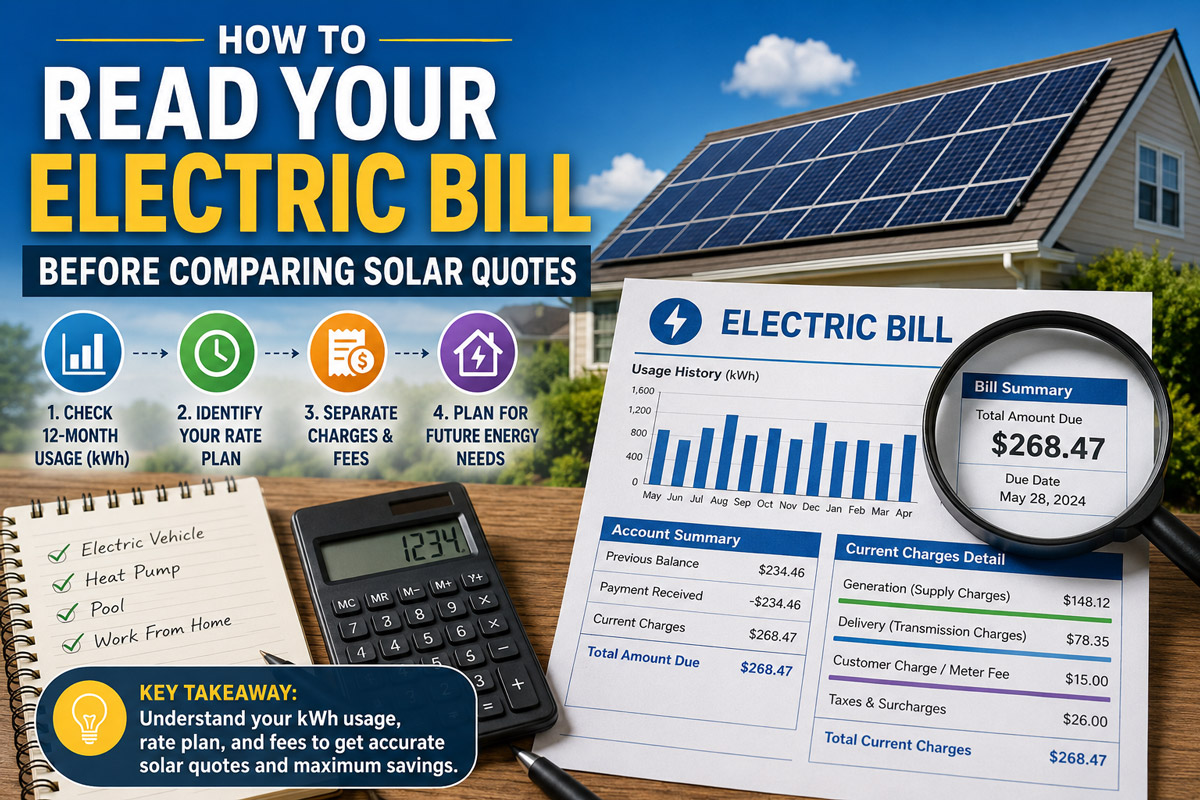
Before you sit down with solar contractors or request quotes online, grab your most recent utility bill and follow this four-step breakdown.
1.Collect Your 12-Month Total Usage (kWh): Step 1.
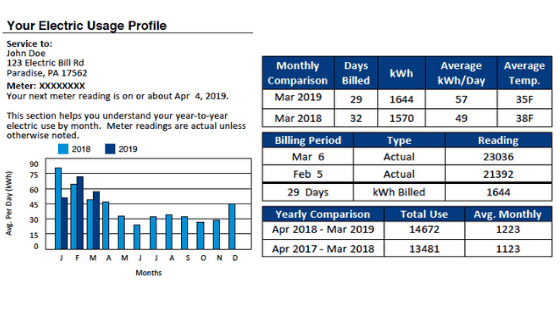
Navigate to the bill details section and locate the usage history section. Most electric companies display a 12-month bar chart showing your monthly consumption in kWh. Add up the kWh listed for all 12 months to calculate your total annual energy volume. If your bill only shows the current month, log into your online utility account to download your full 12-month statement history.
2.Identify Your Rate Plan (Flat vs. Time-of-Use): Step 2.
Check the rate structure listed on your statement. Under a flat rate plan, you pay a consistent price per kWh regardless of when you turn on your appliances. Under a Time-of-Use (TOU) plan, your electricity price varies based on the hour. TOU bills break consumption down into Peak, Off-Peak, and sometimes Super Off-Peak categories. Electricity consumed during peak afternoon and evening hours can cost two to three times more than off-peak power.
3.Separate Variable Charges From Fixed Fees: Step 3.
Examine the itemized line items on your statement. Your bill is divided into two main categories: Generation/Supply and Transmission/Delivery. Supply charges cover the actual electricity produced by power plants. Delivery charges cover grid maintenance and line transmission. In addition, almost every utility charges a mandatory monthly Customer Charge or Meter Fee, usually between $10 and $25, simply for staying connected to the grid.
4.Factor in Future Household Lifestyle Changes: Step 4.
List any major electrical additions planned for your home over the next one to three years. Historical utility bills only reflect your past habits. If you plan to purchase an electric vehicle, install a heat pump HVAC system, add a swimming pool, or switch to working from home full-time, your future energy consumption will be significantly higher than your past 12-month average.
Understanding Supply Charges vs. Fixed Delivery Fees
One of the most crucial lessons in learning how to read electric bill before going solar is distinguishing between variable and fixed costs. Solar panels offset variable energy charges, but they rarely eliminate your utility bill down to zero dollars.
Generation and Supply Charges
This section represents the actual cost of generating power. When your solar panels produce electricity, every kWh generated replaces a kWh you would have purchased from the power company. Under net metering programs, excess solar energy sent back to the grid yields credits that directly offset your generation costs.
Delivery and Transmission Fees
Delivery charges cover the infrastructure, power lines, transformers, and emergency repair crews needed to deliver electricity to your doorstep. In some utility territories, delivery costs are tied directly to your kWh usage and can be reduced with solar. In other territories, a portion of the delivery fee remains fixed regardless of how much solar energy you produce.
Mandatory Grid Connection Charges
Even if your solar system covers 100% of your annual energy consumption, your monthly utility statement will still reflect a baseline customer charge. This fixed fee pays for your physical hookup to the electrical grid, metering services, and administrative costs. Knowing your utility’s exact fixed connection fee prevents surprise bills after your solar system goes live.
How Rate Plans Change Solar System Design
Your utility’s rate structure determines not just how many solar panels you need, but what kind of technology makes the most financial sense.
| Rate Structure | Pricing Characteristics | Impact on Solar Strategy |
|---|---|---|
| Flat Rate | Same price per kWh at all hours throughout the year. | Standard solar array sized to match 100% annual kWh volume. |
| Time-of-Use (TOU) | Expensive peak rates during late afternoon and early evening. | Battery storage adds massive value by discharging during peak hours. |
| Tiered Rate | Rates increase as monthly consumption crosses thresholds. | Sizing system to shave off upper expensive tiers maximizes savings. |
If you are on a Time-of-Use plan, solar production during sunny mid-day hours might occur when electricity rates are lower. As solar energy tapers off in the late afternoon, peak utility rates kick in.
In TOU markets, pairing solar panels with a home battery storage system allows you to store excess daytime solar energy and discharge it during high-cost peak hours. This process, known as peak shaving, prevents you from purchasing expensive grid power when rates double or triple.
Sizing Your Solar System for Future Demand
A common mistake when reviewing utility bills is designing a solar system strictly for past energy consumption. If your lifestyle changes shortly after installation, your newly installed system may no longer cover your electrical needs, forcing you to buy power from the grid again.
To prevent this, calculate the extra energy demand for planned upgrades and ask solar installers to add an extra buffer to your system design.
Rule of Thumb: Adding an Electric Vehicle (EV) to your home typically increases annual consumption by 3,000 to 4,000 kWh, depending on your daily commute. Replacing a gas furnace with an electric heat pump can add another 2,000 to 5,000 kWh annually.
When discussing quotes with solar providers, ask them to incorporate a 10% to 20% capacity buffer if you anticipate higher energy use in the near future. Adding two or three extra solar panels during initial installation is vastly cheaper than adding panels in a separate project years down the road.
What to Look for When Comparing Solar Quotes
Armed with your 12-month kWh total, rate plan details, and future consumption estimates, you are ready to evaluate installer proposals side by side.
- Annual Production Target vs. Historical kWh: Ensure the proposal lists estimated annual kWh production. Compare this number directly to your 12-month usage total. If an installer promises 100% offset but quotes a system that generates less than your annual kWh demand, their financial projections are unrealistic.
- Post-Solar Utility Bill Estimates: Verify that the quote accounts for your utility’s fixed monthly connection fee. A proposal claiming your post-solar bill will be $0 is incorrect if your utility enforces a mandatory $15 monthly service fee.
- Utility Rate Escalation Assumption: Check the annual utility rate inflation rate used in the proposal’s 25-year savings calculation. Realistic inflation estimates hover around 3% to 5% annually. Be cautious of quotes that assume utility rates will rise by 8% to 10% per year to make long-term savings look artificially high.
Understanding how to read your electric bill gives you clear criteria to evaluate every installer proposal. By focusing on kWh volume, rate structures, fixed fees, and future energy needs, you ensure your transition to solar energy delivers maximum financial performance for decades to come.